

Can strong French nuclear fleet utilisation absorb outage headwinds?
Strong YTD output and higher capacity utilization will offset a heavy incoming maintenance schedule, keeping EDF’s official estimated generation target comfortably in reach.
Executive Summary
- Year-to-date nuclear generation in France sits at 246.2 TWh, up 5.2 TWh YoY despite slightly lower average availability, driven entirely by a surge in hourly fleet utilization from 89.9% to 93.2%.
- Kpler Insight forecasts cumulative generation to land between 368.7 and 371.6 TWh, ensuring the nuclear fleet comfortably finishes close to the top end of EDF’s official 350 to 370 TWh target despite heavy Q4 maintenance.
Strong H1 Meets Summer Heat
In 2025, the French nuclear fleet produced a total of 373 TWh, surpassing its original projection of 350 to 370 TWh and landing near the top of EDF's late-year revised forecast range of 365 to 375 TWh. This strong performance highlighted the fleet's continued recovery from the 2022 corrosion-related outages, moving it steadily toward EDF's stated long-term potential of exceeding 400 TWh.
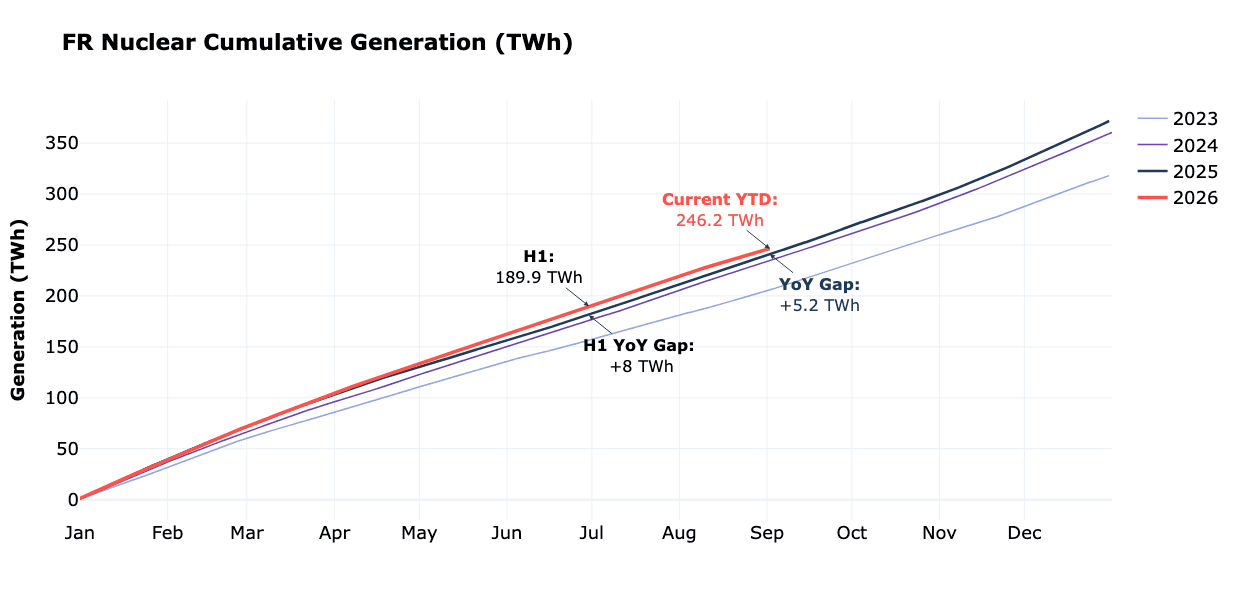
For 2026, EDF estimates full-year generation to fall within 350 to 370 TWh. The first half of the year finished strong at 189.9 TWh, running 8 TWh ahead of H1 2025.
However, that YoY lead has since narrowed due to severe heatwaves in July and August. High temperatures and drought conditions triggered strict environmental regulations, forcing EDF to temporarily curtail or shut down several river-cooled reactors, including units at Bugey, Chooz, and Golfech.
As a direct result of these heat-driven production restrictions, YTD cumulative generation currently sits at 246.2 TWh, slashing down the lead over 2025's pace to 5.2 TWh.
Efficiency Over Volume in 2026
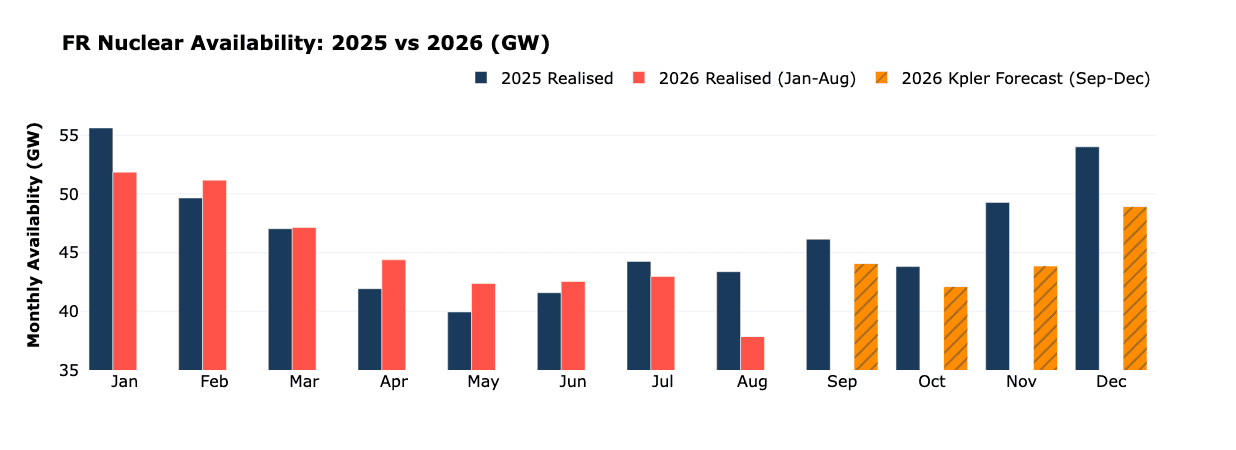
Availability has averaged 44.9 GW year-to-date in 2026, slightly lower versus the 45.4 GW seen over the same window in 2025.
This means that the 2026 generation gain has come despite a roughly flat-to-lower average availability, reflecting higher utilisation of available capacity.
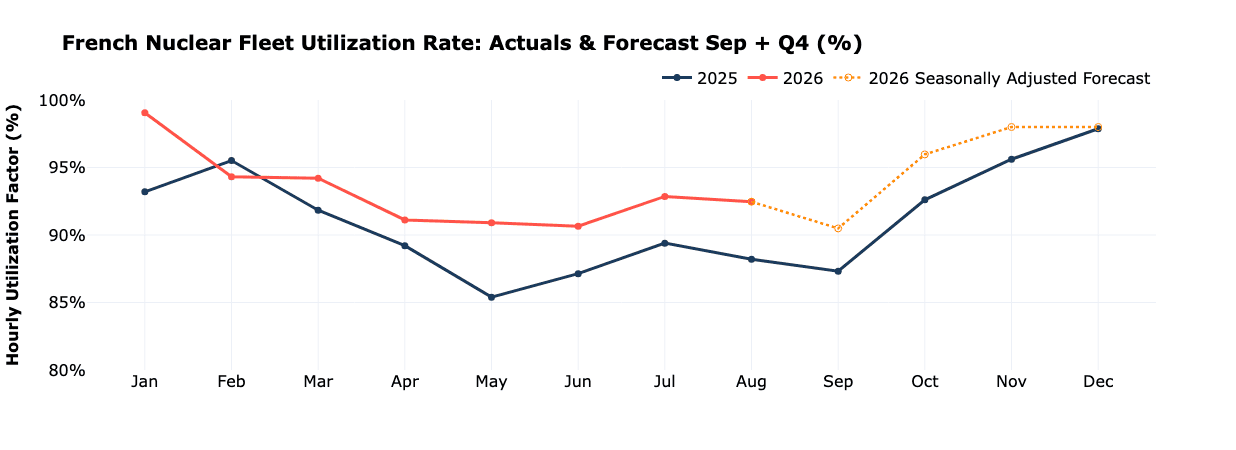
The hourly generation data confirms that improved utilization, rather than higher availability, is driving 2026's outperformance.
Between January and August, the fleet achieved an average hourly utilization rate of 93.2% of available capacity, up significantly from 89.9% over the same window in 2025.
Rest-of-Year Outlook & Targets
As illustrated in the availability plot, Kpler forecasts point to planned and unplanned outages keeping monthly availability tighter than in late 2025 for the rest of the year.
Kpler Insight estimates a forecasted range of cumulative generation in 2026, considering two scenarios of utilisation rates for the rest of the year:
- Base Case (Seasonally Adjusted Rate): Maintaining 2026's relative utilisation rate uplift yields 125.4 TWh across the rest of the year, bringing the full-year total to 371.6 TWh.
- Conservative Case (Reversion to 2025 Levels): If gains in utilisation rates erode entirely and fleet utilization reverts to 2025 levels, output falls to 122.5 TWh, resulting in a full-year total of 368.7 TWh.
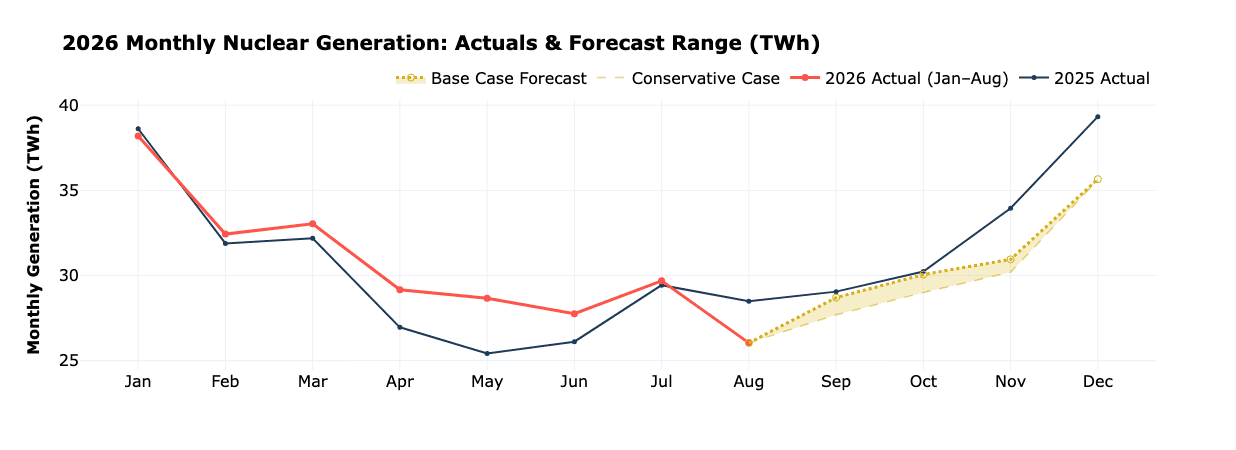
Hence, despite generation being squeezed by tight H2 availability, both forward scenarios position the French nuclear fleet comfortably close to the upper limit of EDF’s 350 to 370 TWh official estimate.

See why the most successful traders and shipping experts use Kpler






