Higher floor, hard ceiling: why we have raised our crude forecast to $81/bbl
A prolonged Middle East conflict has flipped the second half of 2026 from surplus to deficit. Chinese refiners are the reason prices are not higher still.
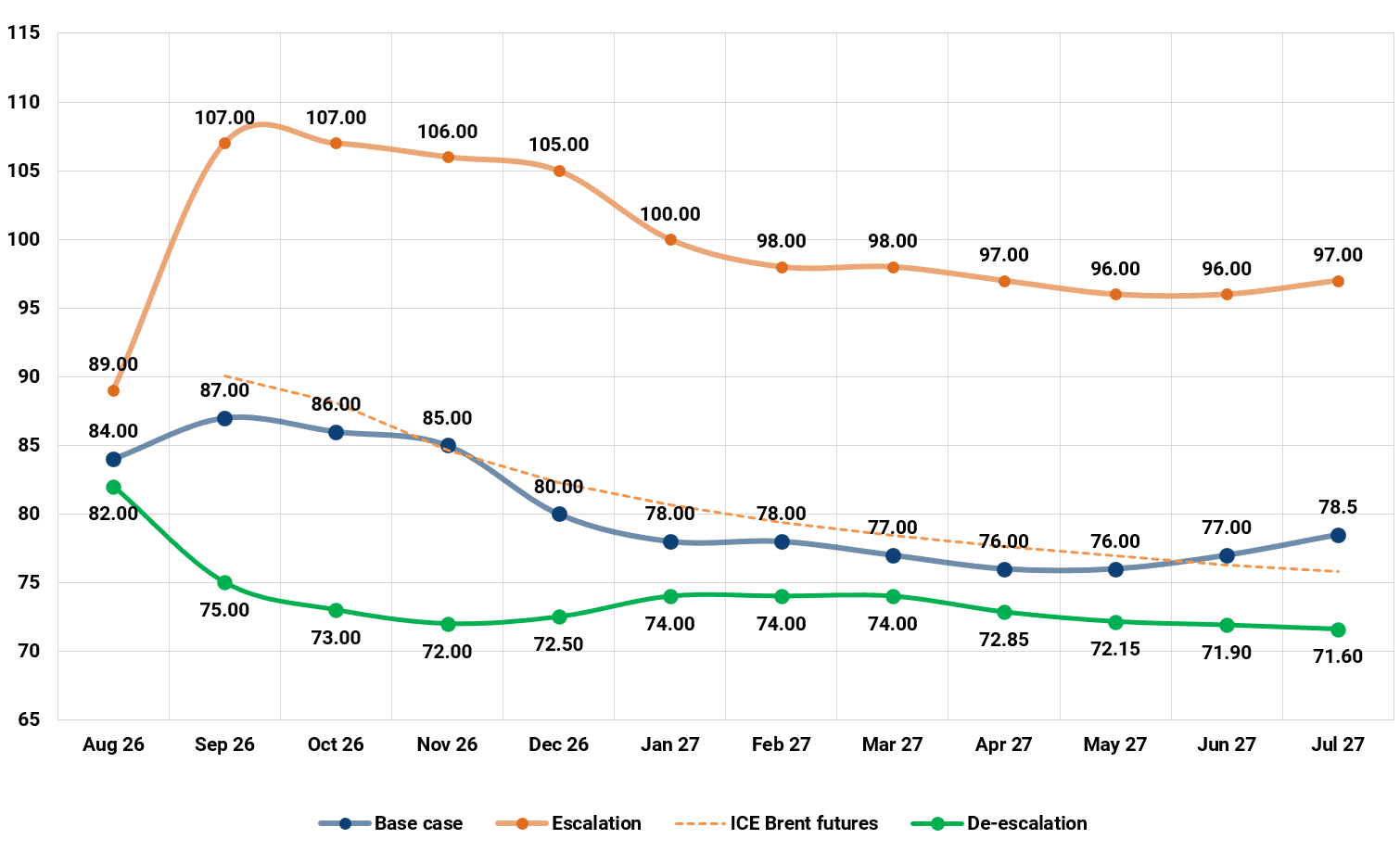
Our 12-month forecast for North Sea Dated is now $81/bbl, up from $73/bbl. That is a large revision, and it rests on a single changed assumption: the confrontation between the US and Iran is no longer a spike to be traded around, it is the market's operating environment until at least the end of the year.
The mechanics are straightforward. Partial closure of the Strait of Hormuz has led us to lower our Middle Eastern production estimates, shifting our H2 2026 balances from a projected surplus of 1.5 mbd to a deficit of nearly 2 mbd. A market that was supposed to be comfortably oversupplied by the autumn is now short.
What is striking is how little of that has shown up in flat price. Brent found support near $70/bbl before rallying to almost $100/bbl as geopolitical risk returned, yet on a monthly basis North Sea Dated averaged $82.1/bbl, down from $85.3/bbl in June. Traders are reacting to negotiation and ceasefire headlines far more than to the physical disruption in front of them. Flows through both Hormuz and Bab el-Mandeb are genuinely restricted, and the market keeps handing back the premium anyway.
The ceiling is Chinese, and it is not lifting soon
The reason the rally keeps stalling sits in China. Refiners there are not rebuilding inventories: domestic demand is weak, refining margins are compressed, and crude stocks are already high. At current import rates, inventories are unlikely to return to March 2025 levels for another six months.
The scale of the pullback is easy to underestimate. We estimate Chinese crude intake at 12.5 to 12.6 mbd over June and July, 18% below year-ago levels, a gap of 2.8 mbd. That is the weight sitting on the market, and it is why we do not expect a broad-based rally in prompt crude even though Saudi Arabia's need to reshuffle Yanbu exports should support regional differentials.
Working the other way, refining margins are doing a lot of quiet support work. Constrained Middle Eastern product exports, driven by restricted Hormuz transit and the shutdown of the 400 kbd Jizan refinery, have tightened global product balances and kept cracks elevated. Strong margins keep runs high, and high runs keep a floor under crude even as the geopolitical premium deflates.
Base case, and the two ways it breaks
Our base case assumes resolution towards year-end, with a maritime blockade eventually pushing Iran into significant nuclear concessions during Q4, after which Hormuz and Bab el-Mandeb flows normalise gradually. Washington matters here too: with Republican losses in the US midterms increasingly priced in, the administration looks less constrained by domestic politics than it did in the opening phase.
Given how wide the uncertainty band is, we are introducing explicit upside and downside scenarios around that base case. The high case assumes renewed escalation alongside a partial return of Chinese buyers, and even then subdued Chinese demand and high inventories cap the upside. The low case assumes a rapid return to the MoU environment, tensions easing and both chokepoints fully reopening, letting Middle Eastern exports normalise quickly.
US exports: a ceiling was tested, not raised
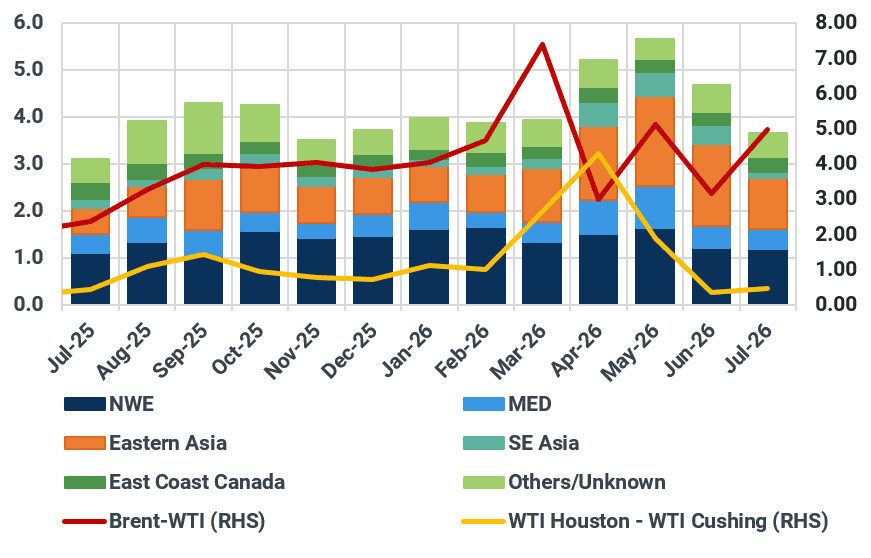
July saw US crude exports fall by 1.9 mbd from their May peak, as recovering Middle Eastern exports and tighter domestic balances closed the exceptional arbitrage that opened during the 40-day US-Iran war. US producers proved once again they can fill a supply gap fast. They have not proved they can do it permanently.
Look at what changed. Crude transit through Hormuz has averaged 3.9 mbd since mid-July despite a broken MoU, around 3.6 mbd excluding Iranian cargoes, against lows of just 195 kbd in March. Adnoc's latest tender awards suggest UAE export logistics have largely normalised and that Asian appetite for Murban is strong. US exports to Asia duly fell from 2.5 mbd in Q2 to 1.4 mbd in July.
At the same time there is simply less US crude to send. Cushing inventories have fallen to 19.4 mb, barely above June's decade low, and total US crude stocks are down from 791 mb in May to 712 mb in July. That tightness has supported WTI Cushing and prevented export economics from improving, even as the Brent-WTI futures spread widened.
Some relief is coming. Canadian wildfire disruption stayed limited, Venezuelan crude imports into the US Gulf Coast hit a record 608 kbd in July, and US refinery runs fall by 800 kbd from September to December. We expect exports to recover from August, but not to revisit Q2 records. The conditions that made US barrels the marginal global supplier no longer hold.
Kpler Dated Brent price forecast, $/bbl
Source: Kpler, ICE
Where it bites by grade
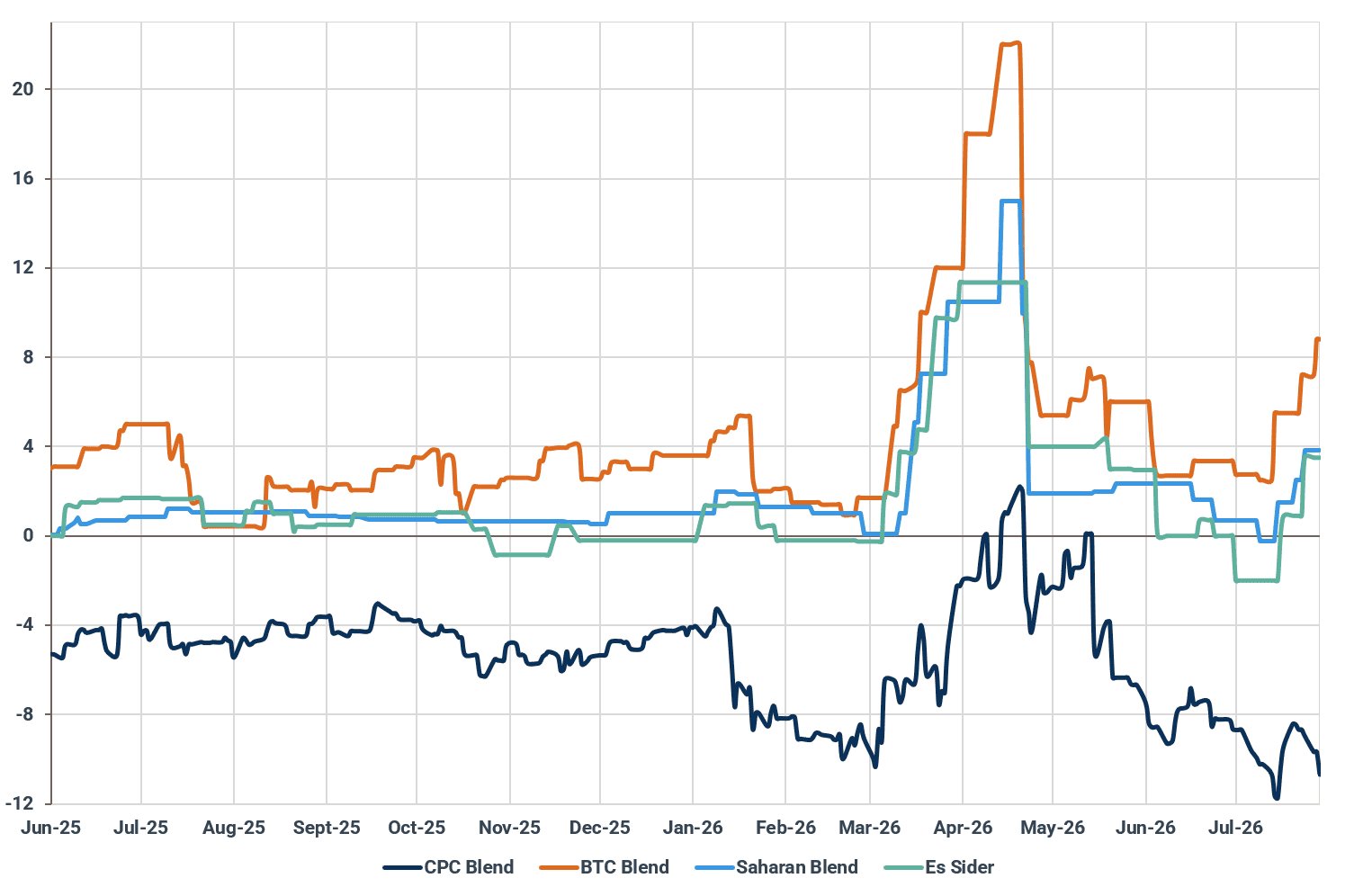
Light crude looks the tightest. Repeated outages at the CPC terminal, including a suspension on 30 July after a drone strike on a tanker, have lifted Mediterranean light differentials by roughly $5 to $6/bbl since mid-July, the strongest versus North Sea Dated since the Iran war began. CPC tanks are near their roughly 6 mb ceiling, so if loadings do not restart quickly, Kazakh shut-ins persist. Vessel availability, not pipeline capacity, is the binding constraint: at least eight vessels have been attacked since mid-July. Some Med refiners have been buying prompt WTI cargoes despite the premium, which tells you how tight the alternatives are.
Medium sours have already repriced. The Dubai curve flipped from contango into backwardation in mid-July, with the M1-M3 spread briefly hitting $10.8/bbl on 24 July. We estimate the September OSP for Arab Light loaded from Yanbu could rise by around $4 to $5/bbl from August levels. The repricing looks largely complete, though: spot differentials for Upper Zakum and Al-Shaheen retreated in late July as confidence grew that Hormuz traffic would continue, and a return to the early-July peak still looks unlikely near term. With Houthi attacks pushing tankers around the Cape of Good Hope to lift Saudi crude from Sidi Kerir instead, Aramco may need a separate discounted pricing mechanism for Asian cargoes out of the Mediterranean. Urals has been the other winner, rallying to Dated Brent -$1 to -$2/bbl delivered India from around -$12.5/bbl in early July.
Heavy is where the China story shows most clearly. Sudanese Dar Blend differentials gained over $10/bbl in a fortnight to reach $3/bbl versus North Sea Dated, the highest since July 2022. TMX went the other way: exports out of Westridge held at 520 kbd in July, but the high-TAN DAP Zhejiang month-1 differential to ICE Brent slid to close to -$7/bbl in mid-July before recovering to -$4.8/bbl, squeezed by soft Chinese runs and by Saudi and UAE grades competing on delivered cost.
US oil exports by destination (mbd, LHS), Brent-WTI and WTI Houston - WTI Cushing spreads ($/bbl, RHS)
Source: Kpler, Argus Media
What to watch
Three things decide whether $81/bbl proves conservative or generous: how quickly CPC loadings recover, whether Hormuz transits hold near 3.9 mbd, and above all whether Chinese refiners come back to the market. Supply has raised the floor. Only demand can raise the ceiling.
Med light crude differentials, $/bbl
Source: Argus Media

See why the most successful traders and shipping experts use Kpler