Disguising Iranian crude as Iraqi looks highly unlikely under the US blockade
Talk that Tehran is getting around the US blockade by passing its crude off as Iraqi has grown louder as Chinese teapots turn to Basrah grades. We see this probability as very low. There is no pipeline, trucking at scale could not be hidden, Baghdad has too much to lose, and Iran has not loaded a crude cargo since late August. Rail to China offers no meaningful alternative either.
Key takeaways
- No Iranian crude loadings since 25 August. Kpler data show zero departures in September, a first since at least 2013 when Kpler tracking begins.
- No pipeline, and trucks do not scale. Moving 50–100 kbd by road would take 250–500 truckloads a day, and filling a VLCC per day would take around 10,000.
- Baghdad has too much at stake. Its gas payments to Iran are already locked in a restricted account. The US has also sanctioned Iraq’s deputy oil minister and two separate blending networks.
- Teapot behaviour points the other way. Private refiners are paying a minimum of $18/bbl over Brent for Basrah crude. That suggests Iranian barrels are missing from the market, not disguised within it.
- Rail to China is a marginal channel at best and most likely is unsuitable for oil trade. It is capped by gauge breaks, distance and cost.
Market & Trading Calls
Basrah Medium/Heavy and Urals diffs NE Asia to remain supported. Teapots are already paying a minimum of $18/bbl over ICE Brent, and there is no disguised Iranian supply to relieve them. Chinese imports of Basrah grades jumped to 1.16 mbd in September, close to pre-war volumes.
Shandong teapot runs: Bearish into November. With no hidden Iranian feedstock, inventories at some plants could run out by end-October. Basrah or Urals alone cannot fully replace more than 1 mbd of discounted Iranian crude at teapot-friendly prices. Run cuts are more likely than a full switch.
Why the theory has resurfaced
The speculation draws on several threads. First, China’s independent refiners have turned to Basrah Heavy and Basrah Medium after the blockade cut off Iranian supply, which has prompted questions about whether Iran is reviving an old workaround of disguising its own oil as Iraqi. In 2025, the US Treasury sanctioned a network of companies run by Iraqi-British national Salim Ahmed Said which used to ship Iranian oil disguised as, or blended with, Iraqi oil.
With the US blockade in place since mid-July, Iranian oil transit through the Strait of Hormuz has cratered to zero. Iran’s oil on water volumes outside the blockade have decreased to 8 mb, down from nearly 90 mb following the MoU implementation. We estimate this means Iran’s oil revenues will face a cliff by mid-December at the latest. Therefore, the use of such blending tactics grows in importance for Iran in order to sell its oil. However, we estimate there is no clear and easy workaround for Iran at this moment.
Iranian crude/condensate transit through the Strait of Hormuz (kbd)
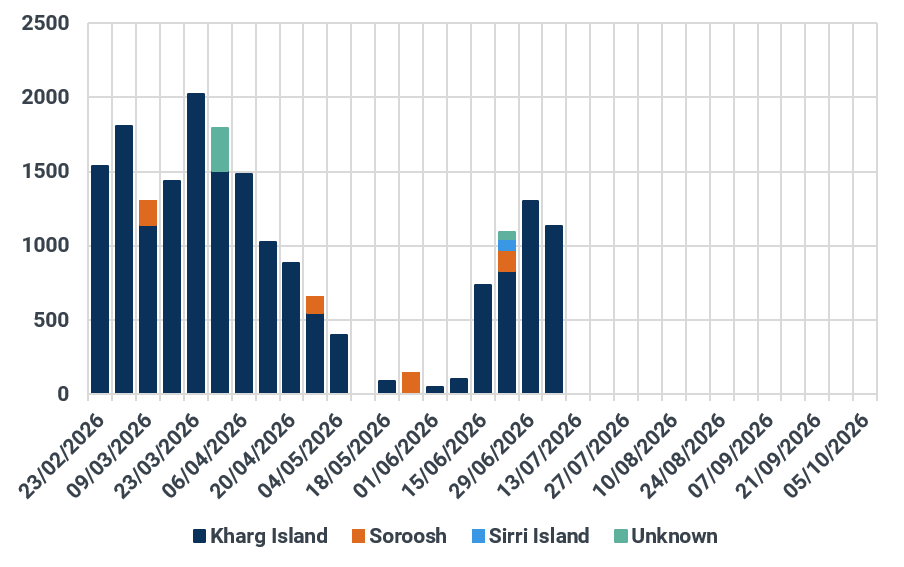
Source: Kpler
Iranian oil on water by location (mb)
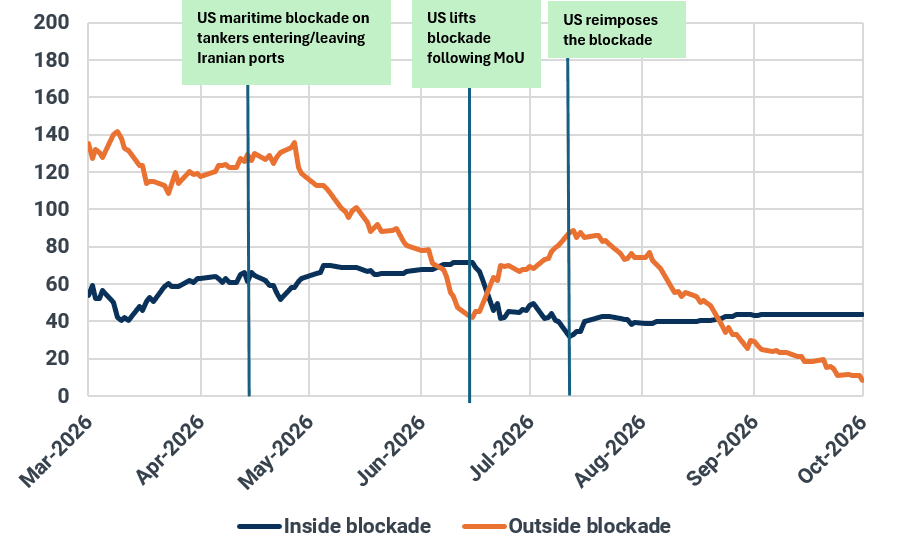
Source: Kpler
1. There is no crude pipeline between Iran and Iraq
Cross-border crude pipelines have been discussed for two decades and never built. An MoU for a Basra–Abadan line was first signed in 2004, sized at around 150 kbd of Iraqi crude flowing to the Abadan refinery. A later Kirkuk–Abadan proposal has seen no development since 2017 and has been cancelled. Both projects were designed to move Iraqi crude into Iran, not the reverse. The two countries have even been at odds regarding the development of cross-border fields, such as Azadegan / Majnoon or Yadavaran / Faihaa. Since both countries are net oil exporters and their main oil regions originate from the same geological plays (the Arabian basin and the Zagros foldbelt), meaning oilfields are geographically close, there has never been a need for a cross-border oil pipeline. The only operating energy pipelines between the two countries carry Iranian gas westward.

See why the most successful traders and shipping experts use Kpler