

Logistics constrain Gulf smelter run rates
With no end to the US/Israel-Iran war in sight, innovative and expensive workarounds continue to be called upon to keep Gulf alumina refineries and aluminium smelters supplied with raw materials.
The brief détente between the warring parties that followed the signing of the Memorandum of Understanding in mid-June allowed a few more ships to bring alumina into the Gulf, easing supply pressures.
However, a tightening of transit restrictions in the Strait of Hormuz has closed off this route to almost all shipping. Daily dry bulk carrier transits have dropped close to zero. The capacity of the transhipment and trucking operation bringing raw materials into the Middle East Gulf is now a determining factor of the run rate of Gulf smelters and refineries.
Raw material availability and the run rate of Gulf Smelters
At full capacity, the Gulf's smelters require almost 800kt of alumina imports per month. 600kt is typically delivered as alumina directly, with a further 200kt refined from seaborne bauxite at Emirates Global Aluminium's (EGA) Al Taweelah smelter.
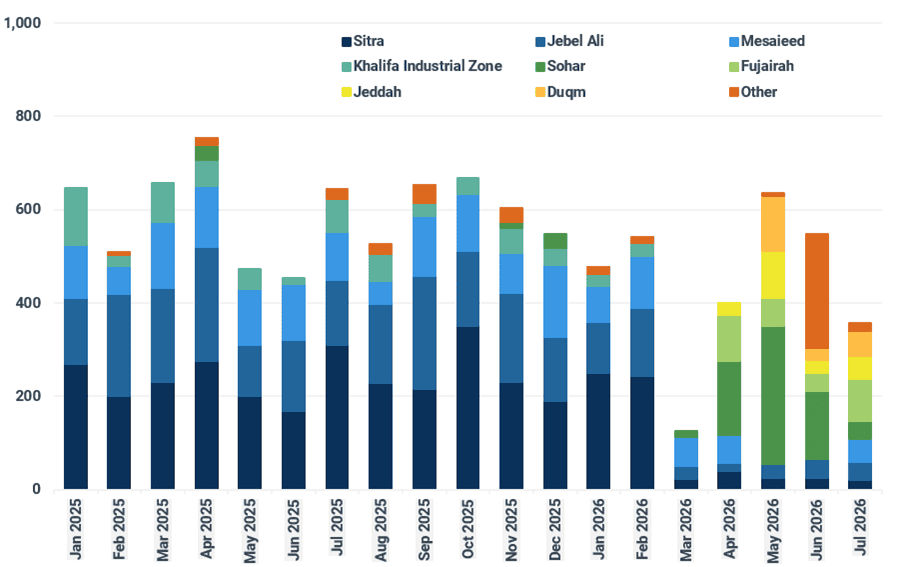
Imports dropped sharply in March following the closure of the Strait of Hormuz, but have proven remarkably resilient since. Smelters have taken receipt of bagged alumina at ports outside the Gulf, such as Fujairah, Jeddah, and Sohar. These deliveries, together with a handful of bulk discharges and direct transits of the Strait, have seen volumes in April, May and June average 517kt.
Middle Eastern alumina imports by port: war drives a redirection of cargoes (kt)
Source: Kpler
At the same time, smelter curtailments have reduced immediate demand from 800kt to nearer 400kt, indicating a regional surplus in the near term. However, as EGA's EMAL ramps up and July’s imports drop to lower levels, the outlook for increased supply is uncertain.
Direct bauxite deliveries have halted since the closure of the Strait, but over 600kt has been delivered to external ports, principally Fujairah, arriving on geared vessels transhipped from Capesizes at anchorage. From there it is understood to have moved overland to Al Taweelah. The refinery is believed to be running at 50% capacity, with EGA targeting full utilisation by year end. Achieving that would require in excess of 500kt of bauxite deliveries per month; volumes that are readily achievable with direct Capesize deliveries into Al Taweelah, but yet to be proven via transhipment and subsequent overland transport.
Anatomy of a bauxite transhipment operation
As anticipated, the bauxite transhipment operation set up at Navlakhi departed following the onset of the monsoon. Heavy rains increase the risk of bauxite liquefaction in the hold. Vessels initially headed for Fujairah but subsequently moved south to Sohar as fighting in the Middle East intensified. However, the bauxite is still being landed at Fujairah. This reduces the trucking distance and avoids delays at the Omani-Emirati border.
- The Loura and Albert Oldendorff transhipment vessels are in the waters off Sohar. The Loura had previously been employed transhipping at Navlakhi, while the Albert Oldendorff had carried bauxite into the Middle East Gulf.
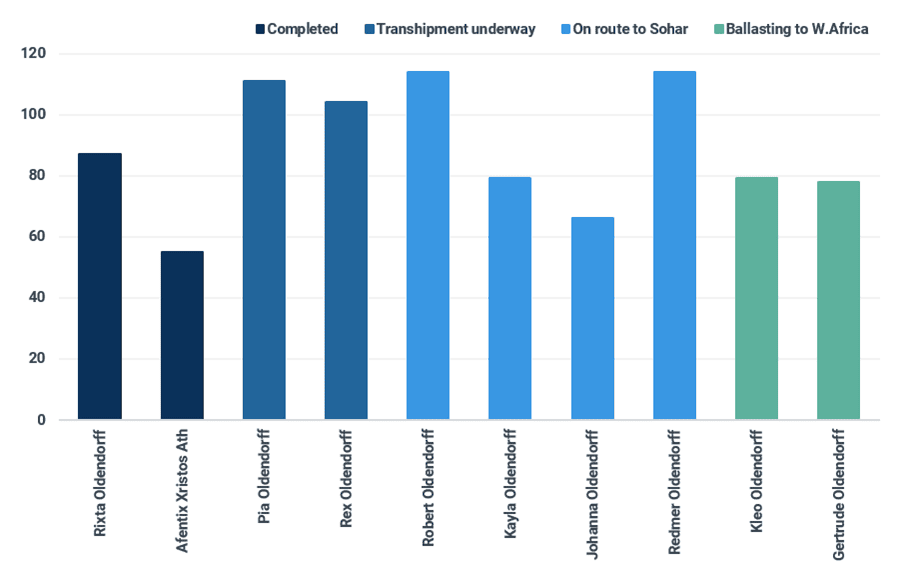
- Ghanian bauxite is shipped to Sohar on Capesize vessels; the Rixta Oldendorff completed the first transhipment event at the new site in mid-July. The Pia Oldendorff and Rex Oldendorff are in waters off Sohar.
- At least a further three Capes laden with bauxite are on their way to Sohar, while the Gertrude Oldendorff is likely heading to West Africa to load. These vessels are all unable to unload at Fujairah due to the shallow draft and lack of cargo handling equipment at the port.
- Transhipment is taking place onto four deck cargo ships (DCS), the DCS Aquarius, DCS Aquila, DCS Aries, and DCS Austral, for discharge at Fujairah.
- The Afentis Xristos Ath has transhipped a cargo of Brazilian bauxite via the Loura onto the DCS Aries and then undertaken a second transhipment event via the Albert Oldendorff onto the Antonie Oldendorff.
Bauxite transhipment events and expected arrivals (kt)
Source: Kpler Insight
Transhipment goes beyond bauxite
Transhipment of alumina cargoes continues alongside bauxite, with the RT Leo relocated from Navlakhi to Sohar and transhipping a cargo of Australian alumina from the Lila Shanghai to the Al Maqam.
The arrival of the Anna Oldendorff off Sohar suggests the transhipment operation now extends to steelmaking raw materials. The Anna Oldendorff had previously been employed in the Middle East Gulf, supporting Bahrain Steel’s operations. It began transhipping a cargo of Chinese slag from the Cape Zhoushan to the Baoying Glory in mid-July.
Both the Al Maqam and Baoying Glory have transited the Strait of Hormuz since the start of the war, and these loading operations indicate they may seek to do so again.
Transhipment, then trucking, is an expensive and inefficient way to bring cargoes into the Gulf, and not a long-term solution. The full bauxite requirement would necessitate in the region of 500 trucks/day. In addition to the physical logistical challenges this would entail, truck hire rates are around 25% higher than pre-war levels, in the region of $8,000/day, and journeys can be slowed by congestion, with large queues at the Omani-Emirati border. Local authorities in Fujairah have introduced new traffic management plans to handle the volume of trucks coming to the port. Etihad Rail is making major investments in regional passenger and freight rail infrastructure however, planned developments are still some way from completion, and existing networks cannot handle the surge in cargo into Fujairah.

See why the most successful traders and shipping experts use Kpler