
Heavier US corn stocks would drive Jul-Sep spread to carry
Lagging US corn export sales point to heavier-than-expected 2026/27 ending stocks, leaving a burdensome carry-in for 2027/28. Historical precedent shows the CBOT corn Jul-Sep spread tracks beginning-stocks closely, and fundamentals do not support its current inversion. As the USDA revises US exports lower and stocks higher, the Jul-Sep 27 spread should move from inverse to carry.
Lagging US export sales threaten heavier ending stocks
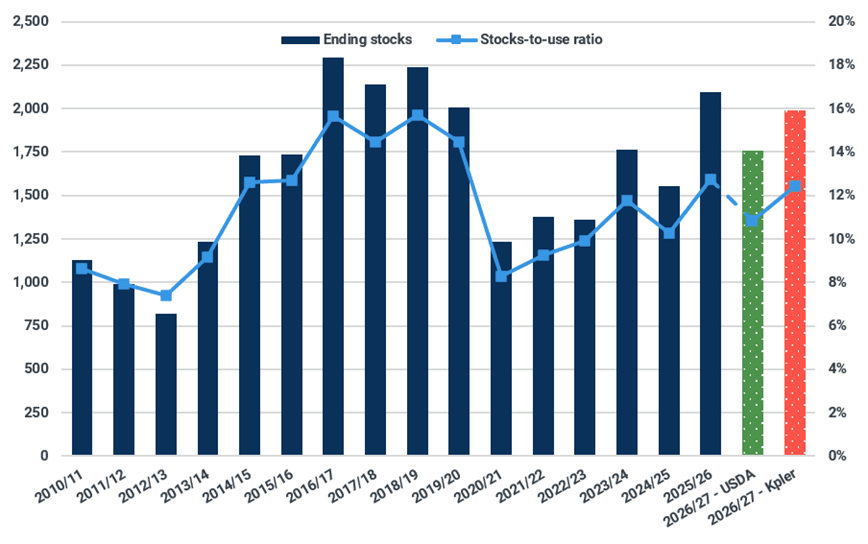
The US has harvested what is expected to be its second-largest corn crop on record, adding an abundance of supply to the 2026/27 balance sheet. However, sluggish export demand and favourable South American supply next year will challenge the opportunity to tighten the balance sheet.
US corn ending stocks (mbu) and stocks-to-use ratio (%)
Source: USDA, Kpler Insight
Burdensome beginning stocks push calendar spread into carry
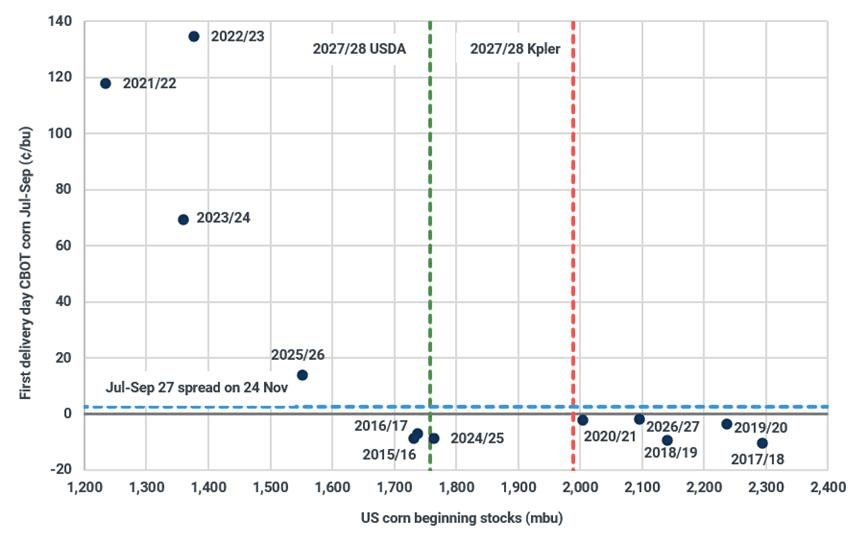
The CBOT corn Jul-Sep spread is one opportunity to trade the heavier US corn balance sheet. In past years, the spread has moved in accordance with how beginning stocks for the upcoming marketing year are shaping.
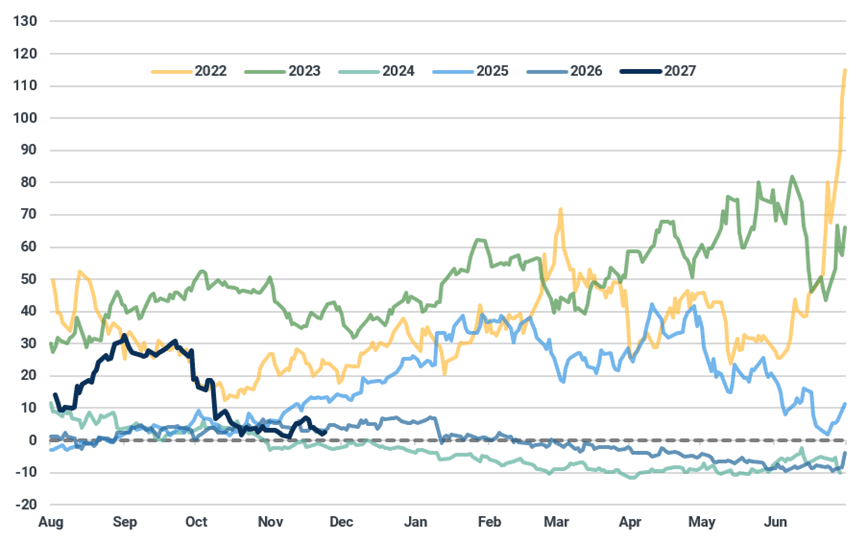
For example, the Jul-Sep 26 spread had been trading at inverse this time last year. By expiry, it was at carry, as conviction of a notable carryover strengthened during the second half of the crop year. In contrast, the Jul-Sep 25 spread remained at inverse as a smaller Brazilian corn crop supported US exports, reducing the carryover of stock into the next crop year.
Since 2015/16, when beginning stocks for the upcoming crop year have exceeded 1,700 mbu, the Jul-Sep spread is usually at carry by the first delivery day for the July contract. Therefore, even at the current USDA estimate of 1,758 mbu, the spread would likely still move towards carry. However, heavier beginning stocks as forecast by Kpler would likely see a greater percentage of full carry achieved, causing a larger movement of the spread from its current level.
Relationship between CBOT corn Jul-Sep calendar spread and US corn beginning stocks
Source: MarketView, Barchart, Kpler Insight
US corn fundamentals do not support CBOT corn Jul-Sep spread inversion
The Jul-Sep 27 spread closed at a 2.5¢/bu inverse on 24 Nov, with full carry at approximately 19¢/bu. The spread therefore sits at -13% of full carry, meaning there is potential for it to move lower as the USDA presents a more bearish fundamental picture. Reaching 50% of full carry would require the spread to decrease by 12.5¢/bu from Tuesday’s close to a 10¢/bu carry. A similar spread had been realised for Jul-Sep 26 during the end of June 2026.
As the USDA acknowledges the weaker US export campaign for 2026/27, market conviction of heavier beginning stocks for the 2027/28 US corn balance sheet will increase. In turn, the Jul-27 contract will come under more pressure than the Sep-27 contract, as the market looks to carry the heavier stock into the next crop year given the weaker export demand. The Jul-Sep 27 spread should receive bearish impetus from upcoming USDA releases and trend lower as a result. While the spread may decline into carry slowly, less gradual revisions by the USDA in upcoming WASDE reports could trigger a later, sharper price reaction. For example, the Jul-Sep 26 saw a notable decline when the USDA confirmed a record US corn yield in the January 2026 WASDE report.
CBOT corn Jul-Sep calendar spread (¢/bu)
Source: MarketView

See why the most successful traders and shipping experts use Kpler