Renewed supply risks may accelerate China's return to the crude market
China's crude inventory drawdown is expected to accelerate as refinery runs recover while renewed supply risks constrain imports, potentially bringing forward the timing of a more meaningful return to crude buying.
Key Takeaways:
- Kpler expects China's crude throughput to rise steadily from August, supported by a temporary relaxation of clean product export restrictions and falling domestic fuel inventories.
- However, delayed Persian Gulf cargoes and potential subdued Saudi liftings amid the Red Sea crisis mean crude arrivals are likely to lag the recovery in refinery runs.
- Russian and Iranian crude can partially bridge the feedstock gap, but supplies remain insufficient to fully offset the shortfall.
- China is therefore likely to accelerate crude inventory drawdowns over the next three months, bringing refiners closer to a threshold that could trigger a more meaningful increase in crude buying.
After keeping run rates at depressed levels for four months, Chinese refiners are finally starting to ramp up runs, albeit at a moderate pace given persistently weak domestic fuel demand and rapidly shifting government policy on clean product exports.
However, the recovery comes at a challenging time: Hormuz transits remain constrained as many shipowners remain deterred by Iran's attacks on commercial vessels in the region, while Houthi threats in the Red Sea are forcing some Saudi cargoes onto longer routes, keeping crude prices elevated and the availability of Middle Eastern barrels uncertain.
Even so, Chinese refiners are expected to proceed with their plans after Beijing unexpectedly allowed nearly 3 mt of additional clean product exports in August, with some shipments permitted to extend into September given the tight logistical window. The relaxation offers state-owned refiners a long-awaited opportunity to capture attractive export arbitrage margins, incentivising them either to raise their own throughput or purchase more refined products from independent refiners that lack export quotas.
At the same time, China's commercial gasoline and diesel inventories are reportedly at relatively low levels, prompting refiners to raise production to rebuild stocks and strengthen domestic supply buffers. According to a survey by China-based consultancy Oilchem, gasoline inventories fell by 140 mt between late April and end-July, while diesel stocks declined by 253 mt over the same period. Both have now fallen back to levels last seen around December.
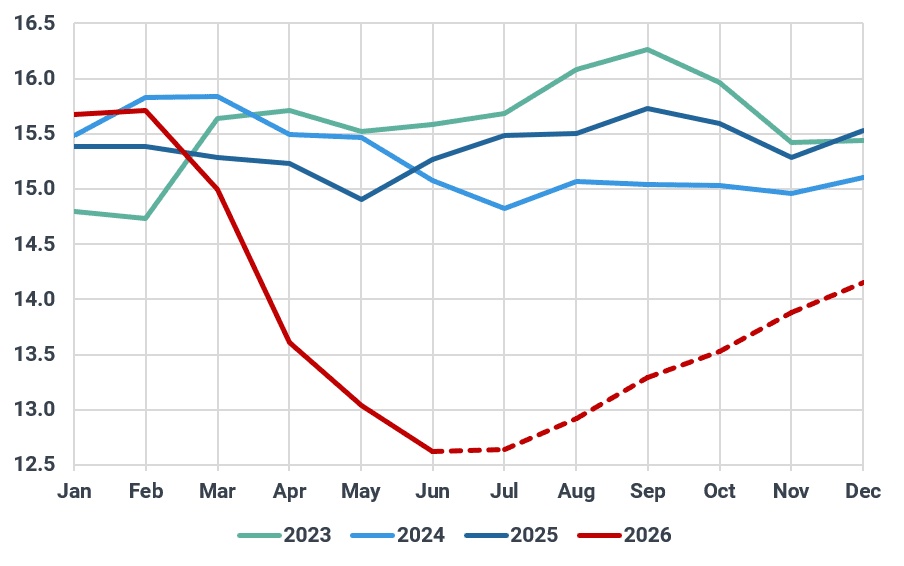
Kpler currently estimates China's crude intake to rise to 12.92 mbd in August, 13.29 mbd in September and 13.54 mbd in October, compared with 12.64 mbd in July.
China's crude intake demand, mbd
Source: Kpler
The key question, however, is whether crude imports can keep pace with the recovery in refinery runs. The recovery in crude imports may lag the increase in refinery throughput, as Middle Eastern crude deliveries remain uncertain, while elevated crude prices and still-thin refining margins—despite some recent improvement—continue to discourage refiners from making large-scale purchases.
Some Persian Gulf cargoes purchased by Chinese state-owned and independent refiners and scheduled for loading in late July have been delayed by two to three weeks. With the recovery in Hormuz traffic remaining stalled, cargoes scheduled for September delivery also face potential delays.
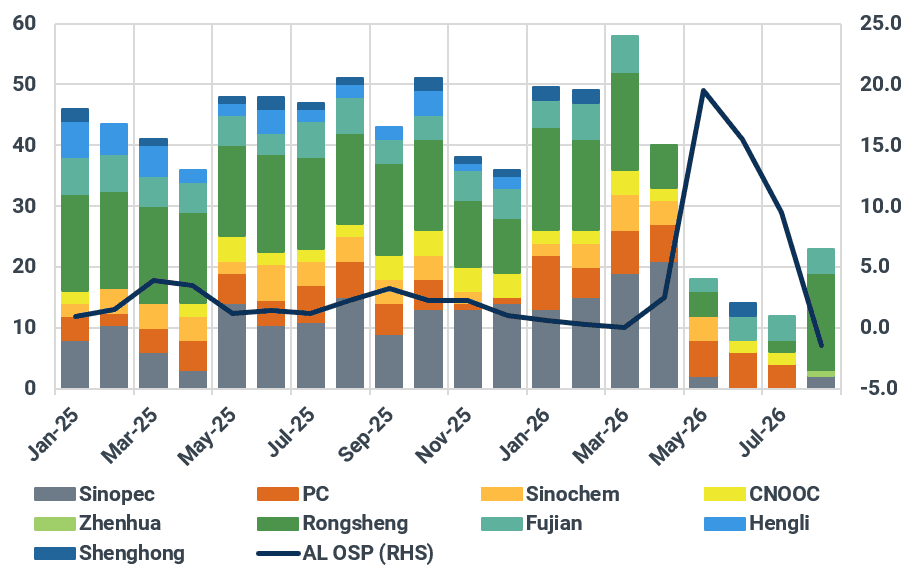
Moreover, despite only a modest increase, Chinese refiners are committed to lifting at least 23 mb of August-loading Saudi crude. However, Houthi attacks on Saudi-linked vessels since late July have prompted Asia-bound tankers to avoid the Bab el-Mandeb Strait and instead take significantly longer routes via the Mediterranean and the Cape of Good Hope, adding at least 20 days to the voyage. Given the longer journey, we understand Chinese refiners have decided to keep nominations for September-loading Saudi crude at low levels, while some may even cancel part of their August-loading volumes.
Even if some Chinese refiners proceed with lifting Saudi crude from the Mediterranean port of Sidi Kerir, deliveries could be delayed by around a month due to logistical constraints, arriving too late to meet refiners' immediate feedstock needs. This has triggered a buying frenzy for Russia's ESPO crude, which can reach Chinese ports in less than a week and faces relatively limited geopolitical disruption apart from US sanctions.
China's planned liftings of Saudi crude by firm (LHS), mb; Arab Light OSP vs Dubai/Oman avg (RHS), $/bbl
Source: Kpler, Saudi Aramco
Against this backdrop, Chinese refiners snapped up available September ESPO cargoes much faster than in a typical trading cycle and pre-booked sizeable volumes of October-loading crude even before the trading cycle began and offers were formally released. Once trading officially kicked off this week, almost all available October cargoes were sold within two to three days, at around ICE Brent +$1/bbl, compared with around ICE Brent -$4/bbl in mid-July.
The competition for prompt feedstock is also increasingly segmenting China's crude market by buyer type. As the vast majority of September- and October-loading ESPO cargoes were secured by state-owned refiners and the 400 kbd privately owned Yulong refinery, teapots have been forced to seek alternatives, particularly Iranian crude. However, the reimposition of the US naval blockade has also constrained Iranian crude availability, limiting the ability of teapots to fully replace the ESPO barrels they have been priced out of.
That leaves Atlantic Basin arbitrage cargoes as one of the few viable alternatives for Chinese refiners, with trading for October-arrival barrels still ongoing. However, elevated freight rates amid heightened Middle Eastern tensions, together with a wider Brent-Dubai spread, have left the arbitrage window open for only selected grades, providing insufficient incentive for refiners to meaningfully step up purchases. For instance, Kpler calculations show that WTI for late-October/early-November arrival is around $4/bbl cheaper than Murban on a delivered basis, while Tupi remains $3-4/bbl more expensive than Upper Zakum.
The reluctance to commit may have been reinforced by ADNOC's latest tender for October-loading cargoes and expectations that Iran and Oman could soon reach an agreement allowing more vessels to transit the Strait of Hormuz, both of which raise the prospect that more Middle Eastern barrels could become available before October-arrival Atlantic Basin cargoes are needed.
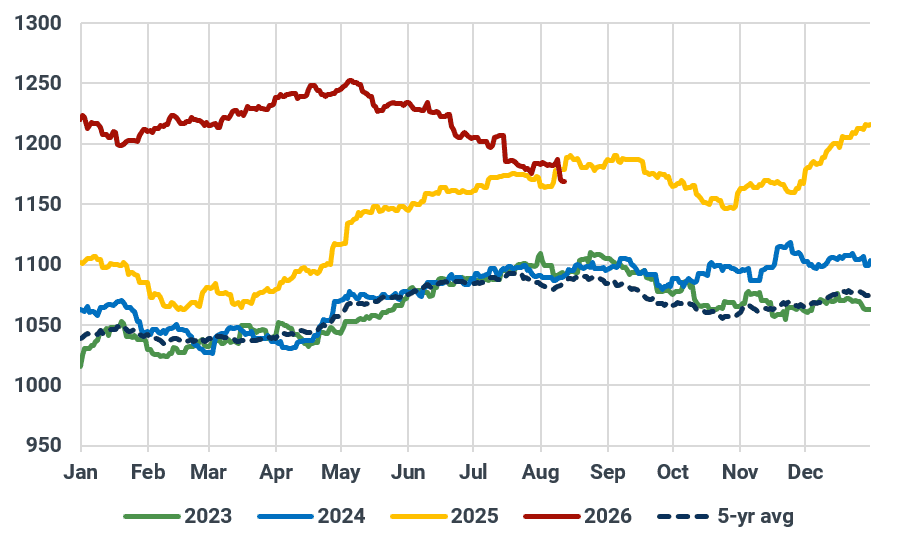
That said, Chinese refiners are expected to accelerate the drawdown of commercial crude inventories over the next two to three months to bridge the near-term feedstock gap. As highlighted in a previous report, it remains unclear what inventory level Beijing considers critical to the country's energy security. However, as inventories decline more rapidly alongside a continued recovery in crude throughput, China may soon approach a threshold that triggers a more meaningful return to the crude market. The current divergence between rising refinery runs and subdued crude imports therefore appears increasingly unsustainable: unless the throughput recovery stalls again, China may need to return to the international crude market more meaningfully—and sooner than previously expected.
China's onshore crude inventory, mb
Source: Kpler
Market Insights you can trust
Kpler delivers unbiased, expert-driven intelligence that helps you stay ahead of supply, demand, and market shifts.
Trade smarter. Request access to Kpler today.

See why the most successful traders and shipping experts use Kpler