Global refining has become the real supply constraint
Refining, rather than crude supply, has emerged as the primary constraint on global oil markets, as geopolitical disruptions, policy constraints and logistical bottlenecks continue to limit incremental refinery runs and refined product supply.
Refined products, not crude, are the binding constraint
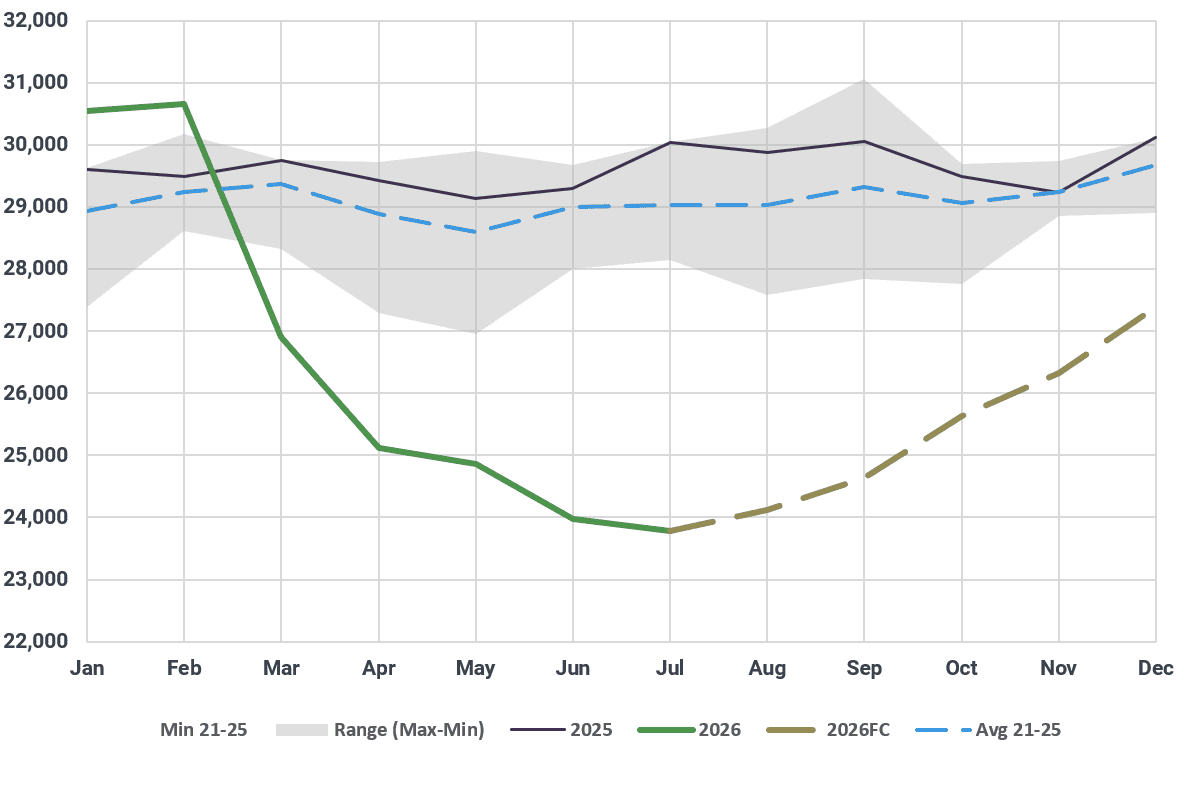
Crude oil continues to dominate headlines, but the more consequential tightness sits downstream. Global spare refining capacity has narrowed to levels which has triggered sever product tightness leaving no further room to absorb further supply shock in refined product market. U.S. utilization is already holding ~95%, European refiners are running at their strongest seasonal rates in several years, and refiners across Asia ex-China, Latin America and Africa have already lifted throughput close to practical limits in response to strong margins and available feedstock. As a result, the burden of incremental supply increasingly rests on China, Russia and the GCC, where constraints are driven by structural and geopolitical factors rather than refining economics.
Russian runs at multi-decade lows
Russian refinery throughput has fallen to its lowest level in more than two decades following sustained Ukrainian drone strikes on refinery infrastructure. A country that has historically been a major exporter of refined products has now relied on imports to balance domestic its fuel markets, further tightening an already constrained global product market. With refinery operations still under pressure, the scope for a meaningful recovery in product exports remains limited.
Middle East exports constrained despite available capacity
Ongoing regional tensions and shipping disruptions continue to constrain refined product exports from the Middle East. As a result, refiners have been unable to fully utilize available refining capacity to meet export demand, limiting the region's ability to offset tighter product balances elsewhere.
China capped by policy, not capacity
China retains ample refining capacity, but throughput remains constrained by government-controlled product export quotas. As a result, refiners have been unable to capitalize on elevated export margins, leaving China's contribution to incremental global product supply well below levels observed during previous periods of market tightness.
Russia, China and ME refinery runs combined & outlook, kbd
Source : Kpler
Net effect: a structurally subdued global run rate
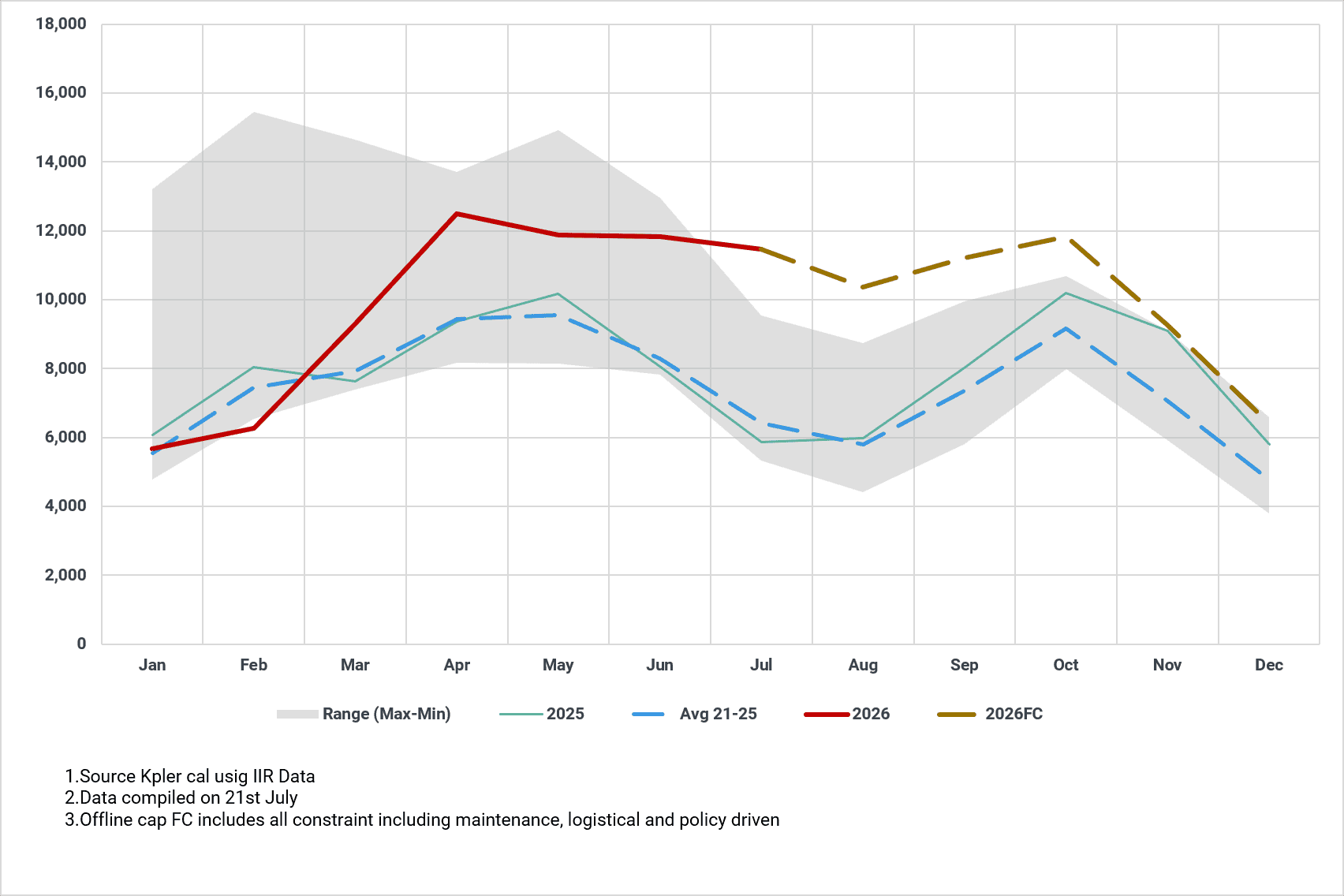
Taken together, these three constraints Russia's impaired refinery operations, Middle Eastern export bottlenecks, and China's policy-driven limits on throughput and product exports, are more than offsetting strong refinery utilization across the Atlantic Basin, particularly in the United States and Europe. As a result, global refinery runs are tracking toward one of the weakest seasonal levels in recent years and supporting refining margins.
The implication is clear: refined product markets remain considerably tighter than crude oil fundamentals alone would suggest. While global nameplate refining capacity remains available, the portion that can respond quickly to market disruptions has become extremely limited.
Global refinery Offline Cap actual & forecast, kbd
Market insights you can trust
Kpler delivers unbiased, expert-driven intelligence that helps you stay ahead of supply, demand, and market shifts.
Trade smarter. Request access to Kpler today.

See why the most successful traders and shipping experts use Kpler