Stubbornly high freight rates fuel an early price war among oil producers
Despite heightened geopolitical risks and lingering uncertainty over Middle Eastern crude supplies, oil producers are already scrambling to lower their offers to stay competitive as freight rates remain near record highs across vessel classes and regions.
Key Takeaways:
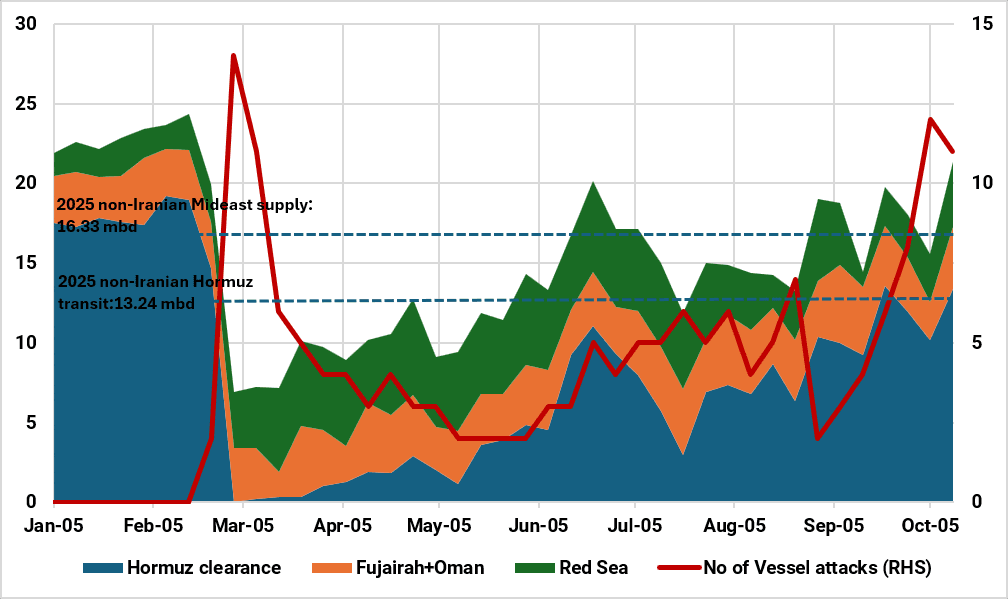
- Overall non-Iranian Middle Eastern crude supply remains near or slightly above pre-war levels, even as Iran intensifies attacks on commercial vessels. Supply to international markets has averaged ~16.8 mbd so far in October, compared with the 2025 average of 16.3 mbd.
- Dubai structure and Middle Eastern spot crude differentials could weaken further as producers adopt increasingly aggressive pricing strategies to attract buyers amid intensifying competition for market share, especially given the limited room for refinery demand growth in the near term.
- Elevated outright oil prices and freight rates keep landed crude costs high, discouraging refiners from initiating large-scale inventory replenishment despite depleted stocks. With refiners potentially waiting for landed prices to fall to $100/bbl or lower, significant restocking demand may not emerge until Q1 2027, if not later.
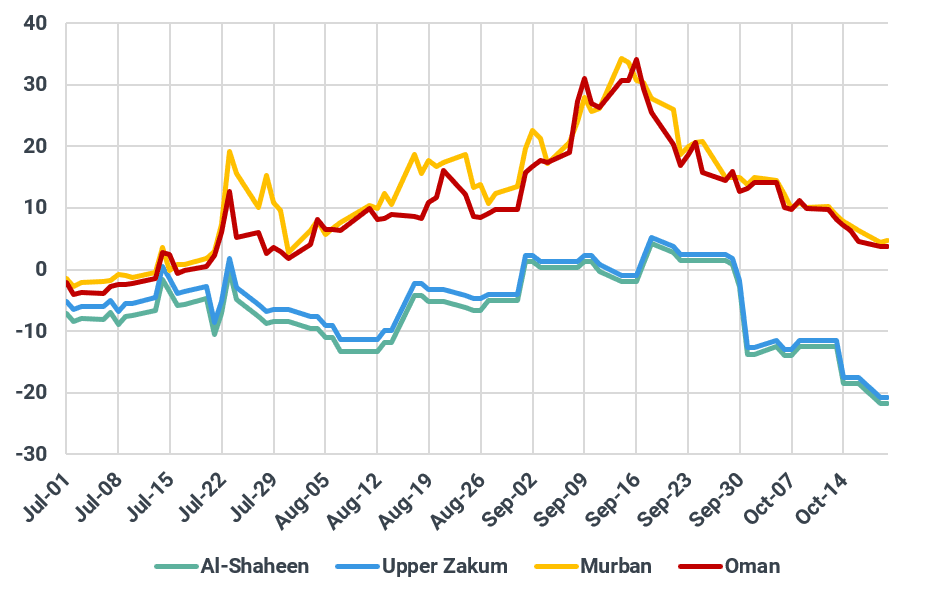
Iraq's state oil marketer SOMO reportedly offered December-loading Basrah Medium and Basrah Heavy at around OSP -$28/bbl on an FOB Basrah Oil Terminal basis. The firm recently sold several prompt November-loading Basrah cargoes to Asian refiners at discounts as steep as $37/bbl to OSP to attract buying interest. Even after accounting for elevated freight costs, Iraqi crude remains among the most competitively priced options for Asian refiners.
The aggressive pricing comes as Middle Eastern producers sharply increase supplies and offer more November- and December-loading cargoes amid expectations of sustained high oil flows through the Strait of Hormuz. Kpler data shows that at least 10.73 mbd of Persian Gulf crude passed through the Strait so far in October, marginally higher than the 10.66 mbd recorded in September, even as Iran intensified attacks on commercial vessels. Including cargoes loaded from terminals outside the Strait, total non-Iranian Middle Eastern crude supply averaged 16.8 mbd over the same period, above the 2025 average of 16.3 mbd.
Non Iranian-Middle Eastern crude supply, mbd; Number of vessel attacks, count
Source: Kpler; UKMTO
Although non-Iranian Middle Eastern crude oil and condensate production remains ~2.7 mbd below pre-war levels, supply to international markets has already recovered and could increase further in the coming months. With outright oil prices remaining elevated at around $110/bbl for ICE Brent futures and record-high freight rates constraining refinery buying, producers are being drawn into a price war earlier than the market had anticipated.
Saudi Aramco, which traditionally relied on term sales at monthly OSPs, has been offering large volumes in the spot market at steep discounts. Some recent November-loading cargoes were reportedly traded at around OSP +$20/bbl on a delivered China basis, implying an FOB-equivalent discount of around $16/bbl to OSP after adjusting for prevailing freight and logistics costs.
Other regional producers, including ADNOC and QatarEnergy, are also offering spot cargoes at increasingly competitive prices.
Market participants told Kpler that producers may offer even deeper discounts to secure larger-volume commitments as competition for market share intensifies.
Selected crude diffs vs Dubai on a FOB basis, $/bbl
Source: Argus Media
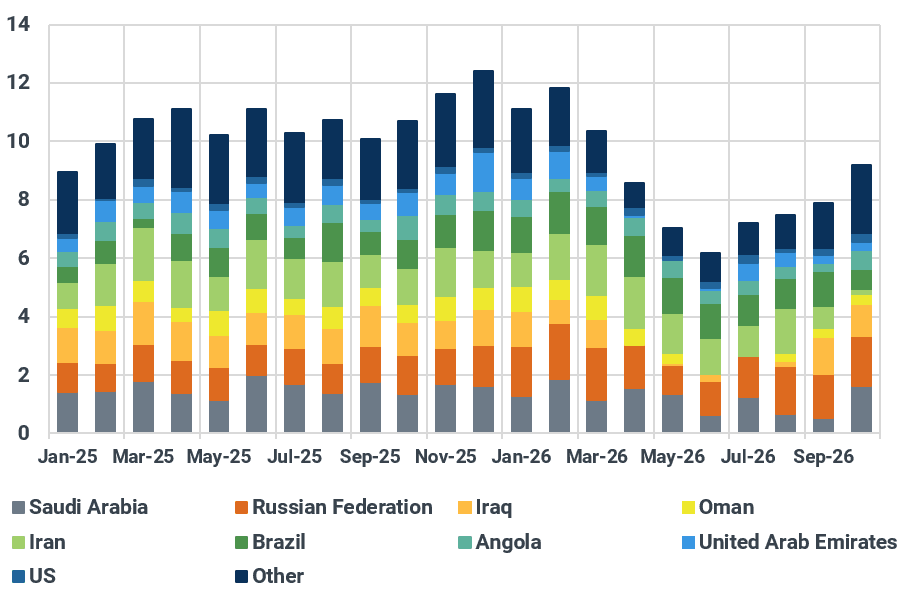
The wave of spot offers has helped draw more Asian buying interest towards Middle Eastern crude for Q4 delivery. Kpler data shows that China's imports from the region are on track to exceed 5 mbd in October, significantly higher than 3.5 mbd in September and approaching the February level of 5.6 mbd. India's intake, meanwhile, has averaged 2.4 mbd so far this month, down from 2.8 mbd in September but above the 2025 average of 2.2 mbd.
Yet, with limited room for growth in Asian refinery crude intake, the increase in Middle Eastern purchases appears to be displacing barrels from other regions rather than generating equivalent growth in overall crude demand. China's largest oil refiner, Sinopec, is estimated to have purchased only ~14 mb of Brazilian crude for December arrival, roughly half its typical monthly intake. This has contributed to a substantial overhang of unsold cargoes in Brazil, adding pressure on sellers to lower Tupi FOB differentials to a record low of Dated Brent -$26/bbl, Argus data show.
Chinese buying interest in Brazilian crude, as well as other arbitrage cargoes, is unlikely to pick up much despite freight rates retreating from recent peaks and sellers continuing to lower their offers. According to market participants, Sinopec is considering a marginal reduction in refinery runs from the current 4.23 mbd to 4.12 mbd in December, while other state-owned refiners are expected to maintain largely steady run rates.
China's seaborne crude/co imports by origin, kbd (as of Oct 21)
Source: Kpler
That said, refiners may make some opportunistic purchases if sellers lower their offers further. However, with landed crude prices still hovering around $120/bbl, refiners are unlikely to initiate large-scale inventory replenishment, despite the need to rebuild depleted stocks in countries such as China and Japan.
With little prospect of a significant pickup in refinery demand and freight costs remaining stubbornly high, the price war between Middle Eastern and Atlantic Basin producers may have only just begun.

See why the most successful traders and shipping experts use Kpler