West African differentials drop with high freight, growing competition
Soaring freight costs are breaking global crude oil arbitrages and having a particular effect on WAF barrels, with differentials coming under pressure.
Key takeaways
- West African differentials plummet to multi-year lows: Discounts on unsold October and November cargoes collapsed. Angola's Hungo hit its widest discount since 2011
- Soaring freight costs sever long-haul arbitrages: Very Large Crude Carrier (VLCC) spot earnings on the West Africa to China route spiked to a record, while Aframax rates on the TD7 North Sea to Continent route reached a year-to-date high of Worldscale (WS) 625. Freight costs have quadrupled from prewar baselines, pressuring WAF differentials
- Resurgent Middle Eastern supply reclaims Asian market share: As Persian Gulf exports and Saudi Red Sea logistics recover, Asian refiners are prioritising Middle Eastern barrels over West African crudes. This leaves roughly 13 WAF October cargoes stranded alongside prompt November programmes.
While crude prices remain elevated globally, WAF differentials are coming under pressure from high freight and increasing competition. Resilient flows out of the Middle East and the Americas are leaving some WAF grades low on the pecking order for demand, resulting in programme overhangs.
The main driver is freight costs. Shipping prices have quadrupled from pre-war baselines, shutting down traditional long-haul trade routes. VLCC spot earnings on the West Africa to China route reached a record $760,000/day, while Aframax rates on the TD7 route from the North Sea to the Continent jumped 19% to a year-to-date high of WS625. By contrast, rates on the TD25 route from the US Gulf to ARA, and rates on the TD27 route from Guyana to ARA eased slightly on the week. This highlights the growing competition WAF crudes are facing in the Atlantic Basin, both into Europe and Asia.
Extreme freight fixtures are also a consequence of constrained vessel availability, further hampering outflows from West Africa. The market overhang for WAF crudes is worsening, which is surprising the risks of sourcing crude from the Middle East. Roughly 13 unsold October-loading Angolan and Nigerian cargoes are now competing directly with November loading programmes.
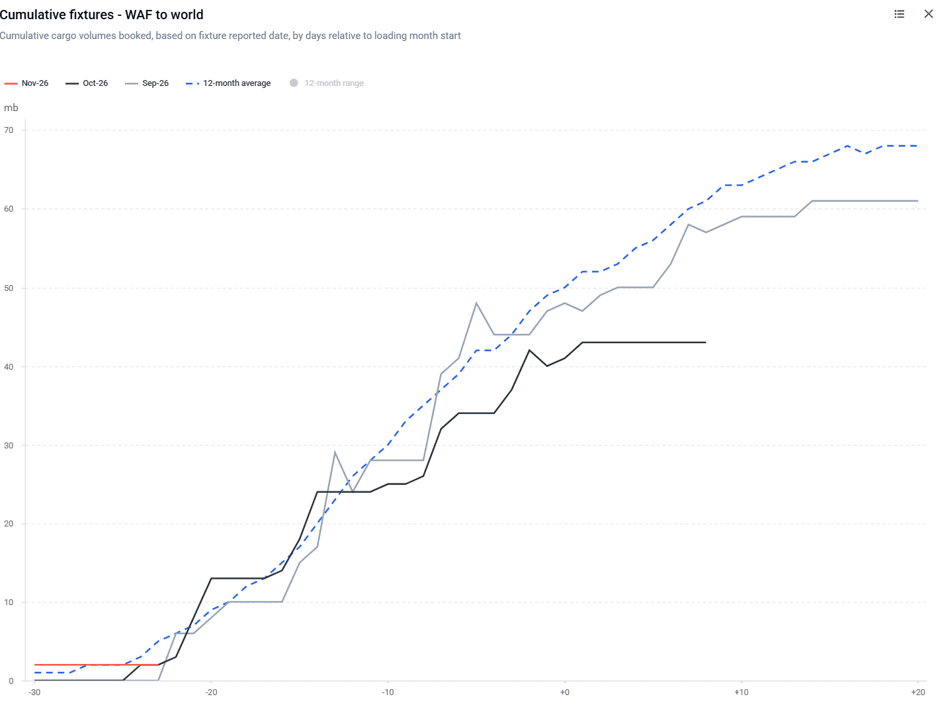
Cumulative fixtures pace for WAF barrels, Mbbls
Source: Kpler
The fixture pace out of the regions shows a growing trend, starting with a deceleration from the September programme itself. The deceleration below the 12-month average highlights the weaker demand, and consequential pressure on pricing.
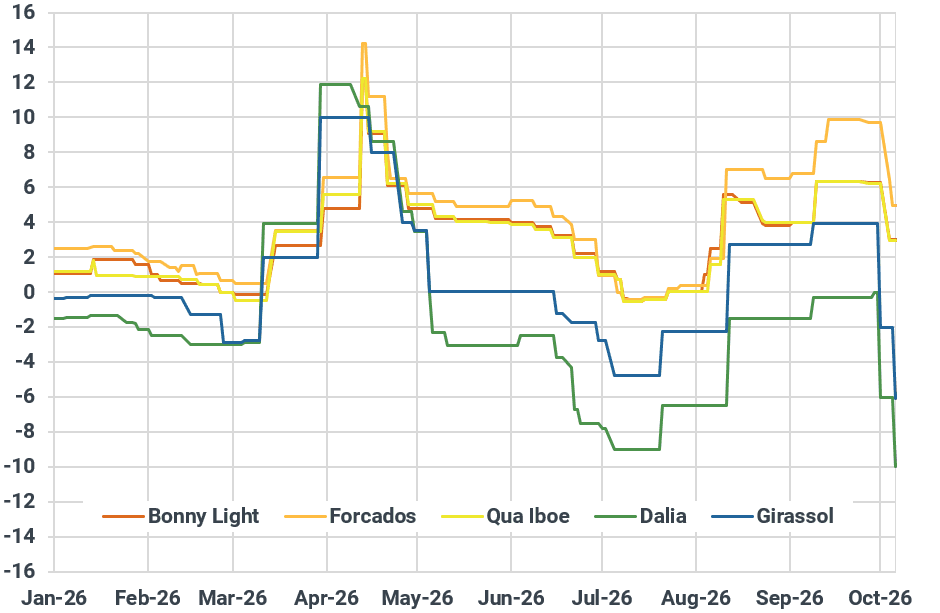
With cargoes struggling to clear via long-haul routes, differentials have been cut severely. Oil majors were heard aggressively offering WAF cargoes (without buyers) earlier this week, with Nigeria’s highly-acidic Usan crude shedding almost $2bbl in on session (Argus Media). Angolan grades were heard dropping even more steeply. Medium-sour Hungo crude printed at the steepest discount to Dated Brent for a WAF grade for 15 years, nearing $20/bbl below the benchmark (Argus Media).
Despite heavy discounts, Asian refiners are favouring Middle Eastern barrels, given the recent resurgence in flows. Indian buyers were heard buying around 3 Mbbls of Middle Eastern crudes this week, suggesting that opportunistic purchases from the region (low sail times and potential discounts being incentives), are taking place.
However, a renewed spate of attacks in the Middle East, resulting in a drop in Hormuz flows, could re-ignite WAF demand. Being a key swing supplier, expect WAF differentials to pick up swiftly if we see a marked and sustained drop in Middle Eastern crude outflows.
Selected WAF differentials to Dated Brent, $/bbl
Source: Argus Media

See why the most successful traders and shipping experts use Kpler