Venezuela's OPEC exit: structurally likely but not now
Venezuela is reportedly weighing whether to leave OPEC, becoming the second member in months to openly consider an exit. As the taboo around key members quitting the group has now been broken, Venezuela's own trajectory, commercially and politically, points the same way as the UAE's. But the timing argument doesn't hold up yet: with output still years away from levels where OPEC's quota system would bind, and with Caracas gaining little in practice from staying versus leaving, there is no pressing reason for Venezuela to formalise a break right now.
Key takeaways
- Venezuela is reportedly in internal deliberations over leaving OPEC, months after the UAE's withdrawal and amid rising friction from Iraq.
- Though an eventual exit has a real probability, OPEC is unlikely to push for quotas on Venezuela in the near term given its still-modest output, a dynamic that removes urgency.
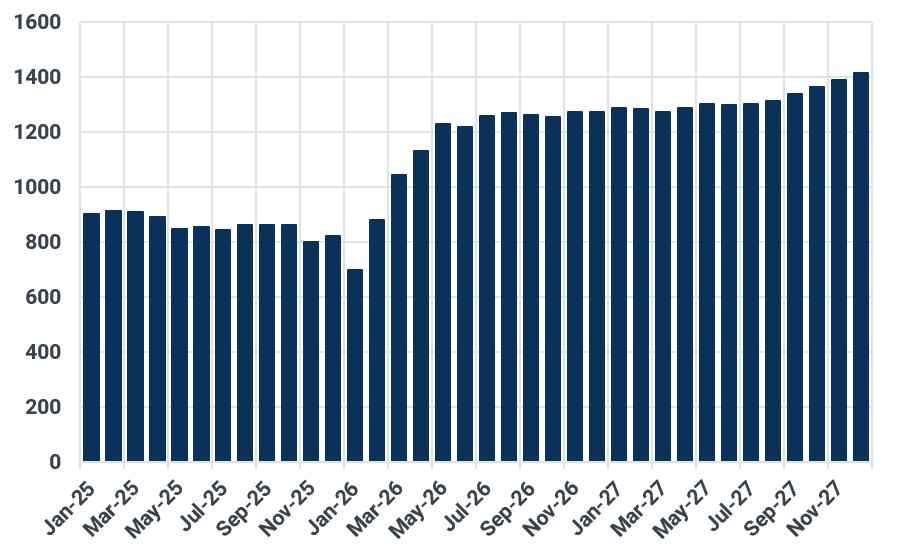
- Venezuela's own production recovery argues for patience: although output has significantly risen year to date, it is only back to around 1.3 mbd and guided toward ~1.4 mbd by late-2027. 2027 could see a flurry of deals signed, but the larger impact on production capacity won't be seen before the end of the decade.
- Domestic politics may end up the bigger swing factor than oil-market logic: acting president Delcy Rodríguez faces internal pressure over her tilt toward Washington, and opposition within Chavismo to that alignment could resurface with knock-on implications for how Caracas handles OPEC.
- In practice, Venezuelan barrels are already moving largely outside OPEC's supply-management logic: record US-bound flows, a returning Indian offtake, and renewed European and Caribbean trade, regardless of what Caracas eventually decides on membership.
A second key member wavers
Although OPEC saw many of its members exit throughout its history, the UAE's withdrawal at the end of April had a particular weight, as it held around 30% of the group's spare capacity. Caracas is now reportedly weighing the same step. The exit of another member would further damage OPEC's cohesion and credibility, especially given Venezuela's major role in OPEC's founding in 1960, under the diplomacy of oil minister Juan Pablo Pérez Alfonzo. Should Venezuela follow the UAE out the door, the two exits combined would strip out roughly 6 mbd of OPEC capacity, or about 20% of total production capacity.
The taboo is already broken
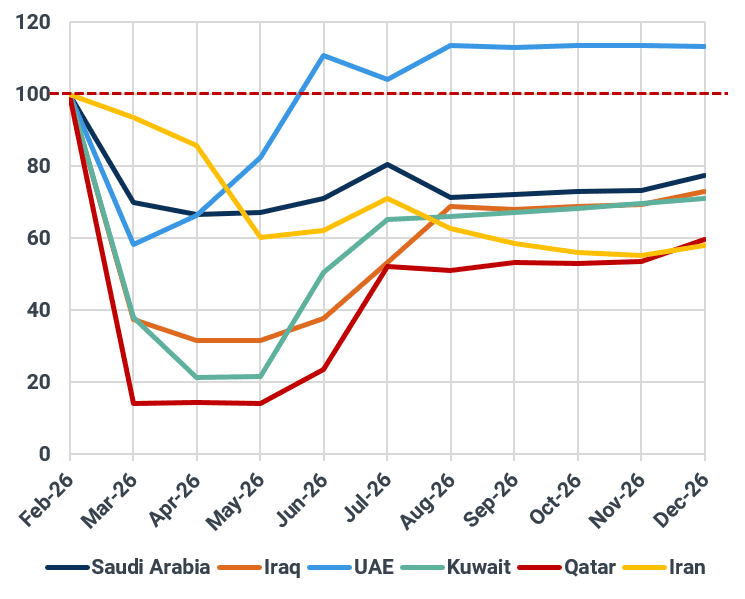
Angola's acrimonious 2024 exit and the UAE's departure this spring mean Venezuela would be the third major producer to leave the group in under two years. The UAE precedent matters symbolically even more than the barrels: once one large producer demonstrates it can walk away - the UAE was the group's second largest oil producer when it exited - and keep selling oil without ceilings, the psychological and institutional barrier for the next one drops. Since the US-Iran war, the UAE has outperformed its regional peers, being the only country where production is already higher than its pre-war level.
Persian Gulf countries production, kbd
Source: Kpler
However, although there is a genuine chance Venezuela ends up leaving, there is an important nuance where comparing with the UAE case: OPEC is unlikely to try to impose formal quotas on Venezuela given how far its production capacity still sits below historical levels (around 3 mbd), which could buy Caracas more time before any decision becomes urgent. There's also a symbolic dimension worth noting: OPEC was founded specifically to wrest pricing and production control away from the foreign oil majors: the "Seven Sisters" era.
A Venezuela exit, at a moment when US supermajors are re-engaging with the country's upstream, would in some respects read as a partial return to that pre-OPEC dynamic. This would be a huge win for the Trump administration, but that framing is politically uncomfortable domestically, and is part of why pressure on Delcy Rodríguez, seen by Chavistas as having conceded too much to Washington, could translate into a more assertive opposition within Chavismo going forward.
The Kpler view: structurally inevitable, but not yet
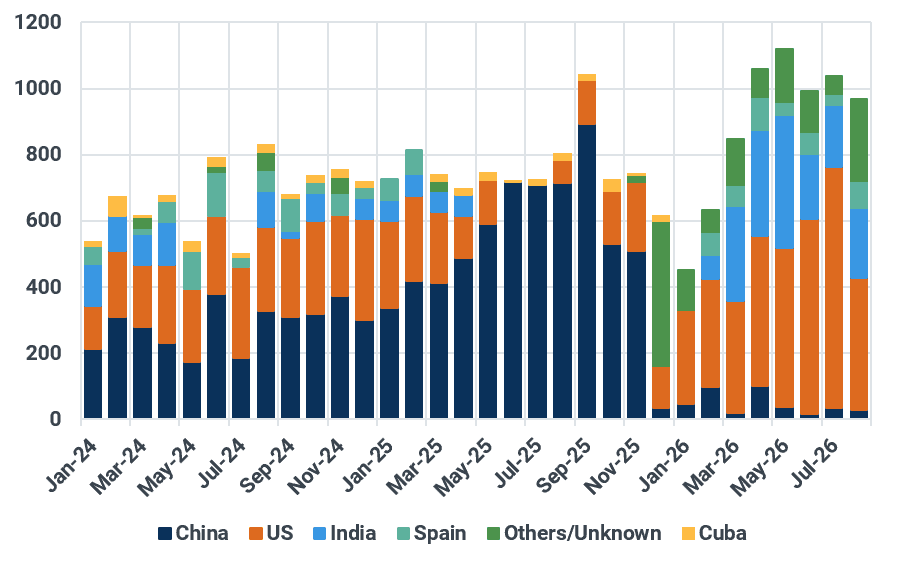
Venezuela sits among the world's largest oil reserves, although these mainly consist of heavy sour the redevelopment of its Orinoco belt, and is the leading candidate to lead future production growth in the western hemisphere, just as US and Brazilian production are about to peak, and on a much larger scale than Guyana or Argentina. Freed from OPEC's constraints, Caracas can chase the same optionality the UAE now enjoys, particularly given how much US Gulf Coast demand exists for heavy Venezuelan barrels. The USGC's imports from Venezuela reached new all-time highs of more than 700 kbd.
Venezuela oil exports by destination, kbd
Source: Kpler
The rumour comes as a way to test the market in prevision of an exit. Similarly, the first rumours around a UAE exit dated back from 2021. Venezuela's production trajectory, from ~700 kbd in January, to 1.2 mbd by now, and only 1.4 mbd by late 2027, keeps Caracas comfortably inside its current quota exemption for at least the next two to three years. After the Hunt Oil agreement, more upstream deals have a great chance to be signed in early 2027, but the impact from on production these won't be seen until later in the decade. In other words, Venezuela isn't yet paying any real cost for staying in OPEC, so there's little commercial reason to spend political capital exiting now.
Venezuela crude oil production, kbd
Source: Kpler
Market and trading implications
- Price impact of an eventual exit: limited. Venezuela accounts for a small share of global seaborne exports, and its output is already exempt from OPEC's cuts, an actual exit would be more symbolic than supply-altering in the near term.
- Venezuela's reshuffling of oil flows matters more right now than the OPEC membership question. Independent of any OPEC decision, Venezuelan barrels are already reintegrating into global markets on distinctly US-aligned terms: exports to the US hit above 700 kbd in July; India has returned as a major offtaker of Merey and Boscan grades; ARA took its first Venezuelan cargo in seven years; and Curaçao's Bullenbay terminal is back in service under the Trafigura/Vitol-linked US marketing program.

See why the most successful traders and shipping experts use Kpler