The great Polish energy transition: solving the coal paradox
To mine or not to mine? Poland’s power sector is navigating a structural policy–market coal contradiction. Kpler Insight's recent whitepaper dives into the evolving Polish power mix, which is planning to replace unprofitable coal capacity with a combination of CCGTs, renewables and BESS capacity by 2030. Over the longer term, risk diversification hinges on a nuclear program, with up to 9 GW of capacity planned by 2040.
Ket takeaways
- The coal economics crisis: Why despite wholesale power prices frequently exceeding 100 €/MWh, Polish coal-fired generation is structurally uncompetitive.
- The hidden BESS giant: How Poland secured 9 GW of battery storage through aggressive capacity auctions, potentially reshaping Central European flexibility markets.
- Gas as the transition backbone: Deep dive into 7 GW of new gas capacity, expanded LNG infrastructure, and Poland's emerging role as a regional balancing hub.
- Renewable revolution: Analysis of Poland's 21 GW solar boom, wind deregulation impact, and 5 GW offshore pipeline that's accelerating the coal phase-out.
- Regional power anchor: Poland's strategic role linking the Baltic States to Continental Europe and supplying 20% of Ukraine's electricity imports amid infrastructure attacks.
- Long-term diversification: The nuclear roadmap targeting 9 GW by 2040 and demand projections showing 60% growth to 240 TWh by 2035.

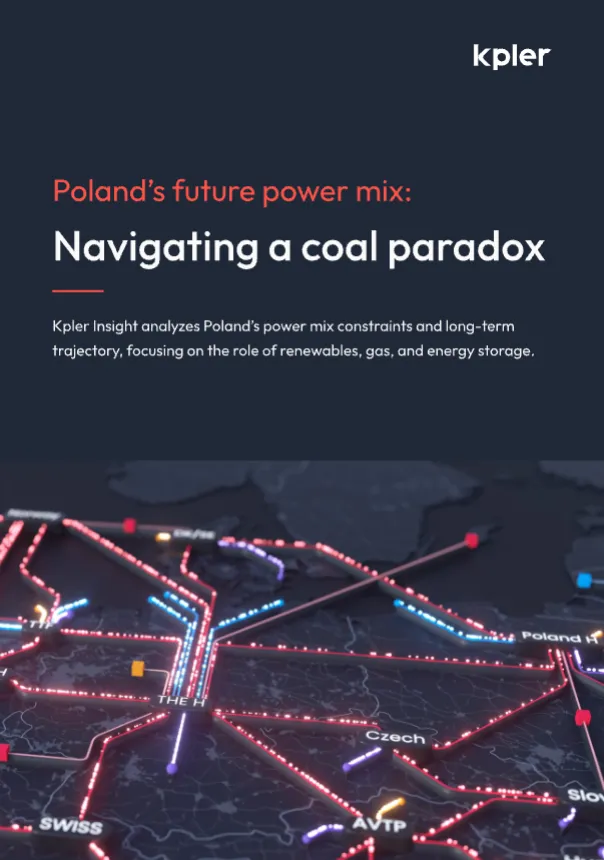
Access our free whitepaper to gain valuable industry insights:
“I rely on the Kpler Whitepapers to stay ahead of the latest market trends and industry insights.”
Michael Rodriguez
Chief Strategy Officer, Global Trade Inc

Known from...





%201.svg)