Real-time visibility into global crude oil, refined product, and petrochemical trade


.webp)


2.8k
10+
500+
200+
- Slice flows by commodity, grade, vessel, region, port, installation, and time range to isolate exactly the market you're watching
- Map cargo movements across trade routes, export hubs, and terminals, or switch to table view for detailed trade-level analysis
- Visualise seasonal patterns and year-on-year trends with dedicated seasonal charts and 5-year YoY comparisons
- Move from high-level regional trends to individual cargo detail in a single workspace

- Track crude oil price movements with real-time crude oil price analysis, benchmarked against Brent, WTI, and Dubai daily settlements
- Access crude oil price forecasts built on cargo, flow, and inventory signals, not just exchange data
- Follow the crude oil outlook across 500+ crude grades, from major benchmarks to niche regional streams

- Identify the buyers, sellers, exporters, and importers behind individual trades
- Track trade flows between producing and consuming regions, broken down by commodity and grade
- Spot shifts in import and export patterns at the country, company, and regional level before they become consensus
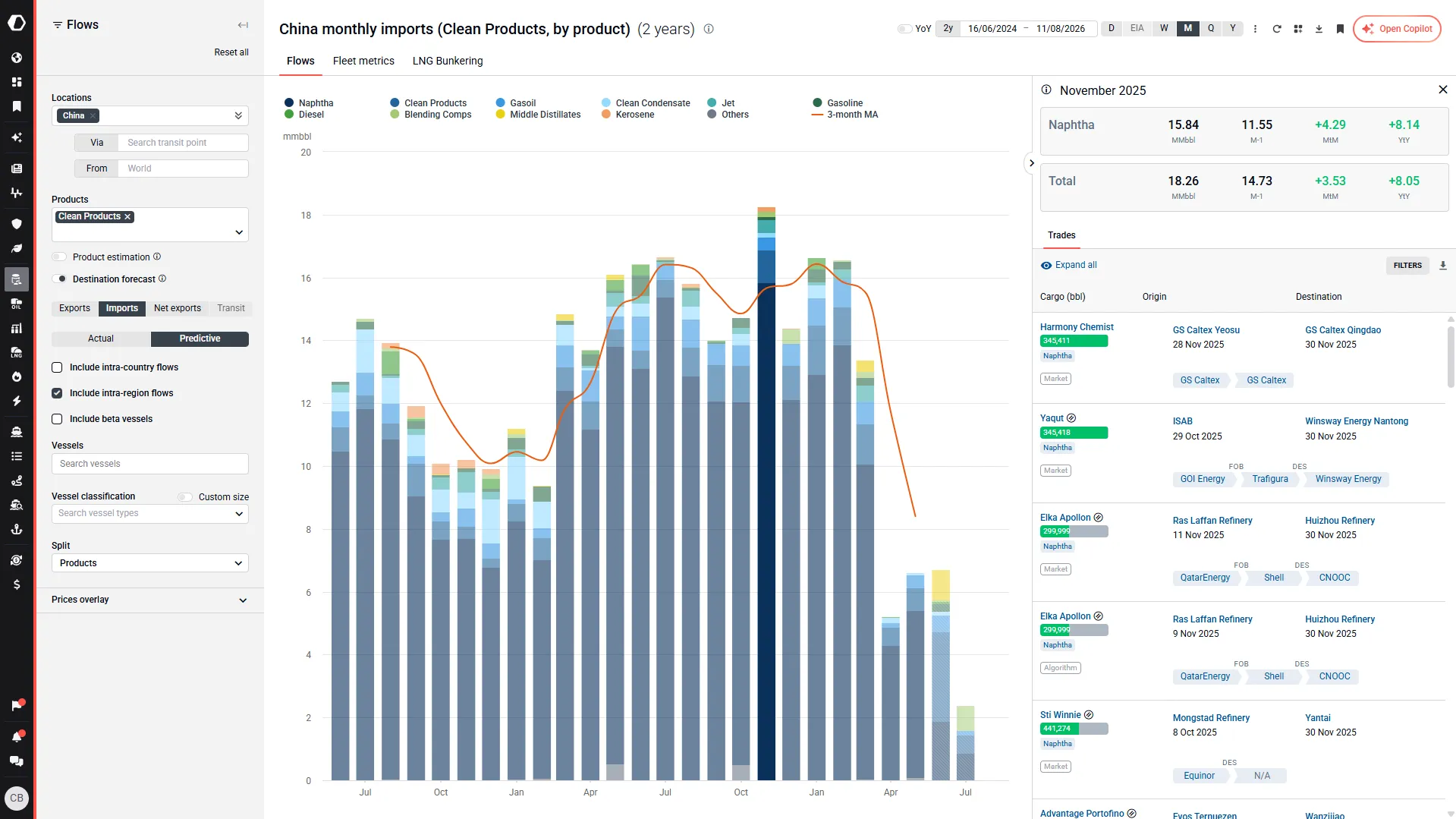
- Track global volumes of crude, refined products, and petrochemicals currently in transit by region and commodity
- Monitor floating storage to identify supply build-ups, delayed discharge activity, and emerging inventory trends
- Analyse how on-water volumes evolve over time to anticipate market tightness or oversupply

- Analyse flows across hundreds of crude grades, from major benchmarks to niche regional streams
- Easy API integration. Track quality characteristics to monitor sweet/sour and light/heavy trade dynamics
- Follow how specific grades move across trade routes and into import markets over time

- Run crude oil supply and demand analysis by region and grade, combining production, floating storage, and refinery intake data
- Monitor crude inventory data across onshore tanks and floating storage to catch builds and draws before they hit official reports
- Track global crude oil supply and demand shifts days or weeks ahead of monthly EIA, IEA, and OPEC reports, using real-time cargo tracking


“Kpler is one of the few truly objective research outfits. No agenda, just data-driven insights.”


.jpg)
FAQ
Crude oil supply and demand analysis compares how much crude is being produced, stored, and exported against how much is being consumed and refined, to identify whether a market is tightening or loosening - by region and by grade. It combines supply-side data (production, floating storage, export flows) with demand-side data (refinery intake, import flows, utilization rates) to build a real-time balance. Unlike monthly reports from bodies like the EIA or IEA, cargo and vessel-tracking data lets you see these shifts days or weeks before they appear in official statistics.
Crude inventory data tracks how much crude oil is held in storage - onshore tanks and floating storage on tankers - at a given point in time. Rising inventories typically signal oversupply, falling inventories signal tightening demand.
At a global level, supply and demand is tracked by aggregating production, floating storage, and refinery/import data across every major producing and consuming region, so a "balanced" global market can still be checked for regional imbalances - for example, a tight Atlantic Basin alongside an oversupplied Asia.
It's the process of monitoring and forecasting oil prices by combining real-time physical market data — trade flows, inventories, and production activity — with fundamentals analysis, rather than relying on delayed surveys or self-reported statistics.