
Iran appears to ready itself to test the blockade with small tankers, but no sign of a breakout yet
Rumours that Iran is preparing to restart crude exports started spreading on November 19th, but evidence is still absent. Several Iranian officials were quoted as saying that the country must break the US naval blockade. They warned that if the US strikes one of its tankers, Tehran will hit oil infrastructure across the region. The rumour also gained traction from the tripartite summit between Chairman Xi, President Trump, and President Putin in China the same day, with some market participants wondering whether the leaders may have agreed to let Iranian oil flow again.
Key takeaways
- No sign of a deal-driven return of Iranian crude. Kharg loadings are still at zero, inventories are flat, and the viral Samoa Prosperity claim doesn’t hold up against Kpler data. Price weakness built on hopes of a summit deal looks premature until vessel activity shows otherwise.
- Even a successful breakout would add only marginal volumes. The products and LPG precedent shows what small-tanker exports can do: a minimum of 106 kbd since August. A crude version using MRs carrying around 330 kb each would deliver similarly small volumes. That is far too little to restore Iran’s revenues or move the global balance, which remains in surplus.
- The bigger price risk is escalation, and that is the point for Tehran. Iran wants higher oil prices to raise the cost of the standoff for Washington. A US strike on a small STS receiver would give the IRGC a stated reason to hit regional energy infrastructure. That keeps an upside tail risk on Brent and Dubai, and on Mideast Gulf freight and war-risk premiums. The first move by the Hao Fan, the Edor or the Ark III will be the signal to watch.
What we know: STS activity is back, but loadings are not
A video circulating on social media added to the speculation. It shows a man on a small boat passing the tanker Samoa Prosperity, which he claims is laden with Iranian crude and heading out of the Persian Gulf. Our data shows that this is highly unlikely. The Samoa Prosperity is owned by Sinokor and discharged Saudi crude in India two weeks ago, and its recent trading history is predominantly related to Saudi crude oil shipments. Its AIS has not been updated for 11 days, but it is unlikely the vessel loaded Iranian oil since then without being detected.
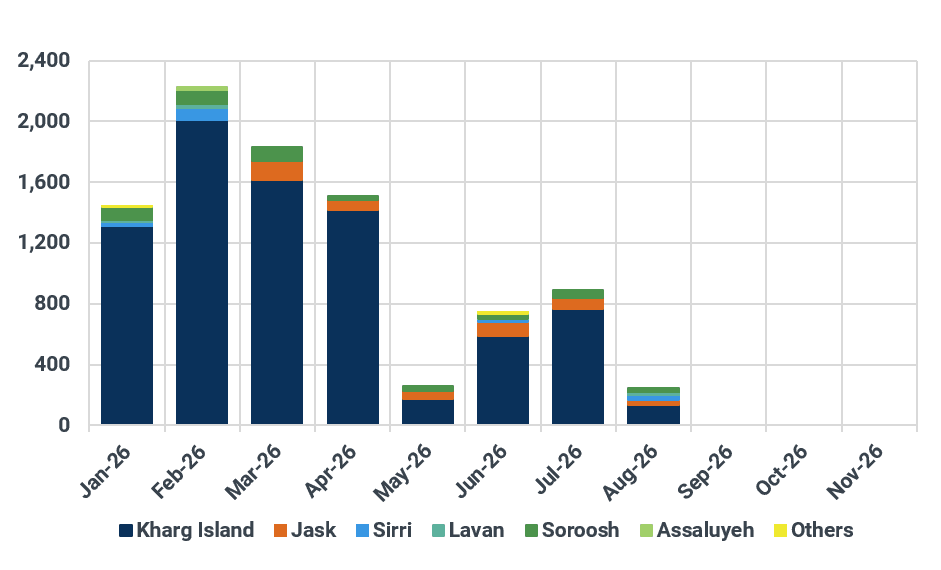
There is little sign of a wider loading restart either. Satellite imagery has not shown a tanker at Kharg’s crude jetties since early September, and the latest images from mid-November showed only tugs. Kharg inventories remain high and largely unchanged. Laden tankers are still at anchor around Kharg and off Qeshm and Larak, as they have been for weeks.
Iran crude and condensate loadings (kbd)
Source: Kpler
What has changed is a return of STS transfers involving Iranian crude and HSFO near Kharg Island and Qeshm. On November 17th, the Suezmax Olym, which loaded 1.1 mb of Iranian crude in August, transferred 327 kb to the Hao Fan, a much smaller tanker, south of Kharg. On November 18th, the Hasna transferred 700 kb of HSFO to the Ark III off Qeshm, and the Argo 1 transferred 480 kb of Iranian fuel oil to the Edor. The Hao Fan and the Edor both arrived empty from Sohar.
Iran’s strategy: test the route at minimum cost
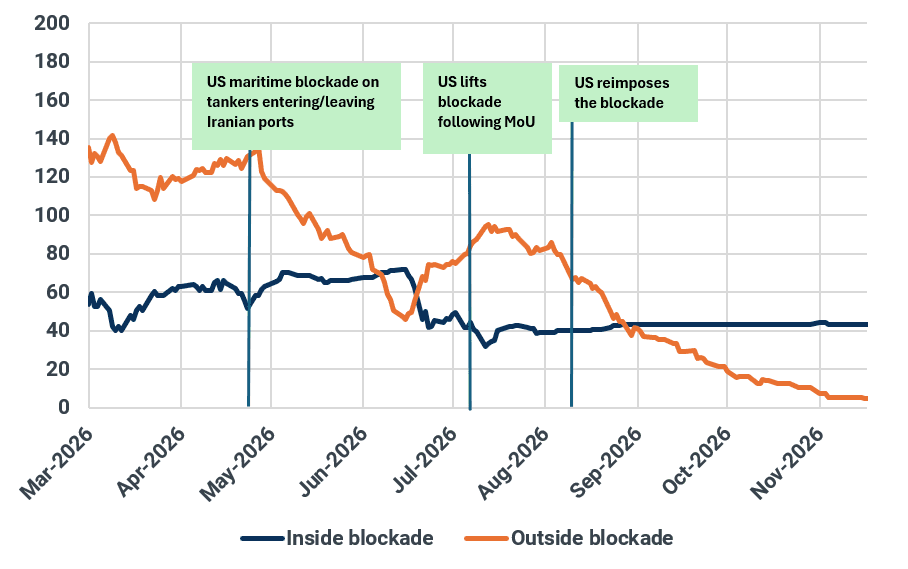
Iran’s push to move barrels reflects how much the blockade is hurting. After Kpler’s adjustment for discharges by “zombie” vessels, Iranian oil on water is now below 50 mb. Only 4.5 mb of that sits outside the blockade zone and is yet to be discharged. Consequently, Iran’s revenues from crude and condensate sales, its main source of income and of foreign exchange, could fall to zero as early as December, considering usual payment timelines for Chinese independent refiners.
Iranian oil on water by location (mb)
Source: Kpler
Interestingly, the Hao Fan fits the profile of a sacrificial tanker sent to test the blockade. It is a 23-year-old MR, it is not on the OFAC sanctions list, and it carries only around 330 kb. If it is stopped, Iran loses little. If it gets through, Tehran learns the route works. The Edor looks similar.
There is a precedent for this approach. Despite the blockade, Iran has managed to get smaller vessels carrying oil products and LPG through Hormuz, with a total of 13 mb of products and LPG already delivered into Asian markets since August, an average of 106 kbd (which is likely to increase as some vessels remain in transit and could already be out of the blockade zone). Tehran may be trying to repeat this strategy for crude, using smaller tankers that are less exposed and less costly to lose.
The strategy also fits the IRGC’s threat. A strike on one of these tankers would give Iran a stated reason to retaliate against regional energy infrastructure. That threat is credible: Kpler Risk & Compliance data records 45 attacks on ships since October 1st, including two VLCCs on November 10th and 11th. Even so, oil has continued to flow from the region despite these attacks. For Iran, a no-war, no-deal scenario is difficult to endure. Tehran is aiming to raise oil prices and the cost for the Trump administration, with the goal of such a strategy being to force the US to back down and accept some of Iran’s demands.
Crude oil flows exiting the Middle East by route, excluding Iranian oil (mbd)
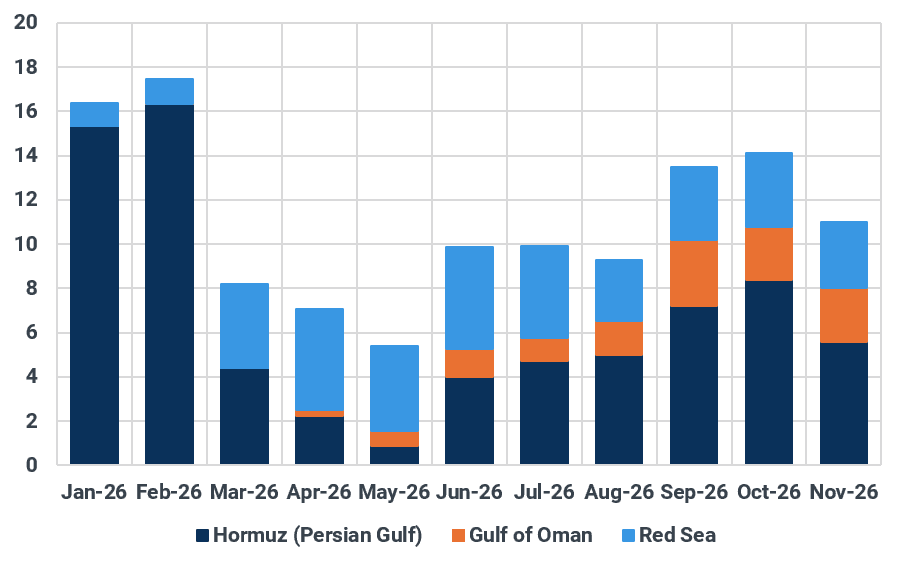
Source: Kpler. November 2026 is showing preliminary data. Our estimates are likely to be revised upwards as we receive more information in the coming days.
The US response and what to watch
The US appears to be fully aware of these attempts. A CENTCOM advisory issued on November 18th states that any ship receiving cargo by STS from a blockaded vessel carrying Iranian-loaded cargo may be treated as evading the blockade. Such ships may be boarded, diverted or seized, and force may be used if they do not comply.
Tracking any breakout attempt will be difficult. These ships keep their AIS signals parked outside Hormuz while operating inside; the Hao Fan still shows at Sohar. A run through the strait would be caught on satellite imagery rather than on AIS. The first of the receiving tankers to move will be the key signal of whether Tehran is ready to test the US response.

See why the most successful traders and shipping experts use Kpler