West African crude prices recover on Asian demand

Amid the ongoing restrictions in the Strait of Hormuz and continued supply threats in the Red Sea, some Asian refiners have turned to West African grades, driving up Nigerian and Angolan spot premiums. Moreover, support is coming from the Dangote refinery operating at close to 110% capacity.

Market & Trading calls

  • Slight upward revision to Nigerian crude and condensate supply for H2 2026, reflecting consistently higher exports over recent months.
  • Dangote refinery runs expected to rise to 700 kbd in August, maintaining these levels in September and causing crude imports to also remain elevated.
  • WAF spot premiums expected to hold steady into September, as disruptions in the Strait of Hormuz and Red Sea persist and push buyers toward alternative barrels.

Nigerian crude and condensate exports (including intra-country flows) have remained elevated in recent months, rising from a Q1 average of 1.63 Mbd to 1.8 Mbd in Q2, and staying above 1.8 Mbd through July and August so far. Part of this increase reflects the new Cawthorne grade, which has consistently added 30–35 kbd since April. Kpler's cargo-tracking data also shows Bonny Light loadings climbing sharply, from 290 kbd in Feb–Apr to 370 kbd in June–July. These higher export volumes point to rising Nigerian oil production, prompting us to nudge our supply estimates upward for the rest of the year. We now expect crude and condensate production of 1.75 Mbd in H2 2026 — 80 kbd above H1 — with similar levels likely sustained into 2027.

Nigeria crude and condensate supply outlook, kbd
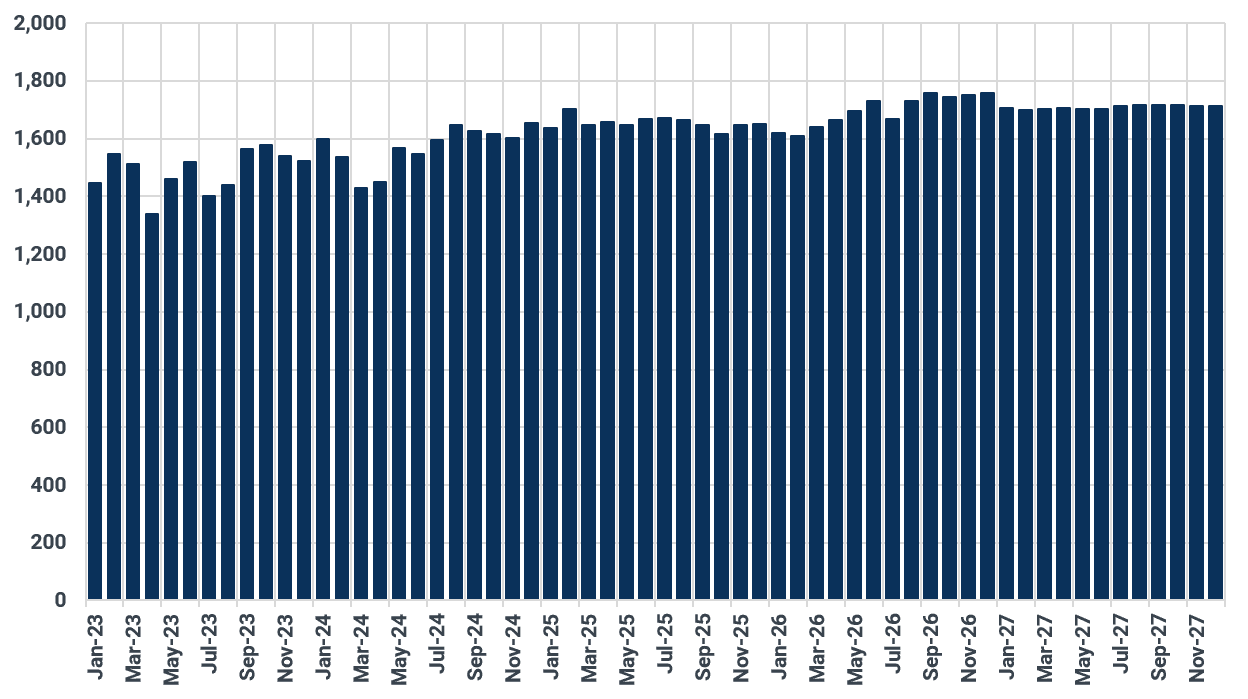
image.png

Source: Kpler

Moreover, Nigerian spot premiums jumped to seasonal highs this month, with Bonny Light, Qua Iboe, and Forcados each rising $3–4/bbl between late July and late August. Forcados is currently trading at $7/bbl vs. NSD, well above last year's level of $2/bbl (Argus Media). This strength has been driven by supply concerns linked to Houthi threats in the Red Sea and CPC loading disruptions, along with growing demand from Asian refiners for West African crude. In a tender that closed on 19 August, Indonesia's Pertamina bought Forcados and Qua Iboe for late-September/early-October delivery, while India's HPCL and MRPL were also evaluating WAF barrels for their October and November needs (Argus Media). Looking ahead, we expect WAF differentials to stay supported next month, which could lead NNPC to raise September OSPs slightly — a reversal from August, when OSPs saw sharp cuts of $3.5–4/bbl.

Selected West African crude differentials, $/bbl

image.png

Source: Argus Media

Domestic demand is providing further support for Nigerian prices, with a growing share of local crude now being absorbed by the Dangote refinery. We expect Dangote to run at close to 700 kbd in both August and September — a 220 kbd jump from July, when runs were constrained by maintenance. Crude imports at Dangote are currently running at a record 670 kbd in August, with domestic crude accounting for some 85–90% of the slate, as in previous months, alongside one Suezmax cargo arriving from Libya. Notably, no WTI crude has landed at Dangote in the past five months. This reflects the US-Iran war pushing more WTI toward Europe during April–June, followed by a significant rise in US domestic crude demand since June — together making WTI imports too expensive and uncompetitive relative to Nigerian and other West African grades.

Dangote refinery crude imports, kbd

image.png

Source: Kpler

Cargo ship docked at industrial port with red-covered containers and red ore piles, city skyline in the background.

See why the most successful traders and shipping experts use Kpler

Request a demo



