


A wheat supply crunch is a warning of things to come
Today's fertilizer and fuel shock, paired with a widening in conflict across the Black Sea is raising the prospects of a food price shock.
Summary
- A Food, Fuel, and Fertilizer Shock: The partial closure of Hormuz and broadening Russia-Ukraine fighting in the Black Sea are compounding into a multi-directional squeeze on the global food system. Collapsing grain exports, constrained fertilizer supply, tight refined-product markets, and rising war-risk insurance. Energy runs through every link of the chain, meaning each component reinforces the others, echoing the 2007 – 08 food-and-fuel crisis that created unrest across dozens of countries.
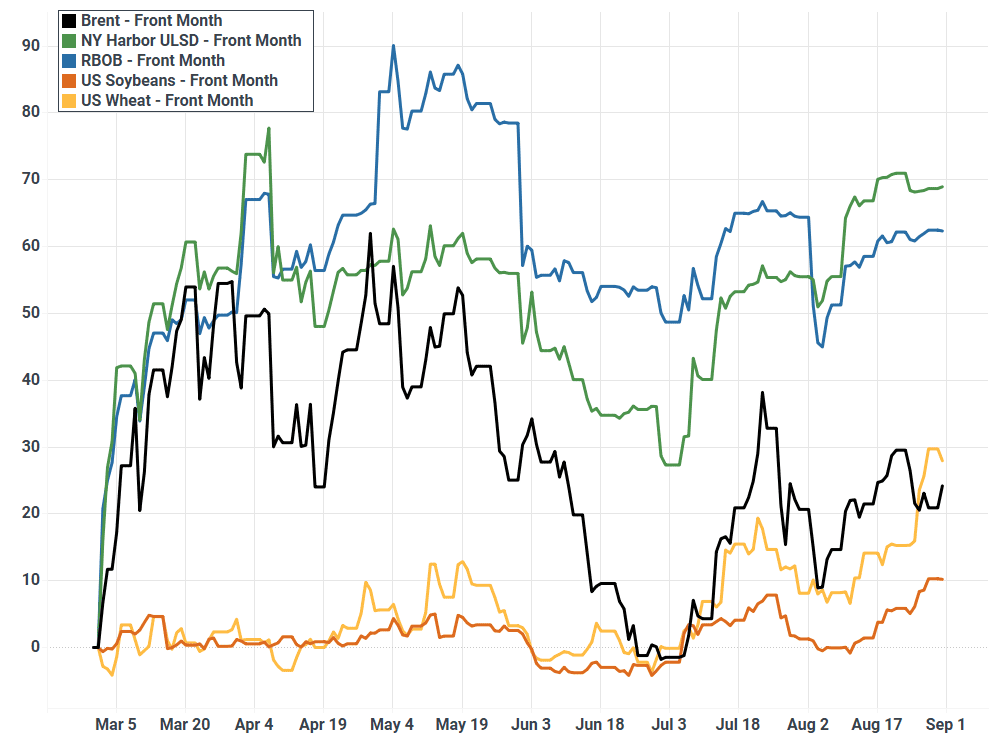
- The Lag is False Security: Strong 2025 harvests left unusually large inventories. Combined major-exporter ending stocks rose 38% to 90.2 Mt, cushioning the immediate price response, but fertilizer and diesel offer far less buffer and move through the system with a lag. As inventories erode toward a forecast 73.8 Mt in 2026/27, today’s input shock increasingly becomes tomorrow’s food-price shock, with CBOT wheat already up 30% since the Iran war began.
- Three Forces Squeezing Wheat: Production is falling as fertilizer and fuel costs push acreage toward competing crops – Australia output could drop as much as 35% y/y under a strong El Nino, US acreage sits at its lowest since 1960, and a weak India monsoon threatens the 2027 winter crop. Export losses compound the damage, with Ukrainian shipments entirely suspended and Russian Azov flows halted, while war-driven freight and insurance costs form the third channel.
- Import Dependency Maps the Vulnerability: FAO data shows the Middle East and North Africa are most exposed, with imports supply at more than 60% of domestic demand, while the Mideast Gulf states 30 Mt of annual seaborne grain imports now must flow through a conflict zone. The greatest risk sits where high import reliance intersects with limit fiscal capacity and thin FX reserves. North Africa, Central America, and parts of the Middle East are most exposed. North African wheat imports already look weak heading into peak export season for Russia/Ukraine.
The world faces up to a food crisis amid constrained fertilizer supply, and rising conflict in the Black Sea.
Over the past half-decade, open borders, and the free flow of goods have steadily been eroded by a pandemic, the Russia – Ukraine war, rising global trade barriers, and now, the Iran conflict. Such major events have injected a fresh sense of vulnerability into the global trading system, particularly for those countries that have long been reliant on imported commodities to feed domestic demand, including Europe, Africa, and East-Asia. As the crisis along the Strait of Hormuz has persisted, much of focus has centered on the availability of critical fossil fuels. However, the partial closure of Hormuz also creates questions over food availability amid restrictions in fertilizer exports out of the Middle East, alongside a broadening in Russia – Ukrainian kinetic engagement in ports along the Black Sea and in the Sea of Azov.
Daily Wheat, Brent, RBOB, and NY Harbor ULSD Price Differential Against February 28, 2026 (%)
Source: NYMEX, CBOT
The political risk building around the global food system is coming from several directions at once. Black Sea grain exports are collapsing, fertilizer supply is constrained, refined-product markets are exceptionally tight, and war is bidding up insurance premiums. Energy runs through nearly every part of this chain — powering farm machinery, providing feedstocks for fertilizer, and moving crops from field to port to consumer. What is developing is a food, fuel and fertilizer shock, with each component reinforcing the others.
For many import-dependent economies, the first impact will appear on the sovereign balance sheet. Subsidies for bread, fuel and agricultural inputs allow governments to temporarily absorb higher global prices and shield households from the full increase. But doing requires the transfer to be absorbed by government balance sheets. Central banks must also decide whether to drain forex reserves to stabilize the exchange rate, a measure that can temporarily stem the tide of damaging devaluation. Nonetheless, the longer food and energy costs remain elevated, the more expensive that protection becomes. Eventually, governments will be forced to choose between maintaining increasingly costly subsidies and allowing higher prices for essential goods to reach consumers.
History offers a warning about what can happen when food and energy pressures collide with limited fiscal capacity and existing political grievances. The 2007–08 crisis was a food and fuel crisis: oil, fertilizer, transportation and staple-food costs rose together, contributing to unrest across dozens of countries. Haiti's prime minister lost his government following food riots, while Egypt experienced major bread protests. Global food prices surged again ahead of the Arab Spring, adding economic pressure to populations already confronting unemployment, inequality, corruption and political repression.
The full impact of today's shock has yet to reach consumers. Strong 2025 harvests left unusually large grain inventories, cushioning the immediate loss of Black Sea supply and delaying the food-price response. There is considerably less cushion in fertilizer and refined products. Fertilizer costs influence what farmers plant and how much they apply; diesel affects the cost of planting, harvesting and transporting crops. Those pressures move through the food system with a lag. If high fertilizer and energy costs reduce acreage, application rates or yields while Black Sea exports remain impaired, today's input shock will increasingly become tomorrow's food-price shock. While the loss of crude and petroleum product supply has a relatively immediate impact on inflation and consumer balance sheets, the impact of a food or fertilizer crisis can persist for far longer.
That lag has created a degree of false security. Inventories and government subsidies have so far limited the transmission of higher input costs into consumer food prices, but neither buffer is unlimited. As inventories decline and the cost of subsidizing food, fuel and agricultural inputs rises, governments will face increasing pressure on budgets and foreign exchange reserves. The greatest vulnerability lies where high import dependence intersects with limited fiscal capacity to continue insulating consumers alongside a limited foreign exchange buffer.
The historical comparison naturally draws attention to North Africa and the Arab Spring. North African importers, including Egypt and Tunisia, remain particularly exposed, but pressure could extend into Gulf states such as Bahrain, Iraq, and Kuwait, and where the Iran conflict has disrupted export capacity and weakened an important source of government revenue. Import-dependent economies across Asia face their own combination of food, fertilizer and energy exposure, while vulnerable economies elsewhere may have even less capacity to absorb another inflationary shock. The political consequences will vary considerably by country; the underlying pressures are increasingly global.
The time available to prevent an agricultural supply shock from becoming a broader food crisis is narrowing. Today's grain inventories were built from yesterday's harvests; the next crops will reflect today's fertilizer costs, fuel prices, planting decisions, weather and disrupted trade flows. The longer these pressures persist, the more the shock moves from inventories and government balance sheets into future harvests and household prices. If political instability follows, it may bear little resemblance to the Arab Spring in either its geography or its timing.
Fundamental outlook – wheat supply under pressure from a loss of production, and exports, alongside higher freight costs.
Three distinct forces are squeezing supply and pushing prices higher, particularly for wheat, the grain we will focus on within the fundamental portion of this report. The three forces include a loss of production, a loss of exports, and higher freight costs.
Production Losses
Loss of production is the first of the three forces, and neither driver behind it is a one-off. High fertilizer prices are a cost pressure that will weigh on planting decisions and farm margins across both the 2026 and 2027 crop seasons. Weather disruption, particularly this year's El Niño, has already affected yields, but its fuller impact still lies ahead, in the second half of 2026 and into early 2027. For wheat specifically, the profitability hit from these cost pressures has pushed some plantings toward competing crops, costing wheat acreage, a dynamic that will persist for as long as fertilizer costs stay elevated. Fuel is also required for all farm operations everywhere, and higher fuel prices erode farmer margins broadly, a production-cost pressure distinct from the freight mechanism.
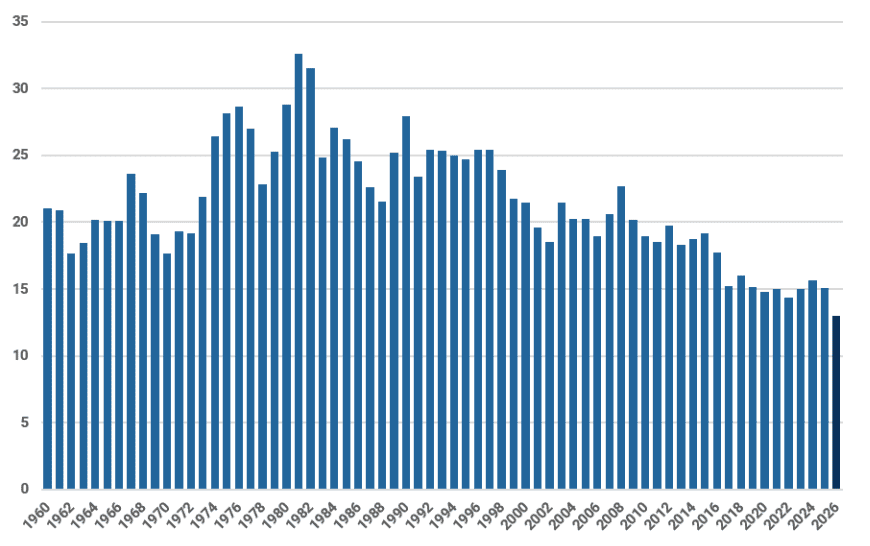
In Australia, a major wheat exporter, ABARES is forecasting wheat acreage down 12% y/y. An expected yield decline on top of that would cut the total wheat crop by 26% y/y. Kpler's own analysis suggests a strong El Niño could push that yield hit further as the season progresses, widening the shortfall to as much as 35% y/y. Canada is following a similar pattern, with wheat acreage losing ground to canola. In the United States, wheat acreage for 2026/27 is now at its lowest level in USDA PSD's historical record, dating back to 1960, and further cost pressure from fertilizer and fuel prices will not help wheat's case against competing crops for acreage.
Yearly US Wheat Acreage (Mha, top) and Y/Y Delta (Mha, bottom)
Source: USD
India illustrates a different, albeit equally important kind of wheat supply exposure. The country produces over 100 Mt of wheat a year, with nearly all of that output meeting domestic demand. Nonetheless, India panic-bought large quantities of urea at elevated prices at the peak of the Hormuz conflict, and while the government is likely to absorb most of that cost rather than pass it to farmers, this is not an indefinitely sustainable solution.
In addition, a strong El Niño could impact the Indian monsoon. This year's monsoon arrived late and is currently running 14% behind the long period average (LPA). A weak monsoon affects India's major crops differently depending on their growing season. Rice and India's main corn crop, the largest of three annual cycles, are both directly rain-fed by monsoon rainfall. Wheat, grown over winter, instead depends on reservoir levels built up by the monsoon rains between June and September, so any shortfall from this year's weak monsoon will not show up until the winter wheat crop is sown later in 2026 for harvest in early 2027.
India's aggressive urea imports crowded out other major producers in the urea market, such as Brazil, which needs urea ahead of its summer crop planting in October. Brazil was unable to buy as much as previous years, with urea imports since April down 40% y/y.
Europe, Ukraine, and Russia will also see production affected by the same fertilizer, fuel and weather induced cost increases, albeit to varying degrees. European production, in particular, has faced persistent weather vagaries in recent years. This year's summer crops have been badly affected by heat and dryness. For Russia and Ukraine specifically, however, the bigger problem is not production but getting grain to market at all.
Export Losses
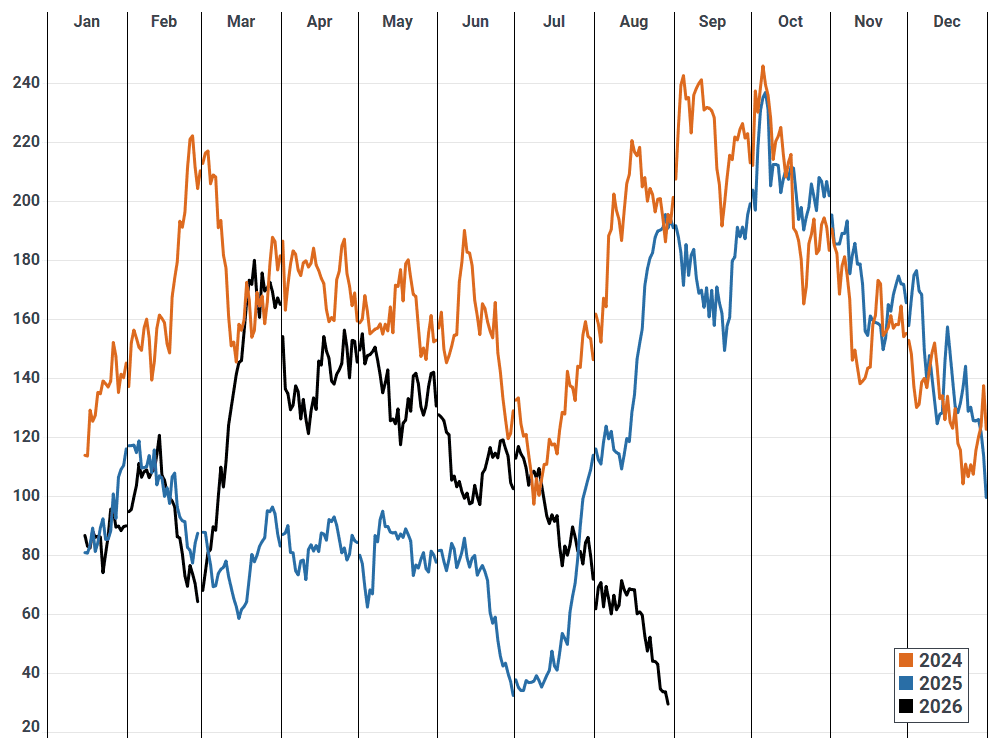
Export losses are the second of the three forces squeezing supply and raising prices. Ukraine's own export capacity was already severely hampered by the war, and its exports are now entirely suspended, removing the 1.5–2 Mt a month it had still been managing to move during the current peak export period.
The scale of the Russian side of this disruption is best understood through the export prices via the Sea of Azov. Small vessels, each carrying 3–5 kt of wheat, load at various ports around the Sea of Azov and either sail directly to their final destination, accounting for roughly half of this flow, or first call at Kavkaz, where cargo is transshipped into larger vessels for longer-haul destinations, accounting for the other half. Escalation of the Russia-Ukraine war suspended all Russian exports from Azov ports entirely by the end of July. This flow can account for up to 35% of Russian exports, equivalent to around 1.5 Mt a month, and its loss lands at the worst possible time, just as wheat exports should be hitting their seasonal peak. Further escalation in August has struck terminals in Russia’s Black Sea ports, severely constraining export volumes not only due to damage but also risk of further attacks. Volumes are down to a trickle: Russia exported just 380 kt of wheat in the last two weeks, down 80% y/y from 1.8 Mt over the same two weeks last year.
Daily Russian + Ukrainian Seaborne Wheat Exports (kt, 15-day ma)
Source: Kpler
There is also no simple substitute for this scale of long-established bulk grain shipping more broadly. Millions of tonnes of Black Sea grain exports cannot be trucked or railed into Europe or China. The volumes involved are far too large for overland logistics to absorb. Using European Black Sea ports to export Ukrainian wheat instead is not an option either, since their combined capacity is a fraction of Ukraine's own and they are already busy exporting their own produce.
Rising Freight Costs
Freight is the third channel working to squeeze supply and lift prices, and yet, is distinct from the production and export losses above. Higher energy costs raise oil prices, which lifts bunker fuel costs and therefore freight rates directly. Rerouting around chokepoints, conflict-avoidance routing, and higher war-risk insurance premiums add further cost on top. All of this traces back to the multiple conflicts currently underway around the world.
Mitigating Factors
Given the mix of bullish pressures on the wheat market, prices have rapidly accelerated. As of the beginning of September, CBOT spot wheat prices were trading at $7.85/bushel, up more than 50% from year earlier levels. However, the situation could have been much worse if not for a strong supply backdrop coming into the current crisis. During the 2022 Black Sea conflict, wheat prices went as high as $9.30/bushel. In 2022, seaborne exports from Ukraine went sharply lower, but Russian exports had continued almost unabated. Recent volumes out of the Black Sea makes the current crisis much worse, as both Ukraine and Russia are struggling to export.
In 2025, not a single major wheat producer suffered a weather-driven production upset, something that had not happened in at least 15 years. Combined ending stocks across the seven major exporters rose from 65.4 Mt in 2024/25 to 86.7 Mt in 2025/26, an increase of roughly 32%. Currently stocks are expected to ease back toward 73.1Mt in the 2026/27 forecast on the production losses described above, but the wheat market is enjoying a healthy supply buffer for now.
Assessing grain import dependency
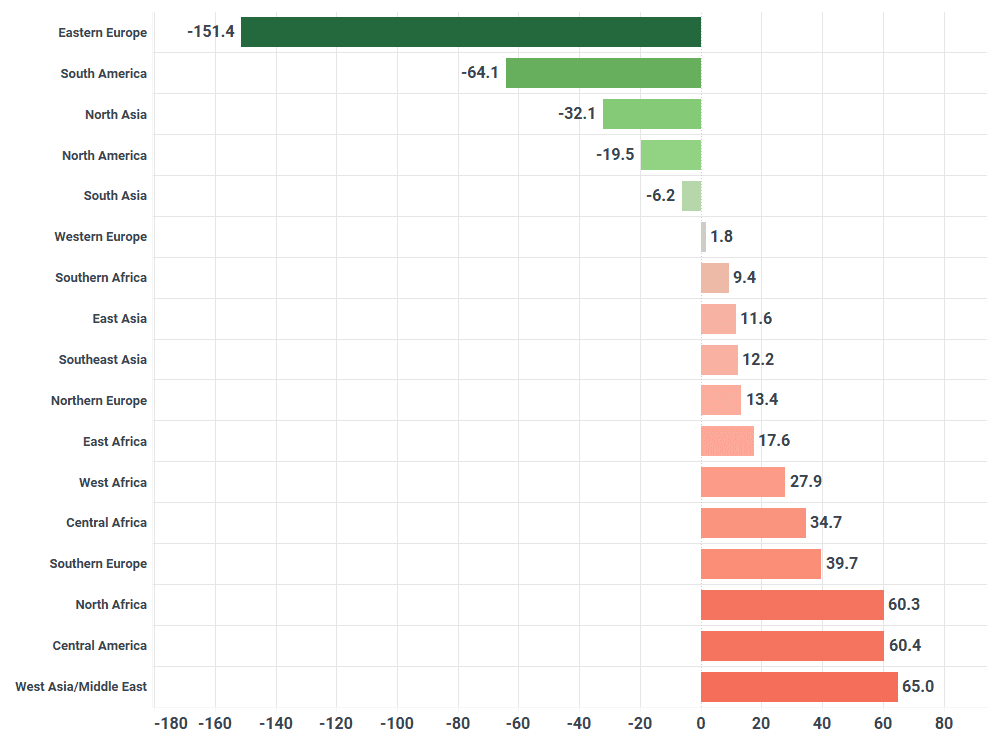
The Food and Agriculture Organization of the United Nations (FAO) publishes a yearly report highlighting the extent to which countries are dependent on imported grain relative to domestic demand. Import dependency, calculated by taking net imports as a share of total demand, can provide insights into which countries are most exposed to an external grain supply shock. FAO data is published on a 3-year moving average basis to smooth yearly differences and is typically lagged by two years (the latest report has figures for 2023). A country with a positive IDR implies that some percentage of domestic demand is met by imports whereas a country with a negative IDR implies domestic production exceeds domestic demand.
Regional Import Dependency Ratio by Subcontinent (%)
Source: FAO; negative figures imply a region produces more than it needs domestically and vice versa with positive values
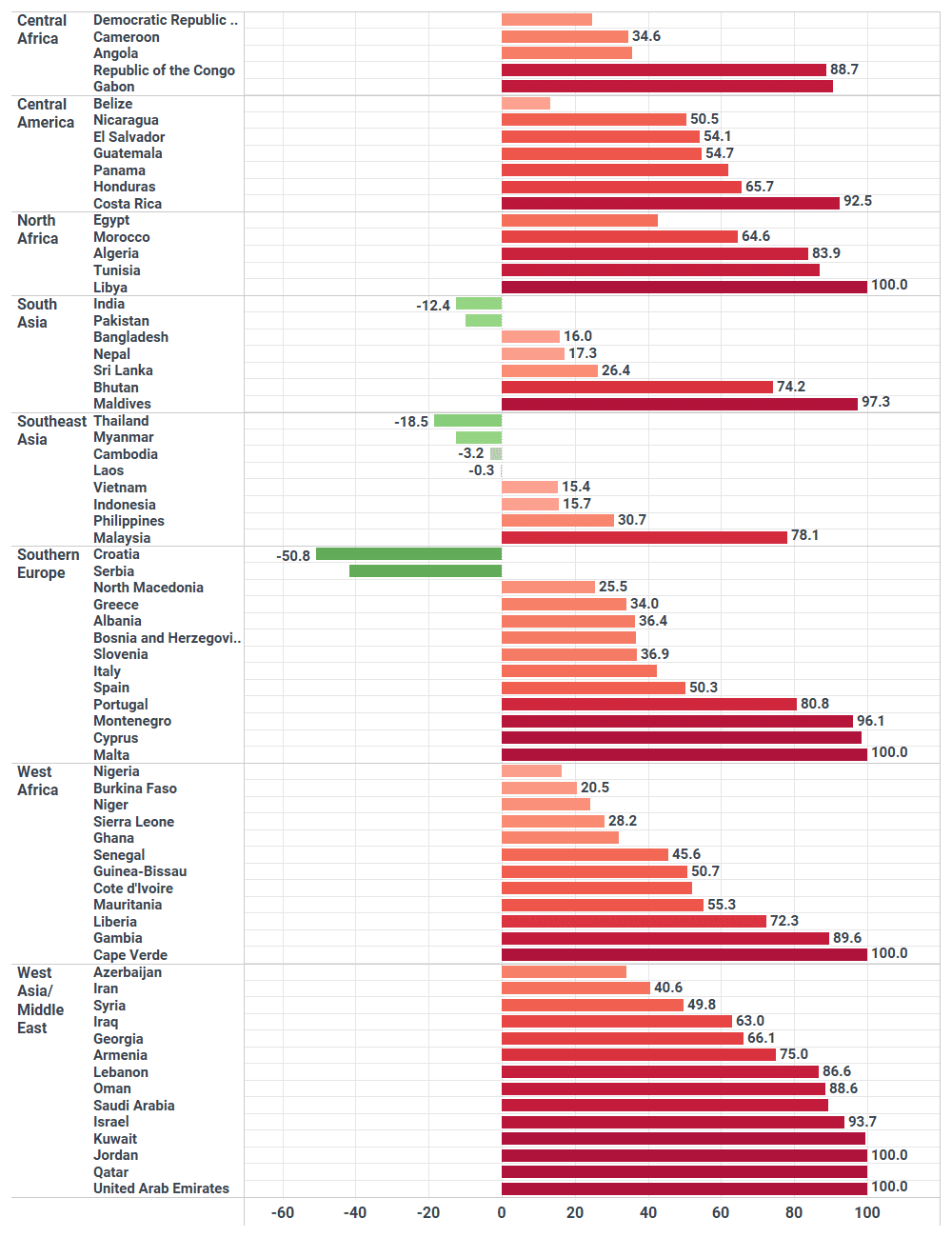
Taking 2023 as our latest IDR benchmark reported by the FAO, cereal dependency is especially elevated across four key subcontinents. The first is West Asia/Middle East, which holds an IDR of +65%. Most countries across the Middle East, in particular, including the UAE, Qatar, Kuwait, Jordan, Oman, Israel, Lebanon, and Saudi Arabia are virtually completely reliant on imported grains to fulfill domestic demand. Iraq (+63%), Armenia (+75%), Georgia (+66%), Syria (+50%), and Iran (+41%), are also quite exposed.
Import Dependency Ratio by Selected Subcontinents (%)
Source: FAO
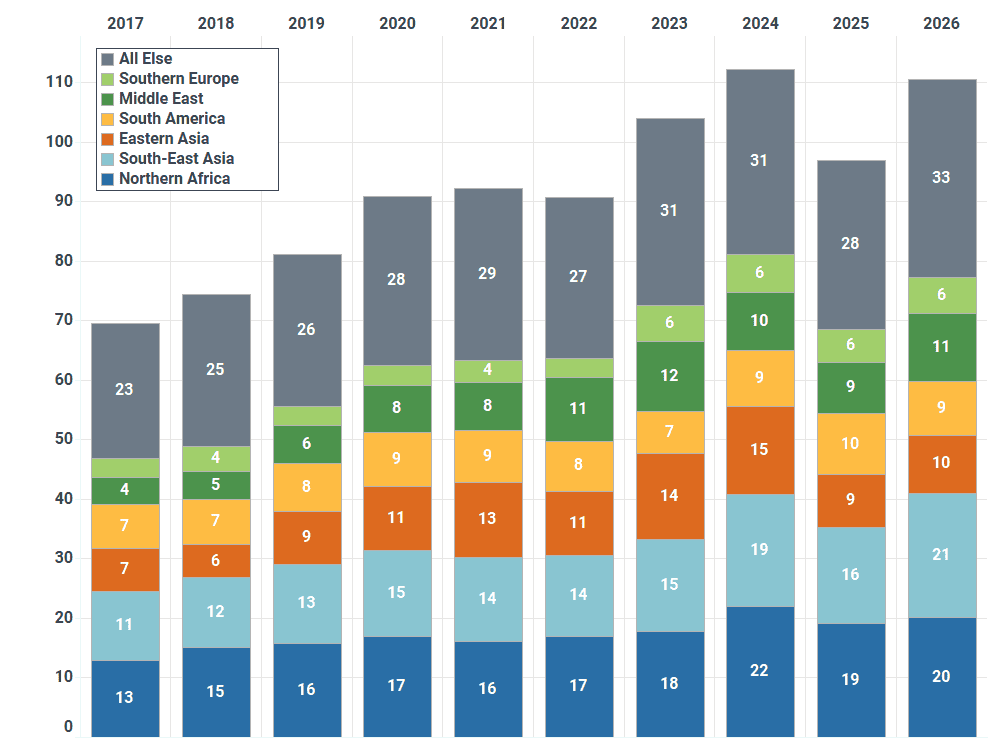
While much of the concern around the Iran conflict has understandably centered around the ability of Middle East energy producers to get crude, petroleum products, and LNG to market amid the closure of the Strait of Hormuz, a key secondary impact has included the flow of grains into the Mideast Gulf. In 2025, combined seaborne grain shipments into states bordering the Mideast Gulf finished at 30 Mt, or roughly 9% of the global seaborne total. Saudi Arabia alone imported nearly 13 Mt in 2025, followed by that of Iran (10.4 Mt), the UAE (3.3 Mt) and Iraq (2 Mt), among others.
A second region with critical import dependency exposure is that of North Africa, where roughly +60% of domestic demand is met through imports. Algeria, Tunisia, and Libyan IDRs all sit above +80%. Morocco (+65%), and Egypt (+43%) are also highly exposed.
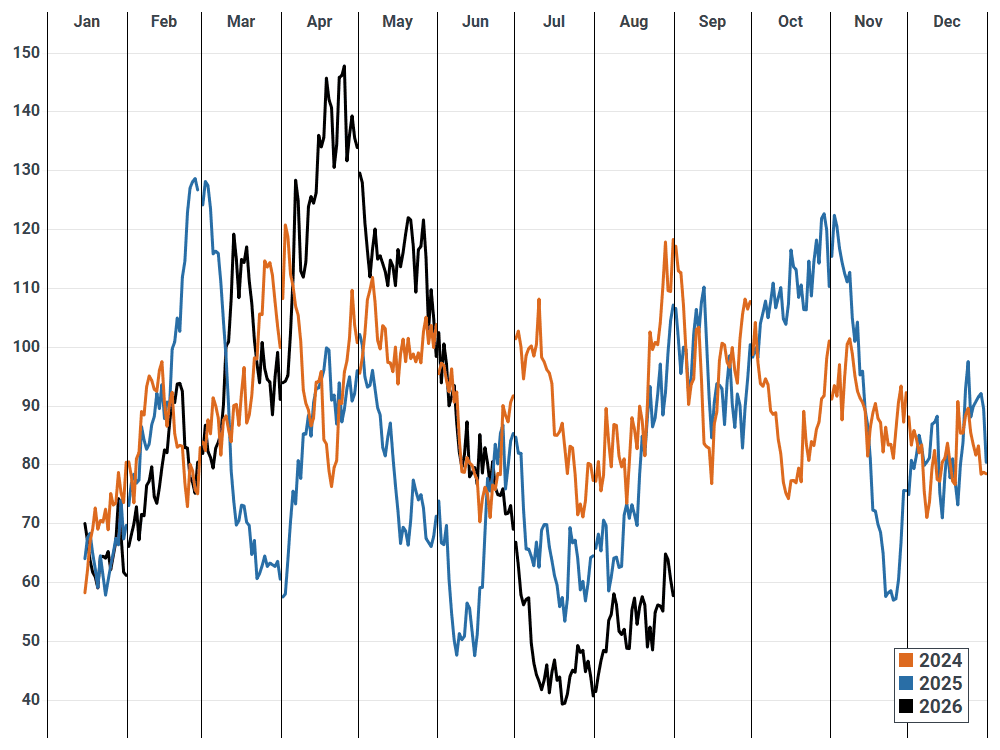
North Africa is no stranger to grain supply shocks, particularly since the Russia/Ukraine war. In the early phases of the war, Russia, under pressure from Egypt and Turkey, allowed a “safe corridor” in which Ukraine was able to export grain from Odessa. The safe corridor was a short-lived, and volatile arrangement that did not work all that well. In 2023, North African grain imports fell to 40 Mt, down 7% y/y with arrivals into Egypt falling nearly 20% y/y, particularly due to a drop in tonnage from Ukraine. Seaborne arrivals into North Africa managed a recovery, finishing 2025 at 53 Mt, accounting for 15% of the global seaborne total. Imports from Ukraine also recovered, finishing 2025 at 8.5 Mt, up from 3.2 Mt in 2023. However, with the lack of exports through peak harvest season, North Africa is set to face issues sourcing supply again in 2026.
Egypt's decision to fast-track its direct-debit subsidy system is a step towards reducing the cost of bread subsidies to the exchequer. The move from directly subsidizing bread prices to offering direct cash subsidies for a range of products is expected to reduce the demand for bread, and subsequently the import burden.
Yearly Jan - Aug Seaborne Grain Imports by Destination (Mt)
Source: Kpler; data for 2026 through August 24
A third region with high import dependency is southern Europe, which holds an IDR of +40%. Unsurprisingly, the small island nations (Malta, Cyprus) are fully dependent on grain import to meet domestic demand. But, even larger mainland states, including Portugal (+81%), Spain (+50%), Italy (+43%), and Greece (+34%), all rely on a rather high level of grain imports.
Southern Europe, unlike Northern Africa, had no issues finding alternatives to lost Ukrainian grain supply in the aftermath of the Ukraine war. Richer, developed economies, such as those in Europe, are better placed to deal with grain supply shocks given wider fiscal and monetary buffers. In 2025, seaborne grain imports into Southern Europe finished at 22.2 Mt, accounting for 6.5% of the global seaborne total.
Two additional regions with high import dependency includes portions of South/Southeast Asia and Central America. Malaysia (+78%), the Philippines (+31%), and Bhutan (+74%) all hold high IDRs. Vietnam, which holds a rather limited +15% IDR, has still seen a significant flip from just ten years ago, when the country was nearly self-sufficient. All the Central American states hold an IDR above +50%, excluding Belize. In 2025, combined imports into South/Southeast Asia finished at 54 Mt (16% of global total) while Central American offtakes managed 9.4 Mt (3% of global total).
Daily North African Seaborne Grain Imports (kt, 15-day ma)
Source: Kpler

See why the most successful traders and shipping experts use Kpler






