Dry bulk markets confront renewed Hormuz risks and escalating Black Sea disruption
Dry bulk commodity markets remain heavily influenced by geopolitical risks and diverging fundamentals. Iron ore rebounded above $100/t as renewed Hormuz tensions lifted freight costs, although soft Chinese demand, high inventories and slowing steel production continue to cap prices. Coal markets benefited from stronger gas prices and tighter Indonesian supply, while India and Japan faced rising summer power demand. Agricultural markets were dominated by escalating Black Sea disruptions, tighter US grain balances and policy-driven South American biofuel demand. Aluminium eased on macro headwind, while alumina remained weak amid persistent oversupply. Freight markets were mixed, with Black Sea disruption supporting regional rates, while Atlantic and Pacific earnings softened.
Dry Bulk Webinar
- Register and join Kpler’s Monthly Grains Outlook Webinar on 21 July 2026 at 14:00 UTC. We’ll assess how heightened conflict between Russia and Ukraine could impact Black Sea exports during its seasonal peak. Also, following renewed conflict between the US and Iran, we’ll review how trade via the Strait of Hormuz has reacted. With US corn remaining competitive on the global market, we’ll discuss how this shapes the current and upcoming export campaign.
Iron Ore & Steel: Prices reclaim $100/t on Hormuz escalation, but fundamentals signal downside
- Freight rates had just begun to reverse and ease pressure on iron ore prices, when renewed tensions in the US-Iran war pushed iron ore back to $100/t. The most traded iron ore contract, DCE September 2026, rose 2% w/w to close at 759.5 yuan/t on 16 July, while the SGX IODEX 61% Fe August contract was trading up 1.5% w/w at $100.15/t at the time of writing.
- With the Strait of Hormuz under pressure, volatility in freight will continue to feed through into iron ore, even as weak demand and CMRG negotiations point towards a weakening ore price. For context, freight peaked at 18-19% of the delivered price of 62% Fe iron ore in China in May, slipping to just under 17% in June, the highest freight component in the price since late 2021. Any escalation or de-escalation could quickly swing the delivered iron ore price.
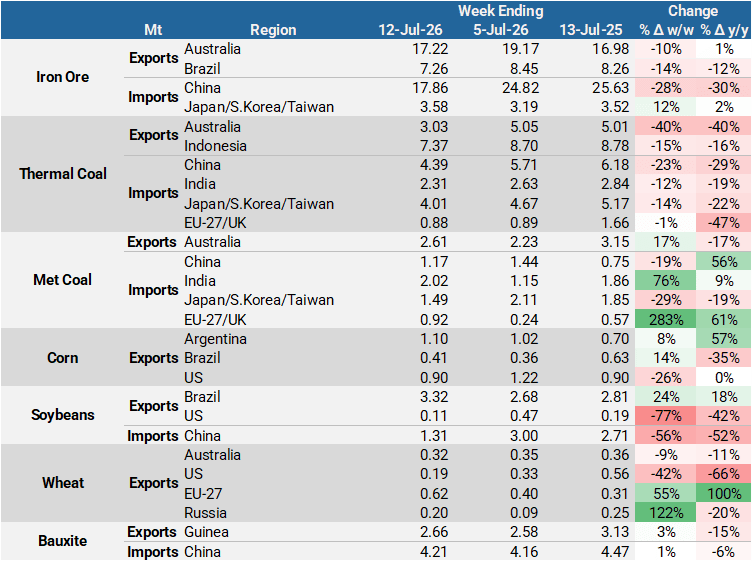
- Despite this price bounce, it is evident that market fundamentals are softening. Chinese seaborne iron ore imports fell sharply to 18.01Mt in the week ending 12 July, down 28% w/w and 30% y/y. Shipments from BHP, Vale and FMG fell, while Rio Tinto and Hancock volumes fared slightly better. Heavy rains and extreme heat have slowed construction activity in China. Mounting losses at Chinese steel mills are likely to further keep spot trading subdued. Crude steel production by CISA member mills averaged 2.02Mt in the ten days between 1 and 10 July, down 4% y/y and 3% m/m.
- Iron ore stockpiles reflect the same softening. While port inventory levels remain much higher than last year’s levels, we are now seeing cautious procurement amid squeezed steel mill margins. Price gains remain capped by mounting losses at Chinese steel mills, which are fuelling expectations of further production cuts and weaker near-term demand.
- Global seaborne iron ore exports fell 10% w/w to 31.73Mt in the week ending 12 July, mirroring the pullback in Chinese arrivals. Volumes were down 1% y/y but remained above the five-year average of 30.38Mt. Australian shipments stood at 17.21Mt, down 10% w/w, while Brazil saw its iron ore shipments drop 11% w/w to 7.26Mt. From a supply perspective, several smaller stories are playing out. The workers' strike at BHP's Port Hedland, CMRG's restriction on certain FMG products, and subsequent negotiations with top miners remain key monitorables. On the other hand, weekly cargoes to the Middle East remain subdued under 0.5Mt on Hormuz constraints.
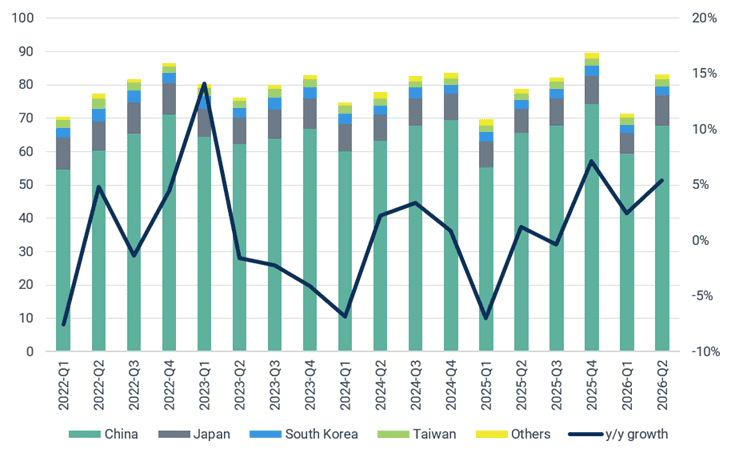
- Against this backdrop, Rio Tinto reported a 7% y/y rise in Q2 Pilbara iron ore sales to 85.3Mt, right at our estimate of 85Mt in the Iron ore miners tracking report, published 1 July. Average pricing at its Pilbara operations improved to $85/t FOB from $83.2/t a year earlier. Construction of Simandou (SimFer) mine and port infrastructure is now over 75% complete. Kpler Insight forecasts for Q2 BHP volumes also tracked closely, with a forecasted 74Mt versus 74.8Mt of actual WAIO production (100% basis).
Rio Tinto’s Pilbara shipments recover in Q2 (Mt)
Source: Kpler
Coal: Coal price outlook improves with gas market strength
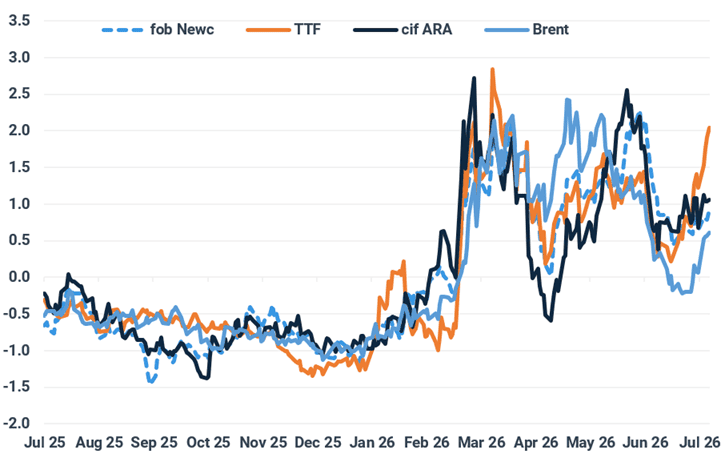
- A renewed escalation of the conflict between the US and Iran, including strikes and the reinstatement of a US blockade and transit fees in the Strait of Hormuz, spiked natural gas prices. This energy supply uncertainty lifted thermal coal prices. European utilities are actively buying forward positions for the fourth quarter, driven by optimism over highly positive generation margins for winter coal burn compared with gas fired generation. Coal inventories in the Amsterdam Rotterdam Antwerp (ARA) hub remain high, but water levels at the Kaub measuring point on the Rhine plummeted to a four year low of 45cm, severely restricting barge deliveries of thermal coal to downstream utilities in Germany. This will limit the upside for coal demand for the short term given high trucking costs into inland Europe compared with barging over the Rhine.
Month-ahead energy commodity contracts (Standardised values)
Source: Enverus, Kpler Insight
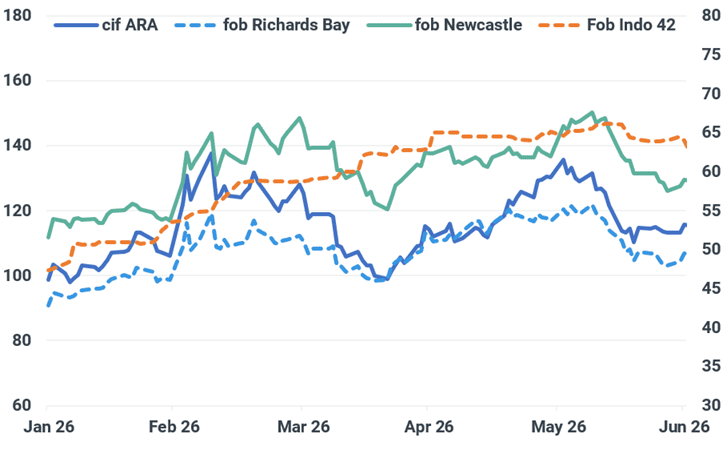
- The Indonesian government raised its domestic coal allocation for state utility PLN to 212Mt, well above the projected requirement of 154Mt, to address recent power blackouts across Java. This prioritisation tightened supply of mid CV coal for the export market, although the impact on the pricing side remains limited given China’s coal burn potential has not materialised for the summer period yet.
Month-ahead coal contracts, fob Indo right-axis ($/t)
Source: Enverus, Kpler Insight
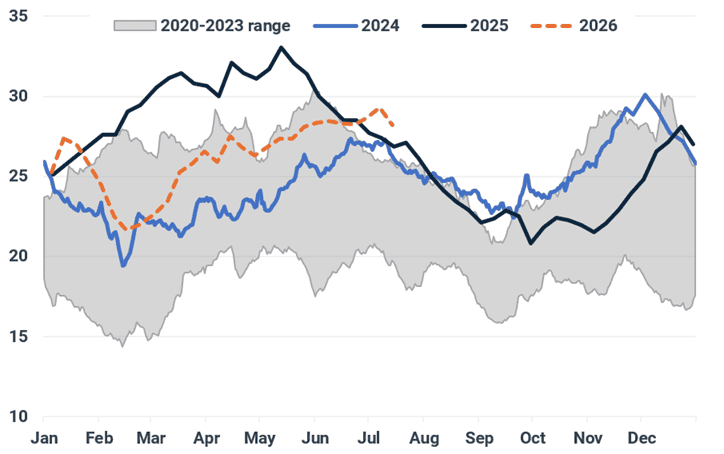
- China’s National Meteorological Center has issued yellow alerts for heavy rain and high temperatures. On 16 July, high temperatures above 40°C were recorded in some areas in eastern Sichuan, western Chongqing and across the Sichuan Basin, Henan, Anhui, Jiangsu, Shanghai, Zhejiang, Jiangxi, Hubei, Hunan, Xinjiang, and Inner Mongolia, though the affected area in southern China will begin to shrink later in the week. As a result of the increased power demand, coal inventories started to shrink in northern China’s Bohai Rim, but still remain elevated compared with 2025 levels. The cooling impact of heavy rains are still offsetting peak power demand to some extent. Coal burn will increase more steeply once dry conditions emerge in China later in the month.
China Bohai Rim coal inventories (Mt)
Source: Sxcoal
- After an exceptionally mild start to the summer season, Japan faces intense heat this week. A heatwave alert has been issued covering 25 prefectures this week. Tokyo faces its first day above 35°C this year, and the latest forecasts suggest the heat will persist through the summer. This surge in cooling demand will lift thermal coal burn at Japanese utilities as air conditioning load pushes power demand higher.
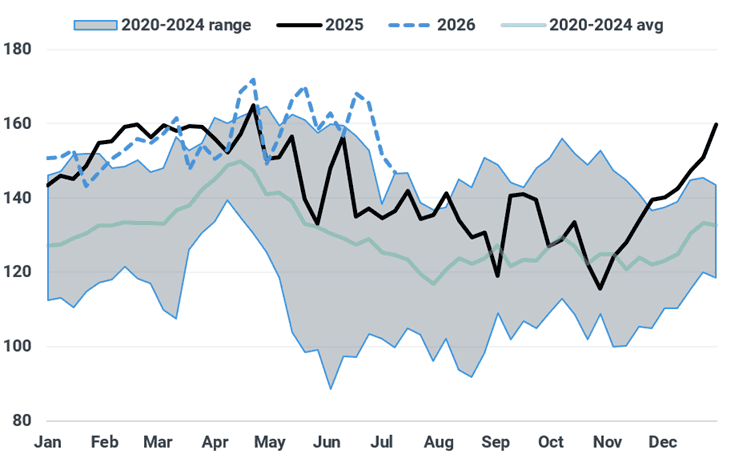
- India's domestic coal stocks fell below 40Mt for the first time since Q2 2025, as record coal burn driven by heatwaves outpaced domestic supply. Utilities have so far offset the drop in stocks with higher domestic production, limiting the need for seaborne cargoes. If stocks drop by another 10Mt, India could need to blend imported material into domestic plants.
India coal-fired generation (GW)
Source: NPP
Grains & Oilseeds: Escalating Russia-Ukraine conflict limits Black Sea wheat exports
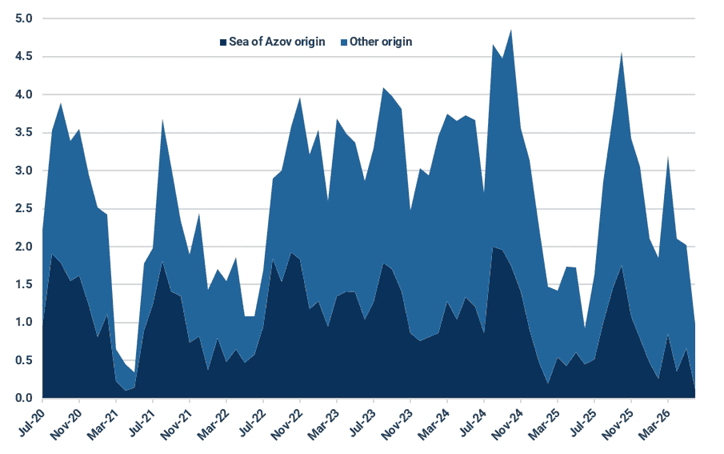
- Since 6 July, Ukraine began a campaign which focused drone strikes on vessels involved in Russian activity, such as trade, within the Sea of Azov and the Black Sea. By 13 July, Ukraine had targeted over 100 vessels and caused Russian authorities to suspend shipping through the Sea of Azov and the Kerch Strait on Friday. Commercial vessels which are situated within the Sea of Azov are reportedly able to move but are bottled. All Russian grain trade originating from the Sea of Azov would transit through the Kerch Strait. Given the shallow water ports, the purpose of these vessels is mostly for transhipment, which typically occurs on the Black Sea side of the Kerch Strait at Taman or the Kavkaz anchorage. Despite the relatively smaller cargoes, the volume of shipments that originate from the Sea of Azov accounts for approximately one-third of seaborne Russian wheat exports.
Seaborne Russian wheat exports by origin (Mt)
Source: Kpler
- The retaliatory strikes on Ukraine have caused several trading houses to halt further grain purchases due to safety concerns. Ukrainian export pace had already been under significant constraint, with ports seemingly prioritising corn over wheat. As a result, Ukrainian wheat stocks for June are the highest since 2023. Moreover, the reestablishment of EU TRQs acts as a de facto ban on Ukrainian wheat after 1.3 Mt. So, with Ukraine no longer able to export as much wheat to the EU, further attacks on seaborne export infrastructure would significantly constrain export capacity.
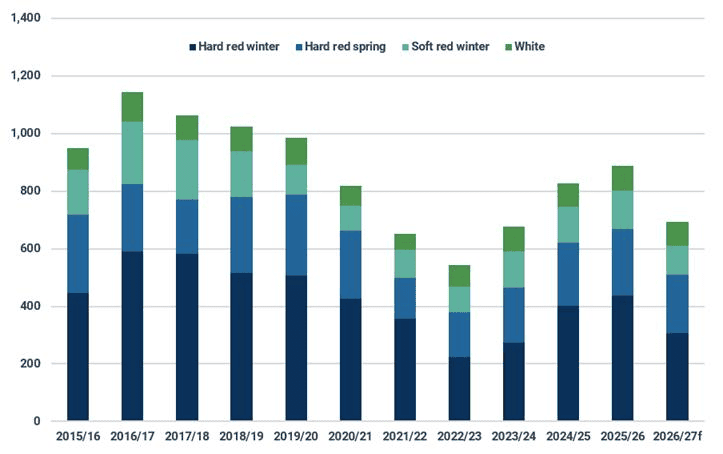
- Following lower-than-expected US corn stocks, the USDA revised feed and residual consumption higher by 150 mbu for its latest 2025/26 US corn balance sheet. Despite a modest decrease in corn ethanol demand, the balance sheet was tightened by 125 mbu to 2,020 mbu. In consideration of a smaller crop forecast, the USDA increased EU corn imports for 2026/27 from 19.5 Mt to 22.5 Mt, close to Kpler’s 22.6 Mt. The first outlook for 2026/27 non-durum wheat ending stocks was 3 mbu from Kpler’s estimate at 692 mbu, the tightest balance sheet since 2023/24. The 2025/26 US soybean balance sheet saw a 10 mbu increase to exports and a net zero change to the 2026/27 balance sheet.
US wheat ending stocks by grade (mbu)
Source: USDA
- US spring crop conditions continue to fare relatively well, with 68% of the corn crop rated in good or excellent condition and 65% for the soybean crop by 12 July, both slightly above the historical average. The ongoing heatwave across the Midwest is adding some caution to the yield outlook given the lighter rain for the coming week. However, heavier and more widespread rains expected for the following week are helping to temper concerns. Both crops have begun initial pollination stages, so current weather conditions play a greater role in shaping the yield outlook.
- Brazil's National Energy Policy Council has raised the mandatory ethanol blend in gasoline by two percentage points to 32% for the next six months. Though announced as temporary, the policy could be subject to extension. The decision comes as Brazil attempts to shield itself from recent oil market volatility, as this will temper gasoline import demand. The two-percentage point hike could increase domestic ethanol demand by around 1 bn gal, which the industry is well positioned to supply. Such policy only further encourages the expansion of corn ethanol production, which continues at record pace and softens Brazil’s corn export competitiveness.
- Following the renewed conflict between the US and Iran, the volume of grain and oilseed trade via the Strait of Hormuz has returned to lower levels. Over the past week, only three vessels carrying such products crossed the strait, destined to either Iraq or Iran. Imports at ports of GCC countries outside of the Middle East Gulf will likely remain elevated, such as Yanbu Commercial and Fujairah.
Minor Bulks: EGA resumes alumina output, but escalating US–Iran tensions cloud recovery
- Aluminium prices have edged lower over the past week as renewed US–Iran tensions fuelled concerns over persistent inflation and weaker-than-expected Chinese economic data further weighed on sentiment. As a result, the three-month LME aluminium contract fell 0.83% w/w to $3,174/t at the time of writing on 16 July. The US Midwest P1020 premium also eased by around 1% w/w, while the duty-paid Rotterdam P1020 premium remained broadly stable.
- In Southeast Asia, Vietnam commissioned its first primary aluminium smelter, located in Dak Nong, in early July. Phase One has a capacity of 0.15Mtpa, with a further 0.30Mtpa expansion planned over the next one to two years. The project is expected to reduce Vietnam's dependence on imported primary aluminium while adding value to its growing domestic bauxite and alumina industries. Vietnam exported 1.36Mt of alumina in 2025, which makes up nearly the entire country's alumina production.
- Alumina prices have continued to soften as the risk premium associated with potential Guinean bauxite export restrictions faded and the market remained fundamentally oversupplied. The most traded alumina contract on SHFE, September 2026, dropped 1.14% w/w to 2,689 yuan/t on 16 July.
- In the Gulf, Emirates Global Aluminium (EGA) announced the restart of alumina production at Al Taweelah alumina refinery on 10 July, expecting the refinery to reach 50% of capacity within days. Before its shutdown following Iranian attacks in late March, the refinery produced 2.40Mt of alumina in 2025, supplying around 46% of EGA's alumina requirements. However, the deteriorating US–Iran tensions in recent days have renewed uncertainty over the recovery of shipping through the Strait of Hormuz, potentially slowing the refinery's ramp-up.
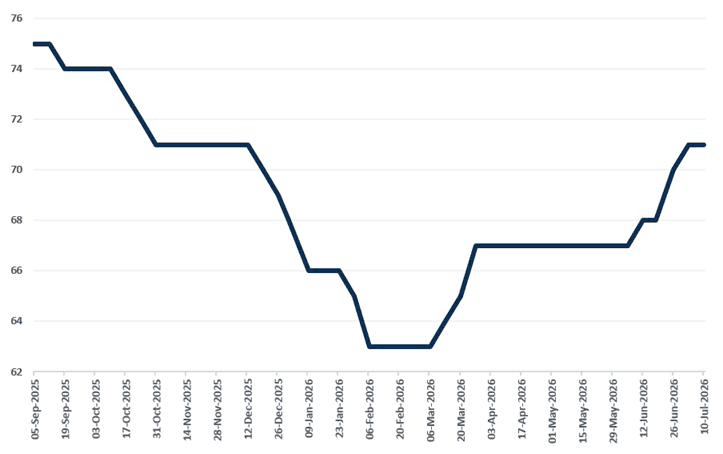
- In the bauxite market, 45% CIF China prices rose to $70–72/t in early July, their highest level since December 2025. The increase reflects decreasing Guinean supply during the peak rainy season and higher freight rates. Nevertheless, further gains are likely to be limited by Chinese port inventories, which remain at their highest level since May 2022, amid subdued downstream demand.
CIF China for 45% bauxite (midpoint, $/t)
Source: Argus, Kpler Insight
Dry Bulk Freight: Uncertainty in the Black Sea and Mediterranean demand outlook as wheat shipments disrupted by war
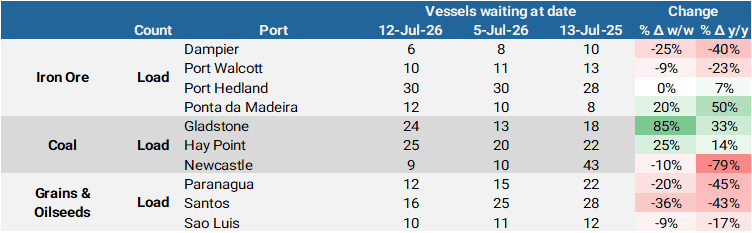
- Disruption to Russian and Ukrainian origin grain loadings across the Azov and Black Sea could provide some short-term support to regional earnings as vessels are tied up waiting to load. However, if disruption extends over the medium term, it will result in lower demand for ships and a weaker market. Excess tonnage supply weighing on earnings in Northwest Europe and the Mediterranean has been a key story of the geared market in recent months. The BSI S1B route (Turkey-Far East) followed the seasonal trend and firmed in the first half of July, hitting a multi-year high of $26,000/day on 16 July, but without Black Sea grain chartering, these gains will prove difficult to maintain. Insurers will be reassessing coverage for the region, and premiums are almost certain to increase. Meanwhile, owners are likely to ramp up their earnings expectations for Black Sea voyages to reflect the increased risks. This will push up the cost of doing business in the region.
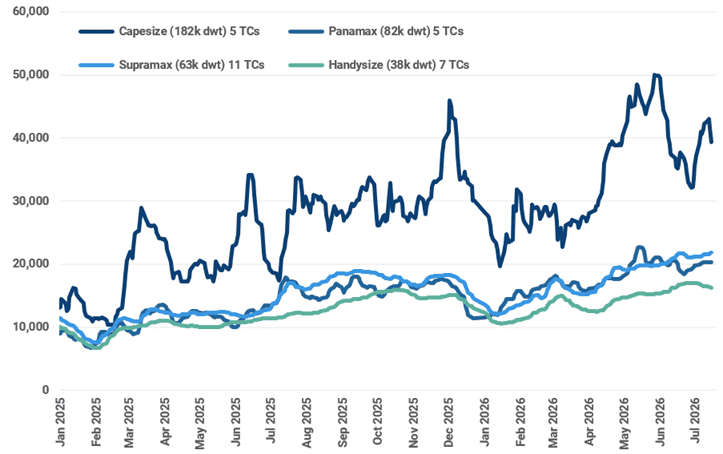
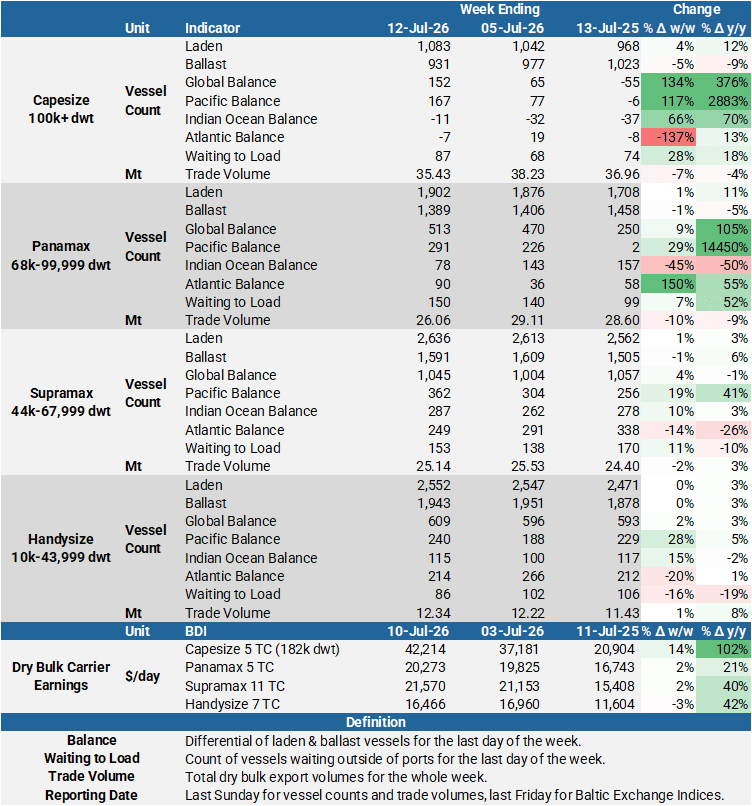
- There were steep w/w declines in Atlantic Supramax and Handysize earnings over the past week as US Gulf and East Coast South American chartering activity slowed. The BSI S1C (US Gulf-Far East) rate dropped by $1,279/day w/w to $32,321/day, while the BHSI HS1 (Brazil-Continent) fell by $1,339/day to $23,161/day. Nevertheless, the Supramax 11 TC average still rose by $377/day w/w to $21,867/day thanks to coal-driven gains in the Pacific. Average Handysize earnings dropped by $236/day w/w to $16,270/day.
- After starting the week stronger, Pacific-led declines have caused the Capesize 5 TC average to fall in recent days. It closed the week down by a net $2,082/day w/w at $39,353/day on 16 July. The Pacific round-voyage rate dropped by $4,320/day to $35,244/day as an easing of discharge port congestion in China brought more ships onto the market. From a recent peak of close to 110 Capesize (100k+ dwt) vessels on 7 July, the number of Capes waiting to discharge in China has dropped to around 80 ships. However, ballaster supply in the Pacific is still lower both m/m and y/y. With more ships heading to Brazil to load iron ore, we expect earnings to find a floor in the short term.
- A thin week for chartering activity saw the Panamax Atlantic round-voyage rate drop by $1,009/day w/w to $22,118/day. However, tonnage supply in the basin is well down on this time last year, and therefore, even a modest upturn in demand could quickly provide support to earnings. Indonesian coal is driving the Pacific Panamax market. The 5 TC average was almost unchanged w/w at $20,316/day.
Dry bulk carrier average earnings: Cape market pullback as earnings for smaller bulkers prove more resilient ($/day)
Source: Baltic Exchange
Key Dry Bulk Market Developments
Dry Bulk Commodity Flows
Source: Kpler
Dry Bulk Port Congestion
Source: Kpler
Dry Bulk Freight Metrics
Source: Kpler, Baltic Exchange

See why the most successful traders and shipping experts use Kpler