
Eroding confidence in the Strait
The hot war has returned to the Strait of Hormuz, raising immediate questions over whether the U.S. will restore its naval blockade of Iran. More importantly, every renewed attack on commercial shipping further erodes confidence in the Strait's reopening, making each future recovery more fragile than the last.
Twenty days after "Let the Oil Flow," the market is once again questioning whether the world's most important oil corridor can be trusted.
The MoU Never Solved the Political Problem
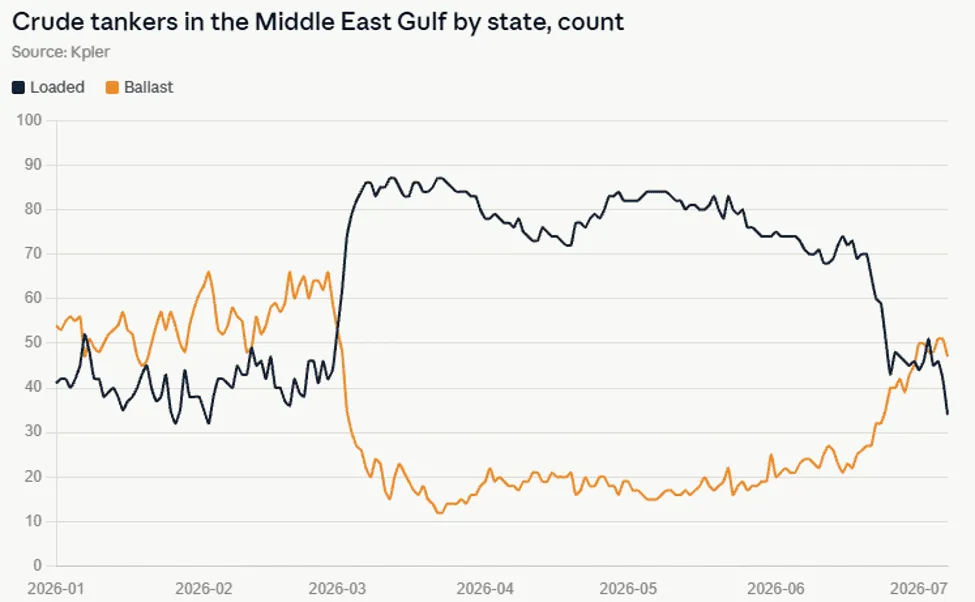
Twenty days ago, the United States and Iran signed a Memorandum of Understanding (MoU) that, for oil markets, had one immediate objective: restore confidence in the Strait of Hormuz. The agreement temporarily solved the market's physical problem—lifting the U.S. naval blockade, reopening the Strait and allowing trapped cargoes to finally clear the gulf—but it did little to resolve the underlying political dispute. Iran continued to view the Strait as a source of strategic leverage, while the United States remained committed to unrestricted freedom of navigation. The MoU didn't resolve those differences. It simply paused them long enough to get ships moving again.
For a brief period, the strategy appeared to be working. Once the Strait reopened, delayed cargoes that had been stranded for months moved surprisingly quickly. More than 70 million barrels of crude cleared the Strait as owners seized the opportunity to move vessels and cargoes out of the Gulf. Middle East Gulf exports recovered much faster than expected, the geopolitical risk premium faded, and crude prices retreated from nearly $100/bbl toward $70/bbl.
But clearing the backlog was only the first step.
The more difficult challenge was convincing ships to return. Every inbound voyage requires a shipowner, charterer and insurer to decide that the Strait is safe enough to re-enter. The MoU had only just begun rebuilding that trust when commercial shipping came under attack again. The next reopening—whenever it comes—is likely to be met with considerably greater skepticism. Confidence, once broken, is far harder to rebuild than it is to lose.
The Waiver is a Distraction
This week, the IRGC attacked commercial vessels transiting the Strait of Hormuz while insisting ships use navigation routes designated by Iran. U.S. Central Command described the attacks as "a clear violation of the ceasefire" before launching a new round of strikes against Iranian targets. Washington quickly followed by revoking the temporary oil-export waivers granted under the MoU.
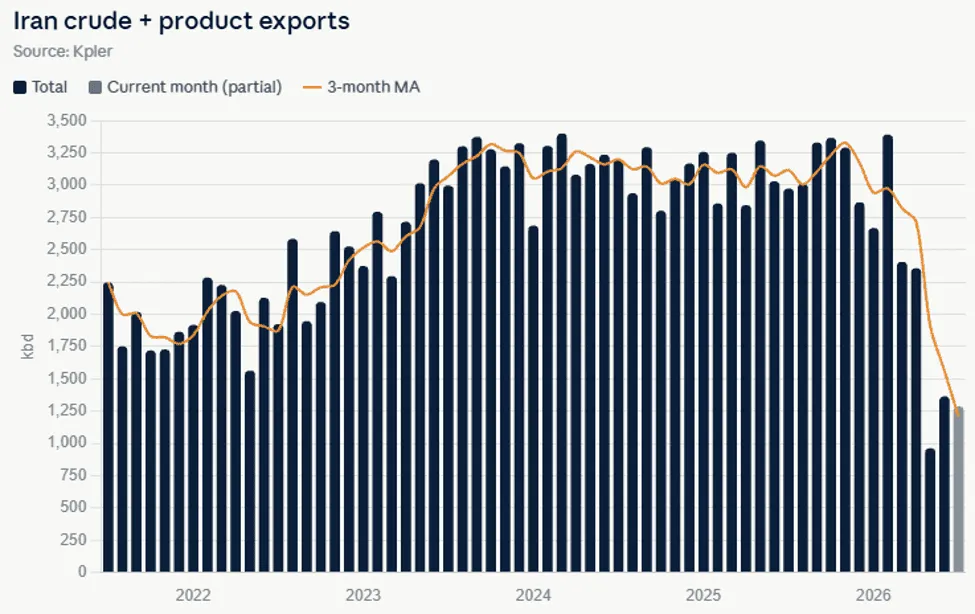
Prior to the conflict, Iran was already exporting near decade highs despite extensive U.S. sanctions, with China purchasing the overwhelming majority of those barrels. The temporary waiver may have broadened the legal framework for Iranian exports, but it did little to change the physical market. Iran already had a buyer before the waiver was issued, and absent stronger physical enforcement, it is likely to retain one after the waiver is revoked.
The real change under the MoU wasn't the waiver. It was the lifting of the U.S. naval blockade and the reopening of the Strait of Hormuz.
When announcing the agreement, U.S. Central Command stated that "all U.S. military blockade enforcement efforts have ceased," but just as importantly added that "our great Naval Ships will remain in the general area to make sure that all aspects of the agreement are adhered to." The blockade ended. The naval presence did not.
That raises the immediate question for the market: Does Washington now restore the blockade?
Unlike the waiver, the blockade directly affected the physical movement of oil. Restoring it would represent a meaningful change in supply. If it does, Iranian exports once again become physically constrained. If it does not, Iran will likely continue exporting to China through the same shadow fleet that operated before the conflict, making the revocation of the waiver far less consequential than the headlines suggest.
The Cost of Lost Confidence
The longer-term risk may prove even more significant than the immediate question of whether the blockade returns.
The first reopening allowed trapped ships and cargoes to leave the Gulf. The next reopening will have to persuade a new wave of ships to return. That requires rebuilding trust—a commodity that has been steadily eroding since the conflict began and has now suffered another setback.
Every attack on commercial shipping after a ceasefire raises the hurdle for the next recovery. Shipowners, charterers and insurers don't simply ask whether the Strait is open today—they ask whether it will still be open tomorrow.
The Strait of Hormuz doesn't have to be physically closed to disrupt global oil flows. It simply has to become a corridor that markets no longer view as dependable. If every reopening is assumed to be temporary, freight rates remain elevated, insurance costs remain high and fewer vessels are willing to re-enter the Gulf.
Markets can recover from a temporary closure. Recovering from a loss of confidence may prove far more difficult—and far more enduring.

See why the most successful traders and shipping experts use Kpler