Ras Laffan thermal activity eases from July 7 peak, six LNG trains show thermal signatures
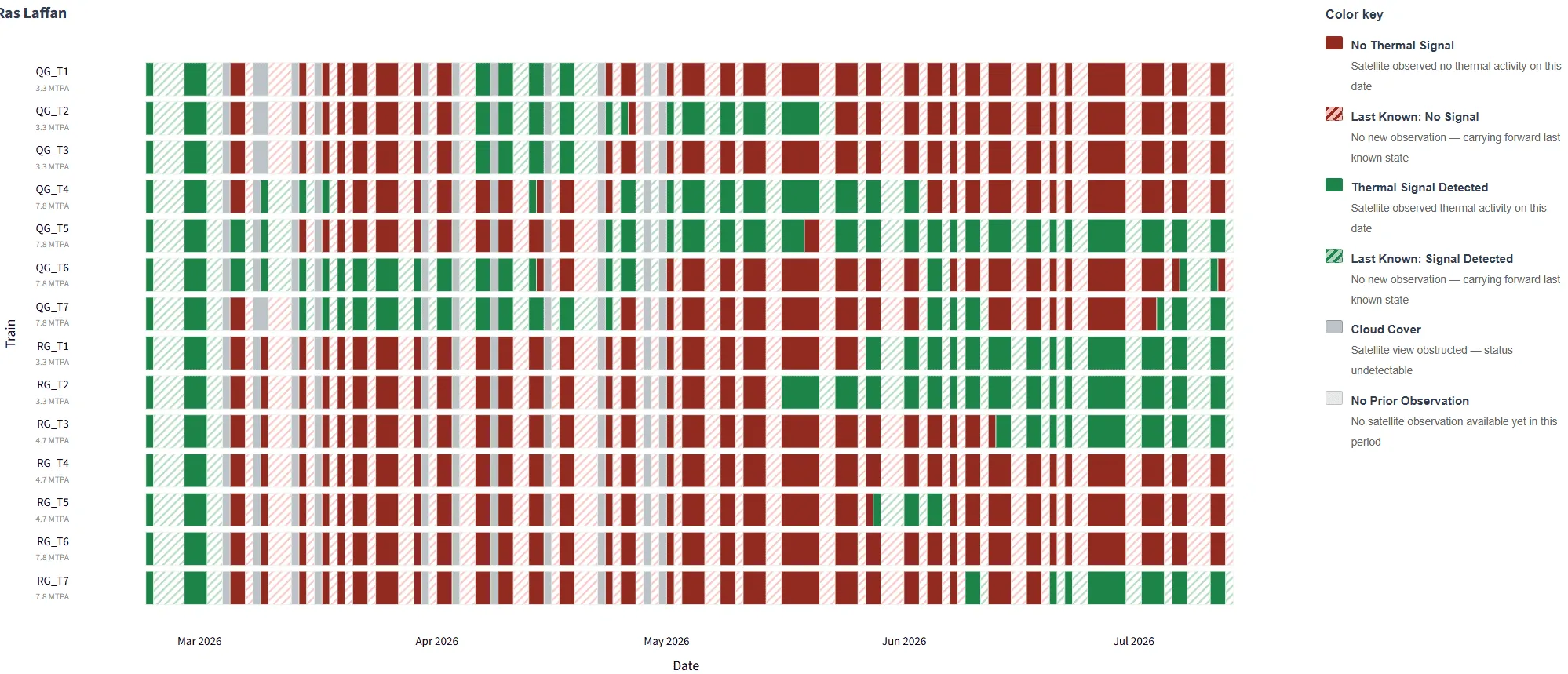
QatarEnergy's 77 mtpa Ras Laffan LNG export complex showed thermal signatures across six liquefaction trains in a satellite image captured on July 12, one fewer than in a previous image on July 7, when the export complex exhibited thermal activity across the highest number of trains since monitoring began on Mar. 5.
Thermal signatures indicate heat associated with plant operations but do not, on their own, confirm LNG production levels, operating rates or the operational status of individual liquefaction trains.
Ras Laffan thermal activity detected by satellite imagery
Source: Kpler
The July 12 image showed thermal signatures at QatarEnergy LNG North (Qatargas) Trains 5 and 7 (7.8 mtpa each)and QatarEnergy LNG South (RasGas) Trains 1 and 2 (3.3 mtpa each), Train 3 (4.7 mtpa) and Train 7 (7.8 mtpa).
The six trains have a combined nameplate liquefaction capacity of 34.7 mtpa.. Those same six trains also exhibited thermal activity in a satellite image Kpler captured on July 6. By comparison, the July 7 image also showed thermal activity at QatarEnergy LNG North (Qatargas) Train 6, increasing the observed total to seven trains with a combined nameplate liquefaction capacity of 41.1 mtpa.
The latest observations show that thermal activity remains concentrated across the same six liquefaction trains observed on July 6, after expanding to seven trains in the July 7 image. Further satellite observations will be needed to determine whether thermal activity broadens to additional liquefaction units.
No additional changes were observed elsewhere across the export complex.
Several liquefaction units continued to show no recent thermal signatures. Qatargas Trains 1-4 and 6, together withRasGas Trains 4-6, were not observed exhibiting thermal activity in the latest imagery, underscoring that observed activity remains selective across the export complex. QatarEnergy LNG South (RasGas) Trains 4 and 6 were damaged during missile strikes on March 18 and 19 and are expected to require three to five years of repairs.
The imagery comes as Qatar's LNG operations remain under close scrutiny following Iran's July 7 attack on the QatarEnergy-operated LNG carrier Al Rekayyat.near the Strait of Hormuz. Although loading operations at Ras Laffan have continued, no LNG carrier has transited the Strait since July 11 following the latest escalation in hostilities between Iran and the United States. Kpler data show two QatarEnergy LNG tankers currently berthed at the export terminal: Al Rayyan and Al Samriya.

See why the most successful traders and shipping experts use Kpler