


Trump tolls
President Trump's proposed Hormuz toll is significant not because of its size, but because it introduces a new model for financing maritime security. Rather than relying solely on taxpayers, countries controlling strategic waterways could increasingly use commercial shipping to fund coast guards, navies and maritime infrastructure, fundamentally changing the economics of maritime power.
"The U.S.A. will be, from this point forward, known as the 'Guardian of the Hormuz Strait'... and... will be reimbursed, at the rate of 20% on all cargo shipped."
– President Donald Trump, July 13, 2026
A Price on Protection
For more than seventy years, the United States has treated freedom of navigation as one of its most important strategic investments. The U.S. Navy protected global sea lanes because an open maritime system strengthened American power, lowered the cost of global trade and reinforced the international order Washington built after the Second World War.
President Trump's proposal suggests a new, emerging philosophy. Rather than underwriting global commerce, the United States would charge for protecting it.
Whether the proposal is ultimately implemented is almost secondary. The more significant development is that Washington appears willing to redefine maritime security—not as a public good financed primarily by American taxpayers, but as a service whose costs are borne by those who use it.
That represents one of the most significant conceptual shifts in U.S. maritime policy in generations.
The Price of Protection
Unlike previous discussions surrounding transit fees in the Strait of Hormuz, the proposal is not described as a fixed fee per transit or a charge per barrel of oil. Instead, President Trump stated that the United States would be reimbursed at a rate of 20% on all cargo shipped.
If interpreted literally as 20% of the cargo's value, the numbers become extraordinary. A fully laden Very Large Crude Carrier (VLCC) typically carries approximately 2 million barrels of crude oil. At $80 per barrel, that cargo is worth roughly $160 million. A 20% assessment would therefore equal approximately $32 million for a single voyage, equivalent to roughly $16 per barrel.
By comparison, the transit fee previously discussed by Iran was $2 per barrel.
Under this interpretation, the U.S. proposal would be roughly eight times larger than the framework that dominated international debate only weeks earlier.
The debate is shifting and is no longer simply about whether strategic waterways can generate revenue. It is about whether the protection of those waterways should become a service paid for by global commerce.
A Different American Strategy
At first glance, charging ships to transit the Strait of Hormuz appears inconsistent with decades of U.S. policy promoting free navigation and frictionless trade. But US policy has been shifting for at least a decade. Washington has increasingly embraced tariffs, industrial policy, export controls, friend-shoring and supply-chain resilience, accepting higher trade costs in exchange for greater strategic security.
A toll on one of the world's most important energy corridors would introduce additional friction into global commerce while disproportionately affecting Asian importers—the destination for most Gulf crude exports and the center of China's manufacturing economy.
Viewed through that lens, a Hormuz toll may not represent a break from recent U.S. policy. It may represent another expression of it.
Rather than asking how to make globalization cheaper, Washington increasingly appears willing to ask whether making globalization more expensive serves broader strategic objectives.
Security Becomes Self-Financing
The proposal also arrives as the Pentagon seeks to reprogram $4.3 billion to cover increasing operational and personnel costs associated with ongoing military operations. Assuming President Trump's proposal refers to 20% of cargo value, approximately 135 VLCC cargoes would generate revenue equivalent to that funding request.
There is no evidence that the proposal was designed specifically to finance military operations. However, it illustrates something much larger. Maritime security is becoming increasingly expensive, and governments are increasingly searching for new ways to finance it.
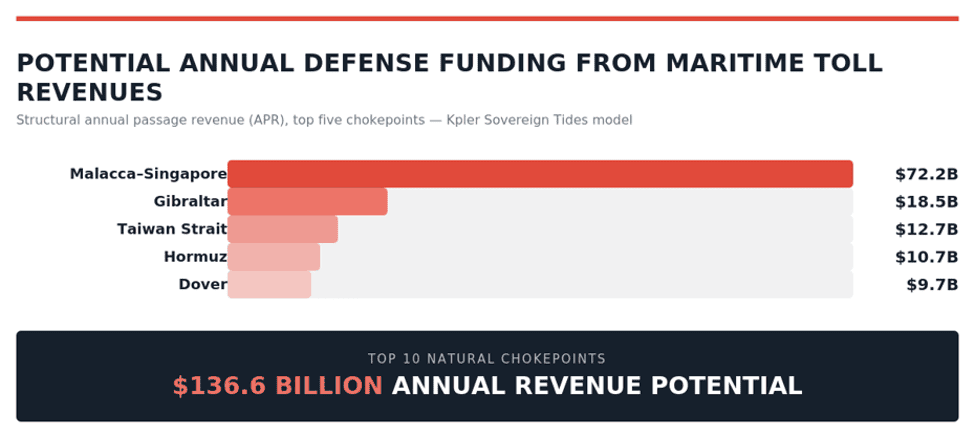
To explore what a user-funded maritime security model might look like, we developed the Sovereign Tides framework. Applying the pricing logic first proposed around Hormuz, the model estimates that the world's ten largest natural chokepoints could collectively generate approximately $136.6 billion in annual structural revenue.
Until now, those revenues represented a theoretical sovereign income stream. President Trump's proposal suggests they could instead become a mechanism for financing maritime power itself.
Historically, countries expanded navies through taxation or borrowing. A user-funded security model creates a third option: commercial shipping finances the military capabilities that protect it. Geography no longer simply provides strategic leverage; it provides a recurring revenue stream that can be reinvested into coast guards, naval fleets, surveillance systems and maritime infrastructure. Over time, maritime trade could begin financing the expansion of maritime power itself.
Geography itself becomes a self-financing defense asset.
A Different Maritime Order
President Trump's proposal may never be implemented exactly as written. That may ultimately prove irrelevant. Ideas create precedents.
For decades, the United States defended freedom of navigation as a cornerstone of the post-war international order. President Trump's proposal introduces a different premise: the protection of global commerce should increasingly be financed by global commerce itself.
If that approach gains traction, future debates over strategic waterways will no longer focus solely on access. They will increasingly focus on financing. The central question will no longer be who protects global commerce, but who pays for its protection.
The more important question is therefore not whether the United States charges ships transiting the Strait of Hormuz. It is whether the world's leading defender of free navigation has begun redefining what freedom of navigation costs—and who should pay for it.
**This note was cowritten with the help of our inter, Oscar Von Stackelberg.

See why the most successful traders and shipping experts use Kpler






