Westbound jet fuel cargo pulls resurge as Asian exports rebound
Dynamic middle distillate realignments have accelerated out of Northeast Asia, sending South Korean jet fuel long-haul toward European buyers as combined regional exports largely recover from their April lows.
Key Takeaways
- Westbound Re-Alignment: Despite general market stabilization following the Middle East Gulf crisis, long-haul jet fuel and kerosene cargo movements from East to West of Suez have resurged.
- UKC Destination Target: The LR2 Sh Unity loaded 90 kt of Jet A-1 from S-Oil Onsan on 6 June 2026; while initial fixture data left options open for Singapore, live AIS signals and updated port tracking confirm the vessel is bound for the Suez Canal and the UK Continent (UKC).
- Yeosu Barrels Move to France: The Vitol-chartered LR2 Yuan Lan Wan is transporting 95 kt of Yeosu-origin Jet A-1 toward Le Havre (ETA 27 June 2026) following a ship-to-ship (STS) transfer at Tanjung Bruas Light.
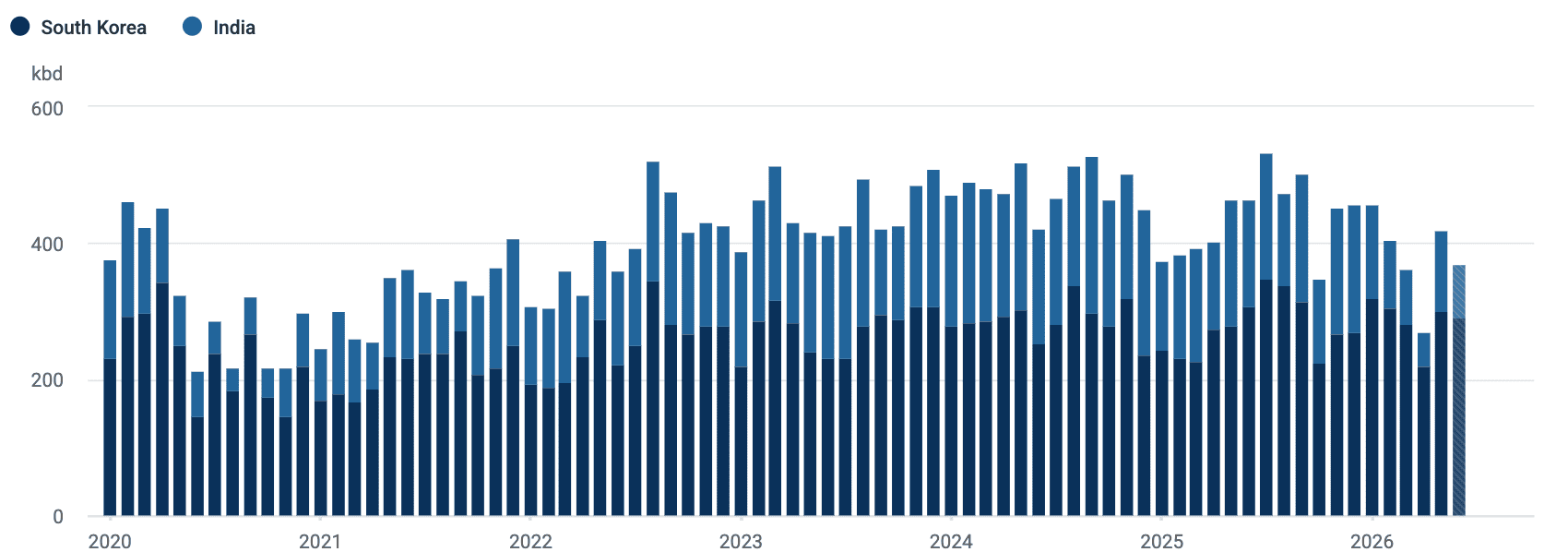
- Volume Normalization: Clean product exports from India and South Korea have rebounded from their crisis-driven lows in April 2026, returning to a running average near the 2025 level of 420 kbd.
The global aviation fuel market continues to experience significant supply realignments, with physical flows actively shifting toward long-haul westbound routes. While the severe constraints triggered by the Middle East Gulf crisis have eased, localized product draws are sustaining a strong cross-regional pull on barrels out of core Asian refining hubs.
Proprietary Kpler cargo tracking confirms this movement through dual long-haul fixtures departing Northeast Asia. On 6 June 2026, the LR2 Sh Unity completed loading 90 kt of Jet A-1 from S-Oil’s facility in Onsan, South Korea. Although initial fixture data indicated Singapore as a potential discharge option, AIS transmissions and market sources indicate that the vessel is navigating the Suez Canal corridor bound for the UKC. This positioning confirms that Western demand centers are actively pulling prompt barrels out of the Pacific basin despite the associated freight and transit requirements.
In a parallel trade loop, South Korean barrels are moving via complex logistical pathways to clear in Europe. The Vitol-chartered LR2 Yuan Lan Wan loaded 95 kt of Jet A-1 via an STS transfer on 21 May 2026 from the LR2 Seriana at Tanjung Bruas Light. The underlying cargo originated at the Yeosu Refinery, and the Yuan Lan Wan is currently traveling westward, signaling a direct arrival into Le Havre, France on 27 June 2026.
This structural realignment coincides with a broader volume recovery across key exporting nations. Refined product outflows from both India and South Korea have successfully reversed the crisis-induced lows registered in April 2026, which marked a severe contraction in shipping velocity. Combined outloads have now normalized back to a running rate near 420 kbd, returning directly to the typical performance levels recorded throughout 2025. As terminal clearing rates stabilize at this 420 kbd mark, the persistence of westbound tanker signals highlights that global jet fuel distribution remains heavily dependent on extended, cross-Suez supply chains.
South Korea, India monthly Kero/Jet exports by origin country

See why the most successful traders and shipping experts use Kpler