Australian majors diverge as Vale faces growing guidance risks
September quarter performance is expected to diverge sharply across major iron ore miners. Rio Tinto’s Pilbara shipments rose y/y despite CMRG tensions, leaving annual guidance achievable, while BHP delivered a record fiscal first quarter as Jimblebar Fines fully recovered. By contrast, FMG’s CMRG dispute drove a 7% y/y shipment decline, although diversification partly cushioned the loss. Vale faces growing guidance risk after exports from Brazil fell 7% y/y.
Executive summary
*The Iron Ore Miners Quarterly report, part of Kpler’s Iron Ore and Steel Insight offering, was previously published as Market Pulse as of August 2026. The report provides forecasts of iron ore producers’ quarterly output and shipments ahead of their official results, using proprietary modelling that combines Kpler’s vessel-tracking and trade-flow data with analysts’ market expertise.
- Australian iron ore majors generally outperformed their Atlantic peers in Q3. Rio Tinto’s physical flows remained resilient despite CMRG restrictions, while BHP posted record September-quarter exports. FMG was the exception, with its dispute with CMRG sharply reducing Chinese sales.
- In the Atlantic, Vale’s exports contracted y/y as elevated freight costs, softer Chinese steel demand, and greater competition squeezed volumes, raising the prospect of a guidance cut.
- Rio-owned IOC, included in our forecast for the first time, staged a sizeable quarterly recovery, but its multi-year operational reset and persistent logistics disruptions mean full-year guidance remains at risk.

Rio Tinto: CMRG tensions have yet to materially affect overall Pilbara shipments
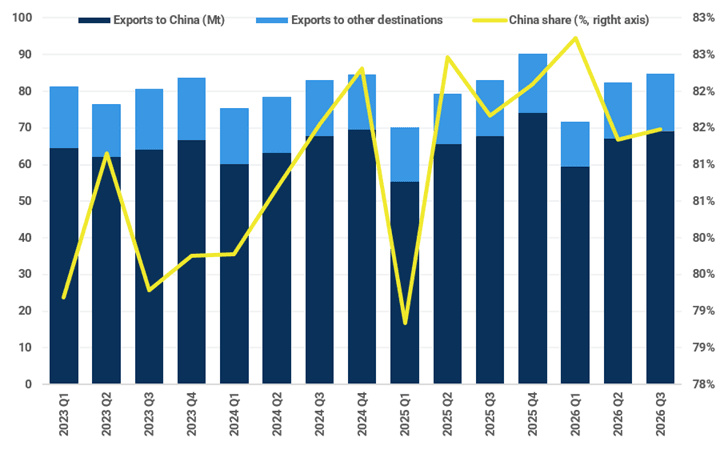
Rio Tinto exported 83.90Mt of iron ore from Western Australia in Q3 2026, up 2% y/y, despite souring relations with China Mineral Resources Group (CMRG). CMRG reportedly asked some Chinese steelmakers to suspend negotiations with Rio Tinto in early August and then asked them to hold off purchases of Pilbara Blend in early September. So far, however, the impact on overall physical Pilbara flows remains limited, even though some of the volumes may translate only into Rio’s portside inventory in China rather than into actual sales, and shipments of Pilbara blend fines are starting to slow down. China still accounted for 81.50% of Rio's Q3 exports from Western Australia, broadly unchanged from a year earlier, suggesting that the miner has made little effort to diversify its customer base.
Rio Tinto’s exports from Western Australia and share of the exports to China (Mt)
Source: Kpler
We expect Rio Tinto to officially report 86.20Mt of Pilbara iron ore sales (100% basis) in Q3, up 2.20% y/y, when it publishes its operational results on 13 October. Combined with reported H1 sales of 157.65Mt, this would lift nine-month volumes to approximately 243.85Mt, leaving 79.15–94.15Mt required in Q4 to meet full-year guidance of 323–338Mt. Rio's Q4 sales have averaged 86.93Mt over the past five years, suggesting that the midpoint of guidance remains achievable at a normal seasonal shipment pace.
CMRG nevertheless remains the principal downside risk. Any escalation could begin to affect physical sales after having so far been largely confined to commercial negotiations. Key indicators to watch include any update on CMRG discussions in Rio's Q3 operational review, Chinese port inventories of Pilbara Blend and any visits to China by senior Rio executives.
At Simandou, total exports surged 66% q/q to 8.74Mt in Q3, although we estimate that BWCS continued to account for most shipments. SimFer volumes should increase further in Q4 as permanent crushing facilities come online and locomotive availability ceases to be a major logistical bottleneck.
Rio Tinto-owned IOC: Q3 recovery insufficient to remove guidance risk
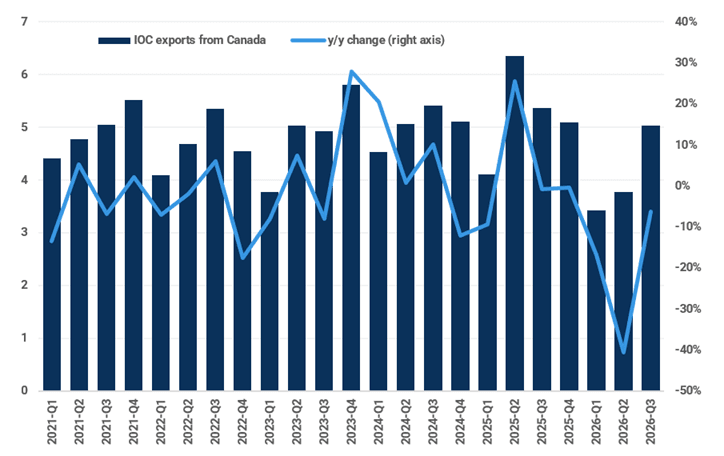
Iron Ore Company of Canada (IOC), Rio Tinto's majority-owned Canadian operation, exported 5.03Mt in Q3 2026, recovering from 3.30Mt in Q1 and 3.77Mt in Q2. The improvement appears to reflect a recovery in port unloading capacity and improved pellet machine availability.
Nevertheless, Q3 exports remained 6.40% below the year-ago level. IOC's strategic operational reset, launched in late 2025, is designed to catch up on deferred waste stripping, improve long-term pit health and restore operational flexibility. Rio has indicated that this process will take several years, during which concentrate production is expected to remain constrained. Logistics has added another layer of disruption, with the QNS&L Railway suffering at least four outages this year due to wildfires, a derailment and adverse weather.
IOC iron ore exports and y/y change (Mt)
Source: Kpler
We expect Rio Tinto to report 3.70–4.20Mt of IOC sales (100% basis) in Q3, bringing nine-month sales to 10.16–10.66Mt. IOC would therefore need to sell at least 4.34Mt in Q4 merely to reach the bottom of its 15–18Mt full-year guidance.
That target remains possible, but increasingly demanding. IOC's Q4 sales have averaged 4.15Mt over the past five years, while concentrate production remains constrained by the operational reset. High shipping costs have cut margins on cargoes to East Asian destinations. A reduction to full-year guidance, therefore, remains a material risk when Rio Tinto reports its Q3 operational results.
Vale: Q3 weakness raises the prospect of a full-year guidance cut
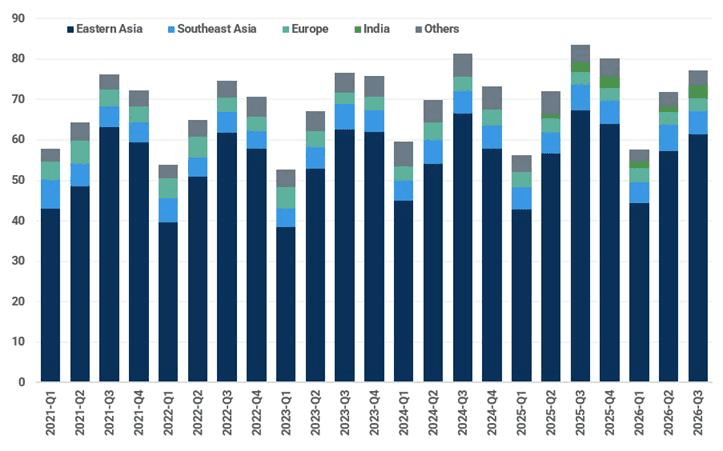
Vale exported 77.30Mt of iron ore from Brazil in Q3 2026, down 7.30% y/y, the sharpest annual contraction since 2020. Shipments to the miner's major markets, including East Asia, Southeast Asia and Europe, all declined y/y. India was the main exception: although still a relatively small market for Vale, shipments to the country reached a record 3.20Mt, supported by capacity expansion among customers such as JSW Steel.
Vale exports from Brazil (by destination, Mt)
Source: Kpler
The Q3 export decline reflects a combination of demand, freight and competitive pressures:
- Chinese crude steel production is expected to fall around 4% y/y in Q3, while preliminary data indicate that the growth of quarterly iron ore imports was at the second lowest since 2022.
- Freight became considerably more expensive, with the C3 Tubarão–Qingdao rate averaging $36.79/t, up 57% y/y. Although Vale said during its Q2 results that spot freight exposure had been reduced to below 10% for H2, the commercial impact appears greater than the headline exposure would imply.
- Competition has also intensified. High freight rates have strengthened the relative advantage of Australian ore in Asian markets, while accelerating Simandou exports are adding another source of higher-grade supply into China.
- Other headwinds may include lower third-party purchases from smaller Brazilian miners, a demanding Q3 2025 comparison base, delays to the recovery of the Fábrica and Viga mines, and a gradual rather than rapid ramp-up of Vale's Oman pellet operations following their partial restart in late June.
We now expect Vale to officially report around 88.80Mt of iron ore production (including third-party purchases) in Q3, down 5.70% y/y from 94.40Mt and substantially below our previous forecast of 94.50Mt. Combined with 153.93Mt in H1, nine-month production would reach roughly 243Mt, leaving 92–102Mt required in Q4 to achieve the existing full-year guidance of 335–345Mt.
Given current market conditions, production above 92Mt in the final quarter appears challenging. With softer Chinese demand, high freight costs and broader pressure on Brazilian producers persisting, the possibility that Vale will follow CSN in lowering its full-year production guidance when it reports Q3 results remains on the table.
BHP: Jimblebar Fines stage a full recovery
BHP exported 74.30Mt of iron ore from Western Australia in the September quarter, up 5.50% y/y and the highest fiscal first-quarter volume on record. A series of industrial actions involving port and maintenance workers in July and August ultimately had little impact on quarterly shipments, highlighting BHP's ability to mitigate disruptions through contingency staffing, scheduling and catch-up loadings.
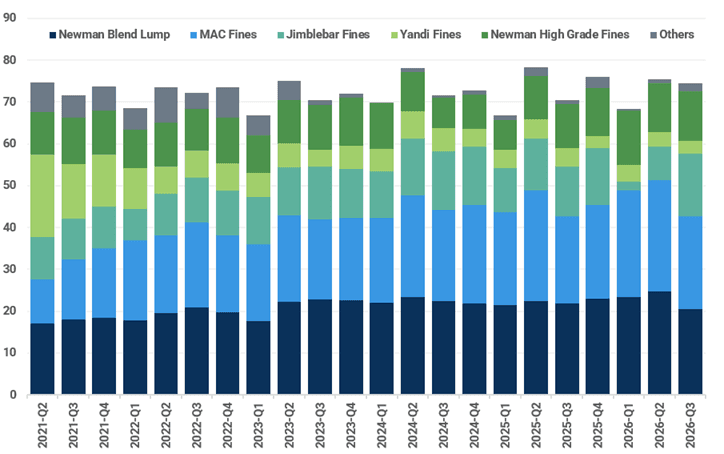
The standout development was the recovery in Jimblebar Fines. Shipments surged 28% y/y to a record 15Mt, compared with 8.10Mt in the June quarter and just 2.16Mt in the March quarter. Around 14Mt was shipped to China, also a record, indicating that Chinese demand for the grade has fully recovered following the restrictions imposed between September 2025 and early 2026. At the same time, shipments to non-Chinese customers, particularly Vietnam, continued to increase.
BHP shipments by product (Mt)
Source: Kpler
We expect BHP to report 73.90Mt of WAIO production (100% basis) in its operational review on 20 October. This would represent the strongest September-quarter production performance in the company's history and a solid start to FY2027, for which BHP has set guidance of 286–298Mt.
Industrial relations remain the main near-term operational risk. Further short-duration strikes at Port Hedland remain possible, with the Fair Work Commission's bargaining proceedings potentially extending through December. However, recent experience suggests that the ultimate impact on quarterly shipments may remain manageable.
FMG: CMRG dispute drives sharp September-quarter contraction
FMG exported 45.20Mt of iron ore from Western Australia in the September quarter, down 7.30% y/y, with the decline largely attributable to restrictions associated with its dispute with CMRG. Shipments to China fell to a two-year low of 39.20Mt.
FMG has responded by accelerating diversification. Exports to non-Chinese markets surged 36.70% y/y to a record 5.93Mt, supported particularly by stronger sales into Southeast Asia and India. However, these gains were insufficient to compensate for weaker Chinese demand. We now expect FMG to officially report Q1 FY2027 shipments of 46.20Mt (100% basis), down from 47.70Mt previously. This would represent a 7.40% y/y decline and leave 151–161Mt to be shipped over the remaining three quarters to achieve full-year guidance of 197–207Mt.
Despite the weak start, we see little likelihood that FMG will lower its annual guidance in its Q1 FY2027 results, to be announced on 22 October. A partial or interim agreement with CMRG remains possible during the December quarter, even if a comprehensive long-term agreement proves more difficult. Continued growth in sales to Southeast Asia and India should also provide a partial offset, although these markets remain too small to fully replace China.
The "Big Four" shipments and their share in the global seaborne iron ore market (Mt, %)
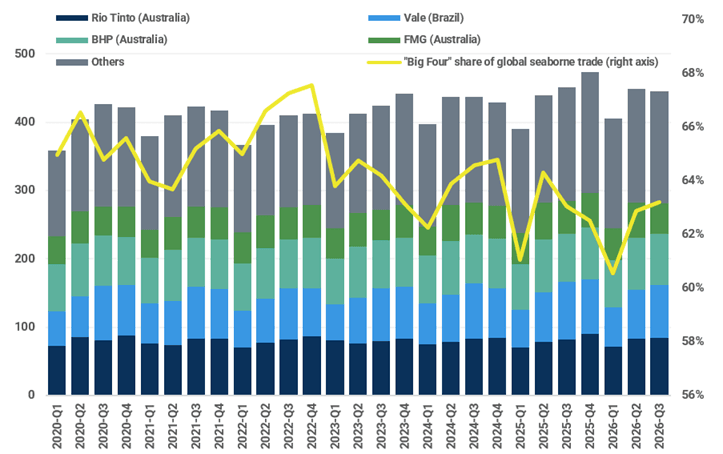
Source: Kpler
Market Insights you can trust
Kpler delivers unbiased, expert-driven intelligence that helps you stay ahead of supply, demand, and market shifts.
Trade smarter. Request access to Kpler today.

See why the most successful traders and shipping experts use Kpler