

Chinese refiners step up Middle East crude buying amid record stock drawdowns
China's inventory drawdowns and demand adjustments helped cushion the initial supply shock at the start of the war. As Middle Eastern supply recovers and global oil balances risk tipping into surplus, Chinese refinery demand and inventory replenishment will once again be key to absorbing additional barrels and supporting the Dubai structure.
Key takeaways:
- Rising prompt Middle Eastern supply and a largely closed arbitrage window are attracting opportunistic Chinese buying. Refiners may have secured more than 80 mb of Saudi crude while actively participating in spot tenders issued by other regional suppliers.
- Record onshore crude inventory drawdowns could raise energy security concerns and prompt refiners to reassess their inventory strategies. Stocks fell at a rate of ~1.6 mbd in September as refinery throughput rose above 14 mbd, while stabilising inventories by December would require seaborne imports to increase by around 1 mbd from current levels.
- Conflict risks, dwindling Iranian supplies and costly long-haul barrels could constrain China's overall import recovery. Virtually all Iranian cargoes positioned outside the US blockade have been discharged, and replacing ~1 mbd of Iranian supplies will be challenging, suggesting that inventory drawdowns are likely to persist.
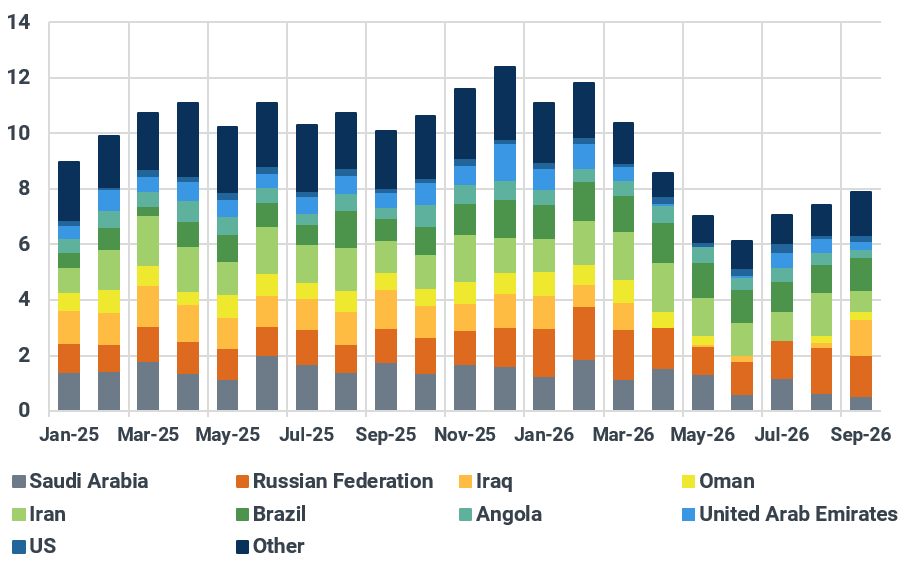
Chinese refiners have been actively snapping up Middle Eastern crude cargoes as regional producers rapidly restore oil production and exports. Media reports suggest that Chinese buyers may have purchased half of the ~40 mb of November-loading Saudi crude offered by Aramco last week. These volumes could be on top of their term allocations for the month, although the term allocation plan has yet to be disclosed.
Since mid-September, Chinese firms are estimated to have secured at least 80 mb of September-November-loading Saudi crude via spot trades, pointing to a recovery in buying interest after Saudi imports averaged only ~20 mb per month in Q3 (excluding the temporary pickup following the brief US-Iran MoU).
Meanwhile, refiners have also been actively participating in spot tenders for Abu Dhabi and Iraqi crude, suggesting that China's imports of Middle Eastern crude could rebound sharply in Q4, provided that cargoes can be shipped on time amid the escalating conflict in the region, which remains a major downside risk to Q4 arrivals.
The renewed Chinese buying interest is partly opportunistic, as rising Middle Eastern spot availability and limited outstanding demand from other Asian refiners have prompted sellers to offer more competitive prices. Meanwhile, steep backwardation in oil benchmarks and elevated freight rates further undermine the economics of long-haul arbitrage cargoes, encouraging Asian refiners to source crude closer to home.
China's seaborne crude oil imports by origin, mbd
Source: Kpler
The recently sold Saudi barrels were likely priced at around November OSP +$20/bbl on a delivered China basis, according to media reports. November-arrival Iraqi Basrah Medium cargoes were traded at around January ICE Brent +$17-20/bbl on a delivered China basis. In comparison, December-arrival Brazilian and Norwegian medium sour crude are being offered at around February ICE Brent +$24/bbl on a delivered basis. While the delivery windows and pricing benchmarks differ, the reported deals are consistent with improving relative competitiveness of Middle Eastern barrels, particularly for buyers seeking prompt deliveries.
More fundamentally, China's crude import demand is expected to continue recovering, driven by rising refinery throughput and rapidly declining crude inventories. Kpler estimates that crude throughput rebounded to 14.05 mbd in September from 13.46 mbd in August and is likely to continue rising through Q4, reaching 14.2 mbd by December, as refiners are incentivised to increase transportation fuel production to meet domestic demand and capitalise on strong refined product export margins.
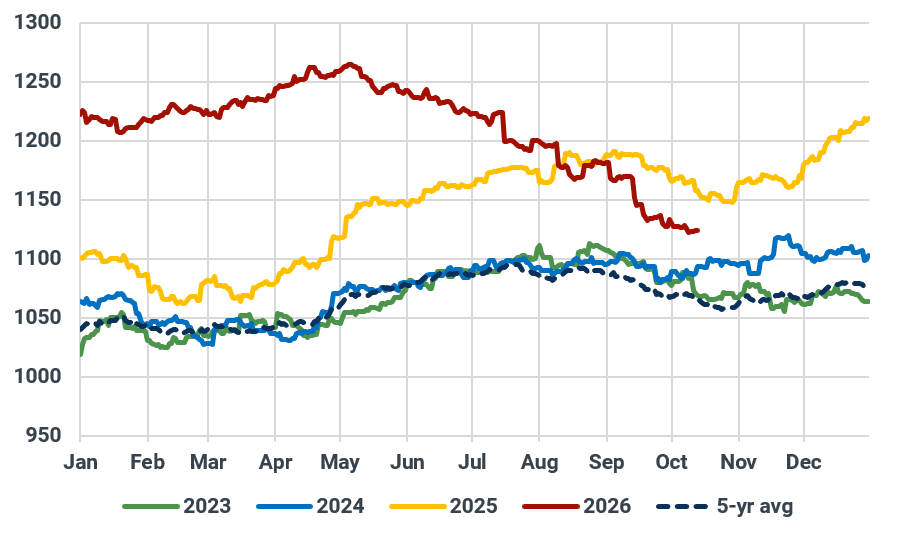
However, the recovery in crude imports has so far lagged behind the rebound in refinery demand, accelerating inventory drawdowns. Kpler data show that China's onshore crude inventories declined at the fastest pace on record in September, at around 1.6 mbd, and have continued to fall so far in October. The drawdown rate was more than twice the rates seen during May-August and far exceeded the previous record of 950 kbd in October 2017.
China's onshore crude oil inventory, mb
Source: Kpler
Although China still holds 1,124 mb of crude in storage, equivalent to around 80 days of refinery crude requirements, continued drawdowns at the current pace could erode stock buffers and test Beijing's energy security limits, prompting refiners to reassess their inventory strategies. The recent drawdowns have so far been concentrated in commercial inventories, while strategic reserves have remained largely untouched.
It remains unclear whether Beijing has issued or will issue any stock replenishment requirements for Q4 or Q1 next year. However, amid adjustments to China's October refined product export program, crude oil inventories are likely to take centre stage in Beijing's energy security considerations.
That said, on a simplified crude balance basis, stabilising China's crude inventories would require seaborne imports to rise by around 1 mbd from September levels by December, assuming throughput of 14.2 mbd, domestic oil production holds steady at ~4.4 mbd, and pipeline imports from Russia and Kazakhstan remain at around 800 kbd.
While increased Middle Eastern crude buying should help, the depletion of Iranian supplies and reduced purchases of arbitrage barrels could make it difficult for China's overall crude imports to rise by that much. We therefore expect Q4 imports to recover, but by less than the increase in refinery demand, so inventory draws are likely to persist.
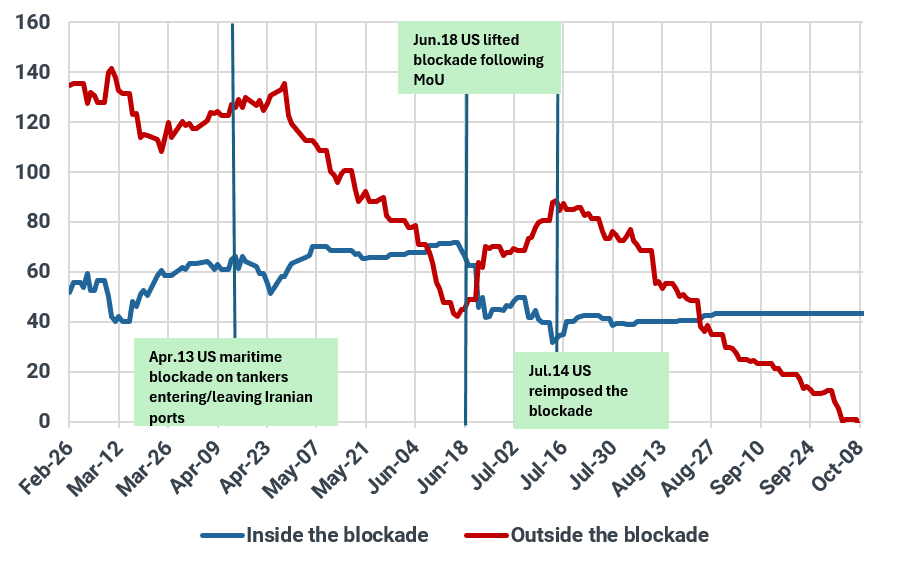
Iranian crude oil on water by current location, mb
Source: Kpler
Kpler data suggest that virtually all Iranian crude cargoes positioned outside the US blockade had been discharged by this week, making further Iranian crude arrivals in China unlikely as long as the blockade remains in place. Against this backdrop, Chinese teapot refiners have stepped up purchases of Russian, Canadian and Middle Eastern crude. However, fully replacing the ~1 mbd of Iranian supplies remains challenging. Increased Middle Eastern buying may therefore not translate into an equivalent rise in China's overall crude imports, especially as purchases of long-haul arbitrage barrels remain subdued.
This suggests that Chinese state-owned refiners, facing higher throughput and inventory replenishment needs, and independent refiners, seeking alternatives to Iranian crude, are likely to have a stronger appetite and greater urgency to secure prompt Middle Eastern barrels, potentially limiting further downside in the Dubai structure.
Market Insights you can trust
Kpler delivers unbiased, expert-driven intelligence that helps you stay ahead of supply, demand, and market shifts.
Trade smarter. Request access to Kpler today.

See why the most successful traders and shipping experts use Kpler