

Seven months on: 2 bn bbl lost, 5 Mbd still offline, and no deal in sight
As the war enters its eighth month, 2 bn bbl have been lost and 5 Mbd remain offline, leaving global buffers thin and Western inventories running low.
Key takeaways
- Cumulative outages: Cumulative Middle East crude and condensate production outages surpassed 2 bn bbl this week.
- Current total outages: As of 6 October, roughly 5 Mbd of Middle Eastern crude and condensate production remains offline versus February 2026 levels, with a large share coming from Iran.
- Exports: Total Middle East crude and condensate exports have temporarily returned to pre-war levels in recent weeks, helped by UAE output above its pre-war level and a likely temporary Saudi crude supply ramp-up to near its 12 Mbd capacity at the end of last month.
- Saudi outlook: East-West pipeline flows have recovered to 5.8 Mbd, but the threat of further attacks clouds the outlook, keeping our expectations for Saudi crude supply ~9 Mbd this month.
- Houthi risk: Houthi strikes recently damaged the Jazan and Najran airports, and the group has warned that Saudi oil facilities and the Bab al-Mandeb strait could be targeted.
- Saudi storage: Saudi Arabia strongly built up underground storage in August (using a balancing factor surplus of 1.7 Mbd). Drawdowns began in September and continued into early October, supporting flows out of the country.
- Saudi September balancing factor: The slight ~150 kbd surplus seen in September turns negative once ~450 kbd of dark Red Sea loadings are included, which indicates some underground storage unwinding last month. Saudi's balancing factor turns even more negative when including potential exports out of the Gulf of Oman, partly offsetting the elevated balancing factor in August.
The war continues unabated and shows no signs of slowing. With tensions between Saudi Arabia and the Houthis in Yemen escalating in recent weeks, Middle East crude and condensate outages continue to reshape global crude markets.
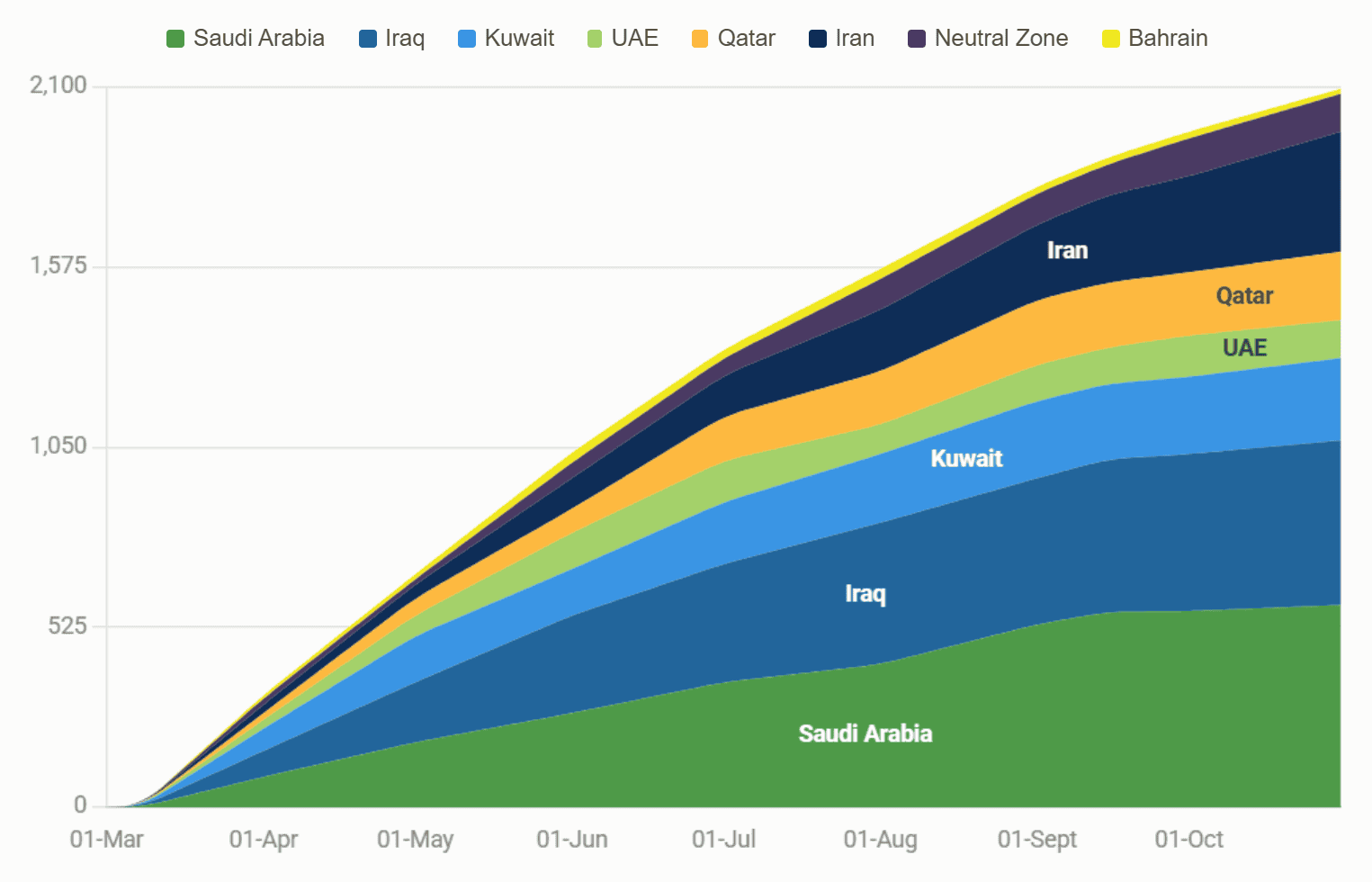
Cumulative Middle East crude and condensate production outages surpassed 2 bn bbl this week (see chart below).
Cumulative crude and condensate supply outages, Mbd
Source: Kpler
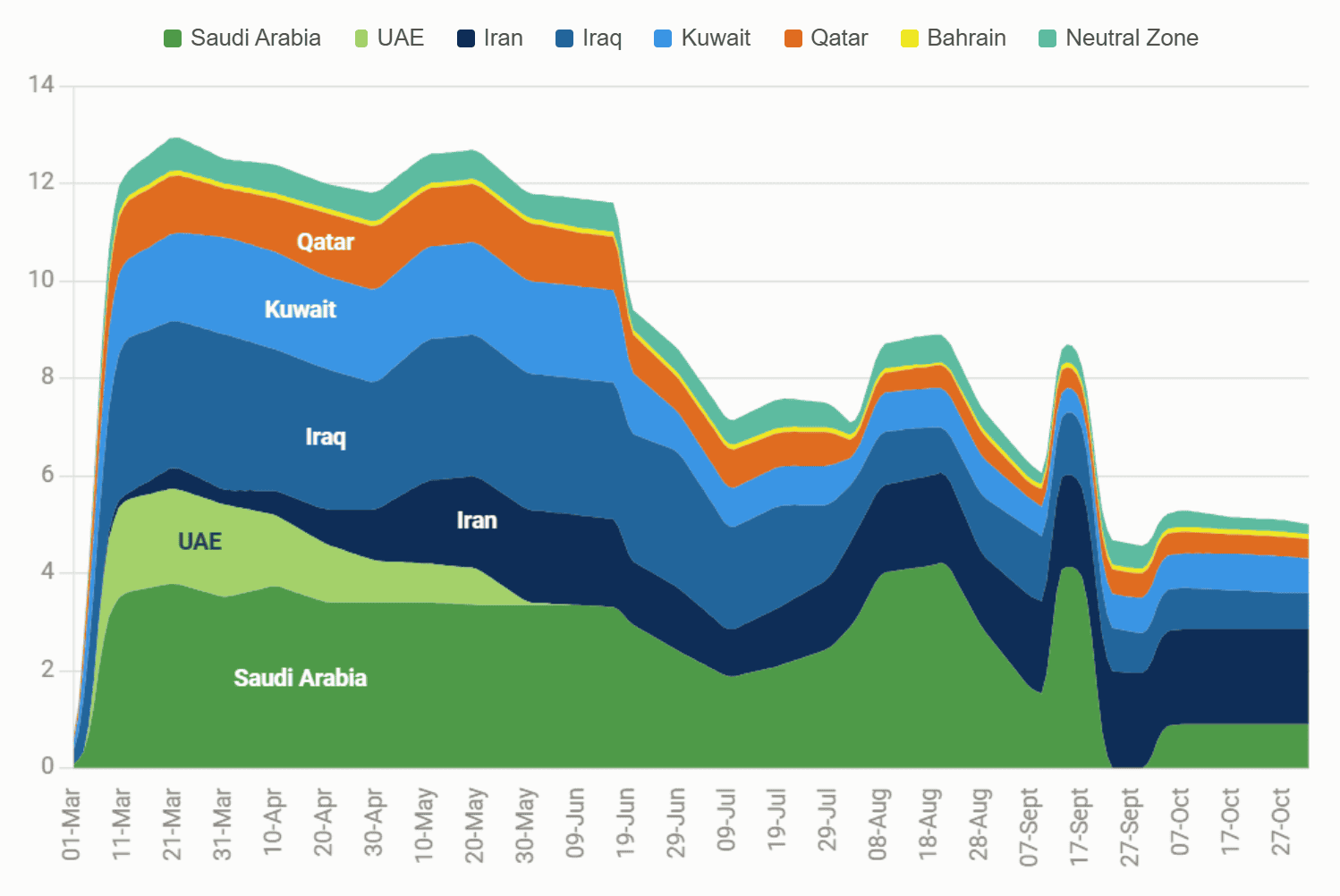
Total Middle East crude and condensate exports have temporarily returned to pre-war levels. Drivers of this are UAE production running above its pre-war level and a recent, likely brief, rise in Saudi crude output to close to its 12 Mbd capacity at the end of last month, according to market sources.
This assumption is corroborated by rapidly rising Saudi crude and condensate exports, with loadings averaging 9.1 Mbd in the week beginning 21 September, a post-COVID high.
Middle Eastern crude and condensate supply outages, Mbd
Source: Kpler
Nevertheless, this ramp-up likely was short-lived. Given this, we estimate that roughly 5 Mbd of Middle Eastern crude and condensate production remains offline (as of 6 October), compared to February 2026 levels.
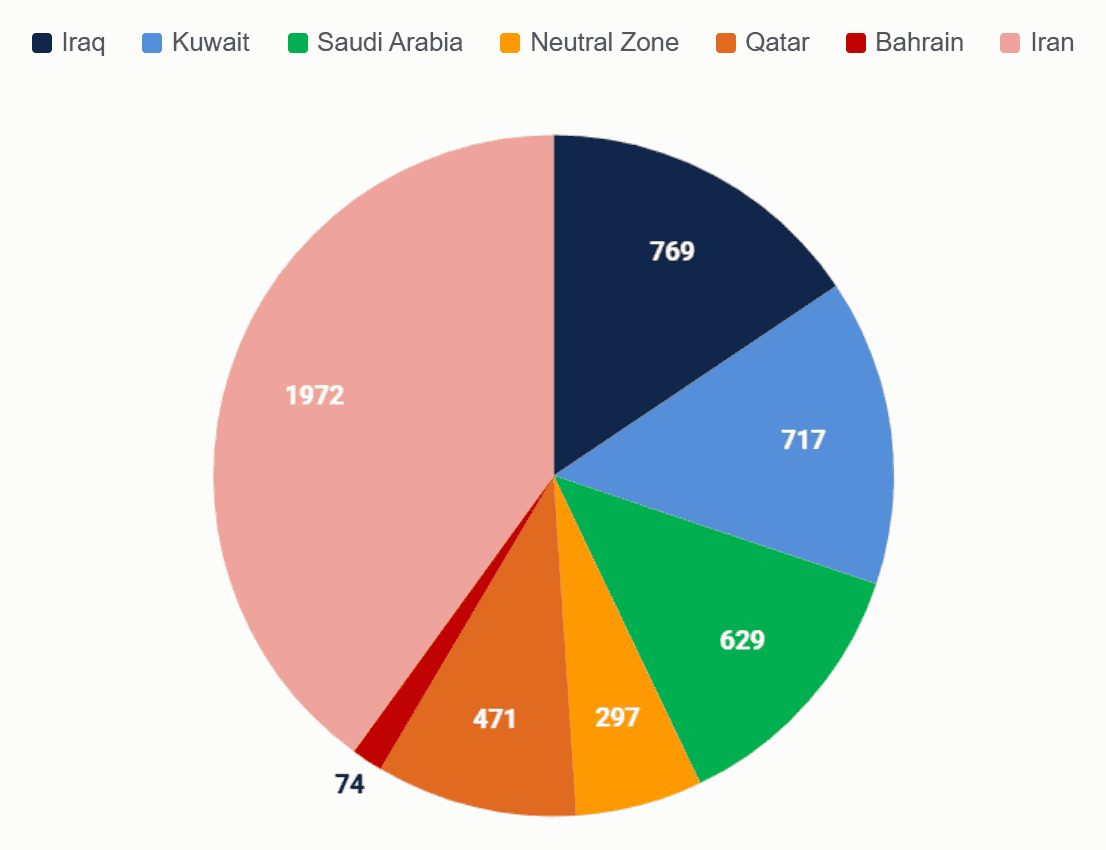
A large portion of the ongoing supply outages continue to stem from Iran, which is currently producing at levels that largely reflect domestic demand, with onshore crude inventories only having limited amounts of additional spare capacity remaining.
Middle Eastern supply outages 6 October, Mbd
Source: Kpler
Recovery in East-West pipeline flows
A rise in Saudi supply comes as East-West pipeline flows have recovered strongly, with Saudi officials saying operations resumed five to six days after the pipeline was hit and that flows are back at 5.8 Mbd.
The threat of further attacks on Saudi oil infrastructure continues to cloud the outlook for sustained high output in the coming weeks, so we expect the kingdom's crude supply to average around 9 Mbd this month.
Houthi strikes damaged the Jazan and Najran airports in southwestern Saudi Arabia this week. The group also claims hits on Riyadh's airport and the Rabigh refinery, though neither is confirmed, and one of its officials has warned that Saudi oil facilities and the Bab al-Mandeb strait could be targeted if Tehran wanted it.
Unwinding of Saudi underground storage
Our data also suggests that Saudi Arabia built up sizeable underground storage in August, with the balancing factor averaging a surplus of 1.7 Mbd, which implies a stock build of around 50 Mbbl for the month. It should be noted, however, that this surplus excludes volumes of crude exported with an unknown origin that are attributed to the country (more on this below).
We believe part of the increase in underground storage was already drawn down in September and that the unwinding has continued into early October, supporting exports over this period.
While the balancing factor for September showed a slight surplus of only ~150 kbd, (implying that our assumptions were roughly aligned with our observed data), this figure does not take into account dark flows either via the Red Sea or the Gulf of Oman.
Unknown-origin STS volumes in the Gulf of Oman (that may have loaded at Ras Tanura) have remained elevated in September.
Moreover, unknown-origin Red Sea flows, being attributed entirely to Saudi Arabia, averaged around 450 kbd in September. The additional 450 kbd of 'other' exports in the Red Sea would push Saudi's balancing factor back into negative territory of ~300 kbd, implying that some unwinding of underground storages has taken place last month. At 300 kbd, this would amount to around 10 Mbbls.
Market Insights you can trust
Kpler delivers unbiased, expert-driven intelligence that helps you stay ahead of supply, demand, and market shifts.
Trade smarter. Request access to Kpler today.

See why the most successful traders and shipping experts use Kpler