Middle East refining under pressure: damage, export disruption, and a two-speed recovery
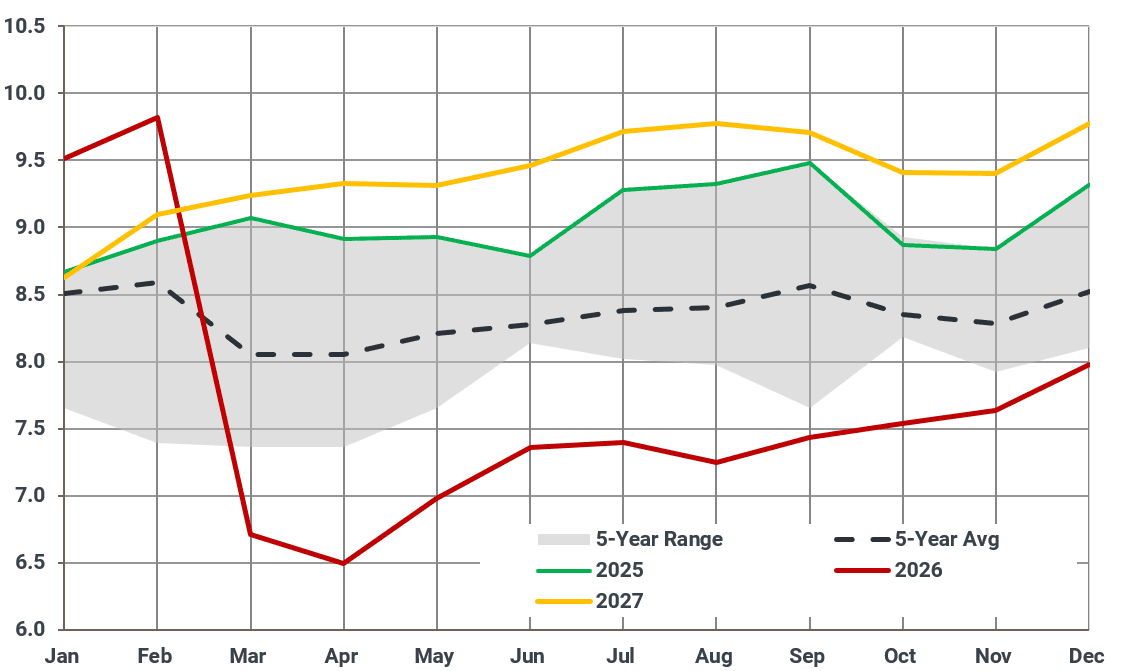
Middle Eastern refinery runs remain sizeably below pre-war levels at around 7.3 mbd versus 9.9 mbd in February 2026, reflecting a combination of physical refinery damage and constrained product evacuation through the Strait of Hormuz (SoH). Looking ahead, we expect a gradual recovery from Q4 2026, but a return to pre-war throughput remains unlikely before Q2 2027.
Near-term recovery is a logistics story; full normalisation is a capacity restoration story.
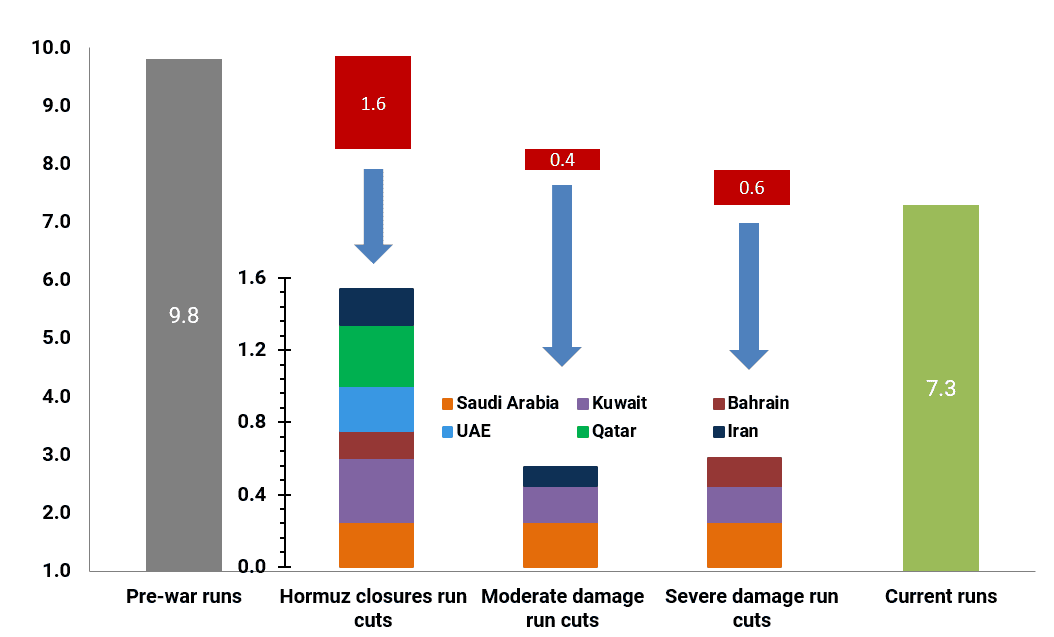
Middle Eastern refinery runs began to recover in May, but renewed regional tensions and the effective closure of the Strait of Hormuz (SoH), followed by disruptions around Bab el-Mandeb (BeM), have interrupted the recovery since. Importantly, run losses have been substantially larger than the amount of refining capacity directly taken offline, as otherwise operational refineries have also curtailed throughput to manage rising product inventories amid restricted export flows.
Middle East refinery runs (mbd)
Source: Kpler
Our base case assumes prolonged disruption with transit remaining constrained through the rest of 2026 before a gradual reopening begins only in late Q4. Regional refinery runs have so far evolved broadly in line with our prolonged-conflict scenario. An improvement in Hormuz transit could therefore unlock a relatively quick initial rebound as operational refineries raise throughput and product evacuation normalises.
Beyond the initial rebound, damaged capacity will become the main constraint. Restoring heavily affected sites requires work across processing units, power, utilities and supporting infrastructure, while certain process equipment will require lengthy repairs or replacement. We therefore expect Q4 recovery to be primarily logistics-led, with the return of damaged capacity shaping the recovery thereafter and keeping a full return to pre-war throughput constrained until Q2 2027.
Middle East refinery run losses by driver and country (mbd)
Source: Kpler & IIR Energy
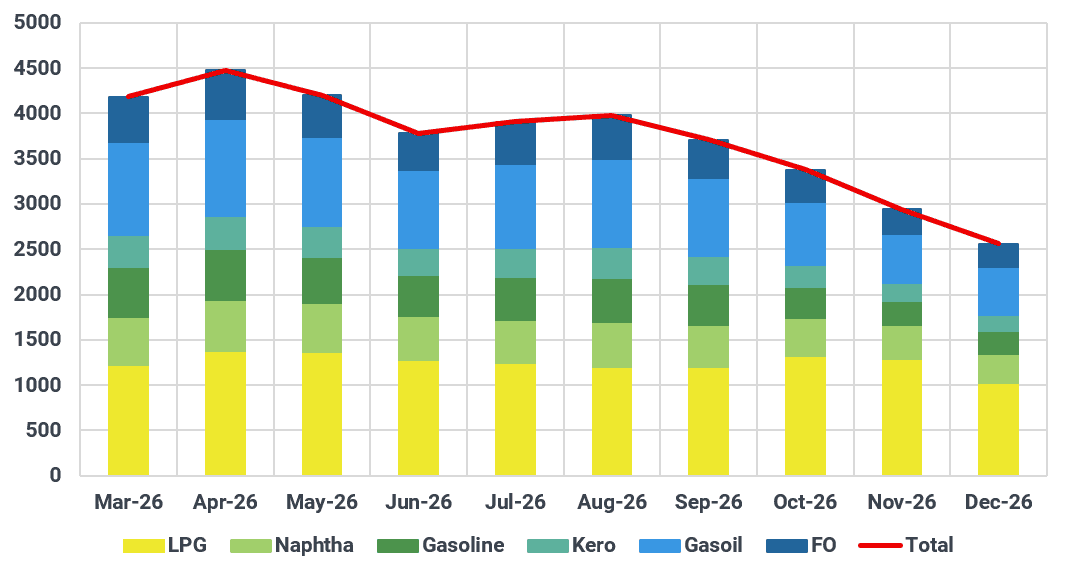
The Middle East has lost around 4 mbd of refined product supply since the start of the conflict.
The impact extends beyond refinery throughput alone. Between March and August, the Middle East has lost around 4 mbd of refined product supply relative to pre-conflict levels. Around 2.5 mbd of this reflects curtailed refinery output, while the remaining roughly 1.5 mbd comes from other regional supply streams, primarily LPG and NGL-derived naphtha.
Refined product loss, including supply from NGL, kbd
Source: Kpler
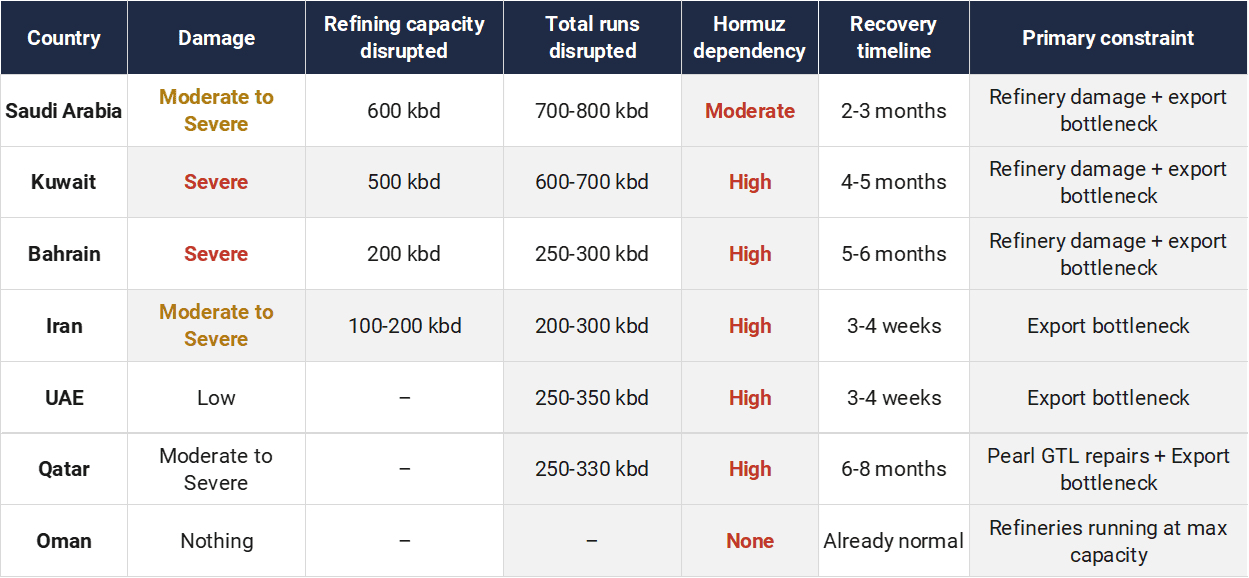
Refinery damage and export constraints leave recovery uneven across the Middle East.
The nature of the disruption differs significantly by country. Saudi Arabia, Kuwait and Bahrain combine substantial physical damage with some of the largest run losses, while the UAE and Iran remain more heavily constrained by product evacuation. Qatar faces a longer recovery following damage to Pearl GTL, while Oman stands apart, with its location outside Hormuz allowing runs to remain near capacity.
ME refineries country-level status: damage, disruption, and constraints
Source: Kpler
Note: Recovery timelines indicate the potential start of a meaningful improvement (from late q4) to pre-war utilisation levels.
Saudi Arabia: Refinery outages and dual chokepoint exposure constrain recovery paths
Saudi refinery runs have fallen to around 2.2 mbd in August. With East Coast product movements constrained through Hormuz, refiners increasingly relied on the Red Sea system, which hosts around 1.87 mbd of refining capacity. However, security risks around Bab el-Mandeb have reduced the flexibility of this alternative route, leaving Saudi product flows exposed across both its eastern and western export corridors.
The 400 kbd Jizan refinery remains offline following Houthi attacks in July and subsequent attacks on associated infrastructure, while SATORP's 200 kbd CDU and associated units have remained under maintenance since April and require extended repairs. We expect SATORP to begin returning around mid-to-late Q4, supporting a gradual recovery in Saudi runs towards 2.45 mbd by Q4. A more meaningful ramp-up is expected in Q1 2027, as the remaining damaged capacity returns to more normal operational levels and runs move closer to pre-war levels.
Kuwait: Hormuz disruption and refinery damage keep runs constrained
Kuwaiti refinery runs are seen at around 570 kbd in Q3 2026, constrained by restricted product exports and damage to Mina Al-Ahmadi and Mina Abdullah. All three major refineries (including Al-Zour) continue to process crude at reduced utilisation rates, with some units idle or under maintenance. In our books, we currently expect runs to recover towards 700 kbd by Q4 as export conditions improve, followed by a stronger ramp-up in Q2 2027 as damaged capacity returns.
UAE: Available capacity could respond quickly to improved shipping
UAE refinery runs are seen at around 700 kbd in Q3 2026, with earlier disruptions at Ruwais largely resolved. The main constraint is now restricted product exports, leaving the UAE well positioned to ramp up refinery runs once shipping improves. We expect runs to recover towards 800 kbd by Q4, with a stronger increase in Q1 2027.
Bahrain and Qatar face longer repair cycles; Iran and Oman are in a better situation.
- Bahraini refinery runs remain sharply curtailed at around 100–120 kbd versus 420 kbd pre-war, following damage to Sitra refinery processing units and restricted exports. We expect runs to recover towards 150 kbd by Q4, before damaged capacity progressively returns and throughput reaches pre-war levels by Q3 2027.
- Qatar’s downstream supply remains constrained following damage to Pearl GTL Train 2 and the idling of Ras Laffan refinery (LR2) following attacks on upstream infrastructure at Ras Laffan. Pearl GTL faces an extended repair period, with restart expected in Q2 2027. Mesaieed & Ras Laffan Refinery (LR1 complex) continues to operate, although at reduced rates.
- Iranian refinery runs have fallen to around 2.2 mbd from 2.45 mbd pre-war, reflecting unit disruptions and constrained naphtha and fuel oil exports. Refiners have increased naphtha blending into gasoline and adjusted fuel oil balances to manage displaced volumes, but limited export outlets continue to constrain runs. We expect throughput to recover towards 2.3 mbd by Q4, with further gains by Q1'27.
- Oman remains the regional exception, with its location outside Hormuz allowing refinery runs to remain near maximum capacity at around 400 kbd, supported by strong margins. Despite reduced access to Kuwaiti crude, the Duqm refinery has shifted towards domestic crude supplies, helping sustain throughput.
Market Insights you can trust
Kpler delivers unbiased, expert-driven intelligence that helps you stay ahead of supply, demand, and market shifts.
Trade smarter. Request access to Kpler today.

See why the most successful traders and shipping experts use Kpler