Rhine River water levels remain critical for European cracker operations
Low Rhine water levels have disrupted feedstock deliveries to inland European crackers since H2 July, forcing run cuts as alternative rail, truck, and pipeline capacity remains insufficient to replace lost barge flows. Looking ahead, official forecasts point to a recovery in water levels into September, alongside rainfall this week. Market prices are also expected to begin reflecting seasonally stronger butane blending demand from H2 September.
Market calls:
- Feedstock disruptions have capped inland European cracker (and downstream plant) runs. We expect cracker runs to average 65–70% into early September.
- If Rhine water levels recover, this will draw down earlier stock builds in ARA butane and naphtha, support inland plant operation recovery and narrow ARA butane barge-to-large cargo spreads into early September.
- From H2 September, the shift to winter-spec gasoline should increase butane blending demand, providing a floor under C4-to-Brent ratios, even if Rhine water levels remain low.
Low Rhine River water levels have disrupted the European petchem market since H2 July. As of 21 August, water levels at Kaub improved to 45 cm (due to the rain), up from below 10 cm at the start of the week. While WSV forecasts point to further recovery, any level below 40 cm will still mean critical disruption to logistical flows along the river.
Feedstock disruption for crackers along the Rhine River
Typically, some 4 Mt/year of naphtha is transported from the ARA region via pipeline or barges to feed the inland crackers (industry report), especially in Germany. Pipeline transport is mainly via the Rotterdam-Rhein-Pipeline (RRP), which connects to the Rhein-Main-Rohrleitung (RMR). However, since pipeline capacity is capped, additional naphtha volumes rely on barges of up to 5 kt for inland transport.
For the past month, barges have been operating at only ~20% of normal capacity, with traffic even coming to a standstill at parts of the Upper Rhine in early to mid-August. The resulting feedstock constraints have forced run cuts at several German crackers.
Steam crackers impacted by low Rhine levels, kt/year
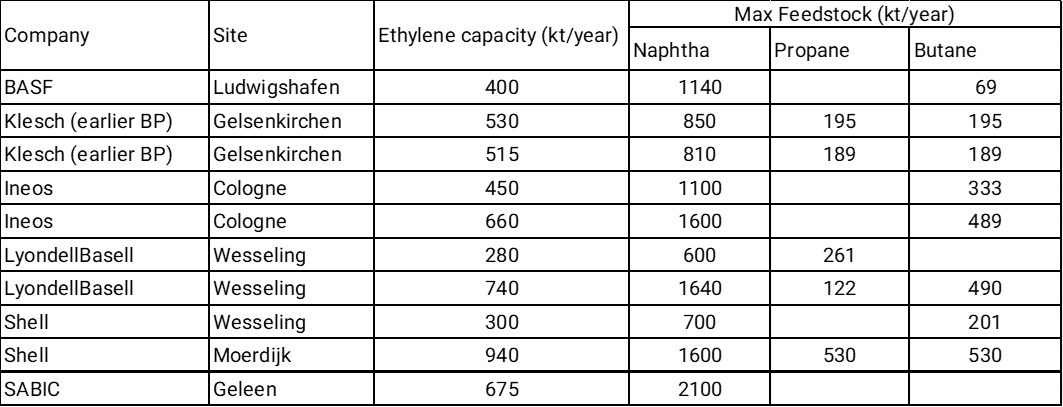
Insufficient feedstock deliveries by barge have directly reduced downstream output across several major production sites. LyondellBasell has declared force majeure on butadiene supplies from the Wesseling plant. Furthermore, Shell's Wesseling cracker has been offline since early July, and is now expected to remain down until end-September (Argus). BASF also cancelled their surfactant supplies in early August.
In early August, Klesch Group acquired BP’s Gelsenkirchen refinery business, including the integrated ethylene plants. Although the two crackers are integrated with the refinery and can process ~20% gasoil, some naphtha imports are still typically required (also it would be quite unprofitable to run gasoil currently). Moreover, the 265 kb/d Gelsenkirchen refinery entered a turnaround this week, expected to last several weeks (Argus), which will likely further dampen cracker runs.
Ethylene crackers along the Rhine River and the ARG pipeline
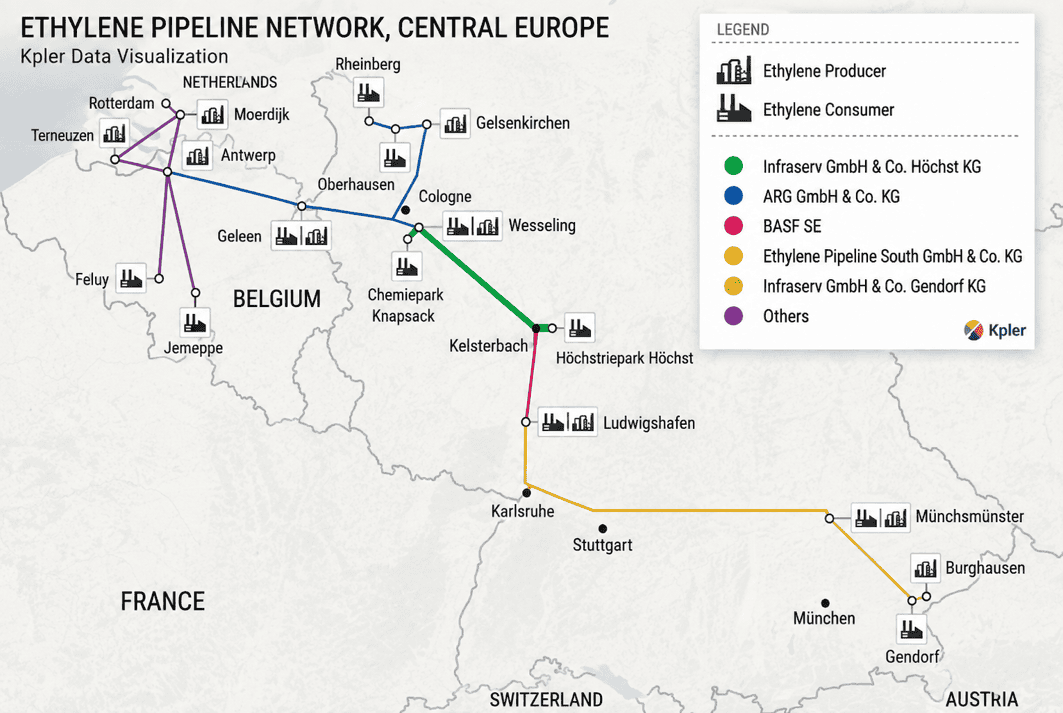
Source: Kpler, Industry reports
Alternatives to Rhine River flows are limited
Companies faced increasing cost with the reduced vessel capacity, increasing dead freight, and low-water surcharges. While LPG fleet availability was a limiting factor, few alternative options were available.
Rail and truck networks are insufficient to absorb the displaced volume and were already being jammed up. Replacing a barge carrying 1.2 kt of butane would need 27 railcars (45t each). In ARA, only three terminals can handle block-train loadings, typically comprising 17–24 railcars. However, they were already operating at maximum capacity (Argus). The limited number of railcars will cap any further upside in the near term.
The ARG pipeline is also an alternative mode of supplying ethylene. It typically receives ethylene from crackers in the ARA region which is then sold to downstream plants with a connection. Although coastal crackers will be incentivized to raise runs to supply ethylene, high energy costs and negative margins will cap operating rates. An overall lower ethylene injection from crackers will mean that ethylene will be priced high to keep the pipeline system balance.
Northwest European gross complex steam cracking margins per ton of ethylene ($/t)*
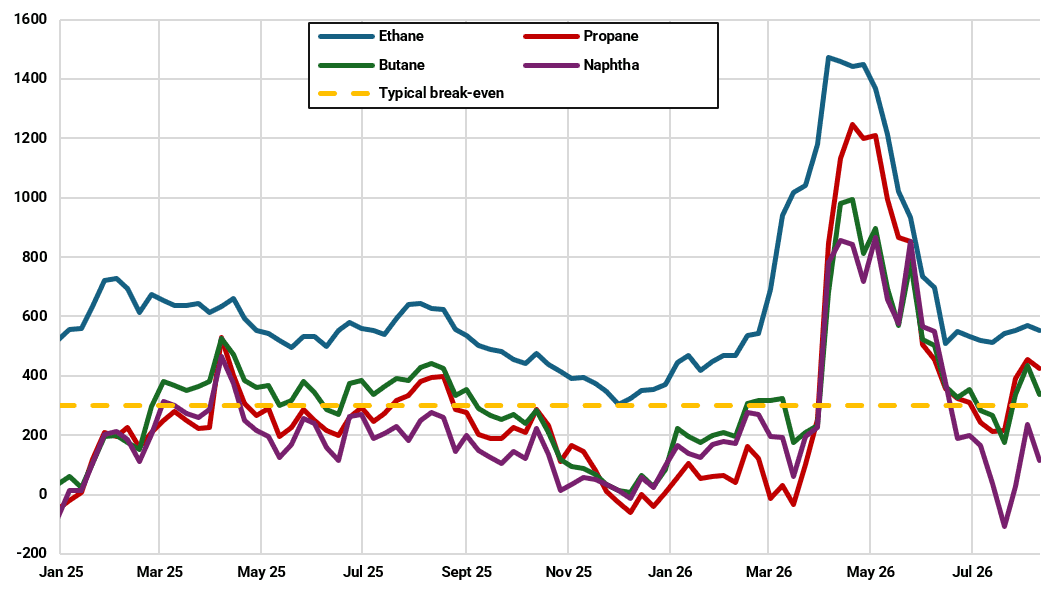
Source: Kpler calculations using Argus Media prices
BASF is working on deploying low-draft barges, previously used in 2023, capable of navigating ~30 cm water levels at Kaub. These barges will help move additional volumes, especially as water levels improve this week. At Ludwigshafen, around 30% of products are transported by rail, 30% by truck, and 40% by barge along the Rhine.
Further challenges also occurred with elevated water temperature restricting cooling systems for crackers, affecting normal operation. BASF alone normally needs to circulate ~5 million cubic metres of water from the Rhine through cooling pipes at its Ludwigshafen site. Additionally, evacuating key by-products (aromatics) also faces logistical challenges.
On 14 August, BASF began expanding its combined transport terminal (Kombiverkehrsterminal) in Ludwigshafen which aims to reduce its reliance on Rhine transport. The expansion will lift annual capacity to 370,000 loading units, alongside deploying three new cranes (Industry news). However, completion is not expected until 2028.
Meanwhile, naphtha stocks around the ARA hub have been building as volumes struggle to reach inland crackers, particularly for light naphtha. This comes despite firm blending demand in both NWE and the US.
ARA: naphtha stocks in independent storages (Mb)
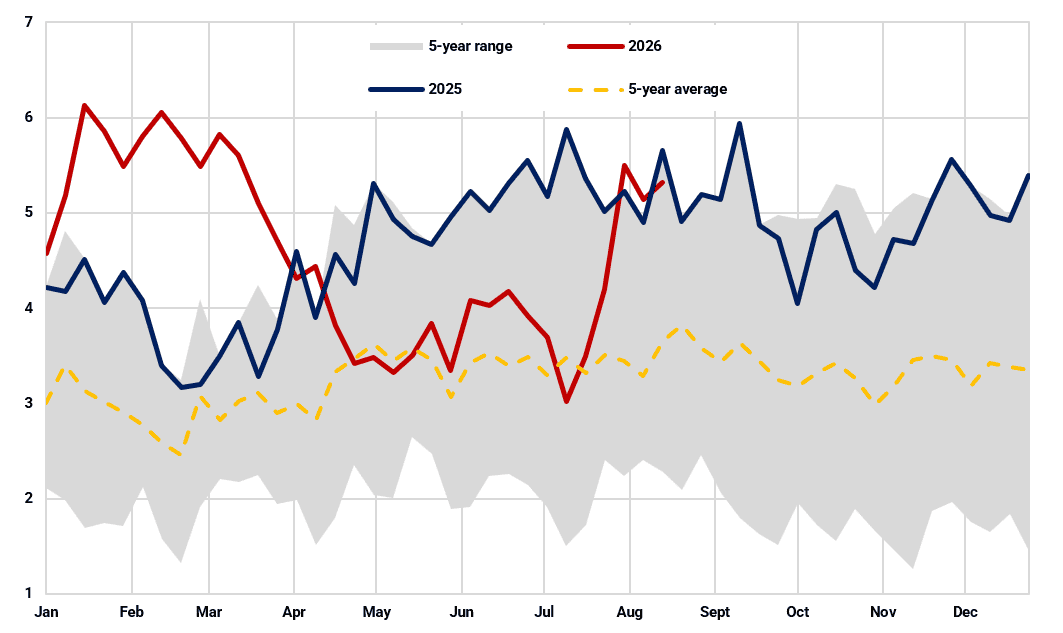
Source: Kpler calculations based on Insight Global data
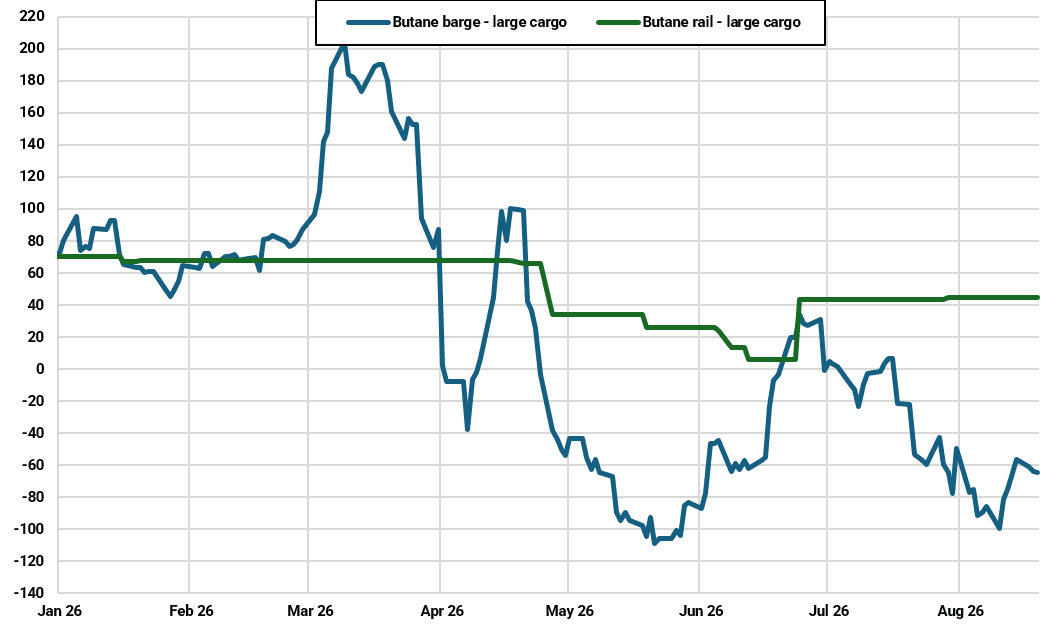
ARA butane inland to large cargo spreads ($/t)
Source: Kpler calculations based on Argus Media prices
The oversupply in coastal storage had also depressed ARA butane inland to large cargo spreads, which is likely to persist into early September amid tight barge availability. That said, the shift to winter-spec gasoline from H2 September will increase butane blending and narrow the spread, even if Rhine water levels remain very low.
Looking ahead, recovery hinges on Rhine water levels, with the official 14-day forecast published on 20 August pointing to levels reaching 77 cm (equivalent water level) at Kaub in September.
If water levels at Cologne could improve to 100cm, the two Ineos crackers with a combine capacity of 1.1 Mt/year should be able to pull more butane from ARA stocks (~24 kbd C4). Together with the gradual shift to winter-spec gasoline blending, this should provide a floor under C4-to-Brent ratios next month. Overall, we expect inland European cracker runs to remain around 65–70% into early September.

See why the most successful traders and shipping experts use Kpler