

The last miner standing: Fortescue faces CMRG alone as Rio Tinto settles
Ongoing miner negotiations with China Mineral Resources Group (CMRG) are reshaping term supply iron ore contracts and splitting pricing into distinct camps. In October, Rio Tinto agreed to a new supply contract, joining BHP. Fortescue is now the last major without a deal and warns operations may be affected if talks run past year-end. Vale remains insulated. Kpler flows show miner volumes held in every case. The impact registered in product mix, China’s share of loadings and realised prices. Futures read Rio’s deal as the removal of a supply-risk premium, with SGX IODEX 61% Fe at $89.90/t leaving cost and freight as the main supports.
Rio Tinto settles: volumes held, mix shifted
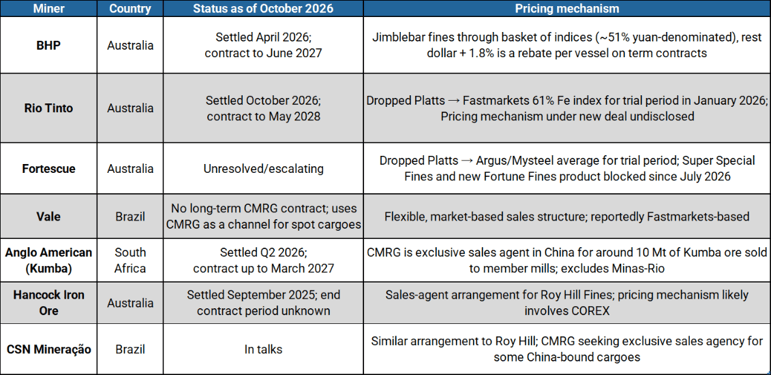
Rio Tinto has reportedly agreed a multiyear supply contract with China’s iron ore state buyer, China Mineral Resources Group (CMRG). The contract extends to May 2028, though volumes and pricing terms are undisclosed. The deal ends a standoff that began in early August, when CMRG told some mills to halt talks with Rio Tinto for Pilbara Blend shipments from September. Earlier in January 2026, Rio Tinto had agreed to trial the Fastmarkets 61% Fe Fines Index but held off adopting COREX directly, citing its short data history and portside-only methodology. Ultimately, CMRG now holds a single aggregated book against Rio Tinto's shipments, replacing dozens of parallel, mill-level negotiations.
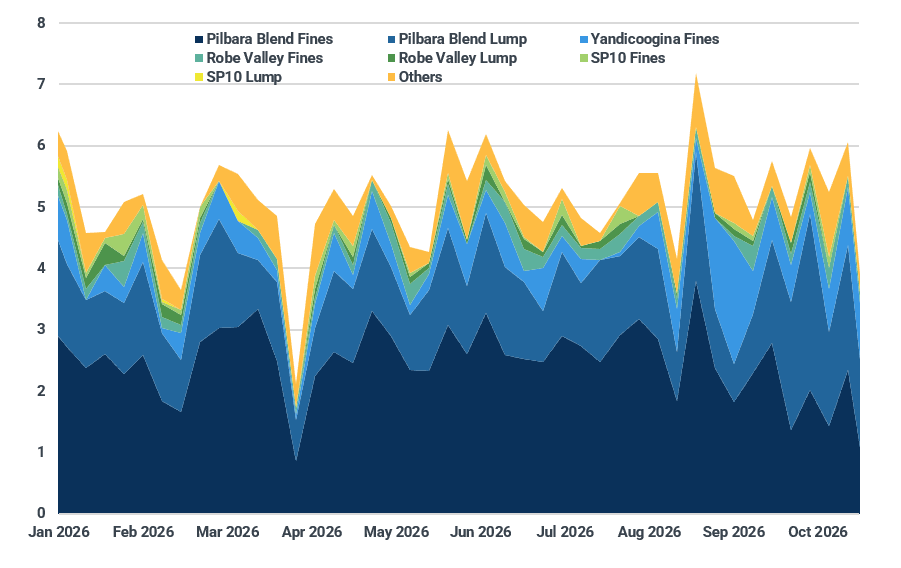
Kpler export data from Dampier and Cape Lambert to China shows no disruption across the negotiation window. The pattern repeats what we saw with BHP, where discharges at Chinese ports continued throughout the pricing dispute. Rio Tinto’s Australian cargoes to China averaged 5.45Mt a week from early September to mid-October, 2% below the same weeks of 2025. But grade-level data shows where the dispute actually landed. Pilbara Blend Fines fell a third to 2.01Mt a week, Pilbara Blend Lump rose 7% to 1.69Mt, and Yandicoogina Fines almost tripled to 0.86Mt. Lump prices off a separately assessed premium rather than off the 61% fines index.
Rio Tinto’s Australian cargoes to China by grade (Mt)
Source: Kpler Insight, Enverus, SGX, TSI
Two structural facts favoured a faster resolution for Rio Tinto, and the first is visible in the flows. Its Pilbara Blend volumes are overwhelmingly destined for China with little capacity to be diverted. Its mid-market grade also lacks both the premium that protects Vale and the discount flexibility Fortescue uses to clear lower grades. Simandou adds a third pull: Chinalco, Rio’s largest shareholder, is its project partner, and first ore through the SimFer port is expected in Q4, with final overall port commissioning slated for completion in Q1 2027. China Harbour Engineering Company (CHEC) reported on 22 Oct that Simfer port has advanced to heavy-load commissioning. Together these leave less room to absorb a long dispute than either of its peers. They also mean the deal’s terms, when they emerge, are likely to set the template for the mid-grade mainstream of the market.
Looking ahead, we forecast Rio Tinto’s Western Australian exports at 87.50Mt in Q4, up 4.1% q/q from 84.07Mt in Q3 but 2.5% below the record 89.77Mt of Q4 2025. The y/y decline reflects a tough comparison rather than lost volumes due to CMRG negotiations.
Simandou: the structural answer arrives on schedule
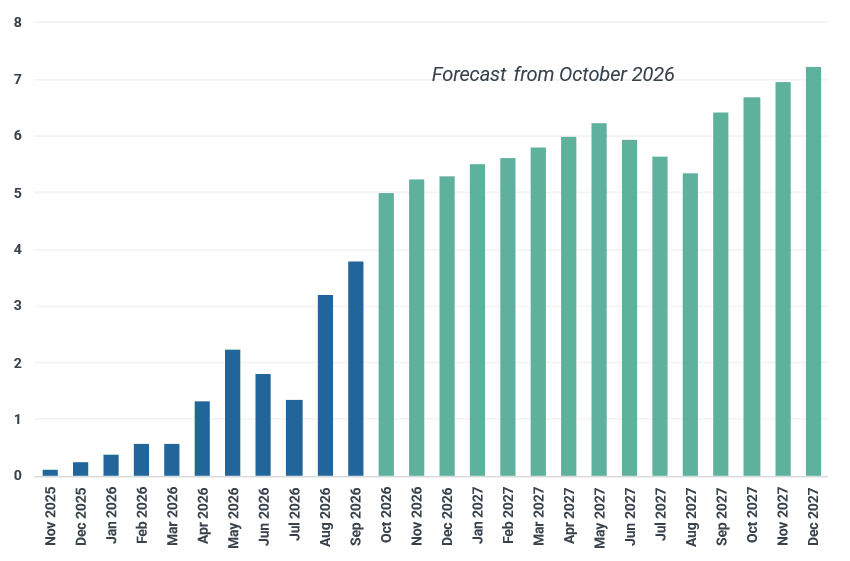
Morebaya loaded 3.78Mt in September, up 17.8% m/m and the highest month since exports began. The weekly series set a fresh high in the week ending 18 October at 1.58Mt, up 41% w/w. October volumes to date stand at 4.36Mt with predictive flows for the month forecasted at ~5Mt.
Simandou iron ore shipments forecasted strong (Mt)
Source: Kpler Insight
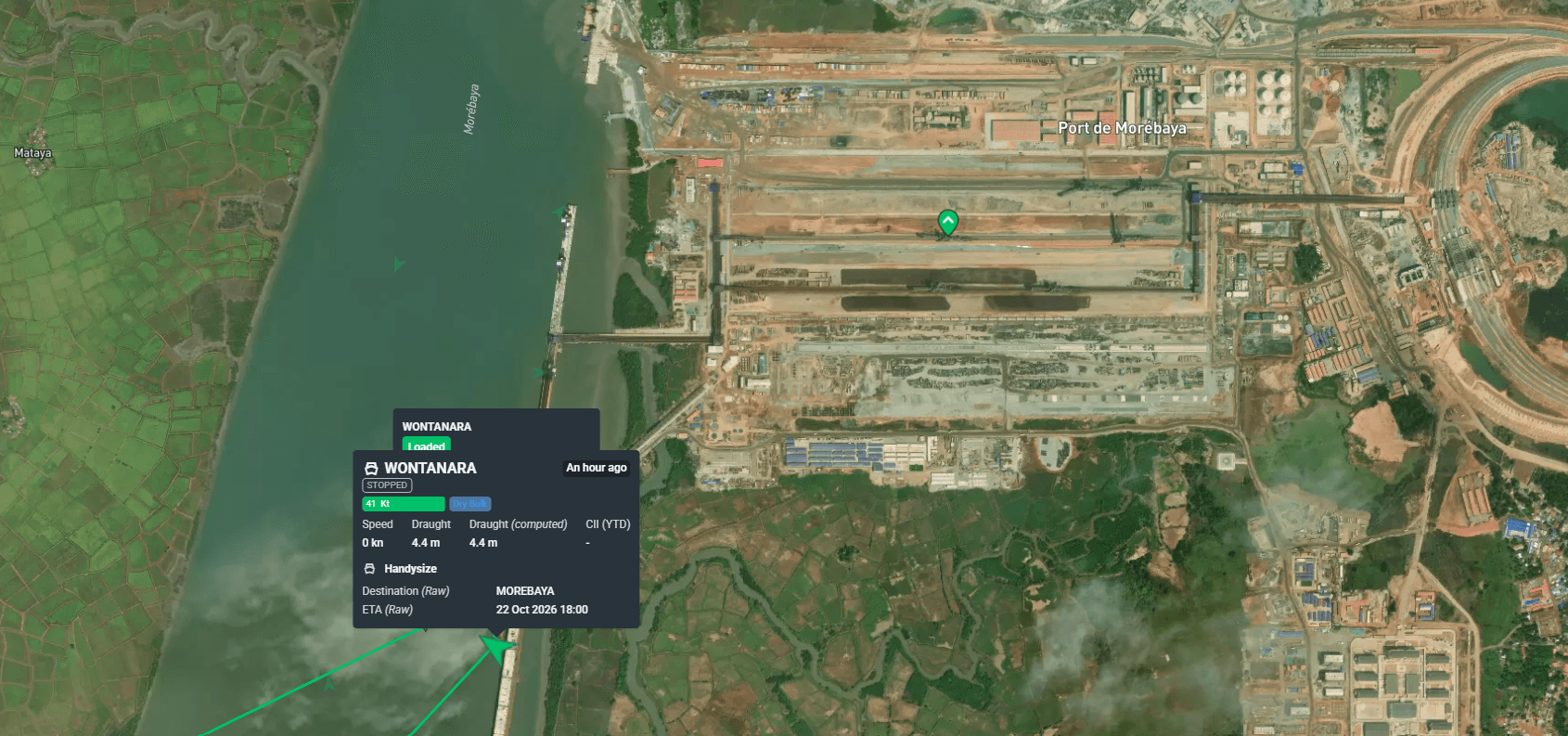
Transhipment shuttle vessel (TSV) Wontanara has arrived at Morebaya, the first of five built for SimFer’s logistics chain. Capacity depends on how fast ore moves from barge port to vessels at anchor, not just on mine output and rail. Every TSV lifts that ceiling, and Kpler can track each one, a forward read no production disclosure offers.
Transhipment shuttle vessel (TSV) Wontanara arrives at Morebaya
Source: Kpler, Mapbox
We forecast 2026 Simandou exports at 28Mt in our base case, rising to 30Mt in our accelerated scenario. Both sit above official 2026 guidance set by Rio Tinto for the four blocks, and the TSV arrival now supports the upper end. For 2027, we forecast 72.6Mt and 77.7Mt respectively. That step-up rests on four more TSVs in coming months, plus WCS Phase 2 and SimFer’s permanent crushing facilities running at higher rates. Locomotive count on the TransGuinean line remains our leading indicator.
West and Central African supply is China's long-term route out of dependence on Australia and Brazil. Simandou is high-grade, and as volumes scale, China gains a supply source where the ownership structure changes the price taker. That is a different kind of leverage from the CMRG negotiations. CMRG changes the terms on existing tonnage. Simandou changes whose tonnage it is. Over the longer horizon, the second matters more.
Fortescue stands alone as volumes and realisations slip
Fortescue is now the only major miner outside CMRG's book, and its own disclosures let us price what that position costs. Fortescue's September quarter report, released on 22 October, puts a year-end deadline on the dispute. FY27 guidance is unchanged but explicitly subject to the negotiations. Realisation is the clearest signal. Against the average Platts IODEX 61% Fe CFR China index, Fortescue realised 89% in the March quarter, 84% in June and 82% in September, even as the benchmark fell. Grade explains only part of it. The rest looks like the discount a consolidated buyer can extract.
Kpler data indicates FMG exported 45.50Mt of iron ore from Western Australia in the September quarter, down 6.2% y/y, largely due to CMRG restrictions. Shipments to China fell to a two-year low of 39.44Mt. Here the physical data says something the company reporting does not. Despite restrictions in place since 15 July, Super Special Fines cargoes continue to discharge in China even as Chinese imports from Anderson Point decline. With Rio settled, CMRG can focus on one counterparty.
Fortescue's shipments to non-China destinations remain elevated, but scope to reroute is narrower than the headline suggests. Its restricted products sit at 56.5% Fe and below, and few markets take low-grade fines at volume. India, Japan and South Korea cannot absorb Pilbara-scale tonnage without displacing their existing supply contracts.
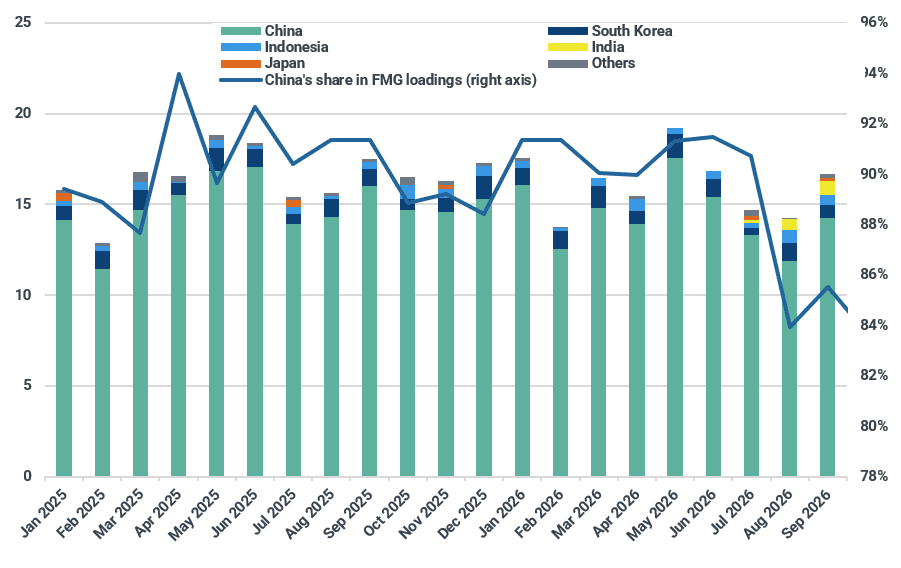
China took 88% to 94% of Fortescue’s loadings every month from January 2025 to July 2026. The share fell to 84% in August, the low in our series, and has held at 84% to 86% since, in line with the 15 July restrictions.
China’s share in FMG loadings (Mt) slides to 84% as CMRG restrictions bite
Source: Kpler Insight
The redirection shows up in destinations that barely existed before. India took no Fortescue cargoes at all from January 2025 to June 2026, then 0.13Mt in July, 0.57Mt in August and 0.80Mt in September. Indonesia rose to 0.71Mt in August against a prior average nearer 0.35Mt. Japan has reappeared after long absences.
Non-China loadings averaged around 1.5Mt a month through 2025 and have run at 2.0Mt to 2.4Mt since August. The problem is scale. The redirection is worth roughly 0.8Mt to 0.9Mt a month. China volumes fell from 15.41Mt in June to 11.90Mt in August, a gap of 3.5Mt. Diversification is covering about a quarter of what China stopped taking, and the rest is going to stockpile and corroborates directly with FMG’s expectation of a further 4Mt to 5Mt during October as it continues to optimise product placement channels.
The year-end deadline
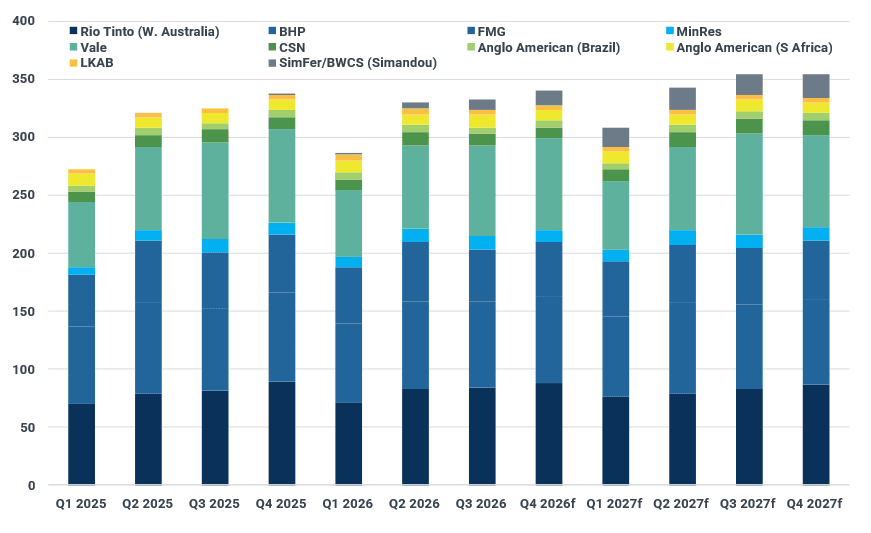
Rio’s settlement weakens Fortescue’s hand, and the year-end deadline adds urgency. We expect a deal sooner rather than later, with a partial or interim agreement possible in the December quarter. We forecast Fortescue’s Q4 exports at 47.20Mt, up 4.4% q/q from a weak 45.21Mt in Q3, which was itself 12.3% below Q2. That is still 5.8% below Q4 2025, making it the third straight quarter of y/y decline. For 2026 we forecast 191.70Mt, down 6.10Mt or 3.1% on 2025’s record 197.80Mt and close to 2024’s 191.19Mt. Kpler forecasts show Simandou supplying nearly all of the growth in major and mid-tier miner exports through 2027.
Seaborne iron ore exports by major and mid-tier miners (Mt)
Source: Kpler Insight
Three candidate floors exist. Cost support, freight and declining domestic Chinese supply. A structural decline in domestic grade and volume keeps import demand underpinned even as steel output falls. Against those, the pressures are unchanged and arguably heavier. The soft floor has not disappeared, but its source has shifted from policy to cost and freight.
A policy premium arrives in one headline and holds for weeks. A cost floor erodes as miners cut costs, and a freight floor can reverse in a fortnight.
Miner/CMRG negotiation summary
Source: Kpler Insight, Company reports, Market sources
Please see the latest Iron Ore Balances dataset for an Excel file detailing our 18-month ahead forecasts for major iron ore importers and exporters, crude steel production forecasts, quarterly projections for major miners, and iron ore price forecasts.

See why the most successful traders and shipping experts use Kpler