Water levels, heat and stretched rail capacity stress German logistics
German oil logistics are under increasing strain as low Rhine water levels and a heatwave put pressure on already stretched distribution systems.
Market & Trading Calls
- Bullish barge freight as low water reduces functional capacity along the Rhine
- Potential for tighter diesel markets in Germany as falling water levels compound strained rail systems, making oil product distribution harder
- Bullish inland diesel prices as increased logistical costs are passed along the value chain
Water levels at Kaub — the key chokepoint on the Middle Rhine — are expected to fall below 100 cm in the coming days, according to the Federal Waterways and Shipping Administration (WSV). Barges moving oil products, primarily diesel/gasoil and gasoline, along the waterway will operate at approximately half capacity at these levels. Barge freight rates across the Amsterdam-Rotterdam-Antwerp hub have reached their highest level since July 2025 (Argus), and prices into Basel, Switzerland, are rising as more vessels are required to move the same volume of material.
The fall in water levels continues a trend visible since April, with levels at Kaub consistently below the five-year average and tracking close to 2022; a particularly bad year for Rhine navigation also affected by summer heatwaves.
Kaub Water levels (cm)
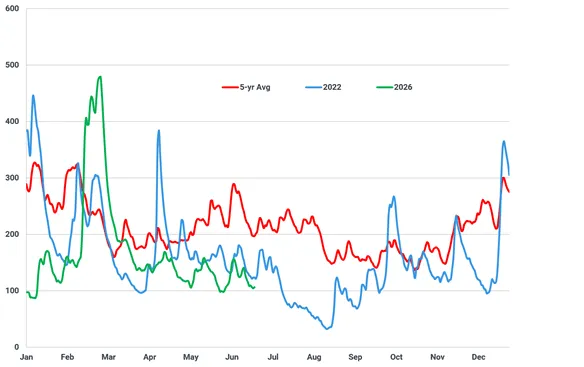
Source: Federal Waterways and Shipping Administration (WSV), provided by the Federal Institute of Hydrology (BfG)
The timing of low water levels is compounding the impact, coinciding with a heatwave across much of Europe that adds further operational pressure. Persistent low water levels drive greater movement of oil products by railcar in Germany. However, rail is significantly less flexible than barge: bookings require planning weeks in advance, specific staffing is needed on non-standard diversion routes, and speed restrictions can be imposed in exceptionally hot weather as rail temperatures approach critical thresholds. This makes routine logistics and depot resupply more challenging as failure rates rise and capacity slots are missed.
For intermodal transport, often a last resort, conditions will be even more difficult. Rail also faces structural capacity constraints of its own in Germany, where a major modernisation programme is ongoing, extending journey times across the network. While some routes have improved — the Hamburg–Berlin corridor reopened in mid-June 2026 after a 10-month closure — the programme is expected to continue until the mid-2030s, with billions of euros of investment still ahead.
According to the Central Commission for the Navigation of the Rhine, total oil product transportation on the Rhine fell 6.2% year-on-year in H1 2025. Low water levels were a contributing factor, meaning that the slack needed to be picked up by other transport means, as flagging diesel demand in Germany required fewer imports. Total imports of diesel into Germany, with Belgium and the Netherlands accounting for over 70% of the total (including via pipeline), fell by close to 4% y/y in 2025 to 14.3 million tons (Eurostat).
Low water levels can also affect refinery operations directly, particularly when they are chronically low. For the two refineries connected to the Upper and Middle Rhine — MiRO in Karlsruhe and Shell’s Godorf refinery near Cologne — constrained barge access complicates product evacuation, especially for niche products where storage tanks are typically small and alternative rail or road options are limited or non-existent. These products tend to be prioritised for the available barge loadings, displacing more fungible products onto rail slots, which can quickly become saturated. Elevated ambient temperatures can also reduce refinery throughput and efficiency, resulting in lower and suboptimal production.
These logistics pressures arrive as Germany also faces additional road fuel demand: a temporary tax reduction on gasoline and diesel — introduced in response to the Ukraine war — expires on 30 June, which may prompt front-loading of purchases in the final days of June.

See why the most successful traders and shipping experts use Kpler