trusted by thousands of organisations worldwide


.webp)



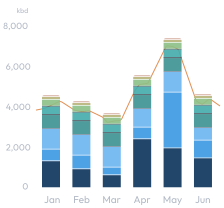
Monthly Crude Exports
United States (by destination)
480+
Buyers & sellers tracked
14k+
liquids tankers monitored
500+
crude grades tracked
Crude oil
Thank you! Your submission has been received!
Oops! Something went wrong while submitting the form.
Accuracy:
98.9
%
Accuracy:
99.5
%
Kpler
Customs
Crude oil
Kpler
EIA
Crude oil
Coal / petcoke
Thank you! Your submission has been received!
Oops! Something went wrong while submitting the form.
Accuracy:
99.29
%
(last 12 months)
Accuracy:
95.62
%
(last 12 months)
Kpler
Customs
Coal / petcoke
Kpler
Customs
Coal / petcoke
Iron ore
Thank you! Your submission has been received!
Oops! Something went wrong while submitting the form.
Accuracy:
96.62
%
(last 12 months)
Accuracy:
97.83
%
(last 12 months)
Kpler
Customs
Iron ore
Kpler
Customs
Iron ore
Grains
Thank you! Your submission has been received!
Oops! Something went wrong while submitting the form.
Accuracy:
99.52
%
(last 12 months)
Accuracy:
98.77
%
(last 12 months)
Kpler
Customs
Grains
Kpler
Customs
Grains
LNG
Thank you! Your submission has been received!
Oops! Something went wrong while submitting the form.
Accuracy:
98.9%
%
Accuracy:
97.5%
%
Kpler
EIA
LNG
Kpler
GTT
JODI
Customs
LNG
LPG
Thank you! Your submission has been received!
Oops! Something went wrong while submitting the form.
Accuracy:
96.9
%
Accuracy:
99.47
%
Kpler
EIA
LPG
Kpler
Customs
LPG
Gasoline / diesel
Thank you! Your submission has been received!
Oops! Something went wrong while submitting the form.
Accuracy:
96.89
%
Accuracy:
94.6
%
No items found.
No items found.
Gasoline / diesel
Includes land-based flow assumptions
Kpler
Customs
No items found.
Gasoline / diesel
Fertilizer
Thank you! Your submission has been received!
Oops! Something went wrong while submitting the form.
Accuracy:
98.38
%
(last 12 months)
Accuracy:
95.67
%
(last 12 months)
No items found.
No items found.
Fertilizer
Kpler
Customs
No items found.
Fertilizer
Metals
Thank you! Your submission has been received!
Oops! Something went wrong while submitting the form.
Accuracy:
99.44
%
(last 12 months)
Accuracy:
98.57
%
(last 12 months)
Kpler
Customs
Metals
Kpler
Customs
Metals
- Leverage Kpler’s coverage of 493+ crude oil grades to gain clarity into changes in the global crude slate
- Dive into crude quality data to determine market gaps in sweet and sour barrels and take advantage of emerging opportunities
- Analyze long and short haul trades with clarity on ship-to-ship transfers, bills of lading, commercial players and charter details to position your strategy
- Build dashboards and alerts to monitor key installations and locations to easily maintain an eye on the interplay of regional crude markets
720+
oil & chemicals grades tracked globally
43M+
barrels per day of crude oil monitored
1.3M+
Kt of clean petroleum products tracked
98.5%
accuracy rating for crude exports
Request demo

- Instantly evaluate 80+ crude alternatives in just a few clicks, saving time when markets shift.
- Landed Value calculation: Combines voyage costs, freight, and quality differentials to assess the true delivered value of each crude grade at destination.
- Refining Margin comparison: Evaluates the theoretical margin for refining a crude at destination, benchmarked across grades and regions.
- Data integration: Leverages Kpler’s cargo tracking, freight, and fixtures data to ensure a consistent, data-driven view of global arbitrage economics.
- Use cases: Supports traders and analysts in selecting optimal grades for arbitrage trades, validating trade economics, and monitoring shifting crude flow incentives.
720+
oil & chemicals grades tracked globally
43M+
barrels per day of crude oil monitored
1.3M+
Kt of clean petroleum products tracked
98.5%
accuracy rating for crude exports
Request demo

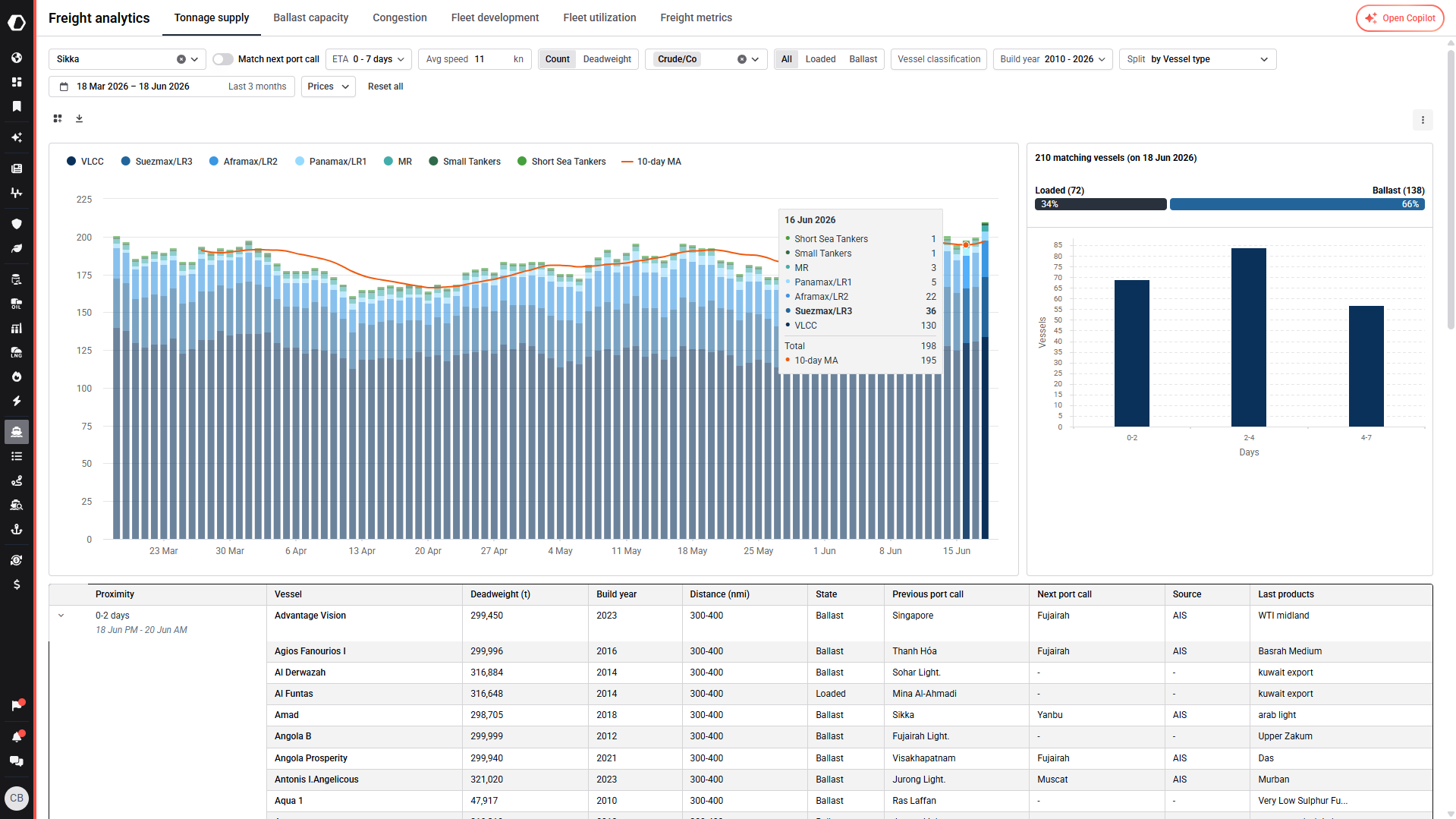
- Analyze and track fleet performance for 9,900+ vessels to understand how market factors such as tonmile demand or ballast speed are shifting
- Decipher utilization with clarity on ownership, charter parties, and history beginning in 2017
- Utilize freight calculator tools to provide insight into voyage planning to save time and cost
- Discover canals and port congestion including duration and vessel data for a robust understanding of the interplay between routes and trades
720+
oil & chemicals grades tracked globally
43M+
barrels per day of crude oil monitored
1.3M+
Kt of clean petroleum products tracked
98.5%
accuracy rating for crude exports
Request demo
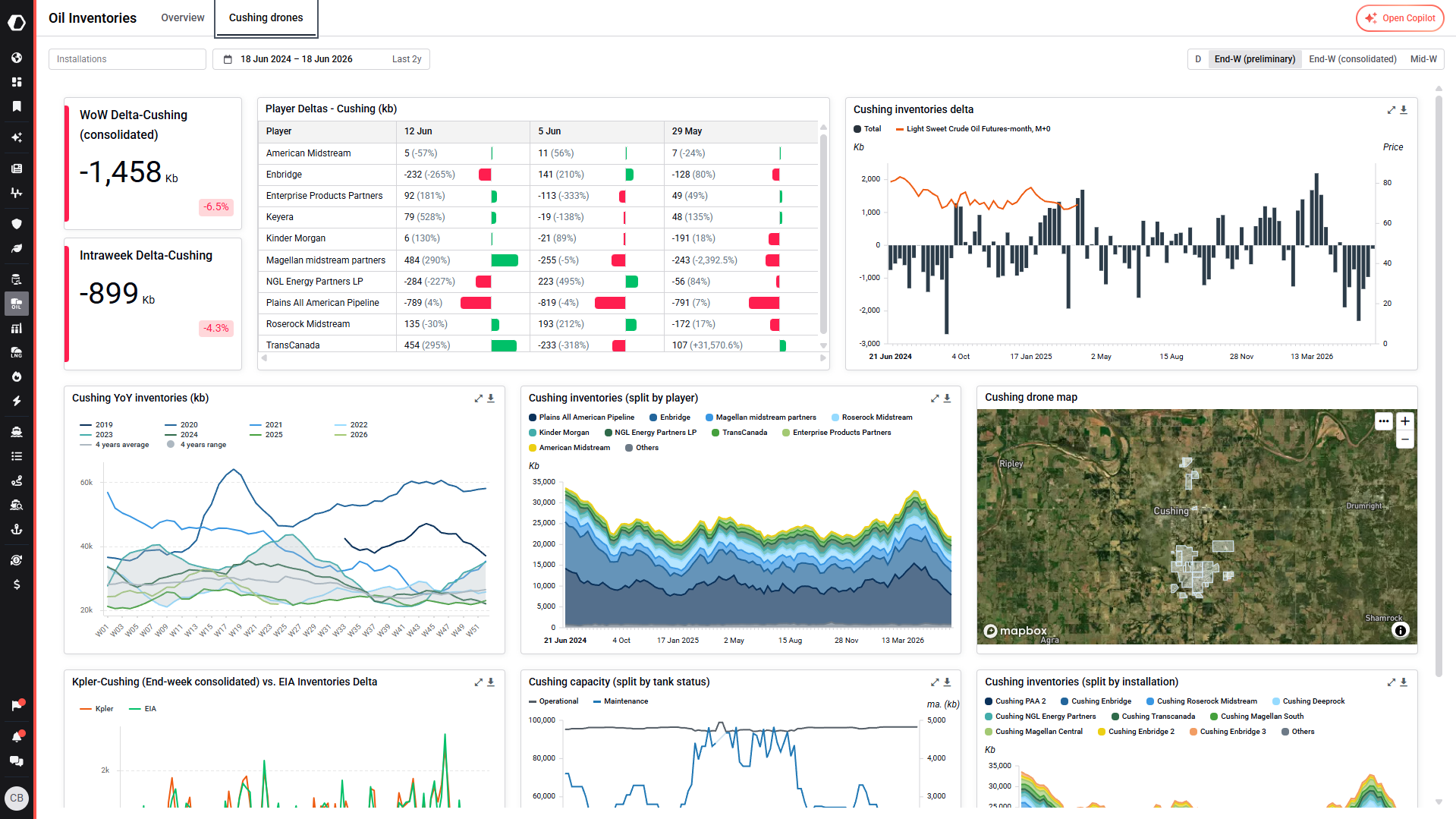
- Gain accurate tank by tank volume for floating roof tanks to establish better and faster trading decisions
- Receive powerful underground and fixed roof inventory volumes through a unique cargo tracking enhancement
- Capture precise real-time floating storage data to incorporate this key supply metric to your analysis
- Tap into bespoke drone technology to quickly and efficiently get 100% of the inventories at Cushing before the weekly EIA release
720+
oil & chemicals grades tracked globally
43M+
barrels per day of crude oil monitored
1.3M+
Kt of clean petroleum products tracked
98.5%
accuracy rating for crude exports
Request demo
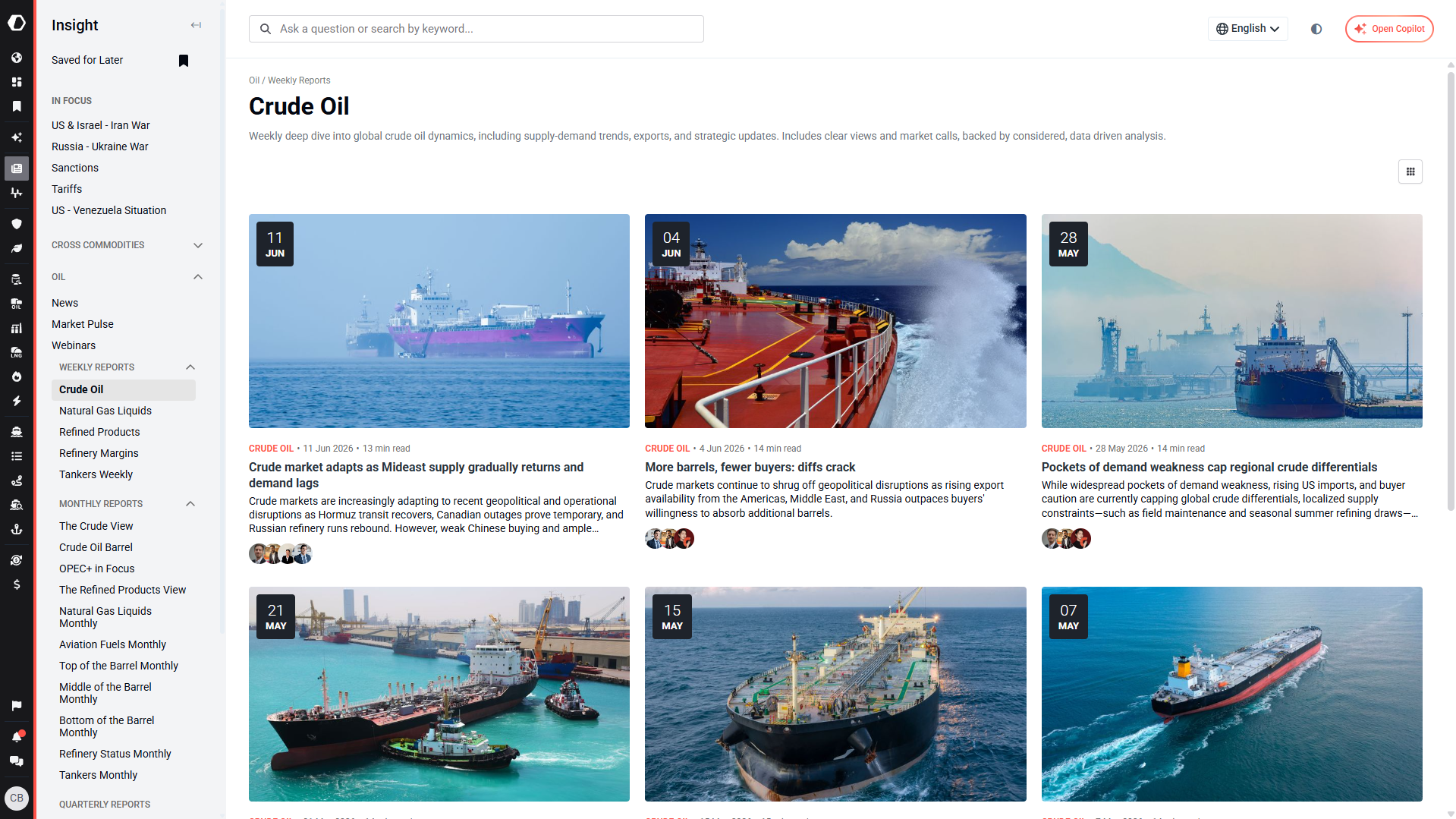
- Get daily updates on crude oil supply & demand, focusing on short-term drivers that impact your investments.
- Discover weekly expert analyses that explore supply, demand, pricing, and trading, with a spotlight on profitable arbitrage opportunities.
- Dive into monthly comprehensive reports on crude oil trends in the Middle East, Asia, the North Sea, the Med, the FSU, WAF, Latin America, US, Canada, and the Gulf of Mexico
720+
oil & chemicals grades tracked globally
43M+
barrels per day of crude oil monitored
1.3M+
Kt of clean petroleum products tracked
98.5%
accuracy rating for crude exports
Request demo
- Track the evolution of crude oil supply and demand balances with historic data back to 2017, thrice monthly present day updates, and monthly forecasts.
- Analyze global, regional, and country level balances or combine countries to form your own regions.
- Zoom into any part of the balance with 5-year charts, tabular views and more, all in a responsive easy-to-view platform.
- Component breakdowns such as direct crude use and stock changes allow customers to see why the balance is changing
720+
oil & chemicals grades tracked globally
43M+
barrels per day of crude oil monitored
1.3M+
Kt of clean petroleum products tracked
98.5%
accuracy rating for crude exports
Request demo




.webp)
Other fundamental intelligence solutions