Iran war and the strait of Hormuz: Oil market implications six weeks in
The Strait of Hormuz crisis is reshaping global oil markets
Six weeks into the Iran–US conflict, the closure of the Strait of Hormuz has triggered the most significant supply disruption in the modern oil market. Approximately 11 million barrels per day of crude production has been taken offline, export volumes from the Middle East Gulf have fallen from 15 million to an effective 7 million barrels per day, and refinery run cuts are adding a further 3 million barrels per day to the supply shortfall. The global market is now drawing at roughly 6 million barrels per day – and the gap is not yet fully reflected in deferred prices.
For commodity traders, shipping professionals, and energy decision-makers, the critical questions are no longer whether this disruption is serious – it plainly is – but how long it lasts, how far prices must rise to rebalance demand, and which trade routes and supply sources emerge as relative winners.
Market context: how we got here
Prior to the conflict, the Strait of Hormuz handled an estimated 15 million barrels per day of crude and product exports from the Middle East Gulf. Saudi Arabia, the UAE, Kuwait, Iraq, and Iran collectively accounted for the bulk of those flows, with China and India as the dominant destinations.
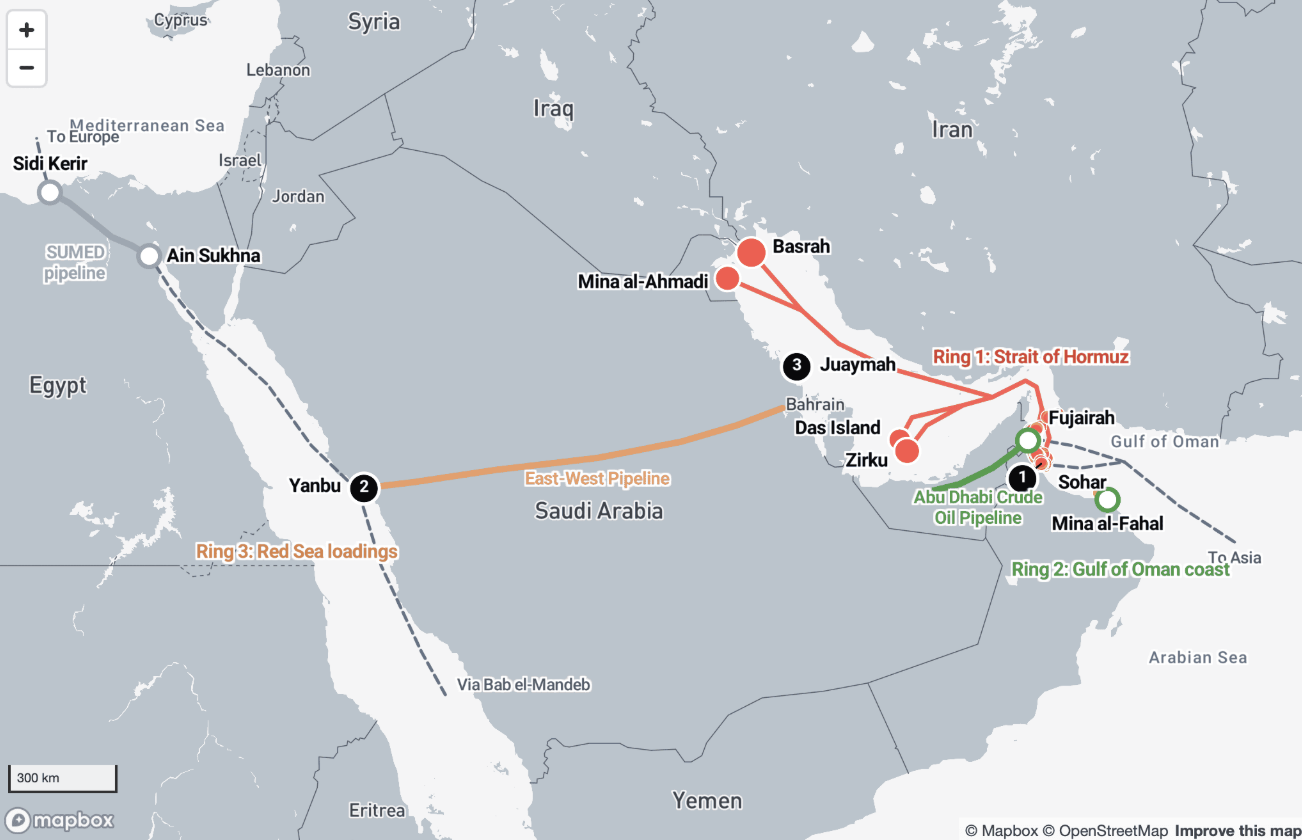
Since the strait's effective closure, rerouting options have been limited. Saudi Arabia has activated the east–west pipeline to Yanbu at maximum capacity – around 4–4.5 million barrels per day of export capacity – while the UAE continues to export approximately 1.5 million barrels per day out of Fujairah. Iranian crude, notably, continues to transit the strait at roughly 1.5 million barrels per day. That leaves approximately 8 million barrels per day stranded.
Iraq has been among the worst-affected producers. Pre-war exports of around 4 million barrels per day have collapsed to approximately 900,000 barrels per day, with only a single pipeline to Turkey – capacity 300,000 barrels per day – providing an alternative outlet.
Key insights and analysis
Geopolitical outlook: escalation risk remains elevated
The dominant base case – assigned a probability of roughly 50–60% – is continued pressure without a decisive breakthrough, characterised by sustained airstrikes and no meaningful diplomatic resolution. A full escalation scenario, including strikes on energy and power infrastructure or boots on the ground, is assigned a 20–35% probability. A diplomatic outcome – while not impossible – is seen as a low-probability event at around 15%.
The US administration's stated preference appears to be de-escalation and an exit from the conflict. However, the disconnect between that intent and the public posture being adopted makes a clean off-ramp difficult to construct. A limited ceasefire framework, potentially involving some form of Iranian oversight over Strait transit in exchange for a halt to bombardment, has been floated – but faces strong resistance from Gulf states, for whom any Iranian control over Hormuz is constitutionally unacceptable under international maritime law.
The Houthis in Yemen represent a secondary but real escalation risk. Should any GCC state formally enter the conflict, disruption to Red Sea flows via the Bab al-Mandeb – currently Saudi Arabia's primary export route via Yanbu – would become a material threat.
Supply disruption: the numbers
Refinery run reductions – affecting facilities in Saudi Arabia, Qatar, Oman, and others – add approximately 3 million barrels per day in product supply losses. India's clean product exports are down roughly 30% (from 1.3 to 1 million barrels per day); East Asian product exports have fallen by around 1 million barrels per day month-on-month.
Price outlook: where does crude need to go?
With the global market running a 6 million barrel per day deficit, analysis suggests that a price range of $160–$170 per barrel would be required to destroy enough demand to rebalance supply and demand – assuming no meaningful policy intervention such as mandatory consumption restrictions.
The current risk premium embedded in front-month Brent is estimated at $15–$40 per barrel depending on methodology, with one school of thought placing fair value – accounting purely for the supply/demand crossover – in the high $90s. Front-month Brent is expected to remain around $125 per barrel for the near term, assuming the strait remains broadly closed.
The back end of the curve is widely viewed as undervalued. With SPR stocks severely depleted across consuming nations and a post-war rebuilding cycle likely to generate structural demand uplift, Brent for delivery in 2026 – currently priced around $74 – is considered to have significant upside. Pre-war levels were approximately $64–$65; a normalised fair value in the $85 range is the working estimate, with upside risk.
Key takeaway: The deferred curve has not priced in either the full SPR rebuild cycle or the structural shift in energy security buying behaviour that is expected to follow resolution of the conflict.
Trade flow reorientation
The disruption is producing clear relative winners and losers among crude exporters and consuming regions:
- Saudi Arabia is benefiting from its pipeline infrastructure. Crude delivered into Europe from Saudi Arabia last month hit a two-year high, as Arab medium grades – transiting Yanbu, Sidi Kerir, and then into Mediterranean ports – partially substitute for lost Iraqi and Gulf supply.
- Iraq remains severely constrained. Any resumption of strait transit for Iraqi cargoes – a limited arrangement appears to be under negotiation – would primarily benefit China and India, which together absorb roughly 50% of Iraqi exports.
- Russia is an indirect beneficiary. Higher oil prices are extending the financial runway for the Russian war effort in Ukraine, while Ukrainian drone capabilities and a self-sustaining defence economy have so far prevented a decisive Russian advance.
- US crude exports are set to reach record levels in April as Gulf supply voids open up demand for Atlantic Basin barrels.
China and Asia: drawing down the buffer
China entered the crisis with approximately 1.2 billion barrels of onshore crude inventory – equivalent to roughly five months of Middle Eastern import needs. That buffer is now being actively drawn down. State refiners are already seeing inventory erosion; independent refiners face a more acute challenge, operating at or near loss at current feedstock prices with limited quota flexibility.
Beijing has responded by issuing additional import quotas, restricting product exports (with narrow carve-outs for political allies such as the Philippines and Vietnam), and mobilising independent refiners to maintain throughput. A prolonged closure would likely force the central government to release strategic reserves and consider subsidy support for independent facilities – a decision that would have significant fiscal and market implications.
India, by contrast, has moved quickly to diversify supply, securing a US sanctions waiver to purchase Russian crude and ramping imports to approximately 2 million barrels per day. Indian refiners are also increasing purchases of West African, Latin American, and Iranian barrels. Despite limited strategic storage infrastructure, India's operational flexibility and speed of response have placed it in a relatively stronger position than many of its Southeast Asian peers.
Implications for traders and decision-makers
Three things to watch:
- The Yanbu–Red Sea route is now the critical artery for Middle Eastern crude reaching Europe. Any Houthi activation against Red Sea shipping would be an immediate market-moving event.
- Iraq restart volumes are the marginal supply story. Even partial resumption of Iraqi exports through the Strait would provide the first meaningful signal of de-escalation – watch tanker movements and loading data closely.
- Back-end curve positioning is the underappreciated trade. SPR depletion, post-war restocking demand, and a structural shift towards energy security stockpiling all point to sustained demand above pre-war levels well into 2026.
For European refiners and traders, the substitution of Saudi Arab medium for Iraqi Basra crude is already live – but Saudi capacity at Yanbu is constrained and dependent on Red Sea security. For Asian buyers, the priority is securing alternative crude supply lines at pace; those that acted early (India, China's state refiners) are better positioned than those still reliant on spot Middle Eastern barrels.
Conclusion: resolution is uncertain, but the post-war market will look different
The probability-weighted outcome remains one of prolonged disruption. Even an optimistic scenario – a ceasefire within four to six weeks – would leave the global market facing months of SPR rebuilding, infrastructure repair, and energy security-driven stockpiling. The structural demand uplift from those dynamics is not yet reflected in deferred crude prices.
In a pessimistic scenario – a conflict extending beyond two to three months – several Asian and African economies risk moving into genuine fuel scarcity, which would intensify international pressure on both parties and potentially accelerate a negotiated outcome. The 20–40 day inventory cover available to many import-dependent nations represents a hard constraint that no diplomatic posturing can override indefinitely.
Regardless of when the Strait reopens, the energy security calculus for every major importing nation has changed permanently. Investment in pipeline diversification, strategic storage capacity, and supply chain resilience will define the commodity infrastructure agenda for the next decade.
Market insights you can actually trust
Kpler delivers unbiased, expert-driven intelligence that helps you to track critical crude oil market developments for your own analysis. Our precise forecasting empowers smarter trading and risk management decisions. In times of conflict and geopolitical uncertainty, our real-time data keeps you ahead of supply disruptions and price volatility.
Unbiased. Data-driven. Essential. Request access to Kpler today.

See why the most successful traders and shipping experts use Kpler