


Grain and fertiliser trade adapt to yet another Middle East chokepoint
Saudi Arabia has already shifted its grain imports onto the Suez Canal route, largely bypassing Bab-el-Mandeb. A Houthi blockade declared 20 July has cut corridor traffic sharply, but grain and fertiliser cargo is still crossing. Other countries in the Middle East, Africa, and Asia depend on Black Sea grain through the strait, and Saudi's recent fertiliser exports to India and Asia sit on the same route. Insurance to cross the strait has more than doubled.
Black Sea wheat and corn dominate Bab-el-Mandeb's grain trade
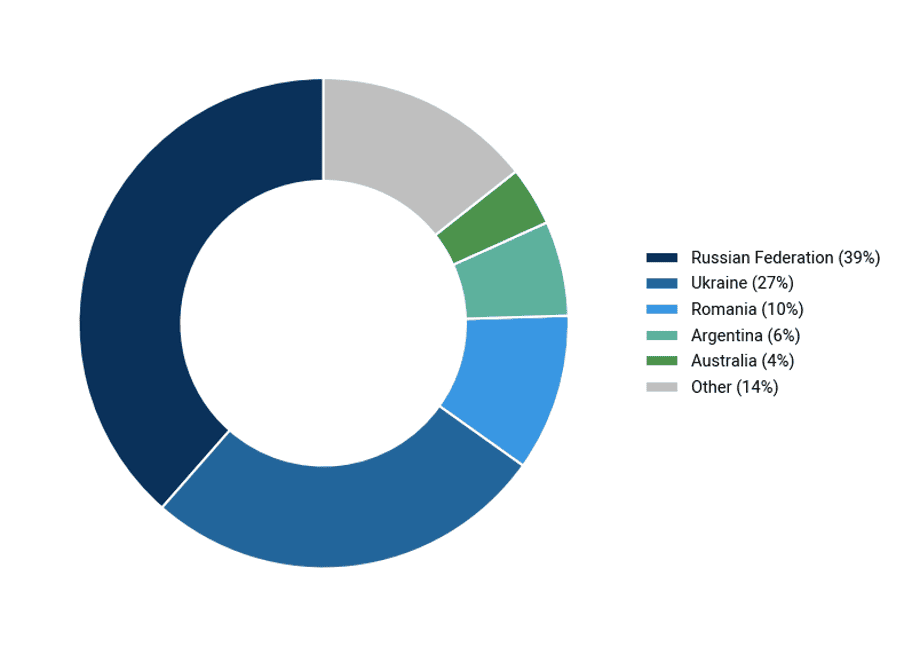
Bab-el-Mandeb carries a meaningful share of the world's seaborne grain and oilseed trade, mostly wheat and corn, with smaller volumes of barley, soybean meal, and sunflower meal. Russia and Ukraine together supply the majority of what moves through the strait, with Romania, Argentina, and Australia accounting for most of the remainder.
On the receiving end, the largest single destinations are Yemen and Iran, followed by Saudi Arabia, China, and a cluster of East African countries including Kenya, Tanzania, and Mozambique. Indonesia, South Korea, Bangladesh, and occasionally Pakistan are the largest Asian buyers. Yemen and Iran's position at the top of the list is notable given their roles in the current blockade.
Russia and Ukraine supply most of the grain moving through Bab-el-Mandeb (kt)
Source: Kpler
Saudi Arabia has moved its grain imports away from conflict
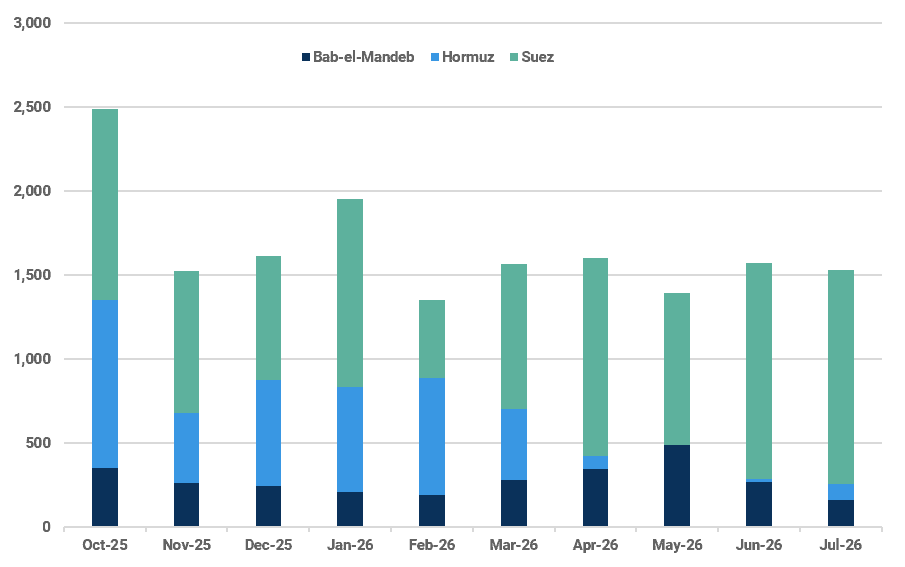
Saudi Arabia's grain imports have moved almost entirely away from the Gulf and into its Red Sea ports since the conflict in the Mideast Gulf started. This trade must pass through one of two chokepoints before reaching Saudi ports, the Suez Canal in the north or the Bab-el-Mandeb strait in the south. Most imports are being routed through the Suez Canal, some by design for pro-active conflict avoidance.
Saudi Arabia's grain imports have shifted from the Gulf to the Red Sea (kt)
Source: Kpler
Tenders to import wheat into the Kingdom after the war started completely excluded the Gulf port of Dammam. These are advance purchases, with delivery 2 to 3 months in the future, which means that Saudi Arabia is avoiding Gulf imports as far out as October 2026. A similar precaution is applied to import commitments through its western ports, where we observe most vessels bringing grain from South America taking the route through the Mediterranean Sea and Suez Canal to get to the Red Sea, instead of going by the Cape of Good Hope and Bab-el-Mandeb.
The latest diversion by the BAHRI ARASCO is a case in point. The vessel is carrying Argentine corn for Saudi Arabia. It loaded part cargo upriver at Arroyo Seco, followed by a top-up at Bahia Blanca. On 5 July, the vessel sailed due East to go to Saudi Arabia, via the Cape of Good Hope. As tensions increased and a Houthi blockade was announced on the 20th, the vessel was about 5 days from the Cape of Good Hope, still in the South Atlantic. On 23 July, she changed heading slightly to port, going towards Cape Town instead of the Cape of Good Hope. On 25 July, near Cape Town, the vessel completely changed course, turned NNW and is now headed to Gibraltar to enter the Mediterranean Sea. Raw AIS updates also show a change in destination to Port Said in Egypt. This is likely a temporary marker rather than a change in the final destination of the cargo. This diversion clearly shows the industry's reaction to the renewed Houthi threat in the Bab-el-Mandeb.
The BAHRI ARASCO changed course mid-Atlantic once the blockade was declared

Source: Kpler
Fertiliser trade lacks alternative routes, unlike grains
The Hormuz closure severely affected fertiliser trade, constricting exports of sulphur and urea from ports in the Mideast Gulf. Saudi fertiliser exports through the Gulf ran at over 1 Mt a month before the closure. When Hormuz shut, loadings continued for weeks, but the vessels carrying that cargo increasingly could not leave.
Pre-war, less than 10% of Saudi fertiliser exports originated from Red Sea ports. This was mainly sulphur from Yanbu and Jizan. All of its urea and phosphorus fertiliser exports used to come from ports in the Gulf. Red Sea exports of phosphates and to some extent, urea have increased since March.
Bab-el-Mandeb has absorbed more of that substitution than Suez has, due to the location of destination countries. India is by far the largest buyer of Saudi fertiliser moving that way, with Djibouti, Indonesia, and China taking smaller volumes. This trade has not been targeted by the blockade, which has so far focused on tankers.
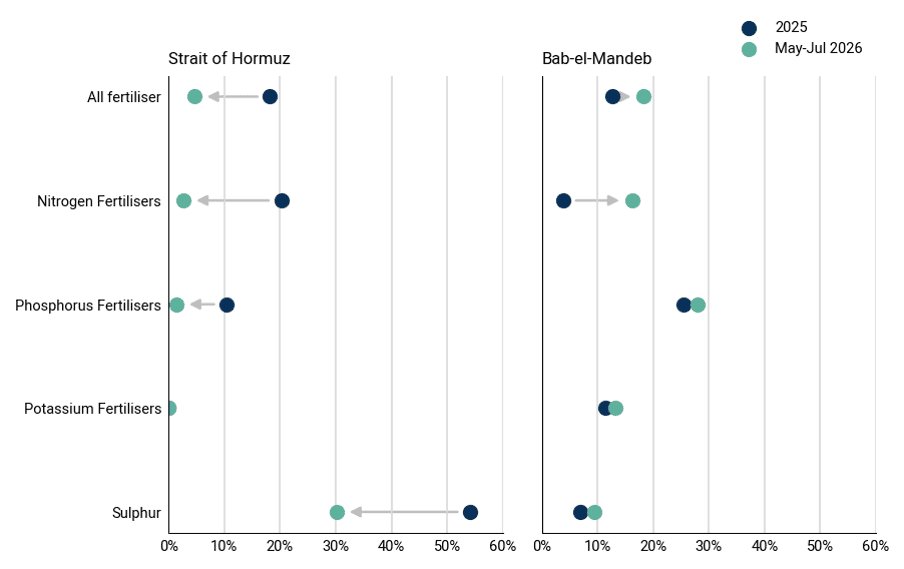
At a global level, Bab-el-Mandeb has gained importance in recent months also due to the Russian and Egyptian urea flowing through it to countries in Asia, mainly India. This volume would have earlier come from the Gulf through Hormuz. This has pushed the percentage of global urea trade through the BeM strait from 4% in 2025 to 16% in recent months.
Hormuz's share has fallen and Bab-el-Mandeb's has risen across every fertiliser category
Source: Kpler
The Houthi threat is another conflict adding to costs
Costs are rising regardless of whether the blockade ever reaches grain and fertiliser cargo directly. Vessel insurance rates to traverse the strait have more than doubled to 0.75% of hull value, affecting all vessels. Ballast vessels from the Red Sea repositioning into the Indian Ocean will increasingly find the direct route through Bab-el-Mandeb too risky, and may have to cross Suez a second time to go through the Mediterranean Sea into the Atlantic instead. That cost filters through to freight rates even on cargo not traversing the strait. Large population centres in Asia, which are importers of both grains and fertilisers, will see their costs increase and the options of origins decrease. While grain supply has alternatives, fewer fertiliser alternatives exist and fertiliser demand rationing will affect crop production in 2027.

See why the most successful traders and shipping experts use Kpler






