Mogas/ULSD $/t spreads on track for worst summer performance on record
At a time when both products are performing strongly, ULSD strength still managed to disrupt the summer driving season, with geopolitics and looming fundamental divergences going into September promising to make this an exceptional summer for intra-barrel road fuel dynamics.
Market and Trading Calls:
- Mogas/ULSD $/t spreads unlikely to flip into sustained positive territory this summer season, after two shy attempts at the beginning of May and July, corresponding with hopes of easing geopolitical tensions in the Middle East.
- Intensifying regional conflict and looming seasonal fundamental shifts come September to keep spreads pressured.
- Despite the resurgence in gasoline markets, amid tight inventories, resilient demand, and depressed yields, strength in the middle distillates complex has remained unabated, forcing mogas to take a back seat during its prime season.
Mogas/ULSD $/t spreads finished July in deeply negative territory across all main trading regions globally. The situation is unparalleled and perhaps only comparable to the summer of 2022, the year of the Russian invasion of Ukraine.
Even then, mogas/ULSD $/t spreads rose above the $200/t mark as the market transitioned to the summer, whereas we never saw spreads above $50/t throughout this year’s season so far, despite building gasoline strength on the back of depressed stocks and relatively resilient demand given elevated retail prices.
In fact, market attention has remained on the middle distillates’ complex, and even discounting US RVO dynamics (that continue to sustain elevated jet yields at the expense of road fuels), the view is that diesel should remain the focus rather than gasoline as we go into the final stretch of the driving season.
This is because the geopolitical context continues to pose more risks to ULSD vs gasoline as crucial Middle East trade routes account for more of the global movement of diesel (996kbd of diesel exports moved via the Bab El Mandeb and SoH routes in 2025 vs 378kbd for gasoline, i.e., ~14.3% of global diesel trade at risk vs ~7.9% for gasoline, with gasoline flows staying more in the Middle East and East of Suez compared with larger East-West movements for ULSD).
At the same time, sizeable fundamental shifts are on the horizon. The global gasoline balance is on a lengthening phase and is set to swell by about 550kbd between August and September, as the end of the driving season and the switch to winter-grade specification take hold. By contrast, gasoil/diesel balances will shrink by nearly 700kbd over that time frame.
Limited PADD 1 diesel inventories mean competition for US cargoes is set to intensify as harvest season and winter heating season approach, curbing export availability into the Atlantic Basin, and compounding the lack of available Russian cargoes. Indeed, Russia's extension of its diesel export ban through the end of August will add further pressure, with partial relief from Indian cargoes more likely to be felt in Africa and LATAM at the expense of Europe, due to the Rosneft-backed Vadinar refinery filling supply gaps to Russian customers.
In the East, geopolitics and the role of China remain the decisive factors in the outlook for both products. While the region remains adequately supplied for now, feedstock procurement risks continue to cap downside as Middle East tensions persist. Reduced crude availability could lower refinery runs and reverse the recent recovery in product exports. At the same time, uncertainty remains around China’s August loading program, which, if limited, could further add upside pressures to the regional market.
Overall, diesel remains more of the pain point, suggesting that despite a constructive August in the cards for gasoline, mogas/ULSD $/t spreads are likely to remain tilted to the downside this month.
Regional gasoline/ULSD spread ($/t)
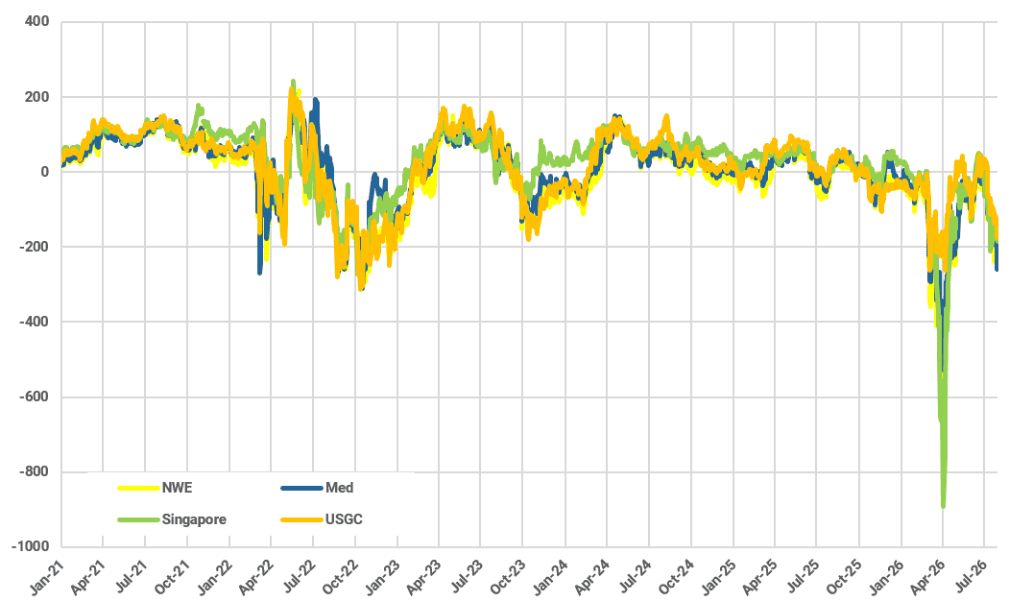
Source: Kpler calculations based on Argus Media pricing data

See why the most successful traders and shipping experts use Kpler