Petroline down, exports pivoting east: key scenarios and where the differentials go
Key takeaways: The pipeline itself is intact, but the damaged pumping station will take four to six weeks to fix, whilst west coast inventories only cover about 3 days of loadings and 9 days of refinery runs. Our base case sees throughput returning at around half of pre-attack rates, cutting Yanbu exports by 2.5 to 2.7 mbd. Dubai structure eases off the extremes but stays bid. Finding ships is not the issue: Bahri and Sinokor can cover the 25 extra shuttle VLCCs per month needed to move 3 mbd through Ras Tanura. The real constraint is how much more Hormuz exposure Saudi Arabia can tolerate.
More details have emerged since Aramco’s East-West Pipeline (Petroline) was damaged last Thursday by attacks reportedly originating from Iraq. As of today, we understand that at least one pumping station has been severely damaged, but the pipeline itself appears to have sustained little damage. Aramco seems to already be laying down a bypass pipeline around the pumping station, but key risks remain.
What's changed since last week
Since our update last week, minor damage to the line itself has reportedly been repaired but the binding constraint is extensive damage to pumping infrastructure, which we expect – as of information received today – to take 4-6 weeks to resolve, given spare-parts availability and impaired supply chains. So far in September, the Petroline sustained around 1.8 mbd of refinery feedstock and 3.6 mbd of oil loadings from the Yanbu terminals.
Two variables drive Saudi export capability, and they are currently moving in opposite directions. Yanbu loadings rebounded by 1.1 mbd to 3.6 mbd in September to date, with a couple of loadings occurring since the attack. However, as Petroline's throughput collapsed last week, the sustainability of Yanbu loadings is now in question. On the other hand, Saudi exports from the Persian Gulf are on the rise: Saudi oil loadings jumped by nearly 2 mbd to 2.46 mbd month-to-date, although volumes passing through Hormuz without STS are stable around 600 kbd. Some Saudi volumes also make part of the STS volumes shipped from the Gulf of Oman, which have risen to 2.5 mbd mtd, up 1.1 mbd m/m. 2.1 mbd of the total is unattributed yet.
East-West pipeline damage
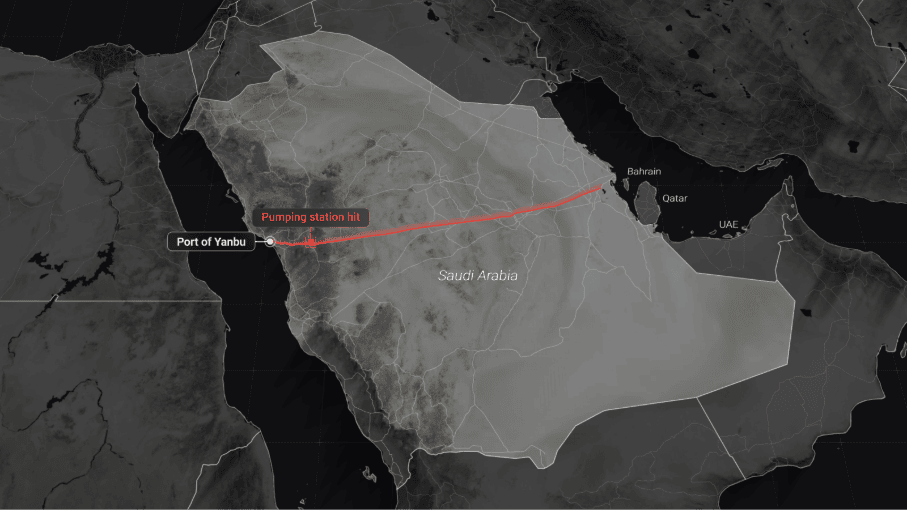
Source: Kpler, based on OSINT reports
From here, we see a few potential scenarios developing:
1. The base case: relatively fast restoration of operations at lower rate and more usage of East Coast terminals (50% probability): Restoring damaged pumping stations and full pipeline operations takes up to six weeks, with a bypass pipeline around the damaged pumping station serving as a temporary fix in the short-term.
In the meantime, Saudi oil infrastructure faces additional attacks. West Coast refineries reduce throughput and increasingly rely on inventories, while Yanbu exports are partially disrupted, including northward flows.
The key issue here is limited crude inventories on the Saudi west coast. We currently assess Yanbu oil terminal inventories at 9 mbbls and other west coast refinery inventories at 16.5 mbbls. Assuming no additional piped throughput, these would be enough to sustain the current pace of loadings and runs for three and nine days, respectively. However, assuming a quick restoration at lower throughput rates of around 50%, Yanbu oil exports could fall by 2.5 to 2.7 mbd if domestic runs are prioritised.
Saudi west coast oil inventories by tank type (mbbls)
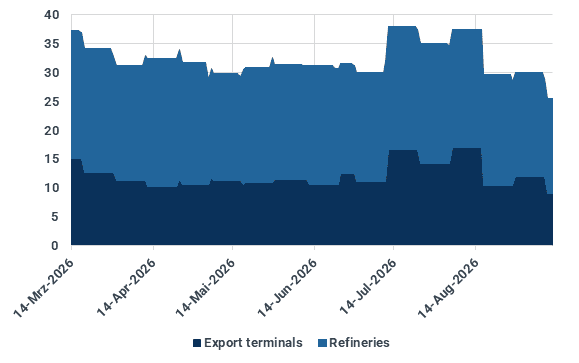
Source: Kpler
As the pipeline was running an estimated 5.4-5.5 mbd before the attacks, a partial restoration would pressure down Yanbu oil exports and increase the need to redirect supplies to Persian Gulf terminals such as Ras Tanura and Juaymah. If Aramco prioritises feeding domestic refineries (except for Jizan, which is set to remain out of operation until late October), the impacts on exports would be as follows:
EW Petroline throughput rate post-restoration vs pre-attacks (%) Impact on Yanbu oil exports (kbd) 30% 3600 kbd 40% 3240 kbd 50% 2700 kbd 60% 2160 kbd 70% 1620 kbd 80% 1080 kbd 90% 540 kbd
Source: Kpler
A partial increase in Ras Tanura loadings helps dampen part of the supply shock to Asia. West-of-Suez deliveries face around one month of additional travel time, while some supply obligations are met from Aramco’s regional stocks until depletion.
Diff implication: prompt Dubai structure rolls off the extremes but stays bid; Murban's premium compresses slowly.
2. The relief scenario (30% probability): damage at the pumping station is quickly circumvented through a temporary pipe bypass installed within roughly 10 days, similarly to what we saw in April, and allowing full throughput. This avoids major disruption to Red Sea exports and West Coast refinery runs. Further escalation is contained, with no additional impact on the Saudi oil industry. Any BeM passage toll has limited impact on flows, if implemented at all. The Yemeni frontline stabilises without spillover into Saudi territory, and an interim Iran–GCC compromise is reached on SoH passage.
Diff implication: prompt Dubai premiums and the Nov/Dec spread are vulnerable to a huge sell-off.
3. The escalation scenario (20% probability): Pipeline integrity is not restored within six months because of repeated attacks. A second pumping station, the repair effort itself, or the Yanbu terminals are hit.
With west-coast cover at eight days or less, Jizan already starved, there is no buffer left to absorb this, as the rise in tensions prevents a large increase in loadings from East Coast terminals.
Attacks on Abqaiq facilities shut in more production for a couple of months, effectively removing Saudi exports from global markets and triggering competition for remaining volumes.
Riyadh would likely expand military operations into Yemen and potentially launch missiles on Iranian proxies based in Iraq. BeM passage opens for selected destinations, while Ain Sukhna operations are also affected.
Such an extreme scenario would push prices higher, forcing the US to grant sanctions waivers on Russian oil again and to consider relaxing the Iranian naval blockade. The latter would be Washington’s last resort card to calm markets down and allow more oil flows to come out.
Diff implication: disorderly. Dubai premiums could reach well north of $40/bbl and Brent goes through $130/bbl before the US lifts its naval blockade.
4. Beyond the escalation scenario: Petroline stays fully down; Yanbu and Muajjiz inventories drain within one to two weeks, and Saudi Arabia becomes a Hormuz-only exporter threatened by Iran. Loading rates from Ras Tanura and Juaymah would depend on tanker availability, but the key constraint would be safe passage through Hormuz.
The east coast has ullage but not evacuation capacity: Ras Tanura at 11.4 mmbbl (51%) and Juaymah at 16.9 mmbbl (67%) leave roughly 20 mmbbl of spare tankage. Saudi Arabia can store barrels east; whether it can ship them depends on safe passage through Hormuz and tanker availability.
Diff implication: the most bullish outcome for Dubai structure, and the one where Murban–Dubai blows out further, because Saudi barrels would then carry the same transit risk as everything else in the Gulf.
Persian Gulf oil transit through Hormuz (mbd)
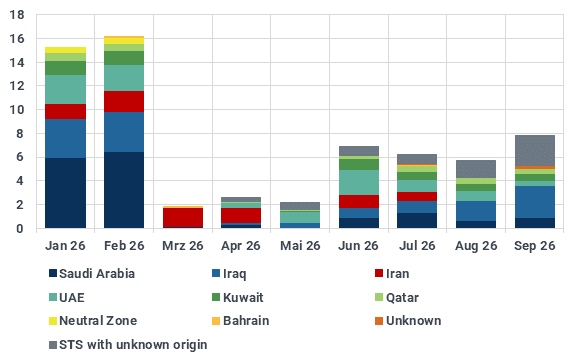
Source: Kpler
Freight:
As infrastructure constraints limit the ability to redirect volumes through Yanbu, Saudi Arabia is likely to increasingly pivot loadings to MEG ports, with a corresponding increase in exposure to the SoH. In August, we highlighted the limited participation of Saudi Arabia in MEG shuttle trades. However, following the late-July Houthi blockade on Saudi-linked vessels in the Red Sea, the Kingdom has gradually reduced its reliance on Yanbu exports by increasing its use of shuttle operations. As of the time of writing, at least 12 VLCCs with an established shuttle-trade history had called at Saudi Arabia’s MEG ports.
As previously highlighted, the continued expansion of MEG shuttle trades entails a trade-off between the number of vessels deployed and their turnaround times, defined as the time required for a vessel to complete a loading–STS–ballast cycle. Observed transits for each shuttle VLCC have consequently declined, from 2.5 per month during the MoU to circa 1.7 as of the time of writing. At these utilisation levels, each additional shuttle VLCC provides approximately 0.11–0.13 mb/d of export capacity per month. Indicatively, in a scenario where 3 mb/d of Yanbu volumes need to be redirected through Ras Tanura, approximately 25 additional VLCCs (per month) would need to be added to the shuttle fleet.
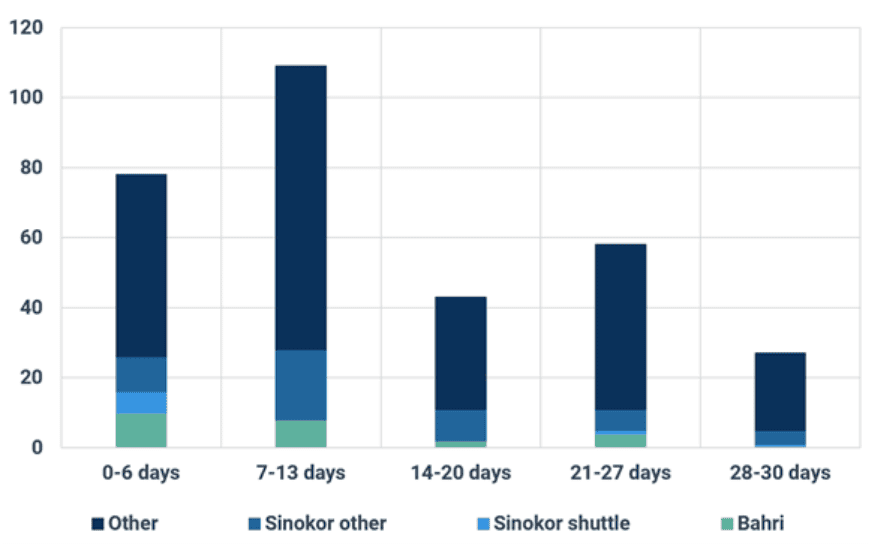
Saudi Arabia’s national tanker operator, Bahri, appears to be the most natural source of additional tonnage, with the company currently estimated to control around 50 VLCCs. The fleet is also favourably positioned to support a rapid expansion of MEG (shuttle) activity. Following the targeting of a Saudi-linked vessel during the Houthi blockade, Bahri VLCCs have largely avoided the Red Sea, which had post US-Iran war represented their primary ballast region, and have instead increasingly positioned in the Gulf of Oman (GoO). Kpler data currently indicates that 17 Bahri VLCCs are ballasting in the GoO, theoretically allowing these vessels to be deployed into the MEG at relatively short notice. At a speed of 12 knots, the voyage from Sohar to Ras Tanura takes approximately 1.5 days.
Bahri VLCC ballasters by Current Sea
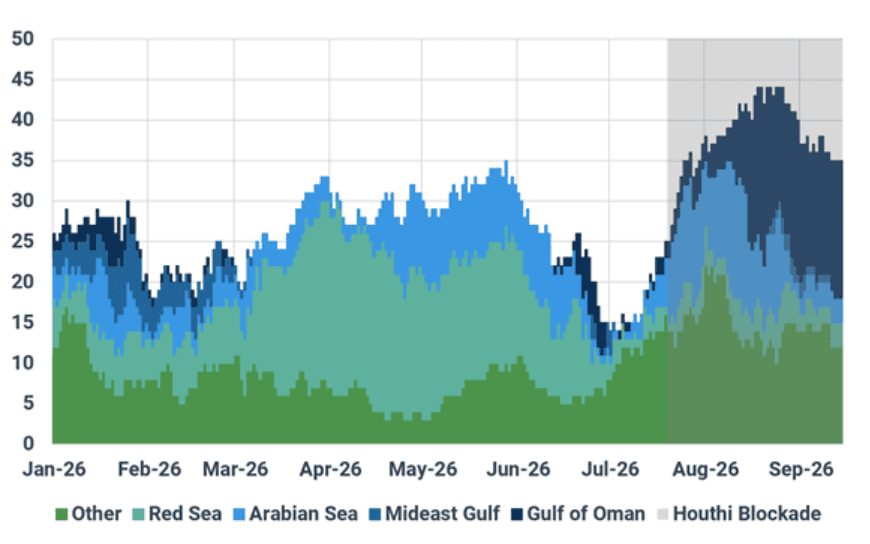
Source: Kpler
However, a closer examination of current shuttle activity indicates that Bahri accounts for only a fraction of the Saudi-linked shuttle tonnage with the bulk associated with South Korea’s Sinokor. This significantly broadens the pool of tonnage that Saudi Arabia could potentially access. Kpler data estimates that roughly 40% of Sinokor’s fleet of more than 127 VLCCs is currently employed in MEG trades (shuttle and direct). Although there may be a practical ceiling on the proportion of the operator's portfolio that can be allocated to higher-risk MEG operations, the economic incentive to do so remains substantial. At benchmark MEG earnings of approximately $1 million/day, current rates imply a premium of around $0.4 million/day over Gulf of Oman trades, providing a strong incentive for additional tonnage to shift towards MEG shuttle activity.
The primary logistical constraints linked to a sustained increase in Saudi Arabia’s MEG loadings, are therefore less related to an absolute tonnage shortage and more closely associated with the implications of a significant increase in SOH transits. Higher traffic through the Strait would provide Iran with greater leverage to disrupt flows if deemed necessary, while the increased use of narrower shipping corridors would further constrain operational flexibility. At the same time, a substantial increase in STS activity could place additional pressure on the already-stretched lightering infrastructure in the GoO ports.
Theoretical Ballast VLCC arrivals in Ras Tanura by time window and profile
Source: Kpler

See why the most successful traders and shipping experts use Kpler
.jpg)