

Progress in US-Iran negotiation weighs on global LNG prices despite supportive fundamentals
With recent developments indicating that US and Iran may be close to an agreement regarding the resumption of traffic through the Strait of Hormuz, the geopolitical premium built into TTF and Asian LNG prices appears to be easing modestly. While TTF prices fell sharply w/w in response to this news, Asian LNG prices remained elevated due to more supportive fundamentals.
Market & Trading Calls
European TTF front-month price outlook: Slightly bearish, as progress on an Iran-US deal over Hormuz shipping looks set to erode the geopolitical premium. Fundamentals lean more supportive, with above-average temperatures and drought-constrained hydro/nuclear output lifting gas-for-power demand, though improving wind and solar in NWE offer some offset. LNG supply is forecast to remain flat w/w, with improved Atlantic Basin supply availability (except Yamal) capped by maintenance in Spain, while both Norwegian and Algerian pipeline flows are expected to decrease slightly.
Asian LNG front-month price outlook: Stable. Kpler Insight maintains a stable near-term Asian LNG price outlook despite a modest bearish bias over the coming weeks, as easing geopolitical risks are expected to be largely offset by supportive underlying market fundamentals. Continued progress toward restoring shipping through the Strait of Hormuz and growing expectations of a broader regional ceasefire should further reduce the geopolitical risk premium. However, China's below-seasonal LNG inventories are expected to continue providing a floor for prices, while balanced regional demand and continued essential spot procurement across parts of Asia should limit downside.
Asian LNG – TTF spread outlook: set to slightly widen, as Asian LNG remains stable while TTF decreases. Over the last week, the Asian LNG premium over TTF increased, with the spread at $3.17/MMbtu on 5 August, compared to $1.28/MMbtu on 29 July.
US Henry Hub front-month price outlook: Stable, as weather model revisions point to cooler temperatures across the Midwest and Northeast in mid-August. This, coupled with an expectedly strong storage build and near-record production will keep prices between $2.60-2.80/MMBtu.
Key natural gas and LNG front-month prices ($/MMBtu)
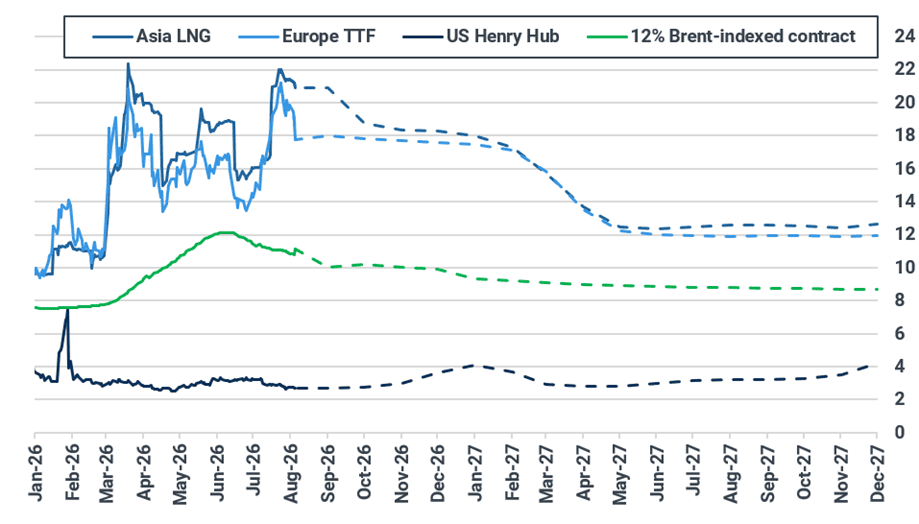
Source: ICE, NYMEX. Brent-indexed price represents 12% slope of 90-day moving average of Brent contract.
Asian LNG-TTF front-month spread ($/MMBtu)
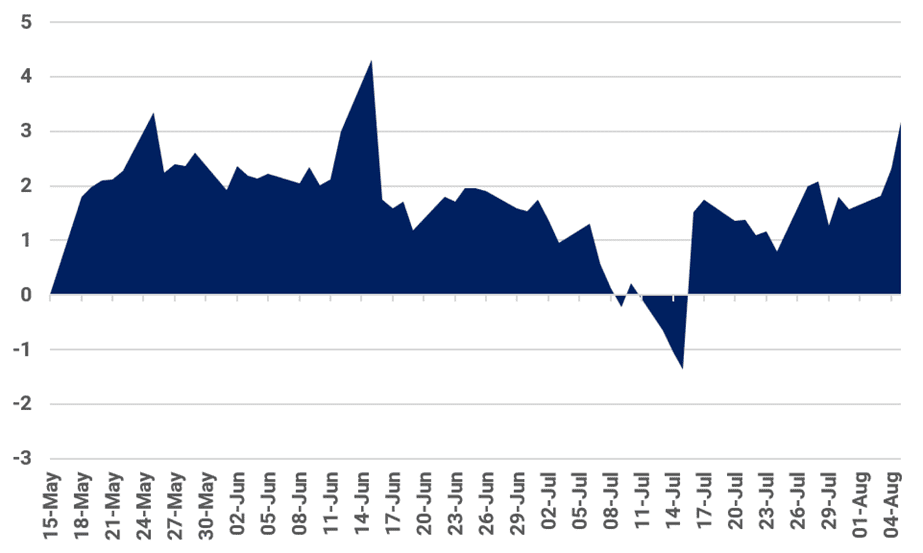
Source: ICE, Kpler Insight
Europe: Easing Hormuz tensions weigh on TTF despite summer heat lifting gas-for-power demand
The European TTF front-month contract declined last week, settling at $17.75/MMBtu on 5 August, down 11.9% from $20.15/MMBtu on 29 July. TTF held in the $19s-20/MMBtu range for most of last week, as geopolitical events maintained the risk premium, with renewed US-Iran strikes and attacks on Egyptian LNG infrastructure pushing prices higher. Though, two Hormuz crossings and rumours of talks around a possible deal to reopen the Strait of Hormuz provided some counterbalance. However, yesterday's announcement of a potential interim deal triggered a bear run, with TTF dropping by 6% - the largest d/d decline of the week. On the fundamentals side, warm temperatures across most of Europe and low hydro and nuclear output put upwards pressure on gas-fired generation, while LNG imports recovered and pipeline flows remained relatively stable.
Looking ahead, Kpler Insight maintains a slightly bearish outlook on the TTF front-month contract for next week. Geopolitics will likely remain the main price driver, with Iran and the US potentially close to finalising a deal on Hormuz shipping, which is expected to bring further bearishness to the market. On the fundamentals side, temperatures are projected to remain above seasonal averages across most of the continent, keeping power demand elevated. Alongside ongoing drought-related risks constraining hydro and nuclear availability, this will continue to put upward pressure on gas-fired generation. However, this could be partly counterbalanced by improved wind availability across NWE at the start of next week, while solar output is expected to remain strong. LNG supply remains relatively stable as improving Atlantic Basin availability (Yamal excluded) is partially offset by scheduled maintenance in Spain expected to cap imports there. A slight decrease in pipeline supply is expected for both Norwegian flows to Europe and Algerian flows to Spain. Overall, for the week ahead, the removal of the geopolitical premium is expected to outweigh modestly supportive fundamentals.
EU net pipeline imports rose slightly by 1% w/w to an estimated 3.17 bcm. The increase was driven by slightly higher Norwegian flows (+0.03 bcm), while Algerian volumes fell by 0.01 bcm w/w as piped flows to Spain decreased. All other major supply sources remained broadly stable. Looking ahead, Kpler Insight expects net pipeline imports to edge lower, as Gassco slightly revised its scheduled unavailability. While Algerian gas flows to Spain have stabilized, volumes are expected to remain below last week's levels going forward.
Algerian pipeline flows to Spain (bcm)
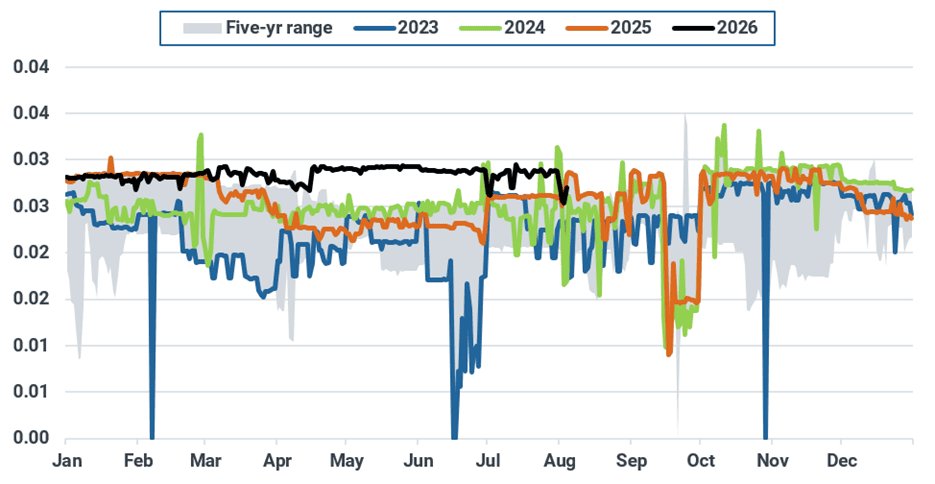
Source: ENTSOG
European LNG imports grew by 15% w/w to an estimated 1.53 mt, driven by increased deliveries into all regions except the Mediterranean and the Baltics. Volumes recovered in NWE as France resumed imports after being outbid by Asian buyers the week before. Iberian imports continued recovering after maintenance concluded at some terminals. Some spot demand also emerged from the UK and Turkey. Looking ahead, Kpler Insight expects LNG imports to remain relatively stable w/w. Indeed, Atlantic Basin availability has improved, and three diverted cargoes from Egypt are set to discharge in Spain and France this week. However, scheduled maintenance is expected at the Huelva and El Musel terminals starting 10 August, thus capping imports into Spain.
European weekly LNG imports by region (mt)
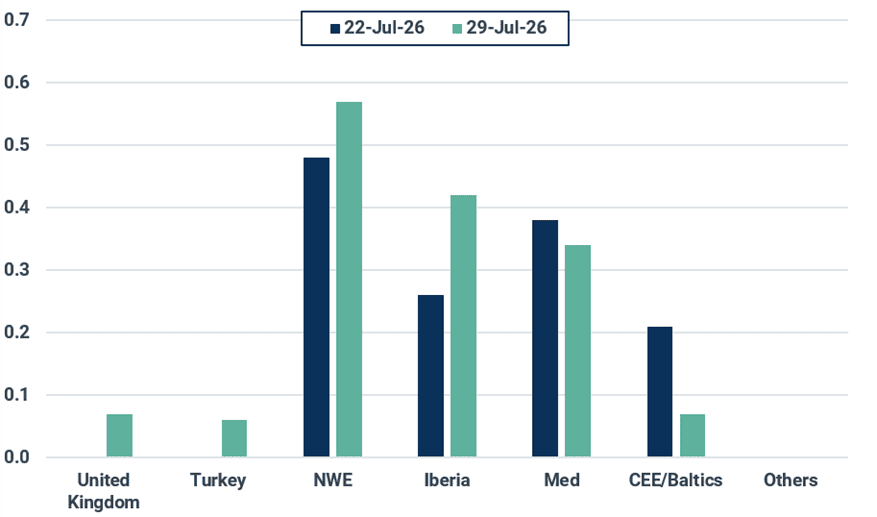
Source: Kpler Insight. Data represents week commencing 22/07 and 29/07. NWE=FR, BEL, NL, GER. Iberia=ESP, POR. Med=ITA, HVR, GRE. Baltics/CEE=FI, LT, POL. Others=SWE, MT.
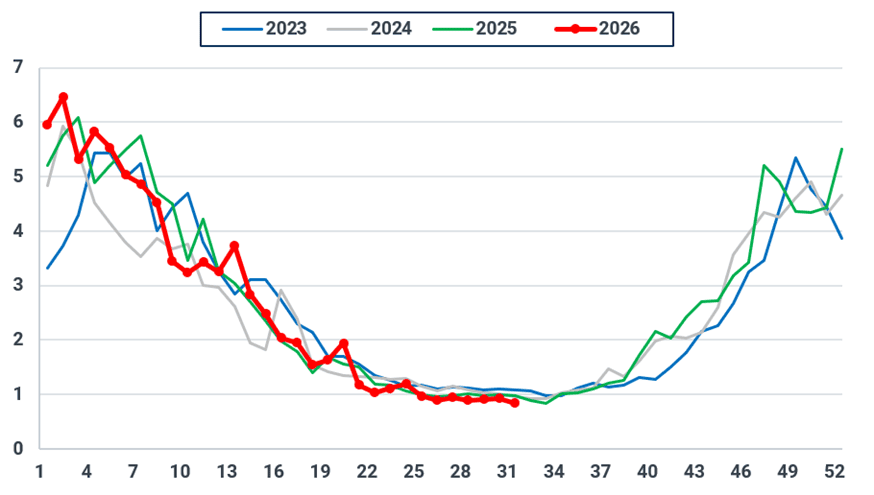
Aggregate local distribution consumption across 16 EU countries decreased by 9.2% w/w to an estimated 0.84 bcm, remaining slightly lower than last year’s levels. Looking ahead, Kpler Insight expects local distribution demand to remain low, as above-average temperatures are forecast to persist across most of Europe.
EU-16 weekly consumption in the local distribution sector (bcm)
Source: ENTSOG, ENAGAS, Eustream, AGCM, Kpler Insight. The EU-16 perimeter includes AT, BE, DE, CZ, FR, HU, GR, IT, NL, LU, PL, PT, RO, SL, SK, and ES.
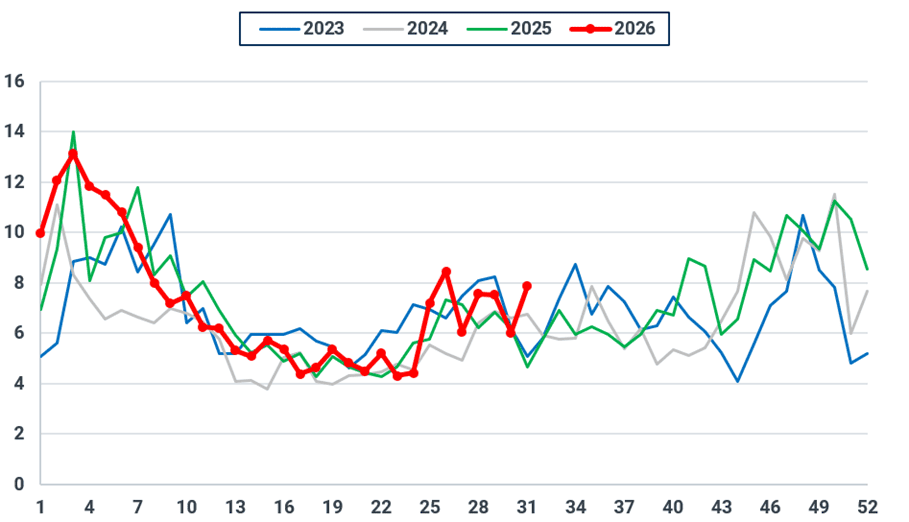
EU-25 gas-fired generation rose sharply by 31% w/w to an estimated 7.9 TWh, driven by robust power demand, low wind speeds, and limited hydro and nuclear availability. Power demand climbed 2.9% w/w on higher-than-average temperatures, while hydro output remained low across much of Europe and drought conditions weighed particularly on nuclear availability in Hungary and Romania. Looking ahead, gas-fired generation is expected to edge higher as elevated temperatures persist across Europe, though this will be partially offset by improving wind speeds in NWE next week.
EU-25 weekly gas-fired generation (TWh)
Source: Kpler Power, Kpler Insight.
Average daily temperature forecast for cooling-sensitive European countries (°C)
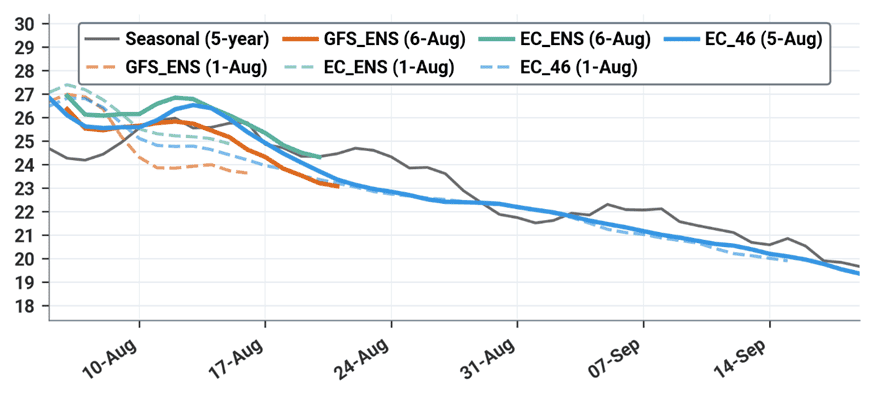
Source: Kpler Insight. Run comparison 05/08 (solid) vs. 01/08 (dotted), 00:00 UTC. Seasonal is a five-year average.
EU-27 underground gas storage levels rose to 57.9% full as of 4 August, up 1.7% w/w. Net injections averaged 0.24 bcm/d over the past week, down slightly (-0.02 bcm/d) w/w and 0.07 bcm/d below the five-year average. Net cumulative injections have begun to underperform summer 2023 levels. Italian UGS levels (76.3%) have overtaken Spain's (72.4%) this past week, with Spanish stocks having seen minimal injection activity over the past few days. Weak Spanish injections reflect impact of above-average temperatures yielding stronger gas-for-power demand, relatively low LNG imports, a dip in Algerian pipeline flows and lower y/y French pipeline imports. This has occurred in a context of high PVB prices, which has made gas comparatively expensive and disincentivised storage injections.
Looking ahead, Kpler Insight expects the pace of injections to edge higher, owing to stable LNG imports and a more favourable injection environment, despite slightly higher expected gas-fired generation. Indeed, the TTF Balance of Summer contract's premium over Winter 2026/27 continues to narrow and is now at €1.36/MWh as of 5 August (-€1.11/MWh w/w). The spread remains unfavourable for storage injections and is likely to continue narrowing next week.
EU-27 net cumulative UGS injections since 1 April (bcm)
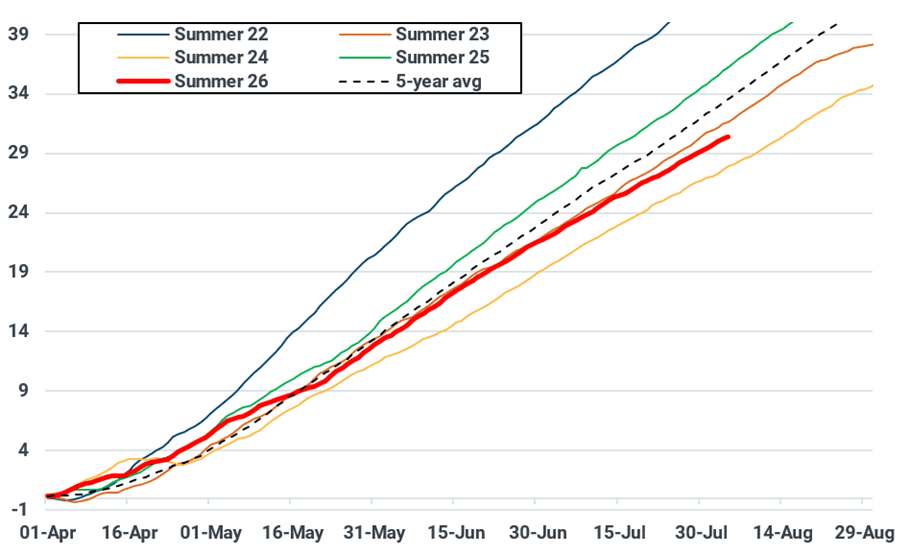
Source: GIE, Kpler Insight. Latest data as of 4 Aug 2026.
Selected TTF contract spreads (€/MWh)
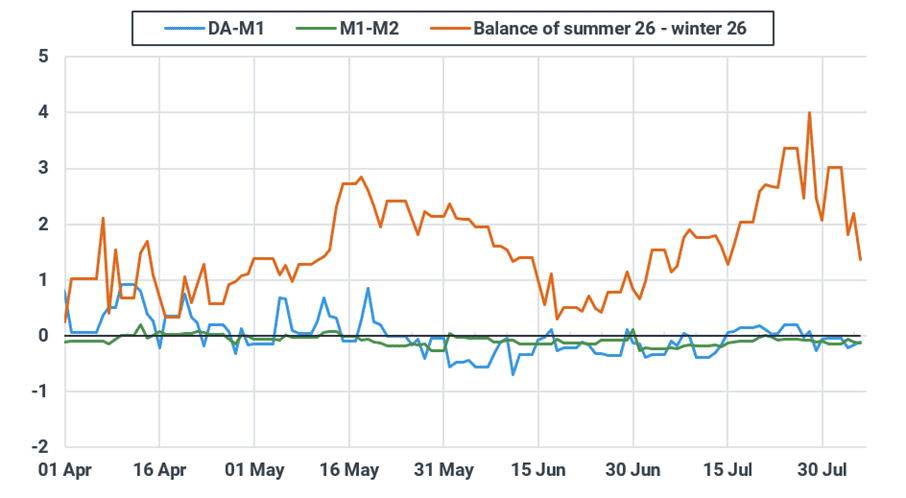
Source: Kpler Insight, Argus, EEX. DA = day-ahead; M1 = Month ahead; M2 = Two month ahead.
Want the complete report?
The full report is available within Insight and contains:
- Market & Trading Calls
- Europe: Easing Hormuz tensions weigh on TTF despite summer heat lifting gas-for-power demand
- Asia: Easing geopolitical risks outweigh supportive China LNG inventories
- US: Rising supply and cooler temperature forecasts to keep Henry Hub near seasonal lows
- Global LNG Supply: Market eyes Strait of Hormuz reopening deal; Russia’s Yamal undergoes maintenance affecting LNG supply to China and EU
Trade smarter. Request access to Kpler today.

See why the most successful traders and shipping experts use Kpler