

Stronger Thai power demand lifts late-Q3 LNG call
Thailand’s gas balance tightened further in June as stronger power-sector demand significantly outpaced growth in domestic supply. Higher cooling requirements, weaker coal generation, and lower electricity imports increased reliance on gas-fired power, leaving LNG to absorb most of the incremental gas requirement. Kpler Insight raises its 2026 Thailand LNG demand forecast by around 0.2 mt to 11.9 mt, with most of the increase concentrated in August–September. We also raise our 2027 forecast by 0.1 mt to 13.5 mt, as limited domestic and pipeline supply growth leaves Thailand increasingly reliant on LNG as its marginal balancing fuel.
Market & Trading Calls:
- Thailand LNG demand 2026–27: Slight increase. Kpler Insight raises 2026 LNG demand by around 0.2 mt to 11.9 mt, concentrated in August–September, and raises 2027 demand by 0.1 mt to 13.5 mt, as stronger power-sector gas demand and limited domestic and pipeline supply growth sustain Thailand’s reliance on LNG.
- Asian spot LNG prices: Slightly bullish in the prompt, as stronger Q3 demand revision increases Thailand’s call on prompt cargoes, adding upside support to late-Q3 Asian spot LNG prices. Slightly bullish in mid-term, as smaller demand gains in Q4 and into 2027 extend support beyond the prompt market, although the more modest scale of these revisions limits further price upside.
Thailand’s gas balance tightened in June as stronger electricity demand and lower competing generation lifted gas-fired power demand. EPPO data showed total gas demand rising 0.54 bcm y/y to 4.35 bcm, with gas-to-power demand increasing 0.46 bcm to 2.79 bcm. Gas-to-power therefore accounted for around 85% of the overall y/y increase.
Cooling demand reached 358 degree-days, around 10 degree-days above the 5-year seasonal average, while electricity generation increased 1.3 TWh y/y. Lower coal generation and electricity imports increased the call on gas. Coal-fired output fell 1.0 TWh y/y to 2.1 TWh, while electricity imports declined 0.5 TWh to 3.1 TWh. Gas-fired generation consequently rose 2.5 TWh y/y to 12.8 TWh.
Supply growth was insufficient to match the increase. Domestic gas production rose only 0.14 bcm y/y to 2.64 bcm, while Myanmar pipeline imports fell 0.04 bcm to 0.35 bcm. The combined net increase of around 0.10 bcm covered less than one-fifth of the 0.54 bcm rise in gas demand. LNG absorbed most of the shortfall, with Thailand’s implied LNG balancing requirement widening by around 0.44 bcm y/y in June.
This dependence on LNG is unlikely to ease materially through 2027. Kpler Insight’s field-level production forecast, starting in July 2026, shows aggregate Thai gas production remaining broadly stable through 2027 despite changes across individual fields. Limited domestic supply growth means incremental power-sector gas demand should continue to translate more directly into LNG demand.
We therefore raise our 2026 Thailand LNG demand forecast by around 0.2 mt to 11.9 mt. The increase is concentrated in August–September and equates to around 1 additional standard cargo in each month. Smaller Q4 revisions add roughly 1 cargo across the quarter. The additional late-Q3 requirement increases Thailand’s call on prompt cargoes, providing incremental upside support to Asian spot LNG prices. Q4 demand remains supportive, although the smaller revision limits the price impact.
The tighter balance extends into 2027. With domestic production broadly stable and pipeline supply offering limited flexibility, LNG remains Thailand’s key balancing source when power-sector gas demand strengthens. We consequently raise our 2027 LNG demand forecast by 0.1 mt to 13.5 mt.
Thailand gas production by field (bcm)
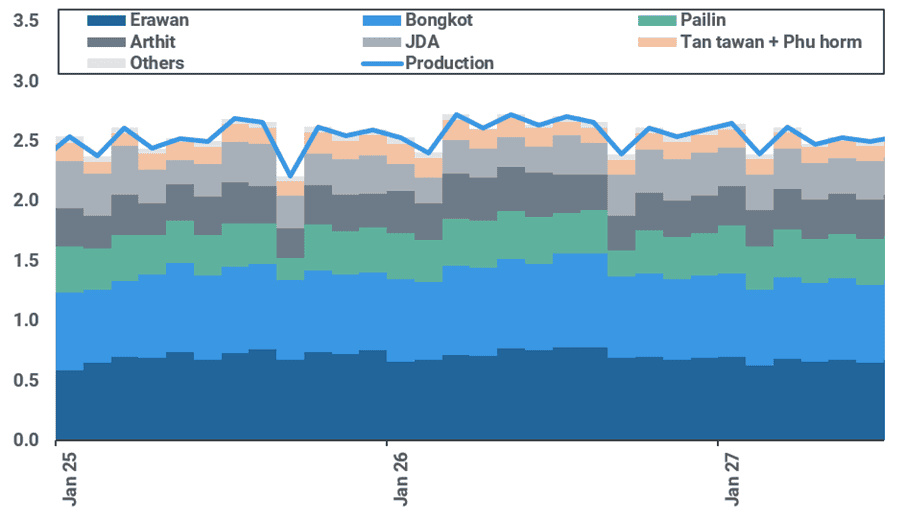
Source: EPPO, Kpler Insight. Note: Forecast data starts from July 2026.
Historical power generation by fuel type in Thailand (TWh)
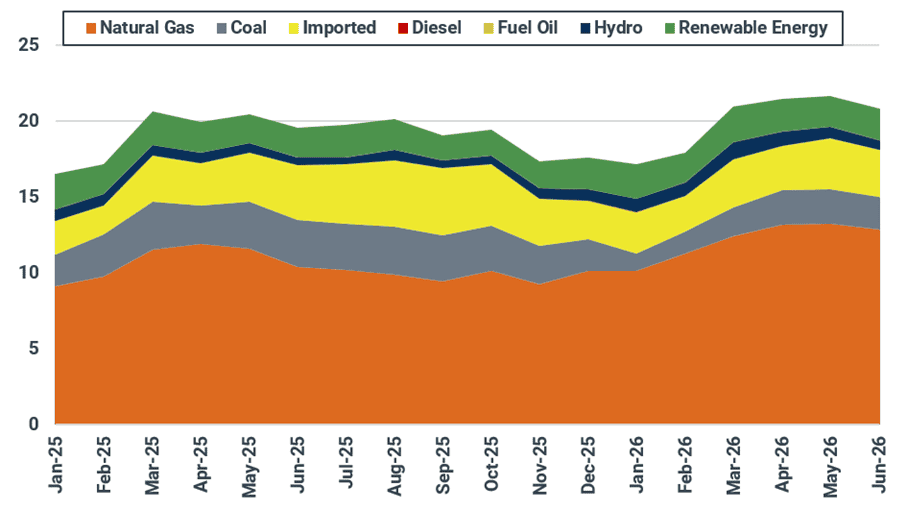
Source: EPPO
Projected year on year changes in electricity generation by fuel in Thailand (TWh)
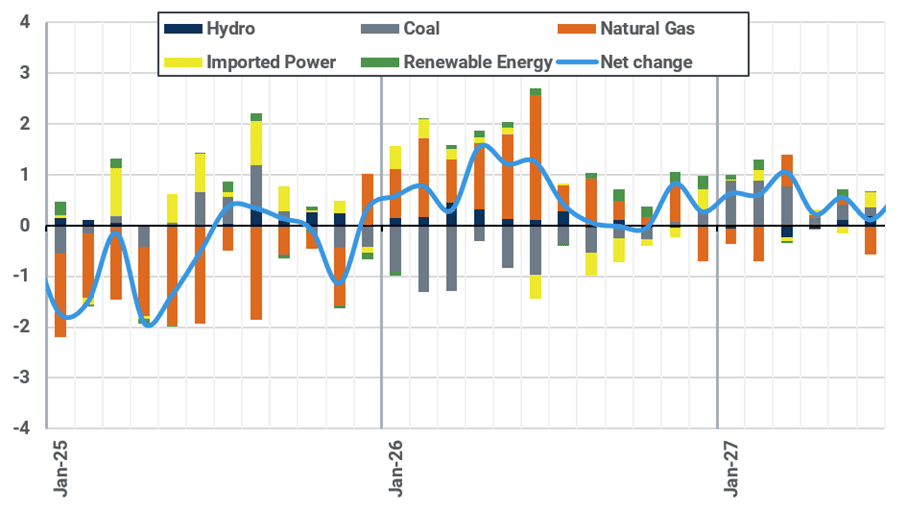
Source: EPPO, Kpler Insight. Note: Forecast data starts from July 2026.
Thailand population weighted cooling degree days (CDD)

Source: Meteostat, Kpler Insight

See why the most successful traders and shipping experts use Kpler






