

The global consequences of Ukraine's economic warfare
Ukraine's evolving campaign against Russia's energy system demonstrates how modern wars increasingly target commercial infrastructure rather than military forces alone. The more effective that strategy becomes, the more likely Washington will face a strategic tradeoff between maximizing pressure on Russia and preserving stability in global energy markets.
This note was written by our Intern, Oscar Von Stackelberg.
The Global Consequences of Ukraine's Economic Warfare
The war in Ukraine has entered a new phase. Rather than focusing primarily on battlefield attrition, Kyiv is increasingly pursuing a strategy of economic warfare by systematically targeting Russia's energy system. The objective is to weaken the commercial infrastructure that finances and sustains Russia's war.
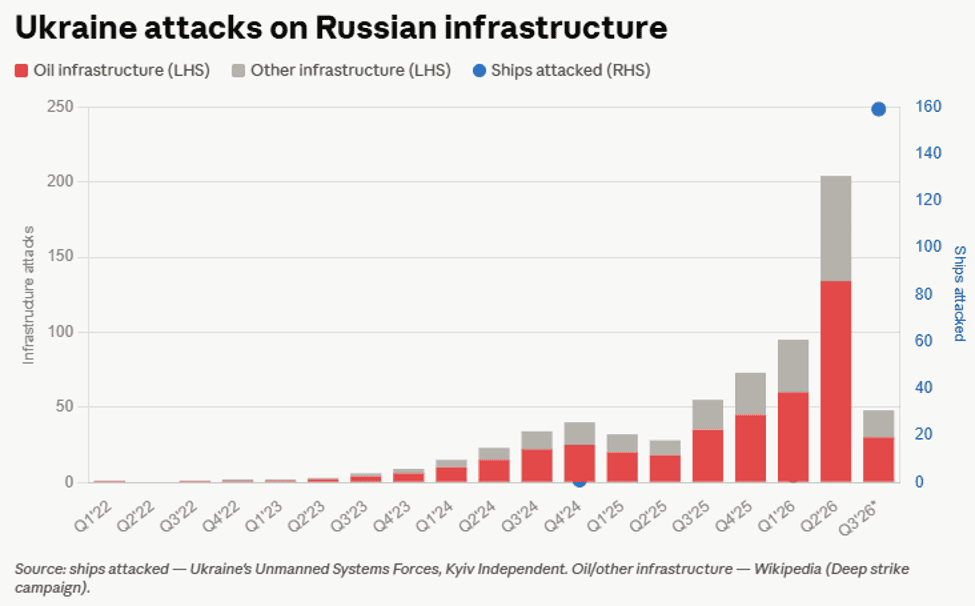
The shift is evident in the scale and composition of Ukraine's long-range strike campaign. What began with attacks on refineries has expanded to include export terminals, commercial shipping, ports and maritime logistics. Rather than targeting isolated facilities, Ukraine is increasingly attacking the commercial networks that transform Russian energy into export revenue.
The strategy is proving increasingly effective because Russia remains one of the world's largest energy exporters. But its success carries consequences that extend well beyond the battlefield. As Ukraine expands its campaign across Russia's energy value chain, the costs are increasingly transmitted through global fuel markets. This will ultimately present Washington with one of the most difficult strategic tradeoffs of the war.
Refining Economic Warfare
Refineries were just the beginning. Ukraine's campaign has expanded beyond processing capacity to encompass the infrastructure that transports, exports and monetizes Russian energy.

Interactive timeline map of Refinery strikes: https://inland.cz/russia/

The geographic dispersion of the attacks is as significant as their frequency. Energy infrastructure once protected by distance is now increasingly vulnerable, dramatically expanding the range of assets that can be incorporated into Ukraine's campaign of economic warfare.
The first phase focused on refining. Long-range drone strikes have increasingly targeted Russia's largest refineries, reducing processing capacity to levels not seen in decades. The strike on the 440 kb/d Omsk refinery—located roughly 2,500 kilometers from Ukrainian-controlled territory—illustrates both Ukraine's growing operational reach and its willingness to target some of Russia's most strategically important energy assets.
The Campaign Moves Downstream
Having demonstrated that Russia's refining system was vulnerable, Ukraine expanded the campaign downstream. Rather than focusing solely on fuel production, Kyiv increasingly targeted the infrastructure that distributes, exports and monetizes Russian energy. Ports, commercial shipping and maritime logistics became integral components of its campaign of economic warfare.
The map illustrates this evolution. Rather than attacking isolated facilities, Ukraine is increasingly targeting the commercial network that connects Russian energy production to global markets. Export terminals, maritime chokepoints and commercial ports are becoming as strategically important as refineries themselves.
The campaign initially expanded into the Sea of Azov, where Ukrainian forces increasingly targeted ferries, tankers and commercial vessels supporting occupied Crimea and southern Russia, while periodic disruptions to the Don-Azov Canal complicated movements through one of Russia's most important downstream transport corridors. Ukraine has since shifted its attention toward the Black Sea, where Russia exports more than one-fifth of its seaborne crude oil. By expanding operations from the Sea of Azov into the Black Sea, Ukraine is increasingly threatening not only Russia's ability to distribute fuel domestically, but also its ability to move crude and refined products to international markets.

Source: Felt, https://felt.com/

Energy Warfare Becomes Global
Ukraine's campaign has extended beyond Russia's domestic energy system. As the battlespace expands from refineries and export terminals to international transport networks, economic warfare increasingly intersects with infrastructure that serves multiple countries, companies and markets.
The Caspian Pipeline Consortium (CPC) illustrates this evolution. Although the pipeline primarily exports Kazakh crude, it traverses Russian territory before terminating at Novorossiysk on the Black Sea. As Ukraine expands operations against Russian export infrastructure, systems that are commercially international—but geographically intertwined with Russia—are becoming increasingly exposed.
CPC is Kazakhstan's principal crude export route and the primary outlet for production from the Tengiz field, where Chevron is the largest investor. A campaign designed to reduce Russian energy revenues is therefore beginning to affect infrastructure that underpins one of the largest American energy investments in the world.
Economic warfare against energy systems does not stop at national borders because energy supply chains do not stop at national borders. Pipelines, ports, tankers and export terminals are shared commercial infrastructure linking multiple producers, consumers and investors. As Ukraine pushes further downstream into those networks, the consequences increasingly extend beyond Russia to the broader global energy system.
Washington's Strategic Dilemma
Ukraine's campaign is increasingly reshaping global energy markets. Disruptions to refining capacity, export infrastructure and commercial shipping are increasing pressure on Moscow while reducing flexibility in an already fragile global energy system.
Russia remains one of the world's largest exporters of diesel and gasoil. As Ukraine degrades refining capacity and disrupts export infrastructure, the effects increasingly extend beyond Russia's borders into global fuel markets. Those disruptions are occurring at a time when the Strait of Hormuz remains vulnerable, traffic through the Bab el-Mandeb continues to face persistent security risks, and global refining capacity is already under significant pressure. The result is an energy market with very little spare resilience.
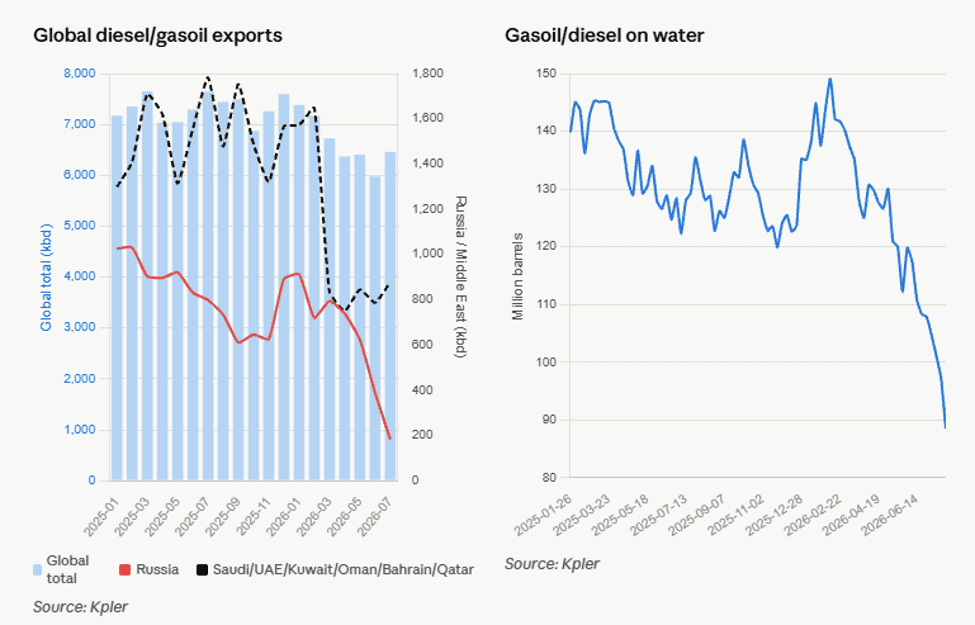
Success may ultimately become a challenge. Every additional disruption to Russia's energy system strengthens Ukraine's campaign of economic warfare while placing additional strain on an already fragile global energy market Although the Trump administration has not approved a major new Ukraine aid package comparable to those enacted earlier in the war, U.S. military support has continued through previously appropriated funding, intelligence cooperation and NATO-coordinated weapons deliveries. That support ensures Washington remains an important stakeholder in how Ukraine's campaign evolves.
It also leaves Washington confronting an increasingly difficult strategic question. Ukraine's campaign is proving increasingly effective, but its success is also transmitting growing costs through global energy markets. If those costs continue to rise, Washington may eventually have to decide how much influence it wishes to exert over Ukraine's targeting strategy—and how much disruption to global energy markets it is willing to tolerate in pursuit of weakening Russia.
This note was written by our Intern, Oscar Von Stackelberg.

See why the most successful traders and shipping experts use Kpler