

The regional turn in maritime security
The security architecture linking the Persian Gulf to Europe is entering a new phase. As regional powers create their own permanent maritime institutions, the foundations of the post-Cold War order are beginning to give way to a more regional system.
The Regional Turn in Maritime Security
Two weeks ago, I argued that Europe's war and the Middle East conflict were converging on the Turkish Straits. Recent developments suggest the institutions now emerging across that corridor are beginning to reflect the same geography.
For decades, the maritime corridor linking the Persian Gulf with Europe operated within a security order underwritten largely by the United States and its allies. The Strait of Hormuz, Bab el-Mandeb, the Suez Canal, the Eastern Mediterranean, the Turkish Straits, and the Black Sea formed one interconnected trading system. Rather than leaving security to the states bordering each chokepoint, the post-Cold War maritime order treated freedom of navigation across the entire corridor as a shared international responsibility underwritten largely by the United States and its allies.
On July 30 a new framework started to evolve. Saudi Arabia brought together fourteen founding members—including Turkey and Pakistan—to establish a permanent maritime security organization for the Red Sea and Gulf of Aden, complete with a joint command headquartered in Riyadh. Eight days later, Saudi Arabia, Turkey, and Pakistan signed a mutual defense pact under which an attack on one would be treated as an attack on all three.
Neither initiative originated in Washington. Both were organized by regional powers. Saudi Arabia's recent initiatives suggest that the post-Cold War maritime order is beginning to give way to a more regional model. Rather than relying on institutions organized from outside the region, governments along the corridor are beginning to build permanent security institutions of their own.
Together, the two initiatives extend across much of the maritime corridor linking the Persian Gulf with the Black Sea. One coordinates maritime security. The other links three regional military powers. Taken together, they begin connecting security institutions across a maritime corridor that has historically functioned as a single commercial system.
Turkey sits at the centre of that emerging architecture. It administers the Bosphorus under the Montreux Convention, the only maritime gateway between the Black Sea and the Mediterranean, while remaining a NATO ally. It now also participates in both the new Red Sea maritime security organization and the Saudi-Turkey-Pakistan mutual defense partnership, linking the Black Sea, Eastern Mediterranean, and Red Sea through the same regional actor.
The table below illustrates how an interconnected trading system responds to military pressure. Throughput through the Strait of Hormuz collapsed as Saudi crude exports shifted from Gulf terminals to Red Sea export routes. Transit through the Bab el-Mandeb increased as those cargoes moved through the Red Sea despite continued Houthi attacks on commercial shipping, while Suez Canal traffic remained resilient as exports continued toward Europe. Bosphorus-related exports followed a different trajectory. Ukraine's expanding campaign against Russian ports, refineries, and merchant shipping placed downward pressure on Black Sea exports moving through the Turkish Straits. Commercial flows adjusted according to where military pressure emerged.
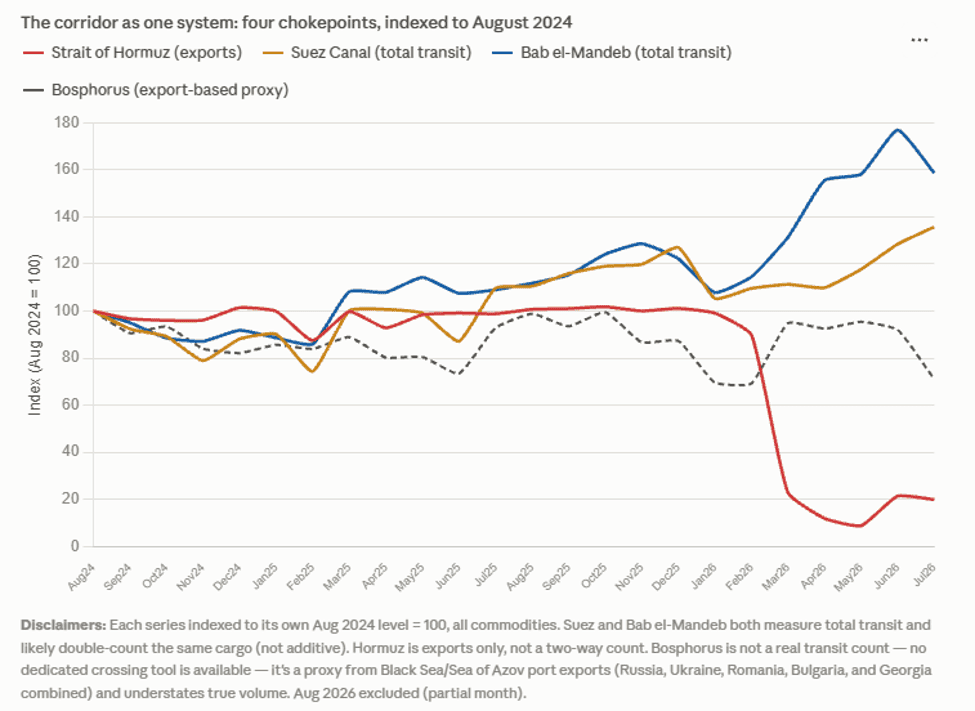
Commercial markets have already adapted to operating across an interconnected maritime corridor. Cargo shifted. Alternative routes absorbed additional volumes. Freight markets, insurers, and shipowners adjusted as military pressure spread from one chokepoint to the next.
Governments now appear to be adapting in much the same way.
The institutions emerging today will increasingly shape how security is coordinated, how commercial traffic moves, how maritime security is financed, and how confidence is maintained across one of the world's most important trading corridors. The geography of commerce is becoming the geography of security governance.

See why the most successful traders and shipping experts use Kpler