West roars, east idles: The geopolitical divide in global refining
The global refining system continues to operate at two speeds. Refiners outside the conflict zone are running near practical limits to offset lost supply from the Middle East, Asia and Russia — but geopolitical relief alone won't rebalance product markets. What matters now is how fast damaged refining capacity returns to service
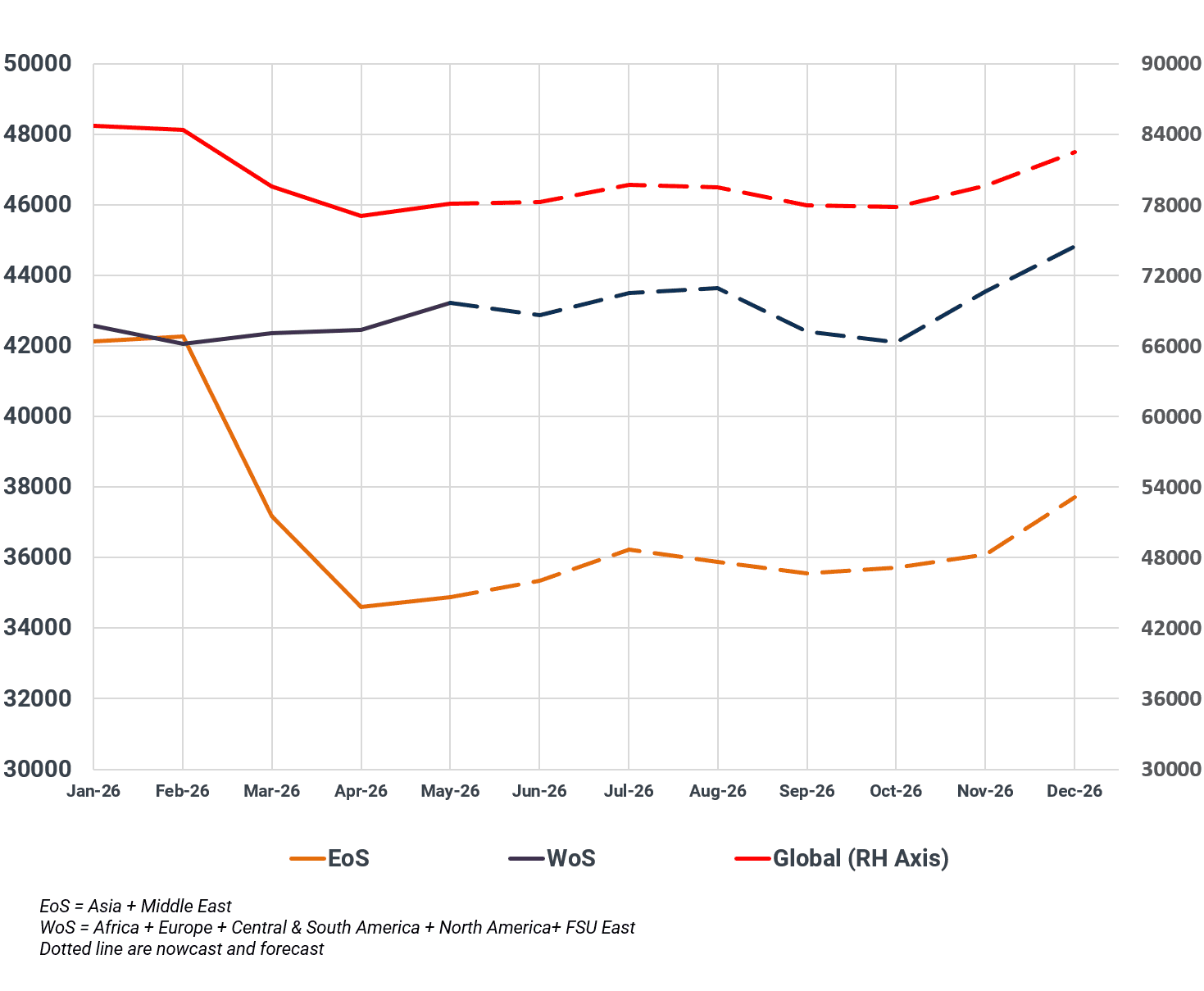
Refiners across WoS (West of Suez) are pushing utilization towards multi-year highs on exceptional margins and tight product balances, while EoS refiners remain constrained by geopolitics — leaving global refining below the lower end of its five-year range. We estimate global refinery runs at ~80 mbd for 2026, ~3 mbd below the 2025 average.
Global refinery runs split by Region, kbd
Source: Kpler
Asia
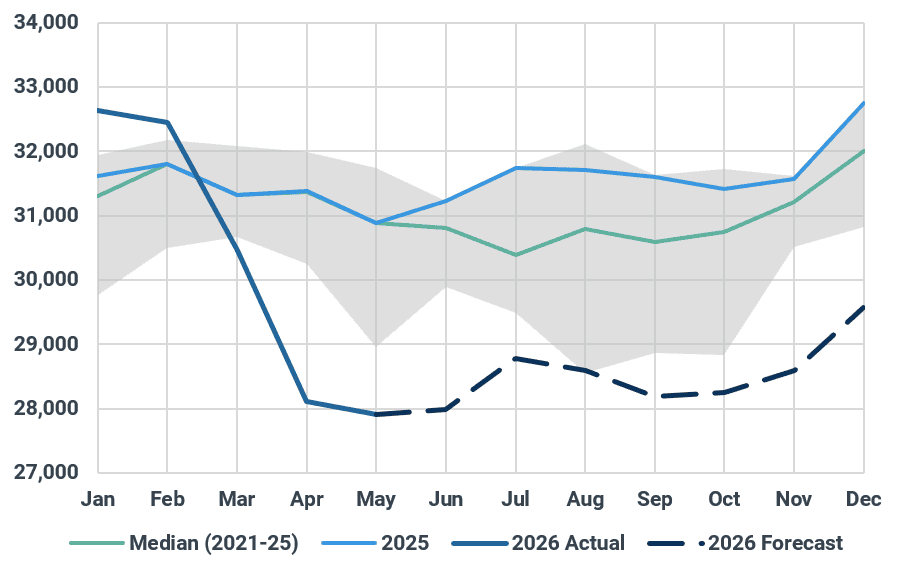
The feedstock squeeze that constrained Asia (ex-China) after the Middle East crisis has eased, as weaker Chinese crude buying freed up barrels for the region, the US-Iran truce (June-July) unlocked stranded Gulf cargoes, and lower Russian runs redirected crude towards India. Combined, this lifted regional refinery utilization to ~96% in May–July, up from ~89% in April.
This relief is likely temporary — much of the crude secured during the truce provides cover only through September. Compounding this, ongoing disruptions in the Bab el-Mandeb Strait are adding further strain, with vessels rerouting around the Cape of Good Hope adding extra voyage days and effectively reducing available crude on the water for regional refiners. Without a broader restoration of Gulf flows, feedstock availability should tighten again in Q4, capping further upside in regional runs.
Asia Refinery Runs, kbd
Source: Kpler
Middle East
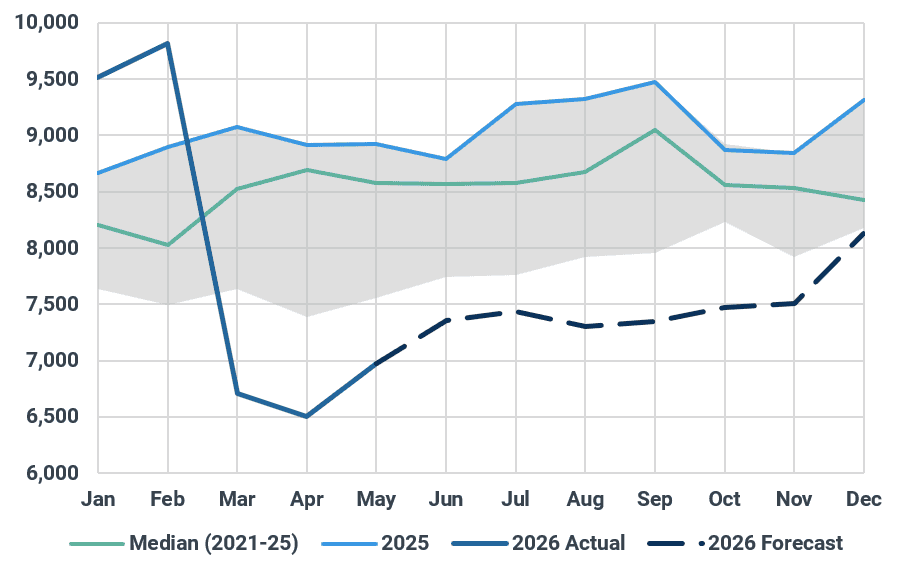
The Middle East has suffered the sharpest decline in refining operations. Export disruptions through Hormuz, coupled with attacks on refining infrastructure such as Saudi Arabia's Jizan and SATORP, Bahrain's Sitra and Kuwait's MAA and MAB refineries, have materially reduced the region's ability to supply global product markets, resulting in regional refinery runs averaging just ~6.5 mbd in Q2-26, down 27% y/y.
Shuttle exports have supported a partial recovery, but remain insufficient to restore meaningful operations. Damage across several complexes will keep maintenance elevated through year-end, delaying recovery even if maritime disruptions ease.
Middle East Refinery Runs, kbd
Source: Kpler
FSU
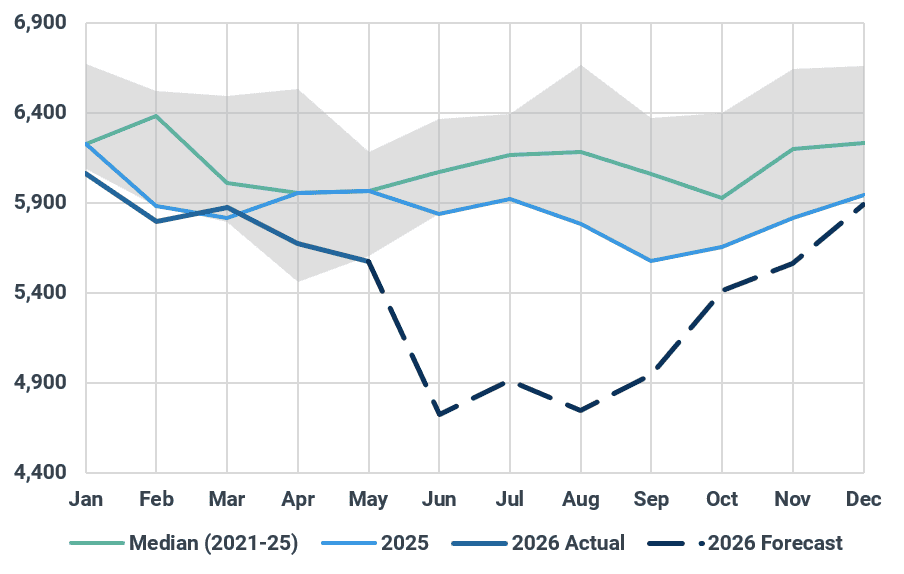
Russian refinery operations remain caught in a cycle of disruption and repair. Refinery runs averaged ~4.2 mbd in July with an August estimate of around 4mbd, hovering near multi-decade lows as successive Ukrainian drone strikes continued to delay restarts and keep extending outages. While the planned lifting of the diesel export ban from 1 September indicates some uplift in refinery activity, it is unlikely to materially alter the operating environment. Continued attacks on refining infrastructure remain the dominant constraint, leaving any meaningful recovery in refinery runs vulnerable to renewed disruptions.
FSU Refinery Runs, kbd
Source: Kpler
Europe
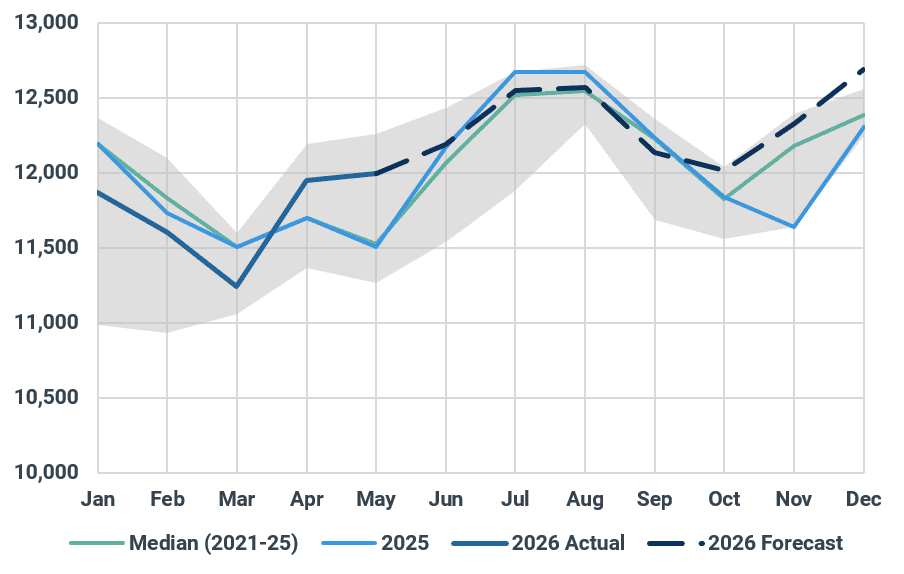
European refiners continue to capitalize on tightening global product balances. Stalled inflows from the Middle East and Asia have driven margins sharply higher, encouraging refiners to maximize throughput — refinery runs averaged around 200 kb/d higher y/y in Q2-26.
However, going forward, falling Rhine River levels threaten oil movement for inland refineries, including Shell Rheinland, MIRO and BP Gelsenkirchen, creating downside risk to refinery runs heading into September.
Europe Refinery Runs, kbd
Source: Kpler
North America
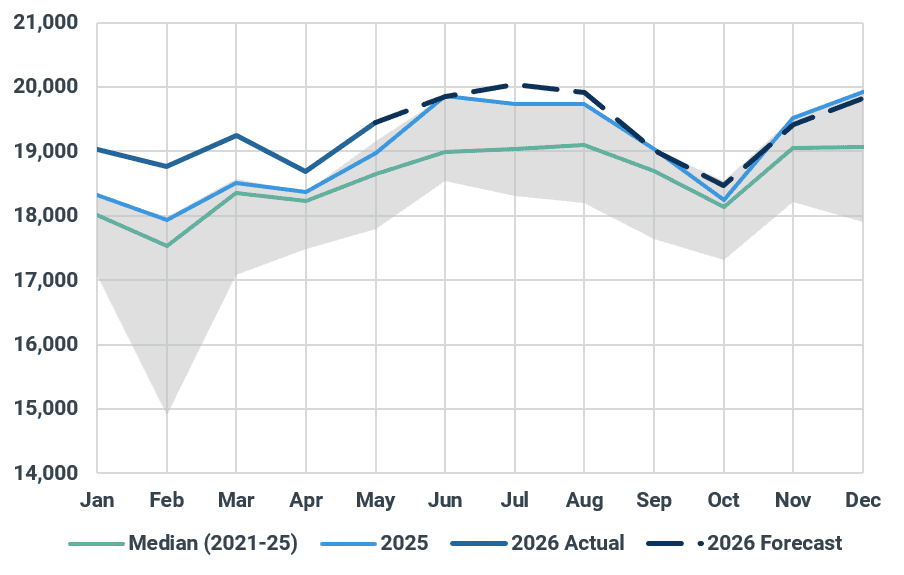
US refiners continue to shoulder the burden of balancing the global products market. Weekly utilization recently climbed to ~97%, the highest since 2018, as high margins and strong export demand incentivize refiners to maximize throughput and defer maintenance, keeping U.S. crude runs consistently above 17 mbd since June.
North America Refinery Runs, kbd
Source: Kpler
Even if geopolitical tensions ease, a meaningful recovery in global product supply won't be immediate — Middle East refinery ramp-up will take months, and Russian operations remain vulnerable to renewed drone strikes. Product balances are expected to stay tight, keeping US utilization close to capacity through year-end.
Conclusion
The market is likely to receive geopolitical relief before it receives additional product supply. Even if Hormuz traffic normalizes and regional tensions ease, refinery capacity lost to infrastructure damage cannot return overnight. Although global refinery outages are expected to trend lower from August onwards, prolonged repairs across the Middle East, recurring disruptions in Russia and only a gradual recovery in Asia will keep effective refining capacity well below normal. Consequently, global product balances are expected to remain structurally tight, sustaining elevated refining margins and keeping refinery utilization across the Atlantic Basin near practical limits through at least year-end. With little spare refining capacity remaining outside the conflict zone, the market has limited ability to absorb any further supply disruptions.
Market insights you can trust
Kpler delivers unbiased, expert-driven intelligence that helps you stay ahead of supply, demand, and market shifts.
Trade smarter. Request access to Kpler today.

See why the most successful traders and shipping experts use Kpler