Dangote: Every Barrel Sourced, Every Opportunity Seized
Nigeria’s Dangote refinery has sustained near-nameplate operations in 2026, with crude imports hitting approximately 630 kbd in April and 609 kbd month-to-date in May, product exports reaching record monthly volumes, and a diversified feedstock strategy replacing US Midland barrels with opportunistic regional and transatlantic grades.
Midland Exits, Domestic Supply Doubles
On Dangote’s crude supply side, WTI Midland, which averaged over 200 kbd through February and March, dropped out of Dangote’s feedstock slate entirely by April. Midland had previously served as the refinery’s primary alternative to domestic supply, 83% of non-domestic barrels in 2025. However, the Atlantic Basin arbitrage shifted materially following disruptions linked to the Strait of Hormuz blockade, with elevated freight, insurance, and voyage costs eroding the economics of U.S. barrels into Lekki.
Dangote Crude Imports split by Origin Country

In April, Dangote approximately doubled its monthly cargo receipt cadence, with domestic Nigerian grades up +262 kbd to 605 kbd. This trend has sustained into May with 552 kbd of domestic crude intake month-to-date.
Cameroon, Guyana, Libya Enter the Crude Basket
Alongside the domestic ramp, Dangote has pursued an active diversification of its feedstock book, chasing other available barrels to sustain run rates:
- Cameroon (Ebome): In April, Navig8 Passion loaded approximately 750,000 bbls of Ebome crude from Cameroon. Ebome is a light sweet grade with similar quality to Nigerian barrels and a sub-week voyage from origin, acting as a competitive regional substitute.
- Guyana (Payara Gold): May sourcing extended further afield, with the Suezmax Advantage Serenity loading ~1 Mbbl of Payara Gold from Guyana, arriving 14 May.
- Libya (Sharara): Libya has also emerged as a feedstock target as the refinery seeks to maximise utilisation. Kriti Energy loaded ~1 Mbbl of Sharara from Zawia on 6 May and arrived on 23 May. Kriti Hero loaded another 1 Mbbl Sharara cargo on 17 May, with arrival expected early June.
Dangote Refined Product Exports Hit Record Highs Amid Operational Shifts
Operationally, Dangote has been running at an average of 600 kbd in April and May following the successful optimisation of key secondary units earlier this year. The refinery is currently operating in simultaneous max-gasoline and max-jet modes, lifting gasoline yields and boosting jet output. This has positioned Dangote as an increasingly important marginal supplier of gasoline and jet fuel into Atlantic Basin markets, while effectively turning Nigeria into a net gasoline exporter.
Overall, Dangote refined product exports hit an all-time high of 341 kbd in April, accounting for just above half of the refinery's total outputs during the month. In May to date, export volumes have fallen to average just below 250 kbd.
Dangote Refinery monthly exports by product (May-to-date)
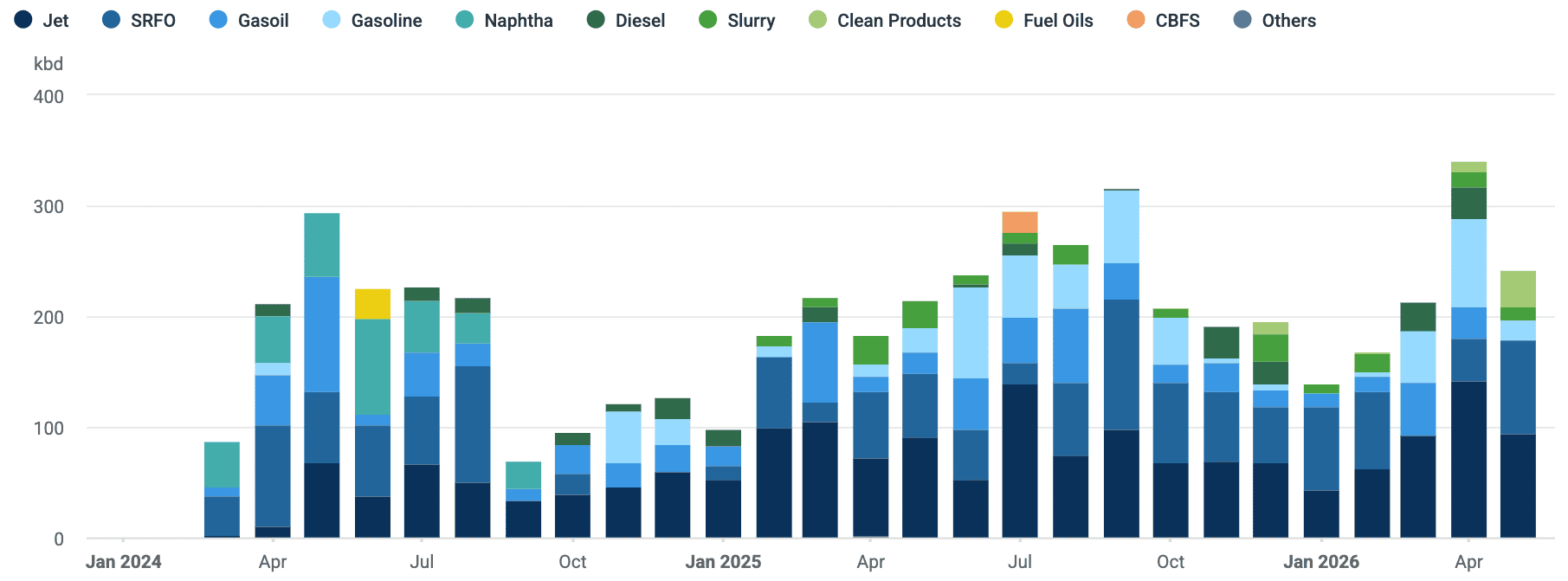
Jet Fuel and Gasoline Clearances
Amidst a globally tight supply environment, the refinery's higher-value slates saw substantial international distribution:
- Jet Fuel Outlets: Northern Europe and the Mediterranean regions absorbed a strong 90 kbd of jet fuel exports in April. This accounted for more than 63% of the total jet fuel exports moving out of the refinery.
- Gasoline Hubs: Near all-time highs of 80 kbd of gasoline exports were primarily directed toward usual African buyers. Concurrently, a rare LR2 Astrea cargo was recorded heading to Singapore, marking a notable geographical expansion.
Secondary Feedstock Surges and RFCC Constraints
Since May began, Straight Run Fuel Oil (SRFO) cargoes leaving the refinery have sharply increased, climbing to above 80 kbd compared to the 38 kbd recorded in April.
- Secondary Unit Outage: This structural jump in fuel oil exports stems from the refinery’s Residue Fluid Catalytic Cracker (RFCC), which has been operating below its nameplate capacity of 204 kbd since late April.
- Run Outlook: Looking ahead, total refinery runs are expected to remain elevated at approximately 600–650 kbd. However, intermittent fuel oil exports are highly likely to continue while the RFCC throughput remains restricted.
Pivot to the Nigerian Domestic Market
Equally visible in May is a clear strategic prioritization of the domestic market. Loadings destined for Nigeria to date have averaged an all-time high above 250 kbd. Within this domestic allocation, gasoline and diesel account for just above 50% and 30% of the total volume, respectively.
Dangote Refinery monthly waterborne domestic deliveries by product

Proprietary Data Spotlight: While Dangote's total international export footprint eased to 250 kbd in May due to secondary unit constraints, its domestic pipeline evacuation has hit unprecedented levels. The refinery's ability to maintain high baseline runs at 600–650 kbd continues to anchor West African product balances.

See why the most successful traders and shipping experts use Kpler