Panama Canal issues persisting into 2027 support higher LPG freight and delivered prices in East Asia
The Panama Canal Authority announced a reduction in transits as a dry period from a very strong El Niño is set to extend into next year. Peak water level impacts are likely in early Q2 next year just as new LPG export capacity is ramping up on the USGC, keeping upward pressure on VLGC freight rates and delivered prices in East Asia through Q2 2027.
Market & Trading Calls:
- A dry outlook for Central America from Q4 2026-Q2 2027 sets the stage for further reduction in Panama Canal transits, with April 2027 likely to set the low water mark at Gatun Lake.
- Canal congestion and transit auction fees are already significantly elevated, boosting VLGC freight and delivered propane prices as importers stock up ahead of peak heating demand. Continued dry weather in Panama and another leg up in USGC LPG exports in 2027 will keep upward pressure on freight and delivered prices in Asia persist through Q2 2027.
- A Panama Canal bypass pipeline is still years off and creative STS shuttle trades on smaller vessels are costly and will move only limited volumes, leaving most operators to choose between longer routes or more expensive Panama Canal transits.
Last week, the Panama Canal Authority (PCA) announced reduced transits through the Panamax and Neopamax locks as dry conditions impact Gatun Lake levels. Daily panamax transits will drop from 26 to 25 on 3 September, then again to 23 on 15 September. Neopanamax transits will drop from 10 to 9 on 3 September.
Gatun Lake levels have declined this year, with the downtrend persisting beyond the beginning of rainy season in May. In response, the PCA marginally limited drafts earlier this summer but limiting transits is a stronger lever to maintain lake levels by reducing the amount of water flushed out to sea during the operation of the locks. The chart below shows lake levels for 2026 as well as the 2023 drought year which heavily impacted LPG movements through the canal.
Gatun Lake Levels (feet)
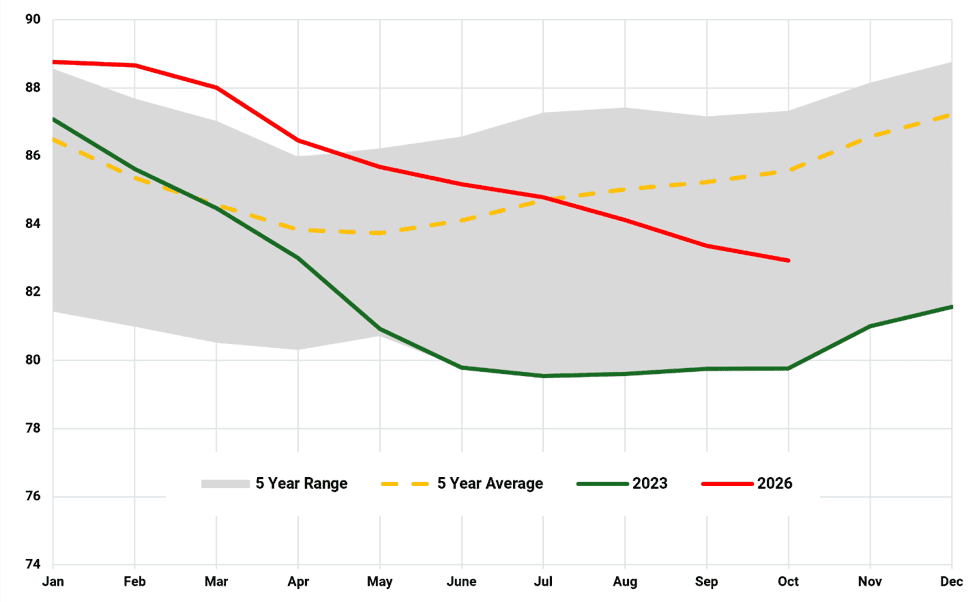
Source: Panama Canal Authority. 2026 values are actual through mid-August and PCA forecasts through October.
With lake levels trending the wrong direction seasonally, the region is also facing a likely dry winter. The US National Oceanic and Atmospheric Administration (NOAA) currently forecasts a >90% chance of a very strong El Niño this fall and winter. Central America typically experiences dry patterns during El Niño, with this winter’s outlook suggesting a very high likelihood of below normal precipitation in the region. Additionally, recorded precipitation for 2026 through mid-August has been 20% below the five-year average.
Modeling Gatun Lake levels
To consider the potential impacts on Panama Canal transits and LPG market ramifications of this prolonged dry spell, we analyze historical precipitation and lake level data from the PCA. The consistent historical relationship between rainfall and changes in lake levels allows us to forecast Gatun Lake Levels under different precipitation scenarios.
First, we analyze a scenario where precipitation from October 2026 to July 2027 (the main period of El Niño impacts) is 20% below the five-year average. This is in-line with YTD precipitation but may prove too wet given previous impacts from strong El Niños. Under this scenario, the lake bottoms at 80.7 feet in April 2027 before precipitation rallies seasonally and El Niño impacts taper.
Scenario 1: Oct 2026 to July 2027 precipitation 20% below five-year average
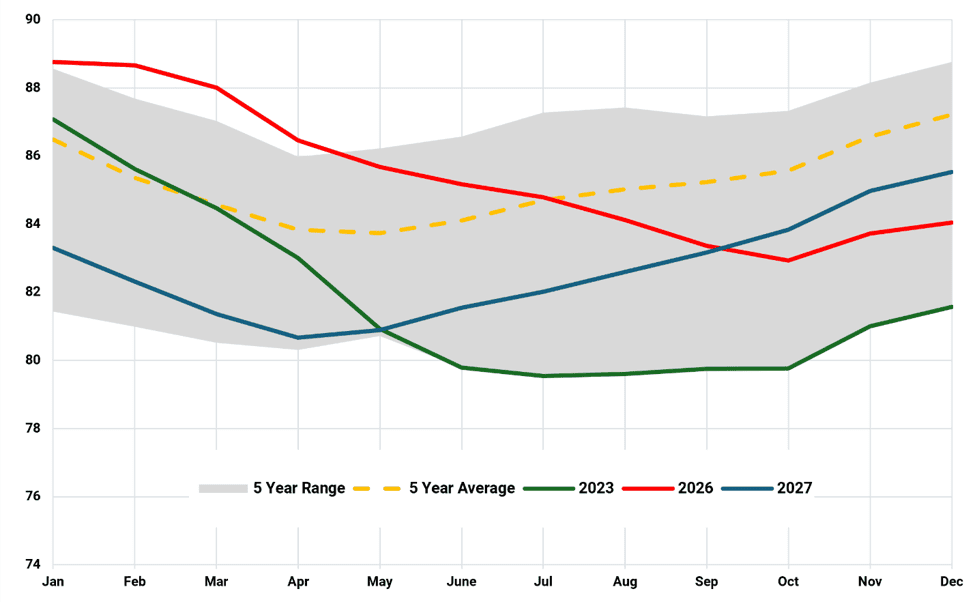
Source: Kpler analysis, ACP data.
Under our drier scenario, precipitation from October 2026 to July 2027 is 40% below the five-year average. This pulls lake levels closer to the 2023 lows, bottoming out in April at 79.9 feet.
Scenario 2: Oct 2026 to July 2027 precipitation 40% below five-year average
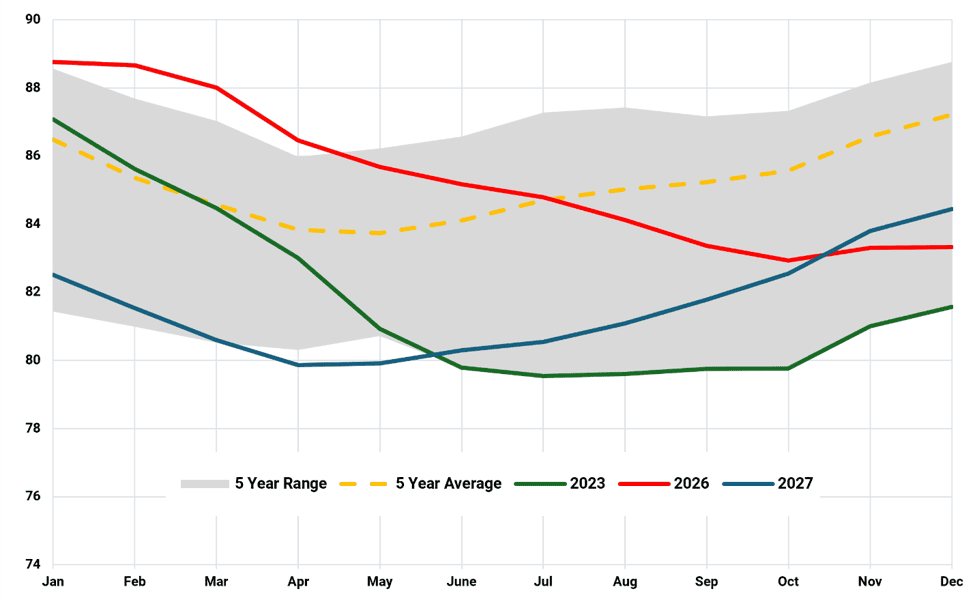
Source: Kpler analysis, ACP data.
LPG market impacts
Under both scenarios, early Q2 2027 will have the most acute pressure from low lake levels. USGC LPG exports are set for a leg up in 2027 as Enterprise Houston (+300 kbd LPG) ramps up in Q1 and Targa’s Galena Park expansion (+130 kbd LPG) comes online in Q3, adding more US to Asia NGL cargoes through the already-busy canal.
As Middle Eastern exports remain limited, US cargoes to the East have increased this year across crude, refined products, and NGLs, increasing demand for Panama Canal transits. While our base case of Middle East supply returning in Q1 2027 will redirect some US-Asia canal traffic to other markets, demand for transits will remain high.
With a proposed canal bypass LPG pipeline not likely until late 2030, strong demand for transits combined with low lake levels will push more vessels around the Cape of Good Hope to meet Asian demand as well as continued canal congestion and upward pressure on VLGC freight rates. Indeed, a Neopanamax slot for 28 August northbound transit recently auctioned for $3.15 million (industry report). Recent proposed trades such as using shuttle vessels through the Panamax locks to avoid Neopanamax congestion (industry reports) shows the extreme costs of canal transits and alternative routes.
More proactive canal management in 2026, but precipitation remains a key variable
The PCA is taking a more proactive approach than in the 2023 drought. During that year, lake levels had dipped and remained well below the five-year average (-5.3 feet or -6.3%) before transit restrictions were put in place in late July 2023. The announcement of reduced transits last week came as August lake levels are just 0.9 feet or 1.1% below the five-year average.
2023 drought lake levels and transit slots
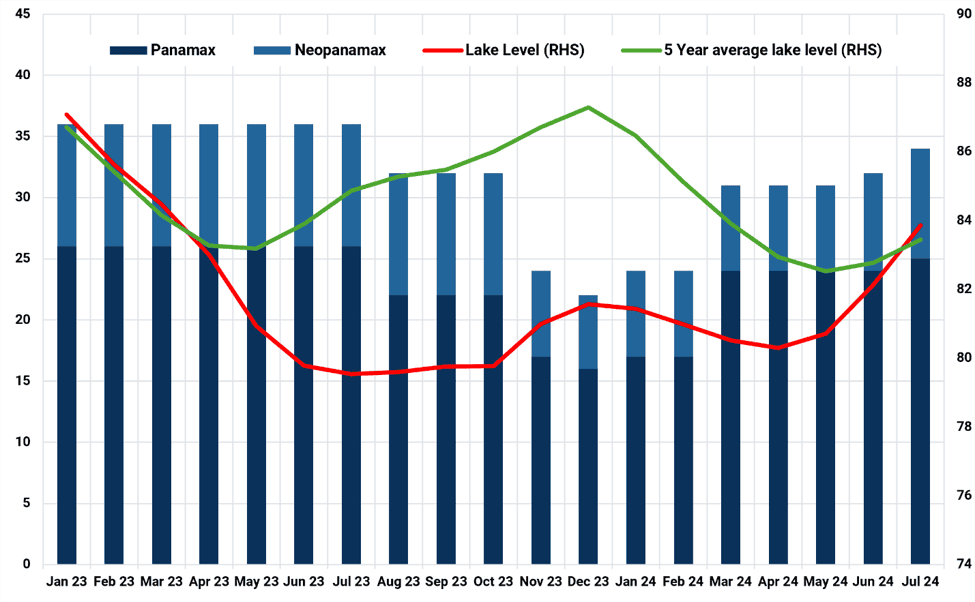
Source: Kpler analysis, ACP data.
The more proactive approach may result in fewer restrictions during peak Q2 2027 impacts as less water is flushed out to sea in the interim, but the situation remains very weather-dependent.
In the near term, propane will feel the squeeze as Panama Canal congestion continues to increase just as seasonal importers are looking to build stocks ahead of peak heating season. This will add support to propane to crude ratios in the East into Q4 as Middle Eastern exports remain curtailed.

See why the most successful traders and shipping experts use Kpler