

US extends Russian crude lifeline while closing the door on Iran
The US Treasury has executed a notable policy reversal, extending the sanctions waiver for Russian crude sold to Indian refiners by two weeks until mid-May, potentially giving a glimpse of post-war buying attitudes from Indian buyers as well.
Key Takeaways:
- The US Treasury has extended the sanctions waiver for Russian crude to Indian refiners until mid-May, yielding to buyer pressure to replace lost Middle Eastern barrels.
- Washington did not renew the one-month general license for Iranian oil, permanently closing the purchasing window on Sunday, 19 April.
- Indian demand for Russian Urals remains unrelenting, pushing May-arrival premiums to ICE Brent to around $6/bbl.
This shift underscores the immense pressure exerted by Indian importers, who are aggressively seeking alternative barrels to replace disrupted Middle Eastern supplies following the closure of the Strait of Hormuz. This comes as the US energy secretary said last week that the broad sanctions waivers for Russian oil would not be extended.
Alongside this, the Office of Foreign Assets Control (OFAC) extended special operation permits for Serbia's NIS and Croatia's Janaf until 16 June, while granting Russia's Gazprom until 22 May to finalize the sale of its stake in NIS to Hungary's Mol.
In stark contrast, Washington held firm on Tehran, refusing to renew the temporary general license for Iranian crude. That window firmly closed on Sunday, 19 April. Prior to the deadline, Indian refiners capitalized on the brief opening to secure Iranian cargoes. To circumvent broader financial restrictions, these purchases, including one VLCC, were settled in Chinese yuan via an Indian bank.
This indirectly placing the buying scrutiny on China’s independent refiners. These refiners have also not materially increased imports, balancing pressure from Beijing to keep running hard with the realities of higher Iranian oil prices and crimped refining margins.
Russia crude oil in transit by current location, Mbbls
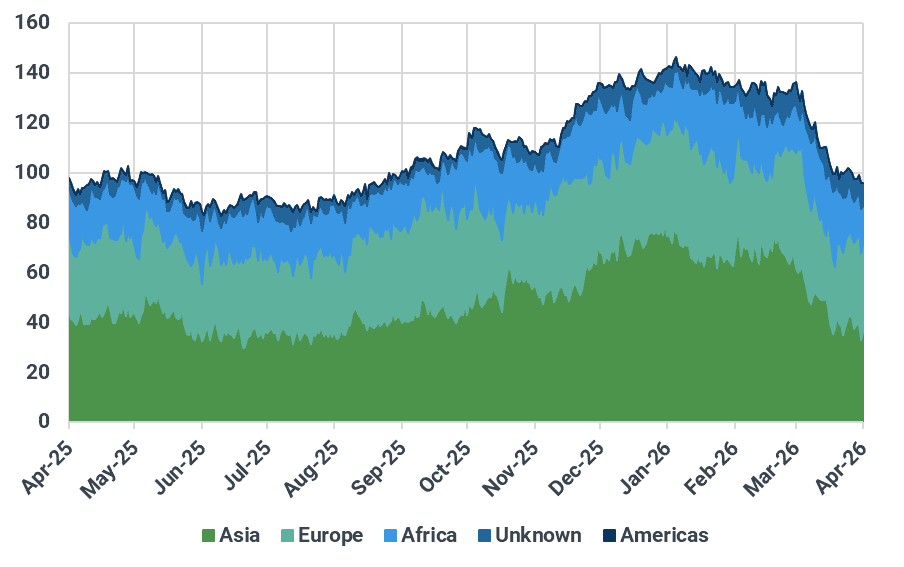
Source: Kpler
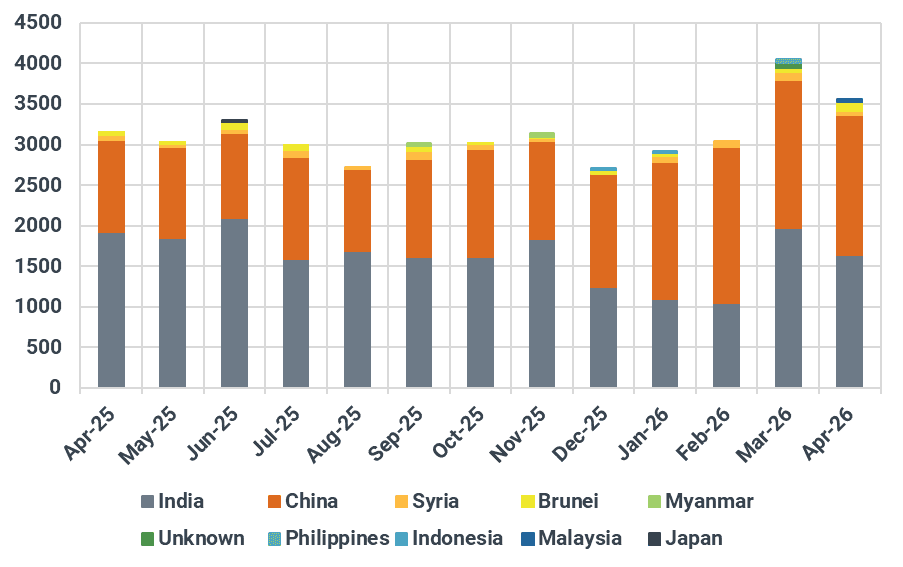
Despite the volatile regulatory environment, India's appetite for Russian oil shows no signs of waning. Refiners are increasingly comfortable operating within a heightened risk landscape, calculating that the need to shore up domestic fuel supplies far outweighs the threat of US sanctions repercussions. This aggressive buying drove an over 900kbd month-on-month surge in India's Russian crude imports in March.
The impact on pricing is profound. Indian buyers have been actively pricing in sanctions risks for weeks. Premiums for May-arrival Urals currently average around $6/bbl above ICE Brent, a couple of dollars higher on the month, according to Argus Media. Urals arrivals to India so far this month stand at around 1.5 Mbd, just shy of the 1.7 Mbd last month.
The scramble for non-Middle Eastern barrels is simultaneously driving Southeast Asian nations toward Moscow. Malaysia, Indonesia, and the Philippines are all pursuing Russian oil to mitigate the regional fuel crisis. Philippine refiner Petron secured over 2 Mbbls of Russian crude, underscoring a fundamental realignment of Asian crude flows.
Looking ahead, risk appetite from Asian buyers towards Russian oil should improve, even in a post-war world. The precedent has been seemingly set, and Indian refiners especially are likely to focus more acutely on price rather than sanctions risk when this war de-escalates. This approach may also become more commonplace around Asia, expanding the potential destination for Russian oil going forward.
An example of this is India’s shipping directorate expanding the list of approved marine insurers and adding a fresh Russian company to the list.
Asia imports of Russian crude oil by destination country, kbd
Source: Kpler

See why the most successful traders and shipping experts use Kpler








