

US tightens the screws on Iranian oil, drawing China into the fray
Seeking to bring an end to the two-month-old Middle East war and gain the upper hand in upcoming trade talks with China, the US has tightened enforcement on Iranian oil shipments and trade, aiming to pressure both Tehran and Beijing.
Key Takeaways:
- US sanctions on the 400 kbd Hengli Petrochemical refinery—the largest target so far—are unlikely to derail its operations in the near term.
- The blockade on Iranian oil shipments has slowed new loadings, but the 155 mb of Iranian crude already outside the Gulf of Oman suggests no imminent supply disruption for Chinese buyers.
- Beijing’s push for independent refiners to maintain run rates exposes them to potential US sanctions, as plants have limited feedstock alternatives under the current supply and margin environment.
China has so far largely stayed on the sidelines of the US–Israeli war with Iran—at least on the surface—even as many countries, including the US, hope Beijing will step up as a mediator to help bring the conflict to an earlier end. In 2023, China brokered the restoration of diplomatic ties between Saudi Arabia and Iran.
Beijing may be weighing its strategic options, given its complex relationship with Washington and its deep economic and political ties with both Iran and the GCC. One thing is clear: a standstill in Hormuz traffic, along with the growing risk of a global economic downturn driven by energy supply shortages and high inflation, is in no way in China’s interest. The question is when—and to what extent—Beijing chooses to get involved.
While there may already be far more happening behind the scenes, the latest US blockade on Iranian shipping and sanctions on a major Chinese refinery appear to be pushing Beijing to take a more active role—while also giving it additional leverage ahead of the scheduled Trump–Xi meeting next month.
Over the weekend, the US sanctioned the 400 kbd Hengli Petrochemical refinery over its purchases of Iranian oil, the largest Chinese refinery by capacity to be added to its blacklist to date. While Hengli has denied trading with Iran in response to the sanctions and a sharp drop in its share price, some market participants suggest the Dalian-based independent refiner is currently running entirely on Iranian and Russian feedstocks.
Kpler does not have visibility into the end buyers of Iranian crude. Imports of Iranian barrels into Dalian Changxing Island—where the Hengli refinery is located alongside other commercial storage facilities—averaged 202 kbd in 2025 and 253 kbd so far in 2026.
US sanctions on Hengli are expected to complicate both its term contracts and spot dealings with other crude suppliers, such as Saudi Aramco, as well as its relationships with overseas buyers of products like MTBE (the refinery does not hold export quotas for transportation fuels). However, operations at Hengli are unlikely to be derailed in the near term. The refinery appears to have little intention of lifting term cargoes from the Middle East given high oil prices, while Beijing’s directive for independent refiners to maintain run rates and prioritize domestic supply points to potential policy support from the government—at least for the duration of the war.
However, Beijing’s push to secure fuel supply is now somewhat at odds with the US blockade on Iranian oil flows and the tightening of sanctions on Iranian trade, as many teapots rely on Iranian, Russian, and domestic offshore crude to meet their feedstock needs.
Kpler data shows that Iranian crude loadings have slowed over the past week, while transit through the Strait of Hormuz has dropped sharply as US enforcement tightens.
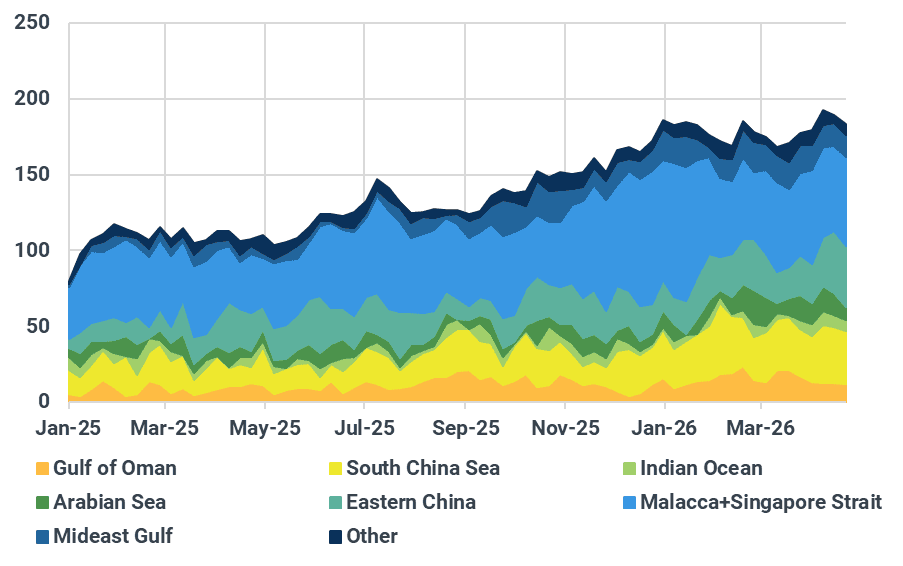
Around 155 mb of Iranian crude is currently located outside the Mideast Gulf and the Gulf of Oman, facing relatively lower risks of interception by US forces. While immediate disruptions to Iranian supply pose little threat to Chinese purchases—at least over the next two to three months—the prospect of tighter cargo availability is set to support prices and squeeze refinery margins.
Iranian crude/co on water by current location, mb
Source: Kpler
At current price levels—Iran Light at ICE Brent +$2/bbl, ESPO at ICE Brent +$7/bbl, and Chinese offshore crude at Dated Brent +$10s/bbl—teapot margins have already fallen to around -$8 to -$10/bbl, according to market participants. As a result, China’s imports of Iranian crude have averaged 1.16 mb/d so far in April, down from 1.71 mb/d in March and 1.57 mb/d in February.
That said, concerns over energy security are likely to keep Beijing urging independent refiners to maintain run rates, which in turn requires continued purchases of Iranian crude—especially given the unfavorable margin environment. But this policy could expose more refiners to US sanctions, as Washington looks for additional leverage in both the Middle East conflict and its trade talks with China.
Expected or not, teapots are becoming casualties of the broader geopolitical contest between Washington, Tehran and Beijing.
Market insights you can actually trust
Kpler delivers unbiased, expert-driven intelligence that helps you to track critical crude oil market developments for your own analysis. Our precise forecasting empowers smarter trading and risk management decisions. In times of conflict and geopolitical uncertainty, our real-time data keeps you ahead of supply disruptions and price volatility.
Unbiased. Data-driven. Essential. Request access to Kpler today.

See why the most successful traders and shipping experts use Kpler








