Why a temporary US-Iran deal looks increasingly likely
Despite ongoing low-level military incidents, the ceasefire between the US, Israel, and Iran has largely held, with both Washington and Tehran appearing to favour a negotiated de-escalation over renewed conflict. The most likely outcome is a limited agreement in which Iran supports the gradual reopening of the Strait of Hormuz in exchange for the lifting of the US maritime blockade and targeted economic concessions, rather than a broader nuclear deal or full sanctions relief.
Key Takeaways
- A temporary US-Iran agreement is increasingly likely. Neither Washington nor Tehran appear willing to resume full-scale hostilities, while both face mounting economic costs from a prolonged standoff.
- The US blockade has achieved its primary objective. Iranian crude/co loadings have fallen below 300 kbd, inventories continue to build, and Tehran is facing growing constraints on its ability to monetise production.
- Washington has incentives to de-escalate before the end of summer. Strong US inventory draws, elevated Gulf supply risks, and pressure from regional allies all support a negotiated reopening of the Strait of Hormuz.
- A JCPOA-style breakthrough remains highly unlikely for now. The most likely outcome is a limited arrangement focused on restoring shipping flows rather than resolving the nuclear issue.
- Our base case remains a gradual reopening of the Strait of Hormuz from July. Physical transit flows should recover only gradually, with normalization likely taking until September or October.
Despite sporadic military exchanges over recent weeks, the ceasefire between the US, Israel, and Iran remains intact. Explosions have repeatedly been reported around Bandar Abbas, Iran has continued limited retaliatory actions against US assets, and missile interceptions have occurred across the Gulf. Yet neither side has crossed the threshold that would trigger a return to full-scale hostilities.
The persistence of negotiations alongside these incidents suggests that both Washington and Tehran are seeking an off-ramp rather than escalation. Rumours surrounding a memorandum of understanding have gained momentum in recent weeks, reinforcing the view that a temporary arrangement is becoming more likely than either a comprehensive nuclear agreement or a renewed military campaign.
For the Trump administration, the strategic logic is increasingly straightforward. The US blockade imposed on 13 April has significantly impaired Iran's oil export capability, but it has not resolved the broader problem created by Iran's ability to disrupt traffic through the Strait of Hormuz. Non-Iranian transits remain well below normal levels, while regional producers continue to face substantial export constraints despite the use of alternative routes through Yanbu and Fujairah.
At the same time, Gulf allies have little appetite for renewed conflict. Saudi Arabia, Qatar, and the UAE remain exposed to Iranian missile and drone capabilities, and all have strong incentives to encourage a negotiated outcome. Recent diplomatic messaging from Gulf capitals has increasingly pointed towards de-escalation rather than confrontation.
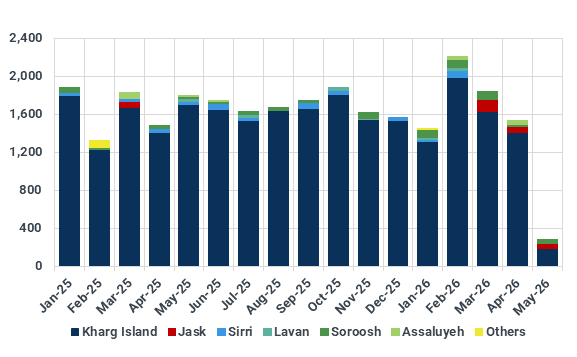
Iran also has incentives to strike a temporary deal. The blockade has severely curtailed export flows and forced production cuts. Iranian crude and condensate loadings have fallen below 300 kbd, compared with an average near 2 Mbd during the 40 days preceding the blockade.
Iran oil exports by origin ports, kbd
Source: Kpler
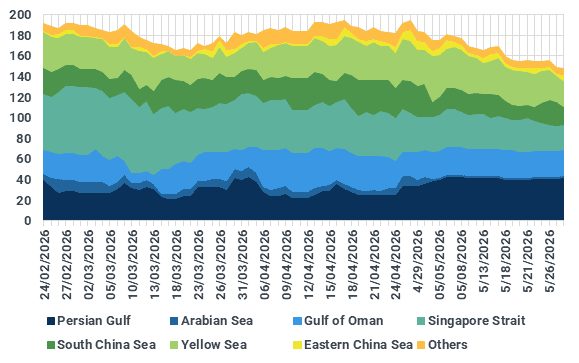
Rising inventories further highlight the pressure on Tehran. Of the approximately 147 mb of Iranian crude and condensate currently on the water, around 67 mb remain trapped inside the Persian Gulf and Gulf of Oman ahead of the blockade line. Meanwhile, volumes already beyond the blockade have steadily declined as cargoes continue to discharge in China: from 127 mbbls when the blockade was launched to 80 mbbls. If the blockade is maintained for another two months, Iran won’t have any more oil to sell to China.
Iranian oil on water, mbbls
Source: Kpler
The obvious question is why Washington would consider lifting the blockade now, particularly as oil prices have softened in recent weeks and pressure on Tehran continues to build.
The answer lies in the growing economic and political costs of maintaining the status quo. While the blockade has been effective in pressuring Iran’s economy, it has not solved the broader problem of impaired Strait of Hormuz traffic. Non-Iranian flows remain heavily disrupted, keeping global energy supply chains under pressure and limiting the ability of Gulf producers to fully access international markets.
The Trump administration also has little incentive to see the conflict dominate the political agenda through the summer. Although equity markets remain near record highs, supported by optimism around artificial intelligence and hopes for a diplomatic breakthrough, US Treasury yields remain elevated and broader economic conditions remain fragile.
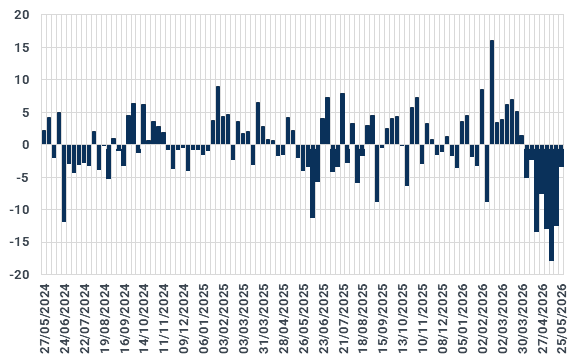
Oil fundamentals are also becoming more challenging. US demand has shown little sign of meaningful destruction despite higher prices. Product deliveries remain broadly within recent historical ranges, but this has been achieved through exceptionally large inventory draws. Over the last six weeks, total US oil inventories have declined by an average of roughly 11 mb per week, one of the strongest drawdown periods on record. If sustained, inventories would fall toward multi-decade lows.
US oil inventory weekly delta, mbbls
Source: EIA, Kpler
From Washington's perspective, a partial reopening of the Strait of Hormuz would help alleviate some of this pressure. Additional Middle Eastern barrels returning to market would reduce the need for inventory drawdowns, ease concerns over physical availability, and lower the export arbitrage for US crude, allowing domestic stocks to rebuild.
There is also a strategic calculation. Once Hormuz is reopened, Iran may find it politically more difficult to close the waterway again without provoking a stronger international response. A temporary agreement would therefore allow Washington to secure the immediate objective of restoring energy flows while postponing the more difficult question of Iran's nuclear programme.
For these reasons, we think that the most likely outcome remains a limited and transactional arrangement rather than a comprehensive settlement. A JCPOA-style agreement or broad sanctions relief until the nuclear issue is not resolved remain highly unlikely. Instead, the most plausible deal would see Iran facilitate the reopening of the Strait of Hormuz in exchange for the removal of the US maritime blockade and limited economic concessions. Under this scenario, we continue to assume a gradual reopening of Hormuz from July, with normal transit levels requiring a further two to three months to recover.
Market insights you can trust
Kpler delivers unbiased, expert-driven intelligence that helps you stay ahead of supply, demand, and market shifts.
Trade smarter. Request access to Kpler today.

See why the most successful traders and shipping experts use Kpler