Aluminium value chain tracking: More ore, less refining - Rio Tinto’s Australian value-chain reset
Rio Tinto’s aluminium value chain in Australia is splitting: the curtailment at Yarwun will remove 1.20 Mtpa of alumina production, while the acquisition of the Aurukun bauxite mine will preserve and potentially expand the bauxite business.
Summary
- Rio Tinto’s curtailment at Yarwun will remove 1.20 Mtpa of alumina production, equivalent to 3% of global seaborne supply.
- The cut could release about 2.70Mtpa of Australian bauxite into exports, initially adding to oversupply.
- The Aurukun acquisition does not contradict Yarwun’s retrenchment: it reinforces Rio’s strategic shift towards a more profitable bauxite portfolio.
Yarwun production cuts: removing 3% of seaborne alumina supply
Rio Tinto's wholly owned 3Mtpa Yarwun alumina refinery in Australia will cut production by 40% from October 2026. The plan was first announced in November 2025 and has been reaffirmed since.
Before the curtailment, Yarwun supplied around 1Mtpa of alumina to Australian smelters, including Tomago and Bell Bay. The remaining roughly 2Mtpa was exported, primarily to Rio Tinto’s BC Works smelter in Canada and to customers in Asia.
Yarwun’s alumina exports by destination (Mt)
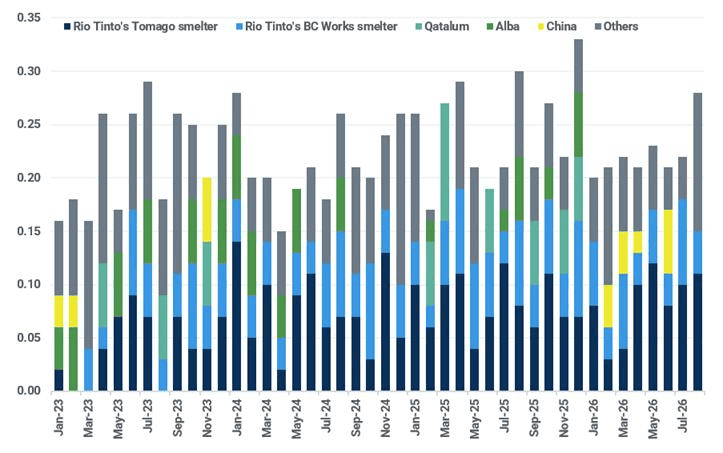
*Most volumes destined for China in 2026 were eventually destined for GCC countries after being bagged in China
Source: Kpler
- Impact on the seaborne market: The cut equates to around 1.20 Mtpa of alumina output, removing over 3% of annual global seaborne supply. The impact will be gradual: the maximum Q4 2026 loss would be around 0.30Mt, with the full annualised impact visible in 2027. Nevertheless, the cut represents another step moving the seaborne alumina market from persistent oversupply towards balance.
- Overall impact on clients limited: The most direct exposure is likely to fall on third-party customers, including buyers in the Gulf Cooperation Council (GCC) countries, who see imports from Yarwun and wider Australia affected but not disrupted since the war, thanks to the bagging operations in third-party countries. However, Rio has emphasised that the production cuts “will be no impact to customer requirements”, suggesting that the company has already adjusted its supply portfolio. Potential measures include reallocating tonnes from the 3.70Mtpa QAL refinery, optimising supply across Rio Tinto's wider alumina system, or allowing flexible contracts to expire rather than imposing cuts on individual smelters. Moreover, it won’t be difficult for any client to secure additional supply elsewhere in the remaining oversupplied market.
- Reasons for the cuts: The immediate operational constraint at Yarwun is limited future tailings-storage capacity, but the decision to curtail production is economic. Rio’s broader alumina business recorded an underlying EBITDA loss of approximately $2 million in H1 2026. Against this backdrop, committing substantial capital to a second tailings facility, required to sustain full production beyond 2031, is difficult to justify.
- When is a full return possible: We estimate Yarwun’s FOB cash cost at $310 to $340/t, with potential capex of $400-600 million for a second tailings facility. Rio would need to see prices sustainably above $450/t, and potentially closer to $500/t, before restoring the curtailed capacity and committing the capital needed to extend Yarwun’s operating life at full rates.
Impact on the bauxite market
Yarwun sources the majority of its bauxite from Rio Tinto's Amrun & Andoom mines in Queensland, supplemented by some volumes from the Gove operation in the Northern Territory. Based on Amrun's published total alumina grade of 50.4% Al₂O₃ and the assumption of an 85–90% effective refinery recovery rate, Yarwun's 1.20Mtpa alumina cuts would lower its annual bauxite requirement by approximately 2.70Mt.
We expect most of these displaced bauxite tonnes to be redirected into the seaborne market, with China the most likely destination.
In the near term, the additional supply would exert modest downward pressure on an already well-supplied global bauxite market. Chinese demand is insufficient to absorb the incremental tonnes.
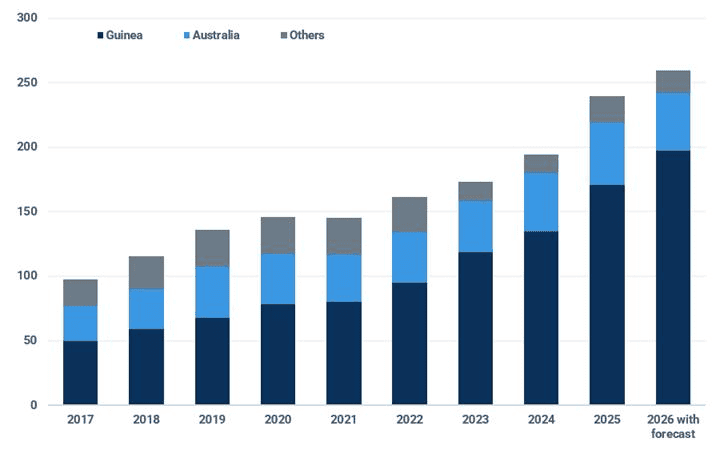
The longer-term implications are more constructive for Rio Tinto and the Australian bauxite sector. Guinea remains dominant in global seaborne supply, leaving the market increasingly exposed to regulatory intervention or operational disruption there. Should the Guinean government eventually impose meaningful export restrictions, Yarwun’s curtailment would give Rio Tinto extra Australian tonnes and greater flexibility to respond to any shortfall in Guinean supply.
Australia is the world’s second-largest bauxite exporter, just after Guinea (Mt)
Source: Kpler Insight
Rio Tinto buys Aurukun bauxite mine: why does the acquisition come despite the Yarwun cuts?
Rio Tinto has agreed to acquire the planned 8Mtpa Aurukun bauxite mine in Queensland from a Glencore-Mitsubishi joint venture. Aurukun remains a development-stage asset, with its environmental evaluation completed in Q2 2025.
The acquisition appears at odds with Rio Tinto's decision to cut production at Yarwun, which will reduce the group's internal bauxite requirement. However, the two decisions are economically and strategically consistent when Rio's bauxite and alumina businesses are considered separately:
- First, bauxite has fundamentally stronger economics than alumina refining. Rio Tinto's bauxite operations have historically been among the more stable and higher-margin businesses within its Aluminium division, supported by relatively low operating complexity and exposure to the growing seaborne market. Its Australian alumina refining business, by contrast, is more capital-intensive, energy-sensitive and environmentally constrained. The Aurukun acquisition, therefore, represents an expansion of an attractive upstream business rather than a commitment to feed additional tonnes into Rio's domestic refining system.
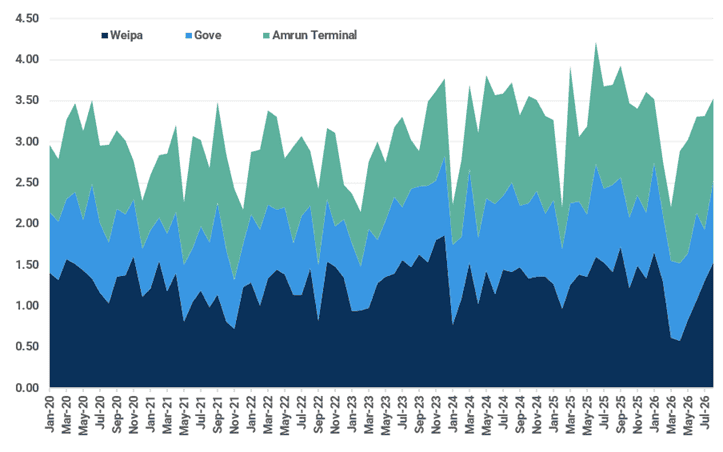
- Second, Aurukun provides long-term replacement supply and potential for expansion. Rio's Gove mine in the Northern Territory and Andoom operation in Queensland are expected to close around the end of the decade. The planned 20Mtpa Kangwinan project, targeted to begin production in 2029, should replace a large share of these lost tonnes, but not all of them. Aurukun, therefore, provides an additional long-dated resource capable of supporting Rio's production base and even expanding its share of the seaborne market. Rio exported around 42Mt of bauxite from its wholly owned Australian mines in 2025, making the company the world's second-largest bauxite exporter.
Rio Tinto bauxite exports from Australia (by origin installation, Mt)
Source: Kpler
- Third, Aurukun offers substantial geographical and infrastructure synergies. The project, located on Mineral Development Licence (MDL) 2001, is effectively surrounded by Rio's existing Weipa operations. Bringing it into Rio's portfolio removes a competing development from the middle of its established operating area and creates opportunities to leverage existing logistics, infrastructure, technical expertise and relationships with regulators.
- Finally, the acquisition fits Rio Tinto's broader effort to diversify earnings growth beyond Pilbara iron ore. Iron ore remains the group's largest earnings contributor, but a weaker pricing environment is limiting growth: Iron Ore underlying EBITDA fell 1% y/y in H1 2026, while EBITDA from Copper and Aluminium & Lithium increased 84% and 38% y/y, respectively.
Market insights you can trust
Kpler delivers unbiased, expert-driven intelligence that helps you stay ahead of supply, demand, and market shifts.
Trade smarter. Request access to Kpler today.

See why the most successful traders and shipping experts use Kpler
.png)