
Five takeaways on refined product demand forecasts, and implications for balances
Our balances show refined product demand recovering everything it lost in 2026, and more, by 2027. But the rebound is built on supply that has not yet returned, lands in products that do not need it, and meets inventories with not much to spare. Five takeaways on where the recovery is real, where it is structural, and where our forecast may be too cautious.
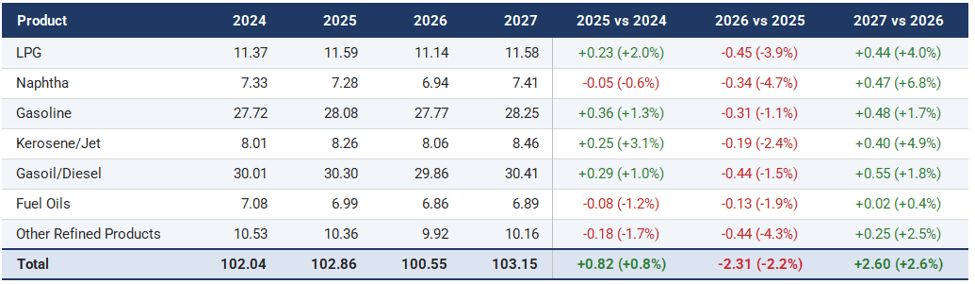
1. Demand recovers sharply in 2027 in our latest S&D release, with 2.6 mbd of growth more than offsetting the 2.3 mbd lost in 2026 and marking the strongest year since China exited zero-Covid in 2023
The recovery is built on supply normalization: Middle Eastern crude, NGL and product exports returning to market, supported by a partial rebuild of Russian refinery runs and product exports, which together allow prices to ease and end-user demand to recover. The 2026 to 2027 outlook therefore hinges on two conflicts, Iran and the wider Middle East on one side and Russia and Ukraine on the other.
Our base case assumes Russian refinery runs do not return to their pre-war baseline over the forecast period, while a full recovery across the Middle East takes until Q2-27. The first assumption is conservative; the second carries a high risk of slipping, particularly if US military engagement in the region is prolonged.
The implication for demand is sequential. Volumes stay suppressed while supply remains offline. Once it returns, demand should respond relatively quickly, tempered by inventory rebuilding, which is likely to keep prices elevated for longer than the supply recovery alone would suggest.
Global refined products demand (mbd)
Source: Kpler
2. The shock hit all product demand in Q2-26, but the lasting damage is concentrated in Asian light ends and Gulf aviation
The 2027 recovery will be decided in the same order the losses were taken: Asian light ends first (-1.5 mbd at the trough, the largest and most reversible loss), then Chinese road fuels and European diesel, where part of the loss is structural and will not return.
Middle East jet losses are smaller in volume but the deepest in percentage terms, and the one place where our forecasts may be cautious. We keep jet demand in the UAE, Qatar, Iran and Kuwait 12% below 2025 through 2027, with Qatar and Iran 15% and 20% below. Yet industry data show Gulf carriers operating at 82% to 90% of pre-war capacity, and Qatar Airways has scheduled more than 170 destinations for the 2026-27 winter season. The binding constraint is no longer demand but airspace risk, insurance and the return of foreign carriers. If those normalize, Middle East jet is the first line in our balances to be revised up.
3. Asian light ends: supply returns in force, but petrochemical margins will set the pace of the demand recovery
The 2026 loss in Asian LPG and naphtha demand was a direct response to absent supply, which makes it the most reversible loss of the year. In 2027 the supply side does more than reverse: US NGL output keeps rising on growing field supplies and new export capacity, and a normalization of Strait flows would release Middle Eastern exports as gas-linked projects ramp up in Saudi Arabia, the UAE and Qatar. In our balances LPG supply grows nearly three times faster than demand, so availability no longer limits consumption. Two factors do.
First, Indian LPG demand lags. The 2026 loss reflects a combination of constrained supply, higher prices for unsubsidized cylinders and a gradual shift towards piped gas, and the pace of recovery will depend on how quickly the first two normalize.
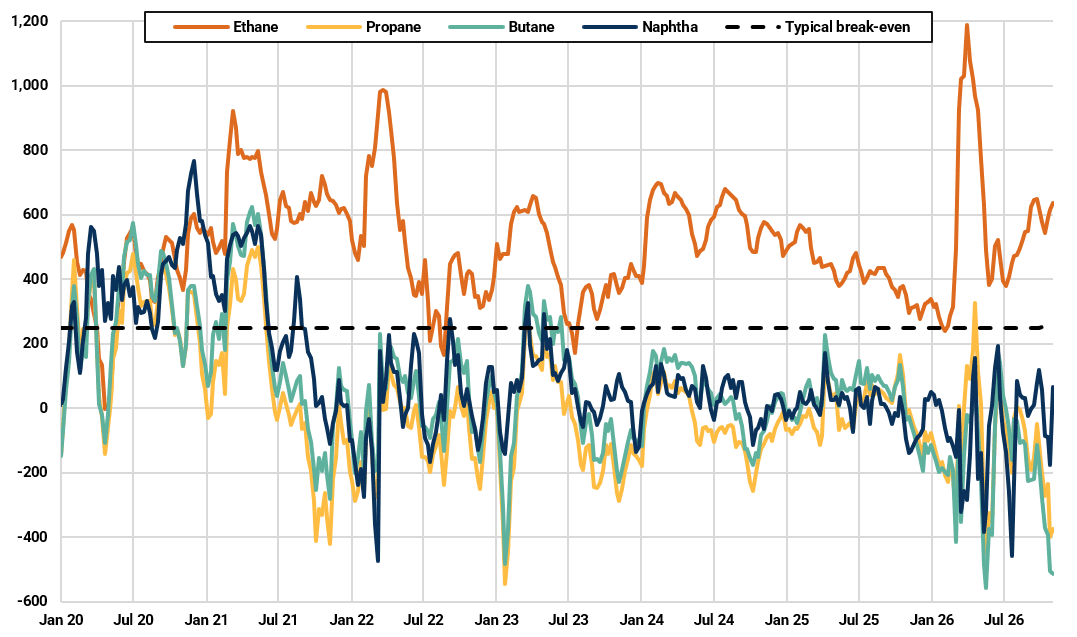
Second, margins. Demand growth in 2027 comes from China, where LPG-flexible coastal crackers and butane into MTBE lift feedstock use even as PDH overcapacity caps utilization and refinery-integrated complexes add little import pull for light naphtha. Elsewhere in Northeast Asia, closures are under way and higher utilization needs a margin recovery that has not occurred since 2021 outside ethane crackers. Against that, 2027 brings close to 0.9 mbd of ethane demand growth as new crackers in the US, Middle East, China and Russia ramp up, undercutting naphtha-based ethylene in Asia and Europe. What decides the recovery is downstream petrochemical demand, not feedstock supply.
Northeast Asian gross complex steam cracking margins per ton of ethylene ($/t)
Source: Kpler calculations using Argus Media prices
4. Transport fuels recover in 2027, but the markets that led the 2026 losses recover unevenly: the US largely, Europe partially, China barely
Gasoline and gasoil/diesel add 1.0 mbd in 2027, more than the 750 kbd lost in 2026, but the growth comes largely from markets that were not the source of the loss. The three that were fell to higher prices, and in each the shock landed on demand already in structural decline, to very different degrees.
US gasoline is the most reversible: the 175 kbd decline followed pump prices 30% higher y/y, against a still modest structural drag from fleet efficiency and EV uptake, and we recover two-thirds in 2027 as prices ease.
European diesel recovers a third of its 290 kbd loss. The 35% price shock compounded an established decline, and new car sales shifting to EVs and hybrids leave little room for Northwest Europe to rebound; the Mediterranean has more, if Russian product flows return.
China recovers least. Higher prices accelerated substitution already under way, with NEVs at 70% of new car sales ytd and LNG and electric trucks eroding diesel. We expect gasoline to fall a further 40 kbd in 2027 after a 250 kbd drop, and diesel to regain less than a third of its 195 kbd loss.
5. Balances lengthen on paper in 2027, but the surplus is in light ends and the system enters the year with no inventory buffer
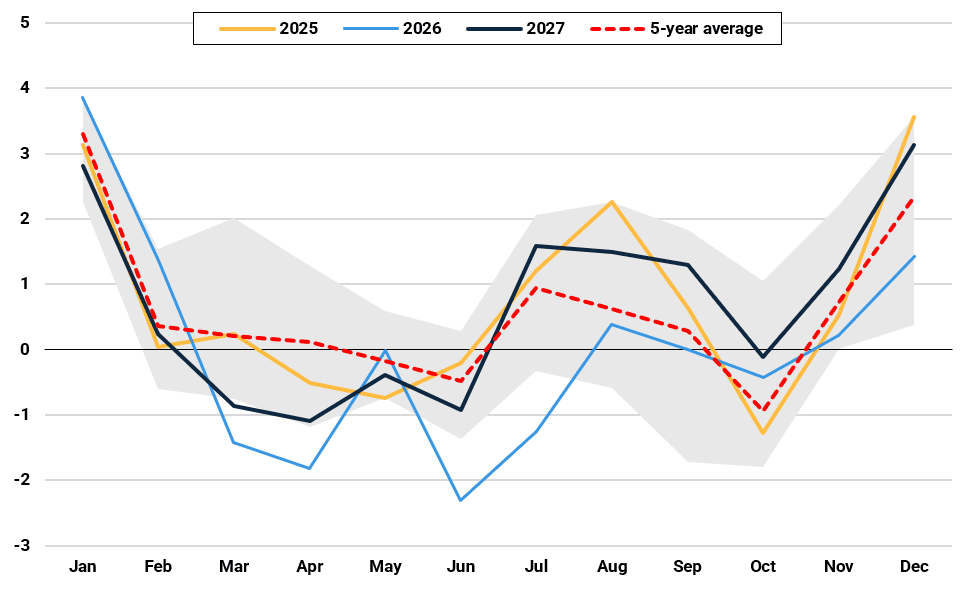
Our refined product balances move from roughly balanced in 2026 to a 1.5 mbd surplus in 2027, but 0.8 mbd of that is LPG. Core refined products swing to a 0.7 mbd surplus, no larger than in 2025, a year that still left inventories below average, with gasoil only back at its 2025 surplus and naphtha and jet providing the rest. Even that depends on Middle Eastern flows normalizing by Q2-27 and Russian output holding.
A large part of the 2027 surplus will likely be absorbed by inventory rebuilding before it weighs on prices. Global observable stocks of every product except LPG sit below their five-year average, with naphtha, fuel oil and gasoline at seasonal five-year lows. Restoring commercial stocks to normal would absorb close to half of next year’s non-LPG surplus, before governments begin refilling strategic reserves. With energy security a policy priority, restocking is likely to take precedence over price relief, keeping prices firmer for longer and slowing the demand response.
Core refined products balances (mbd)
Source: Kpler
Market Insights you can trust
Kpler delivers unbiased, expert-driven intelligence that helps you stay ahead of supply, demand, and market shifts.
Trade smarter. Request access to Kpler today.

See why the most successful traders and shipping experts use Kpler