Coal is back: Which German power plants are the biggest winners from the energy crisis?
Germany's thermal generation mix is shifting as stronger coal economics reshape plant profitability and dispatch. Kpler Insight identifies the units benefiting most, how their generation responds to changes in residual demand, and whether coal's growing advantage can continue through winter.
Key takeaways
- Coal gains competitiveness: High power prices, driven by elevated gas prices resulting in stronger clean dark spreads have supported a 10% y/y increase in German coal generation during Q3 2026. This is despite residual demand falling 4.3 GW, while gas output declined 8%, with a similar shift towards coal continuing into October YTD.
- Profitability and dispatch shift: Stronger coal economics pushed hard-coal and lignite units ahead of gas in estimated benchmark profitability, with only one gas unit among the top 30 most profitable plants and Datteln 4 leading Q3 2026, while coal took a greater role in meeting residual demand, reshaping Germany’s thermal dispatch.
- Winter outlook: Strong coal economics and substantial scheduled availability through Q1 2027 support continued coal dispatch, although low Rhine levels and existing coal-delivery restrictions remain the main near-term risks to generation.
Stronger dark spreads reshape Germany's thermal generation mix
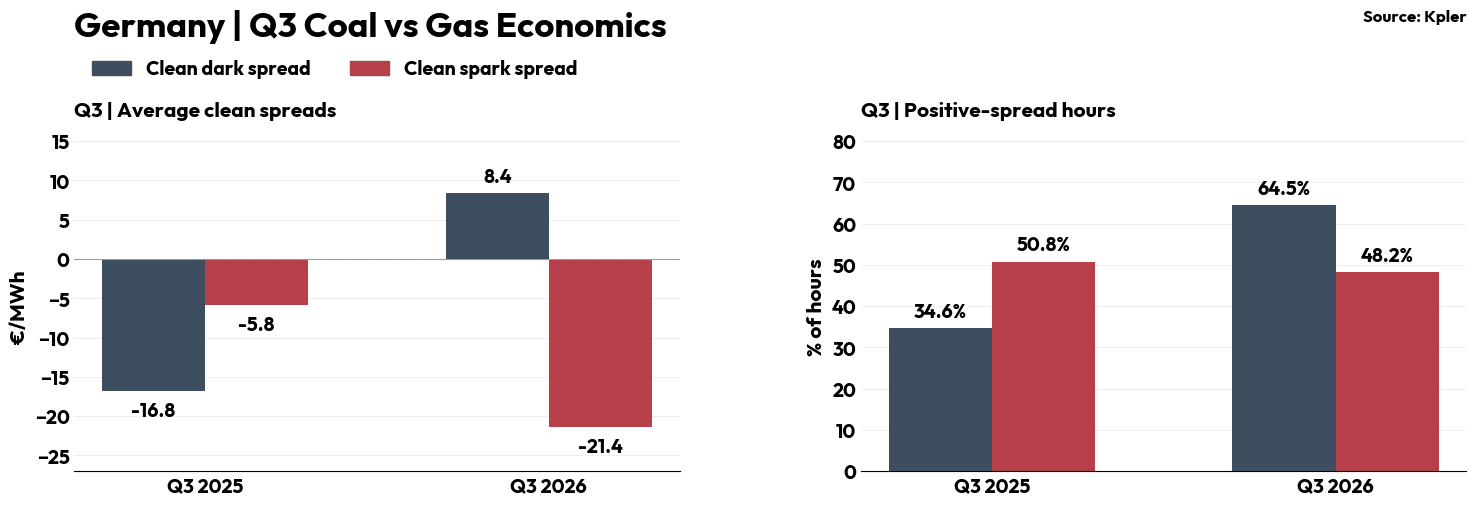
German coal generation increased in Q3 2026 as improving clean dark spreads widened coal's economic advantage over gas, continuing the shift towards coal in the thermal mix over recent quarters.
Despite residual demand falling 4.3 GW y/y in Q3, coal generation increased 10%, led by hard coal, while gas output declined 8%.
The shift was primarily driven by elevated gas prices, which strengthened coal's competitiveness against gas. Clean dark spreads turned positive at 8.4 €/MWh, with profitable hours increasing from 35% to 64% of the quarter, while clean spark spreads weakened to -21.4 €/MWh, with positive-spread hours declining from 51% to 48%.
Hard coal and lignite overtake gas in benchmark profitability
The shift was also evident at the unit level. Gas plants lead estimated net benchmark-margin rankings in Q3 2025, however, hard-coal and lignite units have since overtaken them in Q3 2026.
Kpler Insight estimates show that gas units led Q3 2025 net benchmark margins at €119.9m, followed by hard coal at €27.8m, while lignite recorded -€62m, based on 36% coal/lignite and 54% gas efficiency assumptions. However, these estimates remain sensitive to efficiency assumptions, particularly for lignite, where margins ranged from ∼-€110m to €153m under the 32–42% efficiency range.
By Q3 2026, lignite led with €458m in benchmark margins, followed by hard coal, which increased more than ninefold to €253.8m, overtaking gas, which declined 33% to €80.8m. Although estimated margins vary with plant efficiency assumptions, combined coal and lignite margins ranged from approximately −46% to +53% relative to the base estimate, compared with €9–171m for gas, reinforcing coal's stronger economic position across different efficiency levels.
Methodology: Net benchmark margins = hourly generation × (day-ahead price − estimated SRMC), including negative contributions. Base efficiency assumptions are 36% for hard coal and lignite (32–42% sensitivity range) and 54% for gas (50–60% sensitivity range). Estimates exclude plant-specific state subsidies and support payments, which could affect actual profitability
At the technology level, the benchmark-margin rankings show a clear shift from gas to coal and lignite:
- Q3 2025: Gas dominated the top 30 units, accounting for 21 gas, 7 hard-coal and 2 lignite units.
- Q3 2026: Coal and lignite occupied 29 of the top 30 positions, split between 9 hard-coal and 20 lignite units, with GuD Herne 6 the only gas unit remaining.
At the unit level:
- Q3 2025: Gas units GuD Herne 6, Irsching 5 and Emsland D led the benchmark-margin rankings.
- Q3 2026: Datteln 4 topped the rankings, followed by Lippendorf R, Neurath G and Walsum 10, highlighting the shift towards coal and lignite profitability.
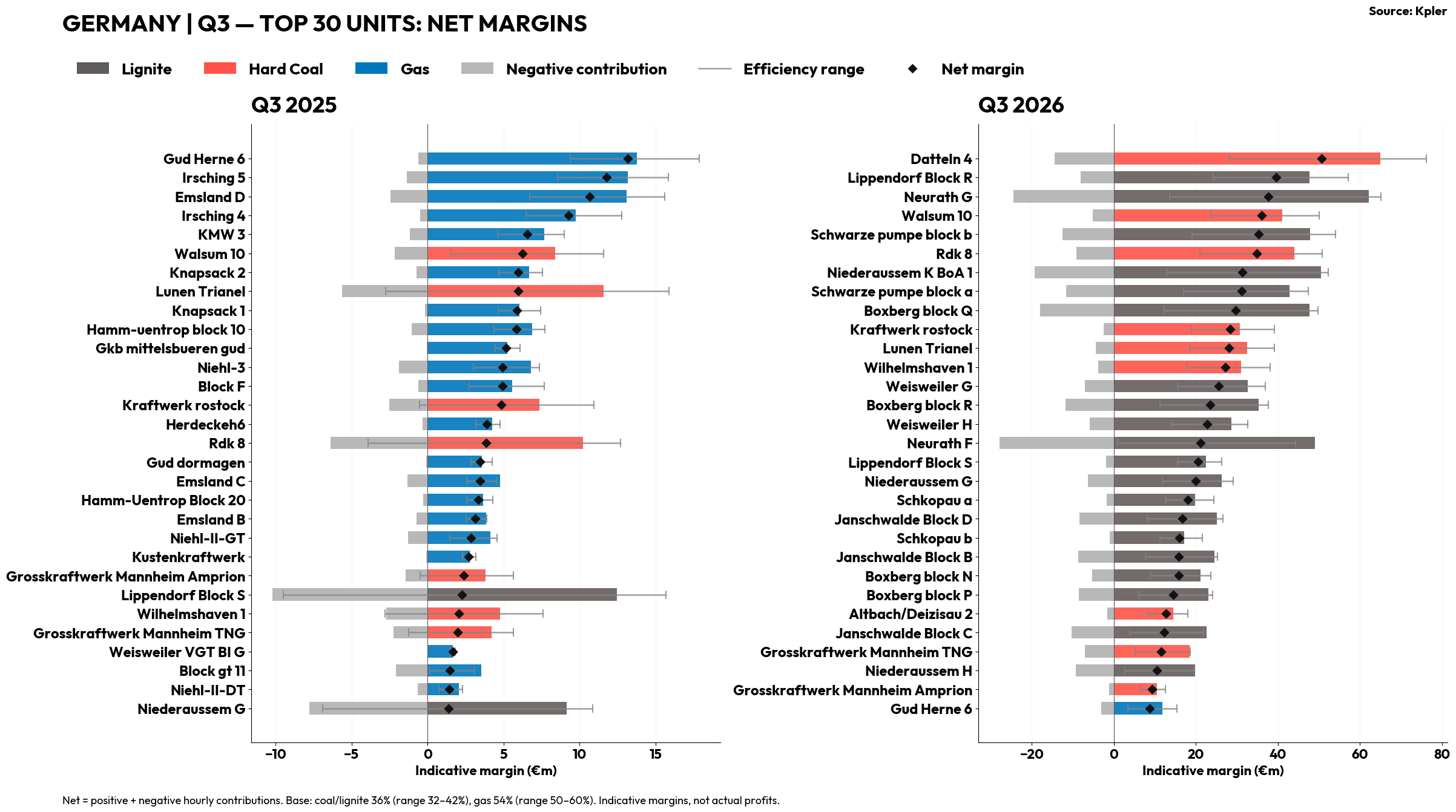
The trend continued into October YTD, with hard-coal and lignite benchmark margins increasing by 280–630% y/y, while gas margins declined 79%. Only two gas units, Irsching 5 and Irsching 4, ranked among the top 30 estimated benchmark-margin contributors, while GuD Herne 6 fell to 32nd place.
Changing dispatch patterns highlight unit-level responsiveness
In Q3 2026, coal generation increased by an estimated 293 MW for every 1 GW rise in residual demand, compared with 132 MW for gas, representing declines of 12% and 30% y/y, respectively.
Coal continued to provide a larger incremental response than gas, although both became less sensitive to residual-demand changes y/y, potentially reflecting stronger coal economics supporting more consistent generation during lower residual-demand periods and limiting the additional output required as residual demand increased.
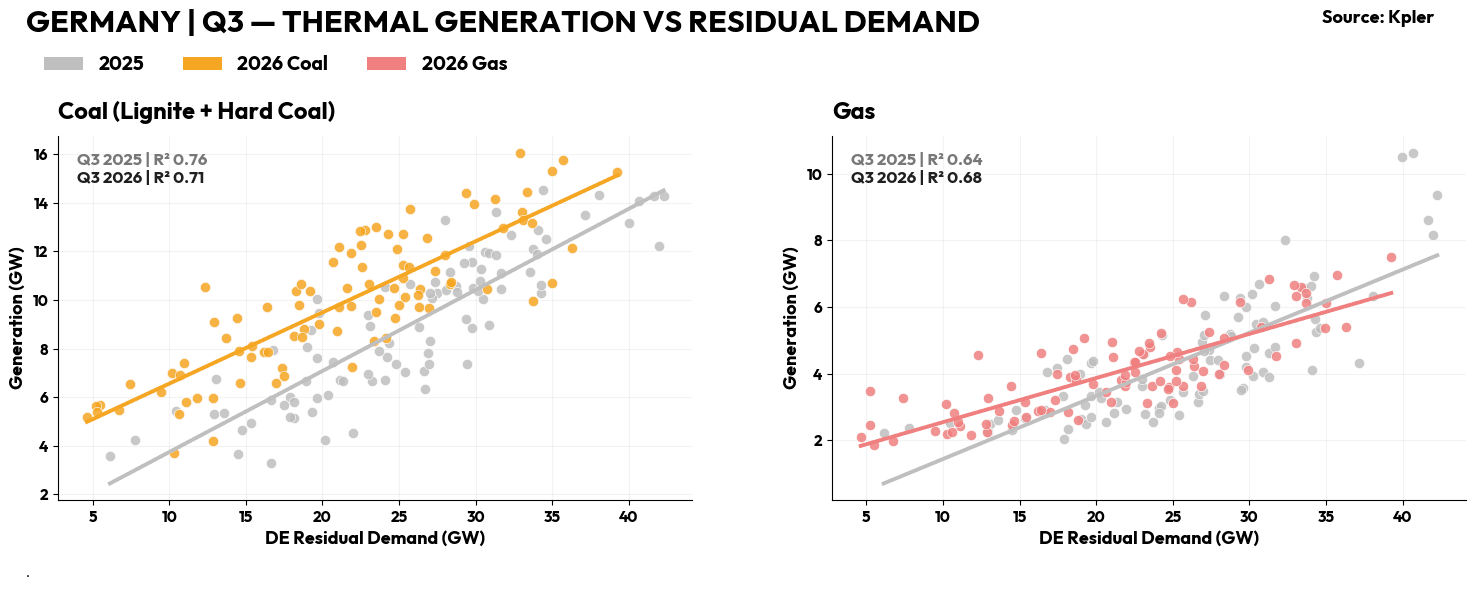
Within the coal fleet, hard coal showed stronger alignment with residual demand, with R² rising from 0.63 to 0.71, while lignite declined from 0.74 to 0.58, suggesting that hard coal increasingly tracked residual-demand movements, whereas lignite followed a more stable, baseload-like generation profile.
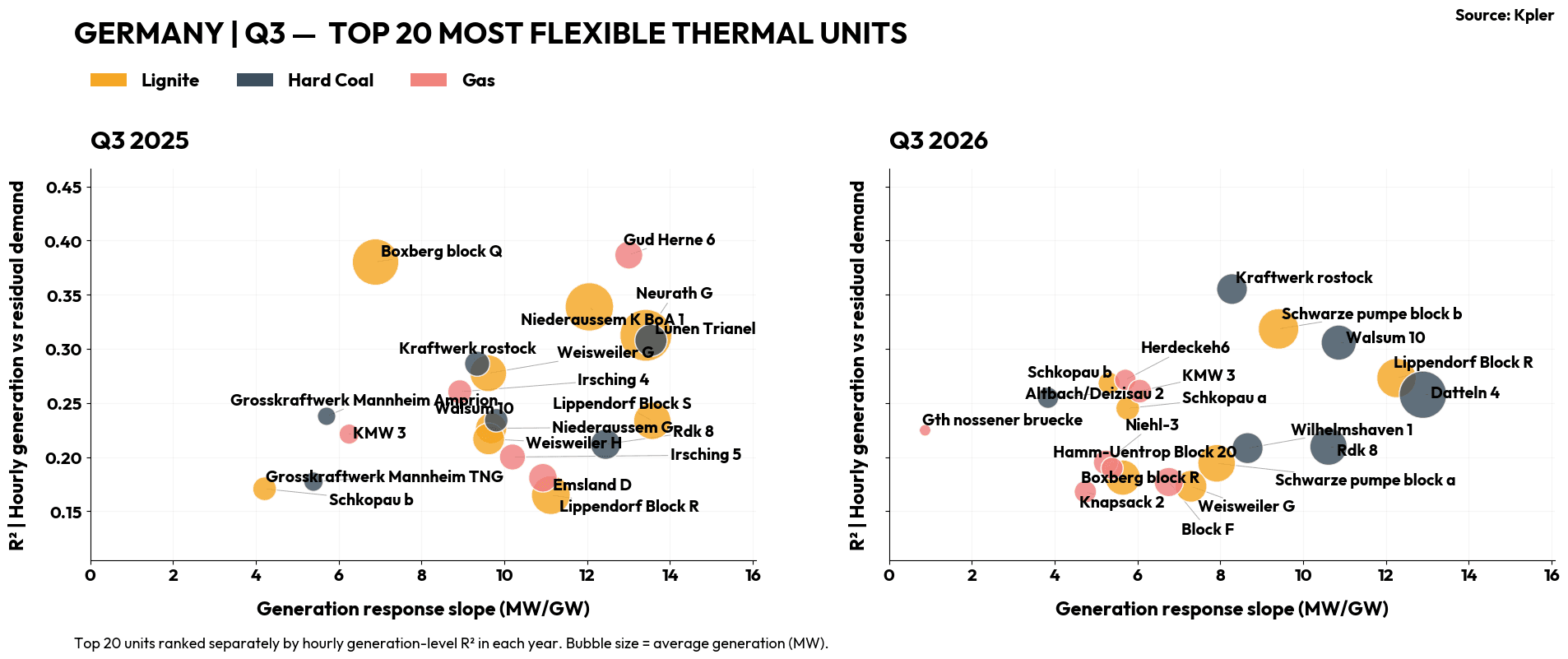
At the unit level,
- Hard coal: Kraftwerk Rostock, Walsum 10 and Datteln 4 showed stronger residual-demand tracking, with Datteln 4 recording the largest improvement among the three.
- Lignite: Schwarze Pumpe B and Lippendorf R became more responsive, while Neurath G and Boxberg Q showed weaker relationships despite stronger coal economics.
- Gas: Herdecke H6 and KMW 3 showed the strongest relationships among gas units, while GuD Herne 6 and Irsching 5 weakened compared with Q3 2025.
Outlook: Strong Coal Economics Support Winter Dispatch?
Kpler Insights expects coal to remain significantly more profitable than gas through November and December, supported by elevated gas prices.
Under 36% coal and 54% gas efficiency assumptions, clean dark spreads average 85 €/MWh in November and 72 €/MWh in December, compared with clean spark spreads of 6 €/MWh and -6.8 €/MWh, respectively, strongly favouring coal-fired generation.
At unit level, most leading coal and lignite benchmark-margin contributors retain substantial scheduled availability through Q1 2027, including Datteln 4 (hard coal), Lippendorf R (lignite), Neurath G (lignite) and Walsum 10 (hard coal).
Coal availability also improves into December, with Boxberg Q (lignite) rising from 744 MW to 893 MW and Lünen Trianel (hard coal) from 283 MW to 754 MW. However, Kpler model central hard-coal forecast remains 1 GW below EEX schedules in November and 1.7 GW below in December, highlighting uncertainty around effective availability.
Rhine logistics remain the main near-term risk, particularly for inland coal units. BfG forecasts renewed low-water conditions during Week 45, while reported fuel-delivery restrictions at Walsum 10 and Grosskraftwerk Mannheim could limit dispatch despite favourable margins. Kpler's Dry Bulk team expects an average $5/t discount to ARA coal prices in November, although higher inland freight costs could offset some of the benefit.
Operators may also face incentives to conserve coal stocks for later delivery periods, but this remains a potential response rather than a confirmed strategy.
Market insights you can trust
Kpler delivers unbiased, expert-driven intelligence that helps you stay ahead of supply, demand and market shifts. Request trial access to Power Insight today.

See why the most successful traders and shipping experts use Kpler
Find the signal in the noise with data-driven analysis of power markets
Related posts