
TTF breaches €100/MWh as geopolitical tensions and seasonal demand push prices upward, with Asian LNG prices rising to remain competitive
With the US announcing a potential resumption of military strikes on Iran after the upcoming midterm elections, geopolitical risk premiums rose globally. Alongside tensions in the Middle East, an early cold snap in Europe is expected to increase heating demand as wind and nuclear generation fall. While fundamentals in Asia are not particularly supportive, Asian LNG prices followed TTF upward in order to remain a competitive destination for flexible Atlantic Basin cargoes.
Market & trading calls
European TTF front-month price outlook: Bullish, driven by increased geopolitical risk in the Middle East and tightening of domestic demand fundamentals. Below-average temperatures and weak wind generation are expected to boost heating and gas-for-power demand. Meanwhile, geopolitical tensions in the Middle East remain a key upside risk to prices. Although stronger-than-expected Qatari LNG exports could ease supply pressures, resilient Asian demand is likely to absorb much of the additional volumes, limiting downside pressure on TTF.
Asian LNG front-month price outlook: Slightly bullish, supported by firm European TTF prices, persistent Middle Eastern supply risks, and stronger Q4 LNG procurement requirements in South Korea and Thailand, each seeing a 0.4 mt upward revision to 2026 demand. However, comfortable Japanese inventories, improving Chinese renewable generation, and lower LNG requirements in Singapore and Indonesia should limit broader regional spot buying. Colder-than-expected winter weather, further geopolitical escalation, or prolonged Qatari supply disruptions remain key upside risks, while increasing Qatari dark loadings and Hormuz transits signal improving supply availability that could cap further price gains.
Asian LNG – TTF spread outlook: TTF premium to widen, as TTF prices are expected to rise more sharply than Asian LNG prices amid a more bullish European outlook. The spread flipped w/w, with Asian LNG trading at a $0.51/MMBtu discount to TTF as of 28 October, compared with a $1.28/MMBtu premium on 21 October.
US Henry Hub front-month price outlook: Bearish, as temperature forecasts for the remaining days of October and first 2 weeks of November point to above-average temperatures across the entire Lower 48. Additionally, domestic gas production is recovering after several weeks of major pipeline maintenance cycles and voluntary supply curtailments. These factors are expected to more than offset strong LNG feed gas demand and an expectedly below average upcoming storage build.
Key natural gas and LNG front-month prices ($/MMBtu)
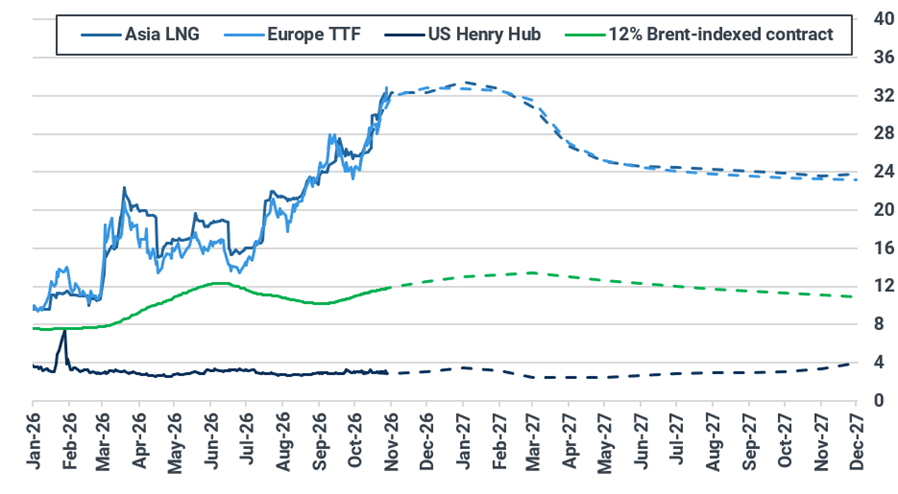
Source: ICE, NYMEX. Brent-indexed price represents 12% slope of 90-day moving average of Brent contract.
Asian LNG-TTF front-month spread ($/MMBtu)
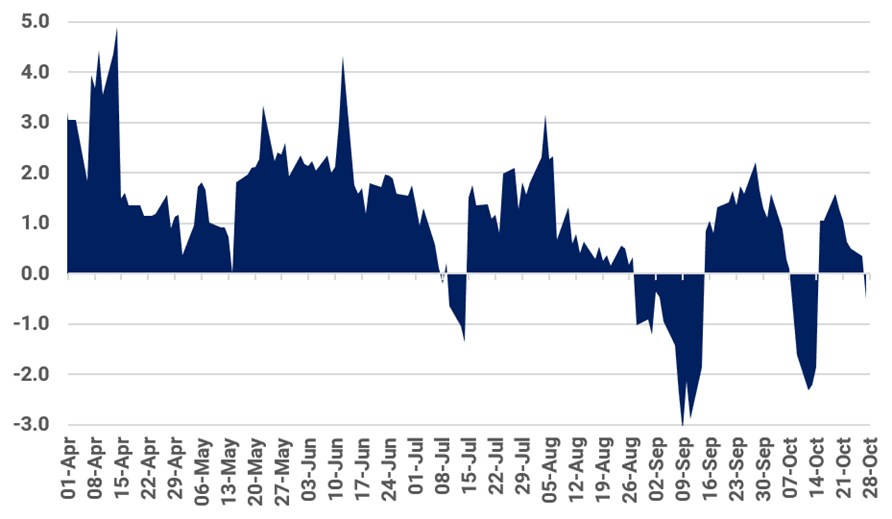
Source: ICE, Kpler Insight
Europe: colder temperatures, weak wind generation and inter-basin competition to support TTF prices into next week
The European TTF front-month contract rose by 14.2% w/w to $32.86/MMBtu on 28 October, with the month-ahead contract crossing €100/MWh for the first time since December 2022. The rally was driven by renewed geopolitical tensions in the Middle East following reports of a potential US military campaign against Iran after the 3 November midterm US elections and a Houthi-claimed missile strike on Saudi Arabia’s Ras Tanura refinery. Bullish momentum was reinforced by downward revisions to November temperature and wind forecasts, unplanned Norwegian outages and continued competition for flexible LNG cargoes. Seasonal demand gains accelerated the slowdown in EU-27 storage injections to just 60 mcm/d, with stocks around 75% full, roughly 10 percentage points below last year. Meanwhile, LNG imports edged lower w/w, while net pipeline imports remained broadly stable as reduced Norwegian deliveries were offset by higher flows from North Africa and the Eastern corridor.
Looking ahead, Kpler Insight maintains a bullish outlook for the TTF front-month contract due to increased geopolitical risk in the Middle East and tightening of domestic demand fundamentals. Geopolitical tensions could escalate following the 3 November US midterm elections, while a weakening polar vortex raises the prospect of well-below-average temperatures across Europe in the first half of November. Colder weather, combined with weaker wind generation and subdued nuclear output, is expected to boost heating and gas-for-power demand. On the bearish side, Qatari LNG exports continue to exceed expectations and are set to surpass our 2.2 mt October forecast, however, resilient Asian LNG demand could absorb much of this additional supply, limiting downside pressure on TTF. Rollover into the December contract will also slightly weigh on prices.
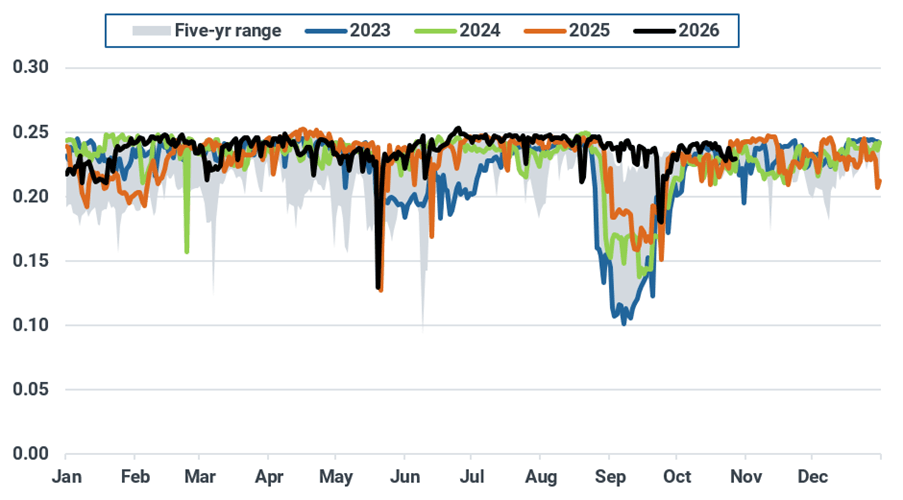
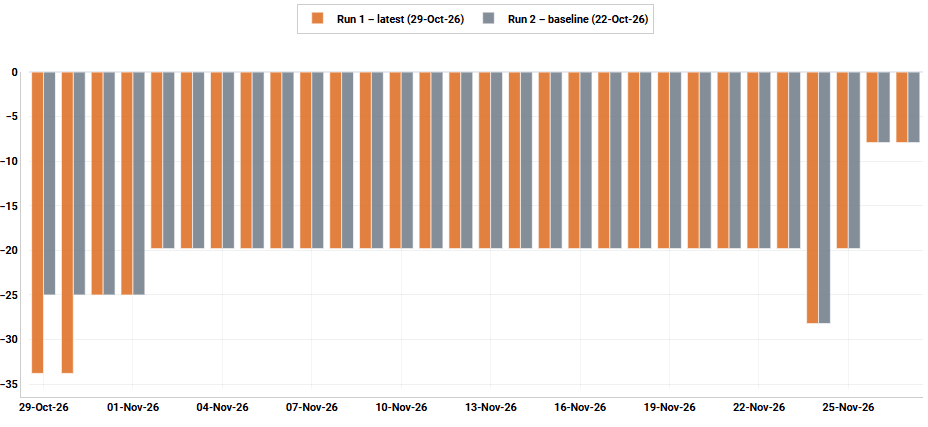
EU-27 net pipeline imports decreased w/w to an estimated 2.92 bcm (-1.3% w/w). The decrease was driven by lower Norwegian and UK flows, which more than offset stronger imports from the East corridor and Algeria. Lower imports from Norway were driven by unplanned outages at the Kårstø and Kollsnes gas processing facilities and at the Åsgard and Oseberg fields, while reduced net imports from the UK resulted from lower deliveries to Ireland and Belgium. Higher imports from the East corridor were the result of higher Turkstream output and a slight increase in Ukrainian exports to the EU, as Algerian flows edged higher towards both Spain and Italy. Looking ahead, Kpler Insight expects net pipeline imports to remain stable, as the UK market is likely to increase imports from Norway for domestic consumption due to expectations of weaker wind generation and colder temperatures. The resulting decline in Norwegian deliveries to the EU is expected to broadly offset higher pipeline imports from Algeria and Ukraine (see our latest piece on monthly firm capacity bookings for November)
Daily Norwegian pipeline flows to the EU (bcm)
Source: ENTSOG
GASSCO scheduled unavailability for fields and processing plants (mcm/d)
Source: GASSCO, on 29 October 2026, 12:00 UTC
European LNG imports fell 8.9% w/w to an estimated 2.04 mt, on the back of lower imports into Iberia and CEE/Baltics and deliveries to the UK, partially offset by higher imports into NWE and the Mediterranean. Total European LNG imports between 1 and 28 October stand at 8 mt, substantially lower than the ~10.57 mt imported in October last year, reflecting reduced Gulf supply, stronger competition for marginal cargoes, and maintenance across several EU terminals. Over the past week, two cargoes were diverted from Europe to Asia and two in the opposite direction, reflecting the tight competition between the basins. Total European sendout rose by almost 30 mcm/d w/w, led by France and Italy (up ~11 mcm/d and ~10 mcm/d respectively) despite ongoing terminal outages in both countries. In Germany, outages at Wilhelmshaven 1 and 2 reduced sendout by ~7 mcm/d w/w. Looking ahead, despite maintenance continuing at Wilhelmshaven 1, Brunsbüttel, Montoir and OLT Toscana, among others, Kpler Insights expects LNG imports to increase substantially w/w, due to a narrowing Asian LNG premium over TTF over the last week. Additionally, a commissioning cargo is expected at Germany’s Stade terminal on 2 November, although full commissioning is not anticipated until early 2027.
European weekly LNG imports by region (mt)
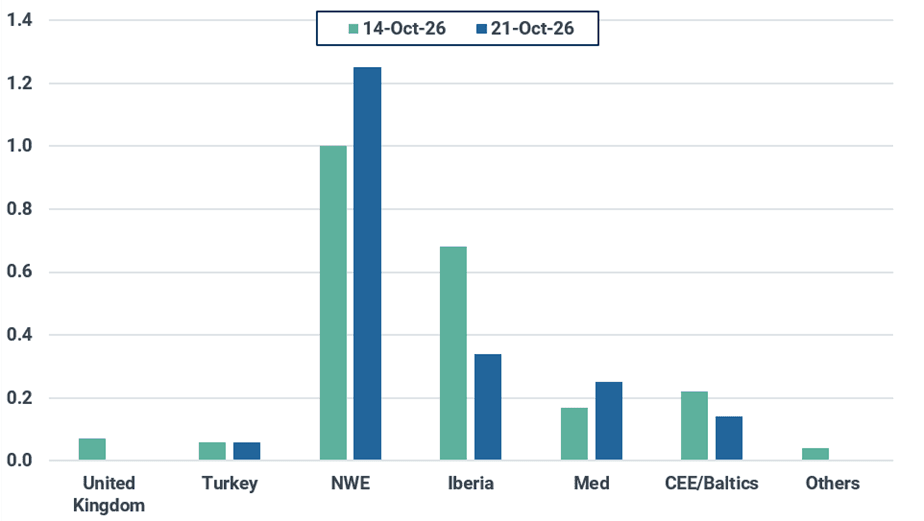
Source: Kpler Insight. Data represents week commencing 21/10 and 14/10. NWE=FR, BEL, NL, GER. Iberia=ESP, POR. Med=ITA, HVR, GRE. Baltics/CEE=FI, LT, POL. Others=SWE, MT.
Local distribution consumption (LDC) across 16 EU countries increased by 24% w/w to an estimated 2.5 bcm, driven by below-seasonal temperatures across Europe, particularly in the South, where temperatures fell on average by 2.2°C w/w to 15.4°C and HDDs nearly doubled to 16.6 (+8.0). Looking ahead, Kpler Insight expects LDC to edge higher next week, as temperatures continue to decline across the continent. In NWE, both ENS forecasts anticipate temperatures to decline to 5.8°C (EC_ENS, 5–6 Nov) and 6.4°C (GFS_ENS, 8 Nov) to then recover to about 7–8°C by 10–12 Nov.
EU-16 weekly consumption in the local distribution sector (bcm)
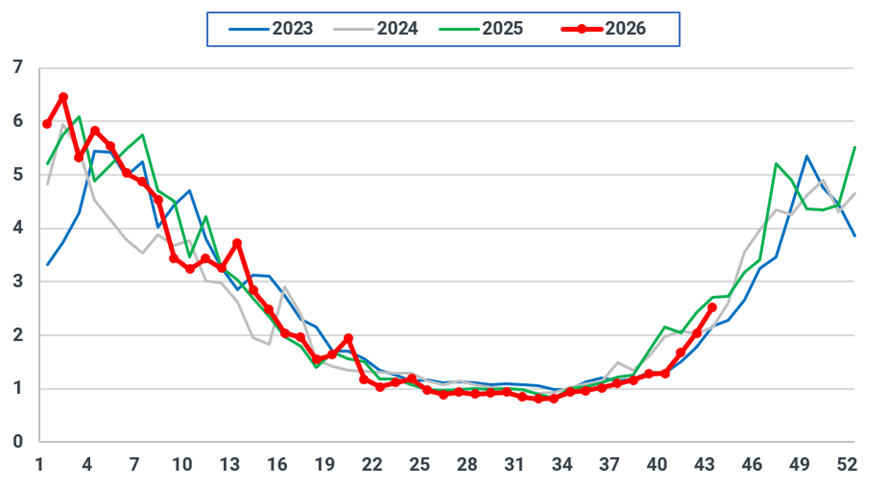
Source: ENTSOG, ENAGAS, Eustream, AGCM, Kpler Insight. The EU-16 perimeter includes AT, BE, DE, CZ, FR, HU, GR, IT, NL, LU, PL, PT, RO, SL, SK, and ES.
Northwest Europe daily average temperature forecast (°C)
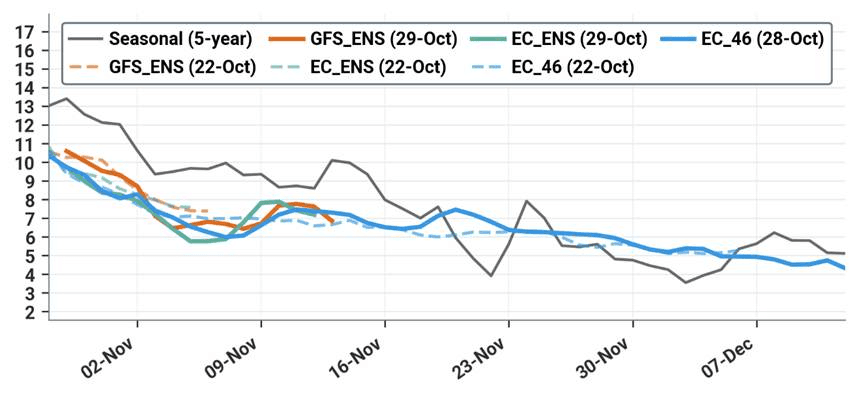
Source: Kpler Insight. Run comparison 29/10 (solid) vs. 22/10 (dotted), 00:00 UTC. Seasonal is a five-year average. NWE includes FR, BE, NL, DE.
EU-27 gas-fired generation decreased by 13% w/w to an estimated 6.9TWh. Despite lower temperatures, which led to a 1.8% increase in power demand, gas-fired generation fell, driven by a 47% w/w surge in wind output. Looking ahead, Kpler Insight expects gas-fired generation to increase due to lower temperatures and a significant drop in wind generation, particularly in NWE.
EU-25 weekly gas-fired generation (TWh)
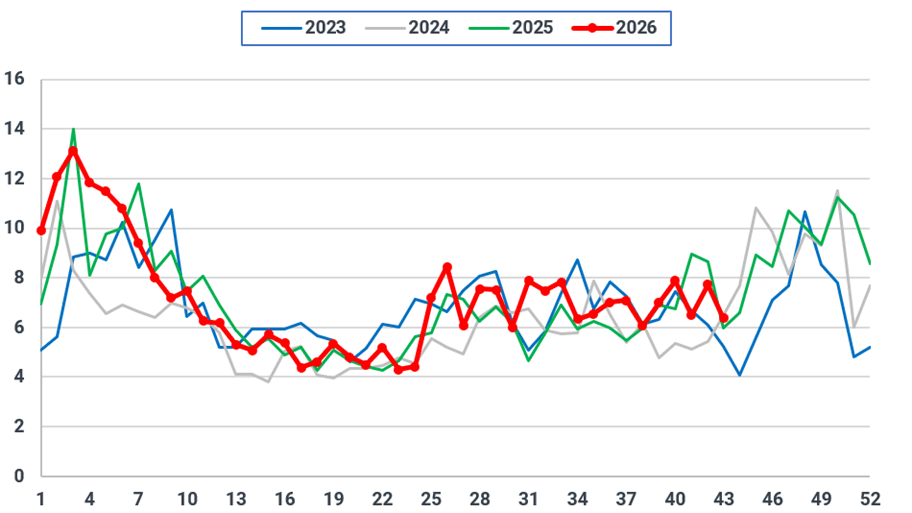
Source: Kpler Power, Kpler Insight.
Average daily net injections slowed to an estimated 0.06 bcm/d (-0.02 bcm/d w/w), as higher consumption and slightly lower supply tightened market balances, with several countries already recording net withdrawals. Looking ahead, Kpler Insight expects net injections to remain under pressure, as colder temperatures and weaker wind generation are expected to accelerate the shift towards withdrawals. However, higher anticipated LNG imports could partially offset rising demand, allowing net injections to persist in parts of the continent.
EU-27 underground natural gas inventories by year (bcm)
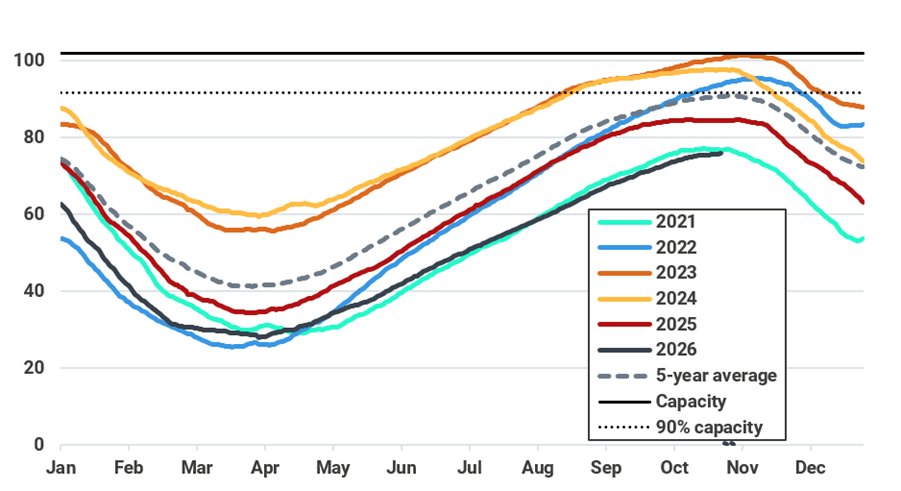
Source: GIE, Kpler Insight. Latest data as of 27 October 2026.
Asia: spot LNG prices to remain slightly bullish on TTF strength, Middle East supply risks and firmer regional demand; recovering Qatari flows cap the upside
Asian spot LNG prices climbed to $32.35/MMBtu on 27 October, up $2.30/MMBtu from 21 October, crossing the $32/MMBtu mark for the first time in nearly four years. Gains were supported by stronger European TTF prices, heightened US–Iran tensions and fading hopes of a diplomatic resolution. Expectations of firmer winter buying and emerging spot requirements from India provided additional support, despite subdued Northeast Asian demand. However, increasing Qatari dark loadings and Hormuz transits suggest improving supply availability, potentially limiting further price gains.
We maintain a slightly bullish outlook for Asian spot LNG prices over the coming week, supported by firm European TTF prices, persistent Middle Eastern supply risks and higher Q4 LNG requirements in South Korea and Thailand, each seeing a 0.4 mt upward revision to 2026 demand. However, comfortable Japanese LNG inventories, improving Chinese wind generation in Q4, and lower LNG requirements in Singapore and Indonesia should limit broader spot buying. Colder winter weather or further supply disruptions pose upside risks, while recovering Qatari flows could cap price gains.
Near-term weather conditions provide modest upside support to Asian LNG prices, with temperatures in South Korea and northern China expected to dip slightly below seasonal averages, increasing heating requirements. However, easing cooling demand in southern China and the broader warmer-than-normal November–January outlook should limit sustained gas demand growth. Overall, the weather-driven impact on prompt Asian LNG prices remains neutral to slightly bullish.
Forecasted average temperatures for Asian countries (°C)
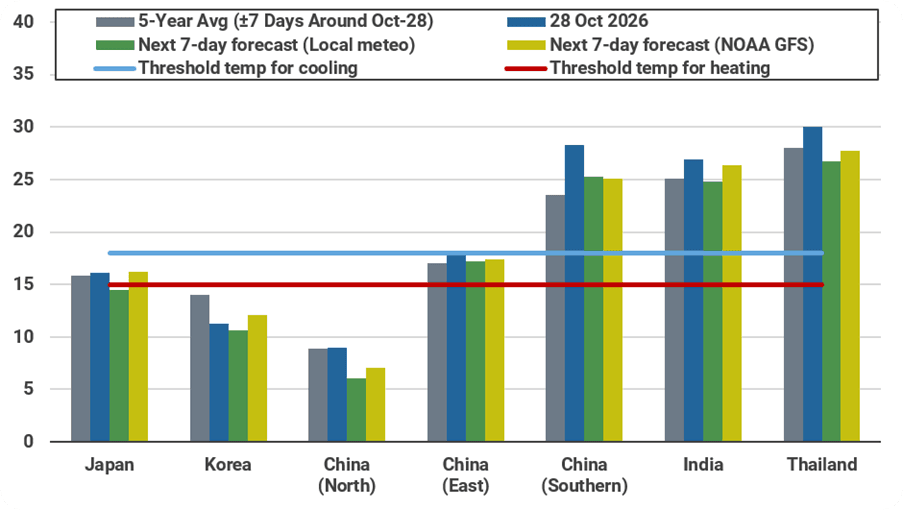
Source: Meteostat, Kpler Insight. As of 29 October 2026 00:00:00 UTC. Population-weighted average temperature of selected major cities across a country is shown for both historical and forecast.
Japan's prompt spot LNG demand remains subdued despite a sharp 0.38 mt w/w draw in major power utility inventories to 2.15 mt as of 25 October, the second-largest weekly decline since 2022. The draw was primarily driven by higher gas-fired generation (+24%) amid a 43% decline in solar output, stronger electricity demand (+3.6%), and the Onagawa 2 nuclear outage, rather than weaker national LNG arrivals. National inventories are forecast to remain comfortable at 5.2 mt by end-November and 5.1 mt at end-December, broadly in line with seasonal averages and limiting near-term restocking requirements. Latest temperature forecasts favor warmer-than-normal conditions through January 2027, reinforcing expectations for subdued heating demand and gas-fired generation. However, sustained colder weather or prolonged nuclear outages could accelerate inventory draws and trigger additional spot procurement. Overall, comfortable national inventories and the warmer winter outlook should keep Japan's near-term impact on Asian spot LNG prices broadly neutral.
Japan implied total LNG inventory forecast (mt)
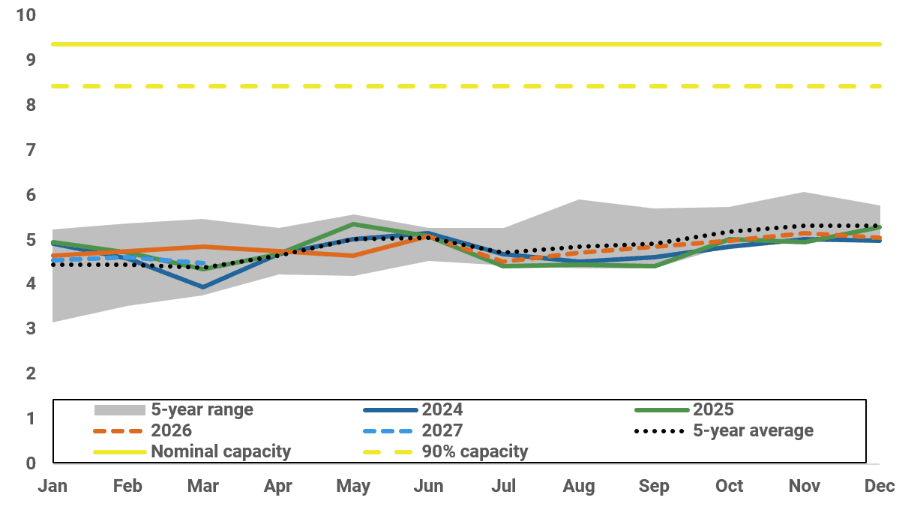
Source: METI, Kpler Insight
Population-weighted apparent HDDs in Japan (degree-days)
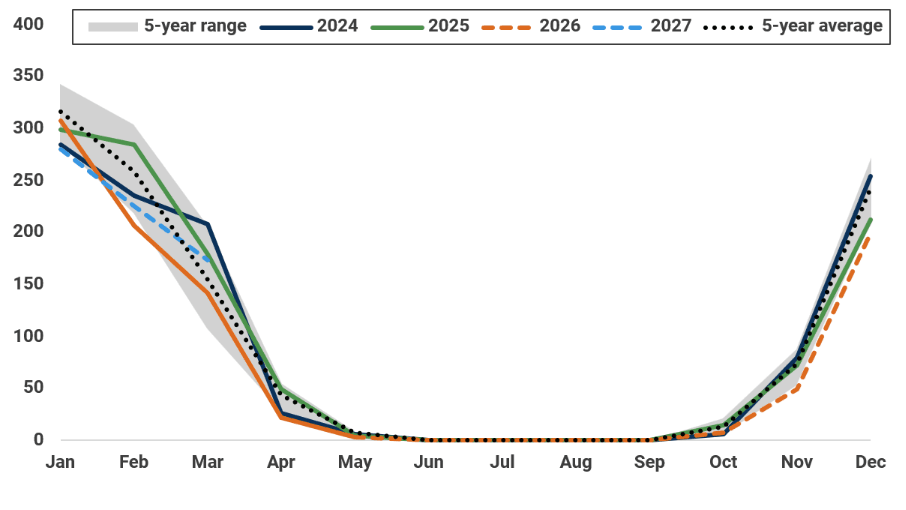
Source: Meteostat, Kpler Insight. Note: Population-weighted HDD of selected major cities across Japan is shown for both historical and forecast.
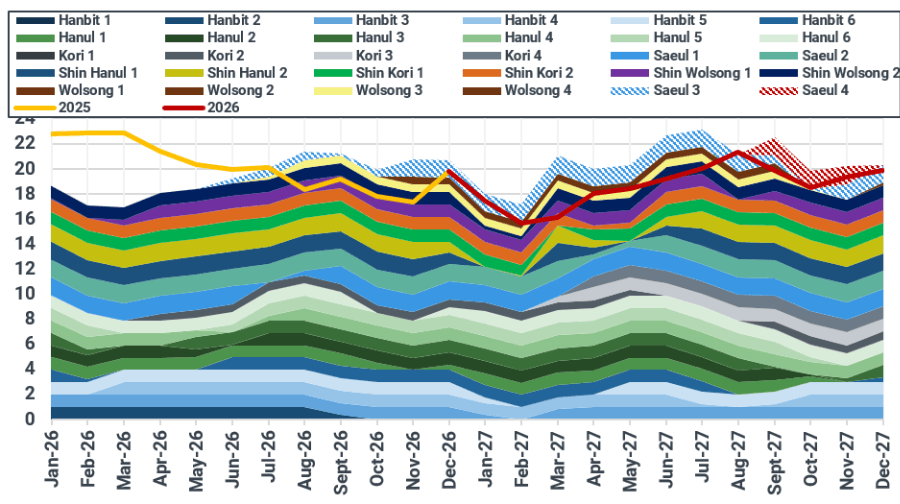
South Korea's lower-than-expected LNG inventories are increasing winter restocking requirements, supporting modest upside to November–December Asian LNG prices despite stronger coal and nuclear power generation. August inventories were 0.3 mt below expectations, prompting Kpler Insight to raise its 2026 LNG demand forecast by 0.4 mt to 47.0 mt and its 2027 forecast by 0.1 mt to 47.2 mt. Stocks are projected to recover to 4.7 mt by end-October and 4.8 mt by end-November before declining to 4.3 mt in December. Meanwhile, regulatory approval for the restart of Kori 3 and 4 in March–April 2027 will restore 1.9 GW of nuclear capacity, potentially displacing around 0.18 mt/month of LNG demand under full gas-displacement assumptions. However, these restarts are already factored into our demand model, implying no incremental impact on the outlook. Overall, additional Q4 restocking supports a slightly bullish November–December price outlook, while stronger non-gas generation and higher term contract utilization should limit upside in Q1 2027.
South Korea monthly implied LNG inventory (mt)
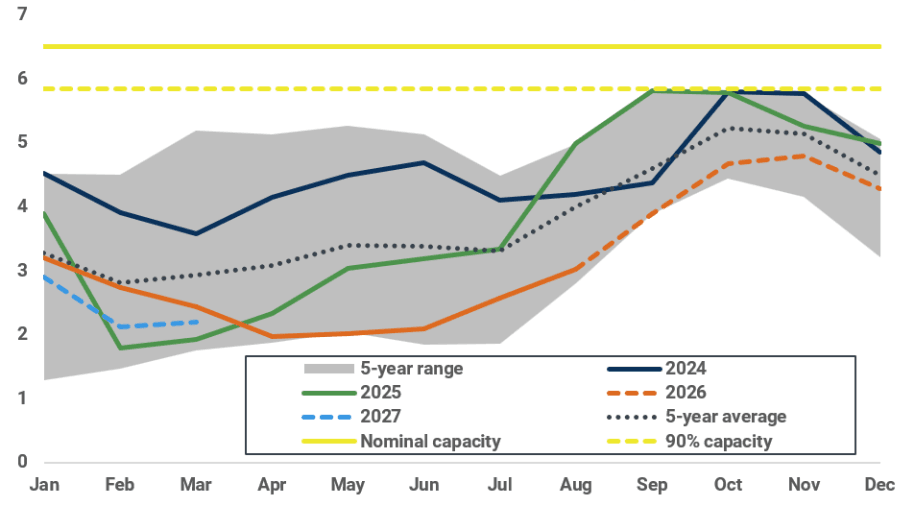
Source: Kpler Insight, KESIS
y/y changes in monthly power generation by fuel type in South Korea (TWh)
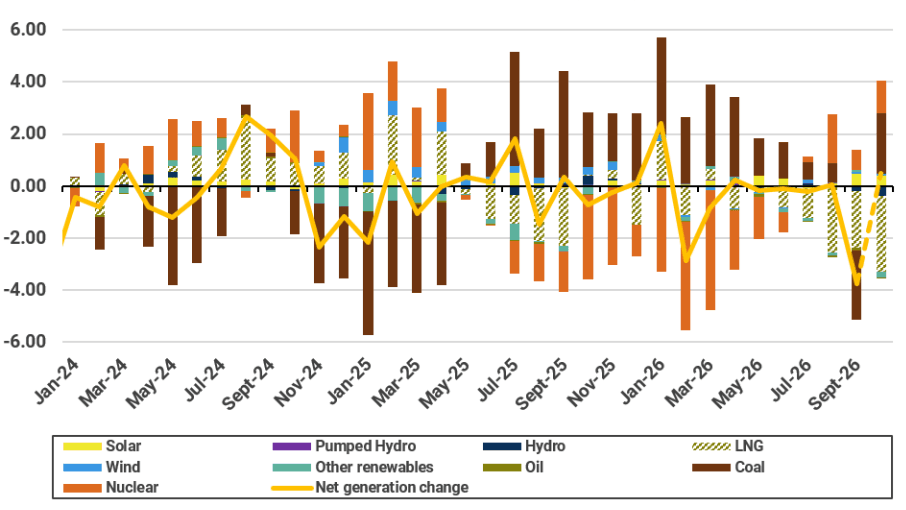
Source: KPX, Kpler Insight
Korea available nuclear capacity by unit (GW)
Source: KHNP, Kpler Insight
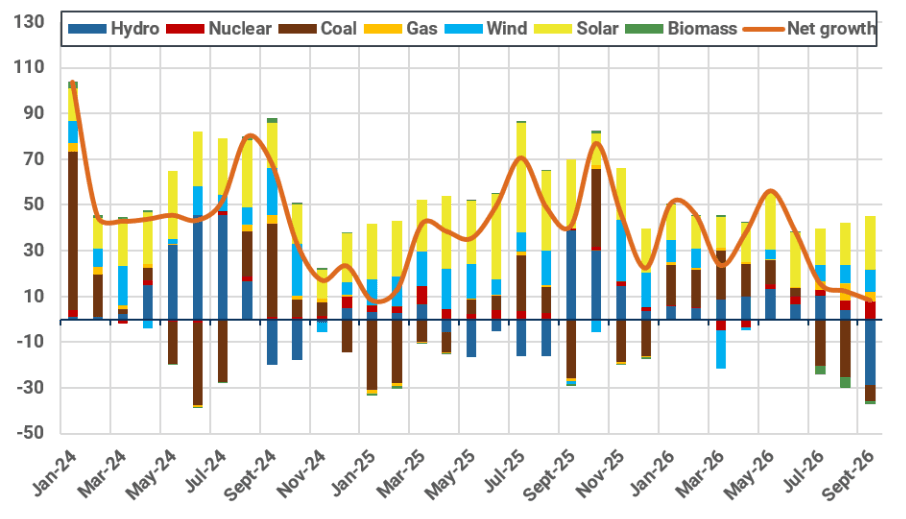
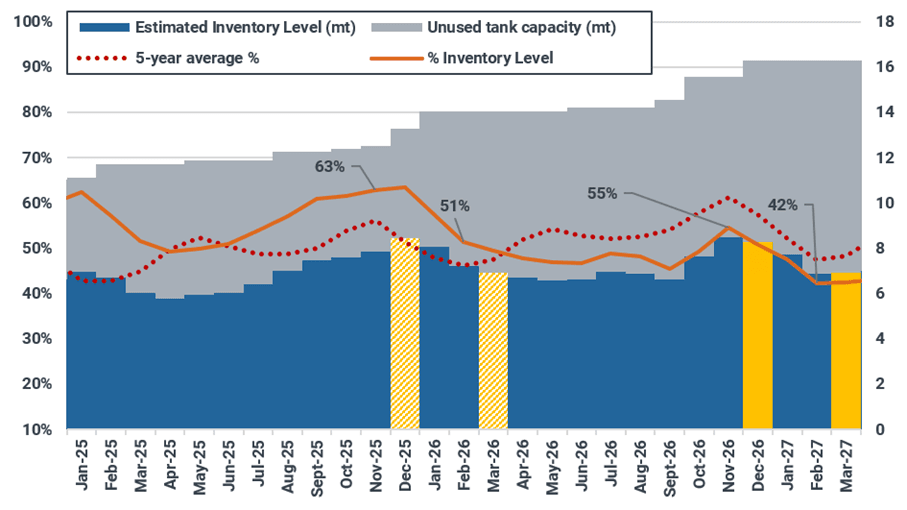
China's weaker domestic gas production and slower wind capacity additions are supporting LNG demand, although the near-term impact on Asian spot prices remains limited. September domestic gas production declined by 1.0% y/y, while stronger gas-fired generation amid hydro shortfalls highlights growing power-sector balancing requirements. Kpler Insight maintains its 2026 LNG demand forecast at 62.3 mt, while raising its 2027 forecast by 0.3 mt to 63.0 mt as slower wind capacity additions increase gas-for-power requirements. Implied LNG inventories are projected to rise from 7.7 mt in October to 8.5 mt in November, before easing to 8.3 mt in December, limiting aggressive restocking despite below-average stocks. Improving wind conditions and modest hydro recovery should largely offset weaker winter solar generation, with only 1–2 additional LNG cargoes expected in Q1 2027. Overall, higher term-contract utilization and measured restocking should limit incremental spot procurement, keeping China's impact on prompt Asian LNG prices broadly neutral with a bullish bias. Colder-than-expected weather or further renewable underperformance across eastern and southern coastal China remain key upside risks.
Implied historical power generation by fuel in China (TWh)
Source: NEA, NBS, Kpler Insight. Note: Thermal coal and gas-fired generation are implied statistics.
China implied total LNG inventory vs terminal capacity (LHS: % of nominal capacity; RHS: mt)
Source: Kpler Insight
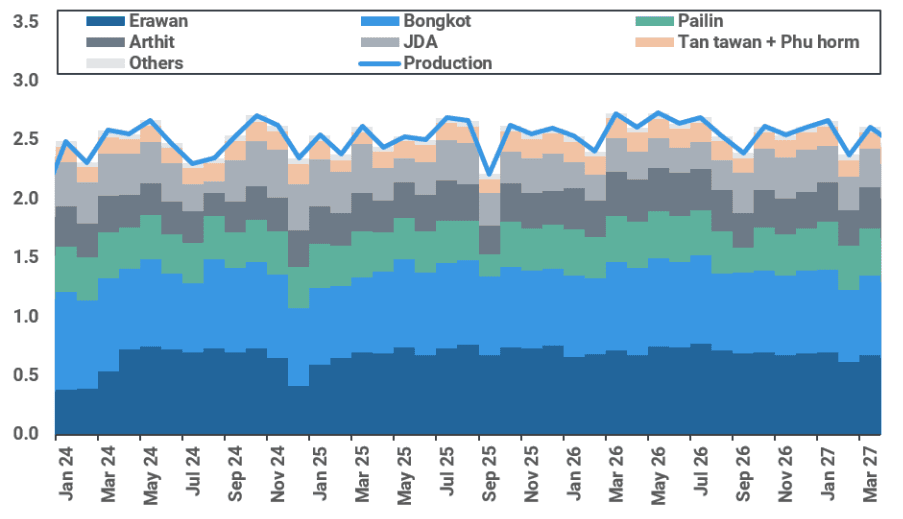
Thailand's stronger gas-for-power demand and weaker competing generation are increasing winter LNG requirements, providing bullish support to Asian spot prices. Kpler Insight raises its 2026 LNG demand forecast by 0.4 mt to 12.7 mt and Q1 2027 demand by 0.35 mt to 3.0 mt, driven by warmer, drier weather, weaker hydro generation, lower electricity imports and constrained coal capacity. Additional requirements amount to around two LNG cargoes per month in October–November and one in December, increasing competition for spot supply. Despite some coal-fired generation recovery in Q1 2027, limited alternative generation and declining domestic gas production should sustain LNG imports. Overall, Thailand's higher winter procurement requirements are bullish for Asian LNG prices, with further coal outages or hydro shortfalls posing additional upside risks.
Thailand gas production by field (bcm)
Source: EPPO, Kpler Insight. Note: Forecast data starts from September 2026.
Projected y/y changes in Thailand’s coal-fired generation (TWh)
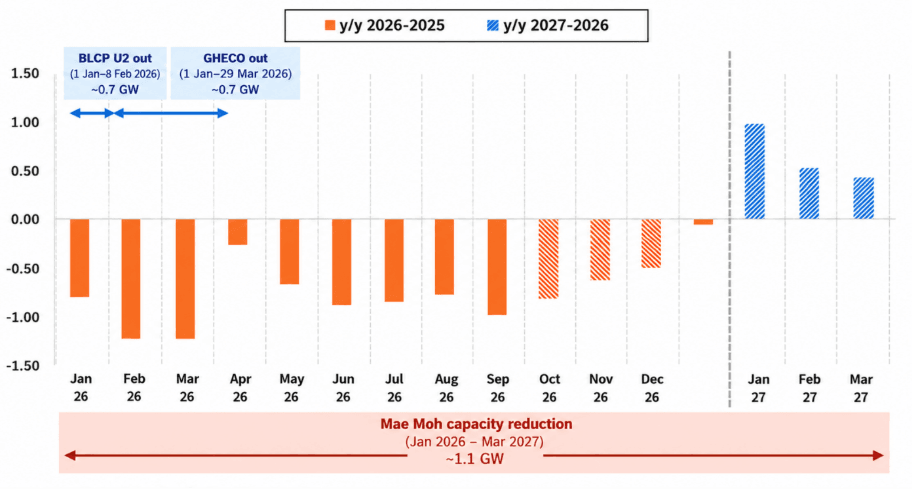
Source: EPPO, EGAT, GPSC, EGCO, BLCP, Kpler Insight
Stronger Indonesian pipeline gas imports are reducing Singapore's LNG requirements, although the impact on Asian spot prices remains broadly neutral. Kpler Insight lowers its Singapore 2026 LNG demand forecast by 0.1 mt to 4.9 mt and its 2027 forecast by 0.1 mt to 6.2 mt, reflecting improved Indonesian deliveries and stable Malaysian supply. Higher pipeline availability is expected to displace around 3–4 LNG cargoes over November 2026–March 2027, modestly easing spot procurement needs. Overall, Singapore's impact on Asian LNG prices remains neutral, although earlier Indonesian export curtailments could increase LNG buying requirements and pose upside price risks.
Faster domestic gas production growth is reducing Indonesia's LNG import requirements and improving export availability, modestly easing Asian LNG supply tightness. Kpler Insight lowers Indonesia’s international LNG import forecast by 0.1 mt to 1.3 mt in 2026 and by 0.3 mt to 2.6 mt in 2027, while raising 2027 exports by 0.4 mt to 9.0 mt. Faster Maha gas production and improved Bontang feedgas availability more than offset stronger domestic demand and pipeline exports to Singapore. Overall, Indonesia's impact on prompt Asian LNG prices remains neutral, although additional exports in Q1 and Q3 2027 provide modest downside pressure. A slower-than-expected Maha ramp-up or stronger domestic gas demand remain key upside risks.
Domestic gas production in Indonesia (MMscf/d)
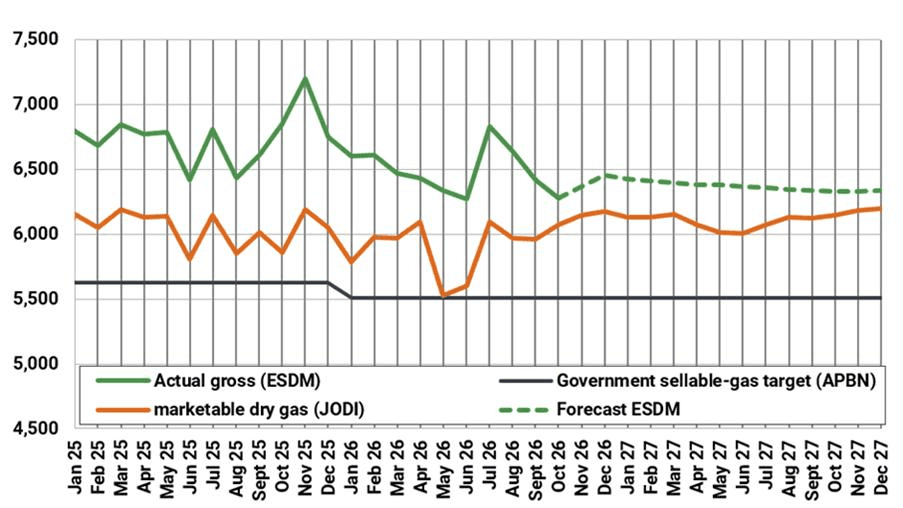
Source: JODI, ESDM, Kpler Insight.
South Asian LNG supply remains constrained by disruptions to Qatari deliveries through the Strait of Hormuz, although October cargo arrivals offer some relief. Bangladesh received two Qatari cargoes in October, but Excelerate Energy's long-term deliveries remain under force majeure, with no confirmed timeline for resumption. Qatari shipments to Bangladesh total just 1.49 mt year-to-date, compared with 3.32 mt during January–October 2025. Meanwhile, Pakistan is set to receive its third Qatari cargo in October, bringing monthly imports to 0.18 mt, supported by ship-to-ship transfers. Overall, persistent supply uncertainty poses upside risks to South Asian spot LNG procurement and regional prices, although recovering Qatari flows could ease near-term pressure.
US: Henry Hub to remain below $3.00/MMBtu as bearish temperature forecasts extend further into November
US Henry Hub front-month prices settled at $2.82/MMBtu on 28 October, up from $2.77/MMBtu on 21 October. Trading proved volatile over the last week, with revisions to temperature forecasts stripping additional degree days for the two-week outlook and production recovering above 109 Bcf/d. These factors led to Henry Hub falling to $2.60/MMBtu on Monday, with robust LNG feed gas demand and another below-average storage build unable to offset the decline. Prices then rapidly rose on Tuesday and Wednesday, primarily due to end-of-contract volatility amid dwindling trading volumes in the final hours leading up the expiration of the November contract on 28 October rather than any material changes to fundamentals.
The December contract also fell throughout the week, dropping from $3.16/MMBtu on 21 October to $3.03/MMBtu on Wednesday. Kpler Insight expects that December will continue to decrease in the coming days, quickly falling below $3.00/MMBtu in its debut as the front-month on 29 October as above-average temperature forecasts and rising production overpower upward support from LNG feed gas demand and another likely below-average storage build. Kpler Insight expects Henry Hub to average $2.80-2.90/MMBtu for the coming week.
US domestic gas consumption by sector (bcf/d)
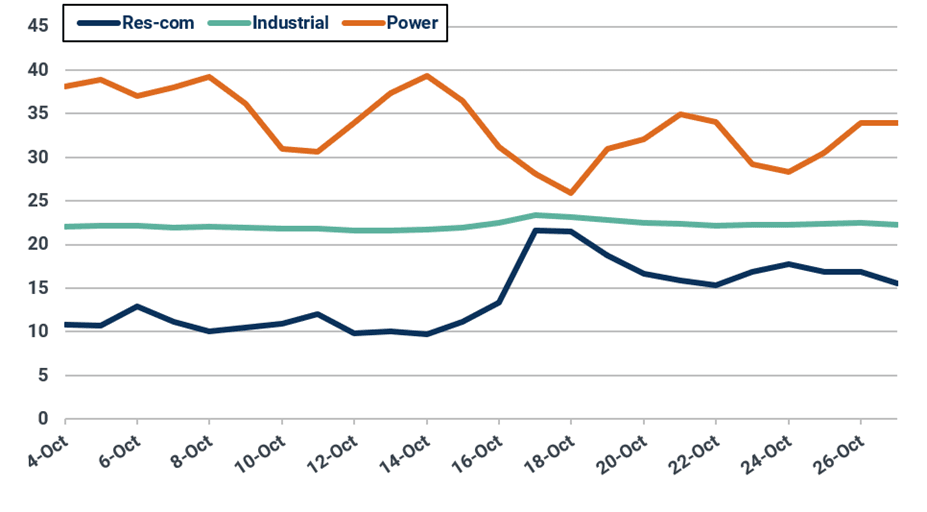
Source: EIA
US gas consumption averaged 71 Bcf/d over the last seven days, up 0.5 Bcf/d from the previous week. The slightly higher w/w consumption was primarily due to marginal growth in heating demand which averaged 16.5 Bcf/d over the last week, up from 16.1 Bcf/d the previous week. Power burns also came in marginally higher w/w, averaging 32.1 Bcf/d vs 32 Bcf/d. Consumption is expected to fall over the coming week as most of the Lower 48 experiences above-average temperatures that fail to stimulate meaningful heating or cooling demand.
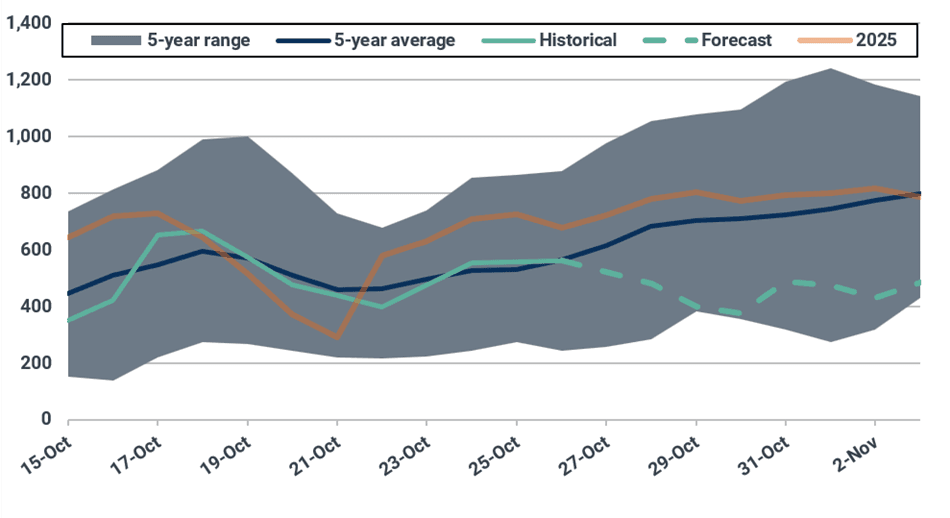
Forecast of residential and commercial heating demand (bcf/d)
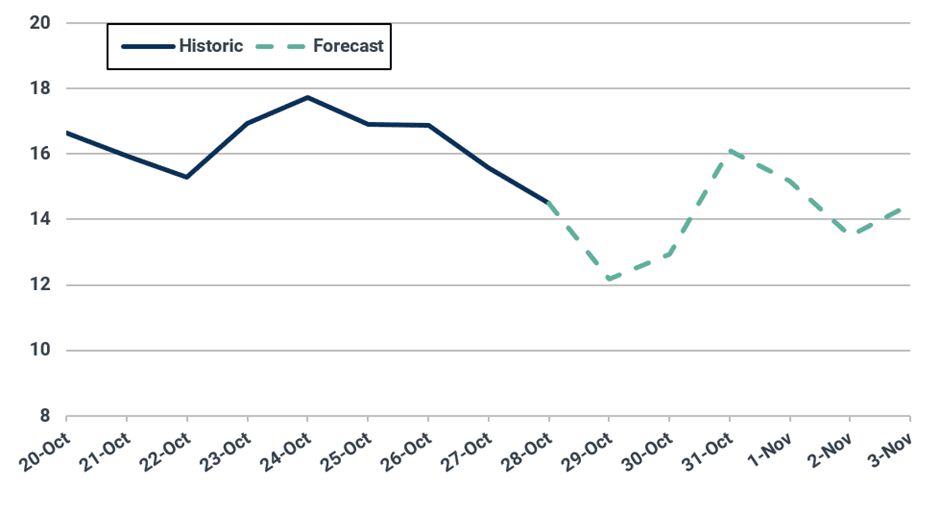
Source: National Weather Service, Kpler Insight
Forecast of heating degree days
Source: National Weather Service
Dry gas production averaged 109 Bcfd over the last week, a sizable 2 Bcf/d uplift from the week prior. Supply rose amid the completion of scattered pipeline maintenance activities and the winding down of voluntary output curtailment programs from major gas producers, principally in Appalachia. Kpler Insight expects production to average near 109.5 Bcf/d over the next week as producers increase output ahead of winter.
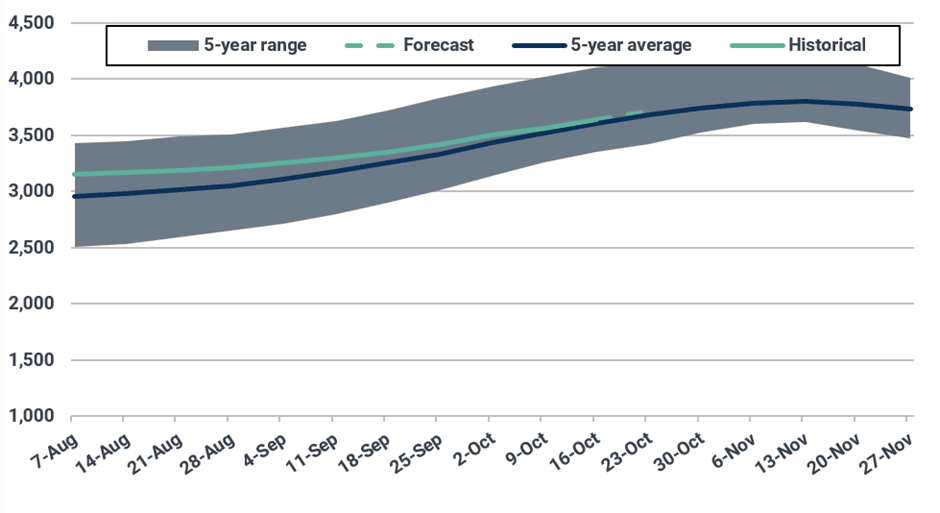
Forecast of natural gas volumes in underground storage (bcf)
Source: EIA, Kpler Insight
The US injected 77 Bcf into underground storage for the week ending 16 October, coming in below consensus estimates closer to 80 Bcf. Inventories rose to 3,644 Bcf, with the surplus above the five-year average reduced to 1% from 1.3% the previous week. Kpler Insight forecasts a net storage build of 74 Bcf for the week ending 23 October.
Global LNG supply: exports dip to three-week low as Wheatstone, Bioko and Atlantic LNG maintenance continues
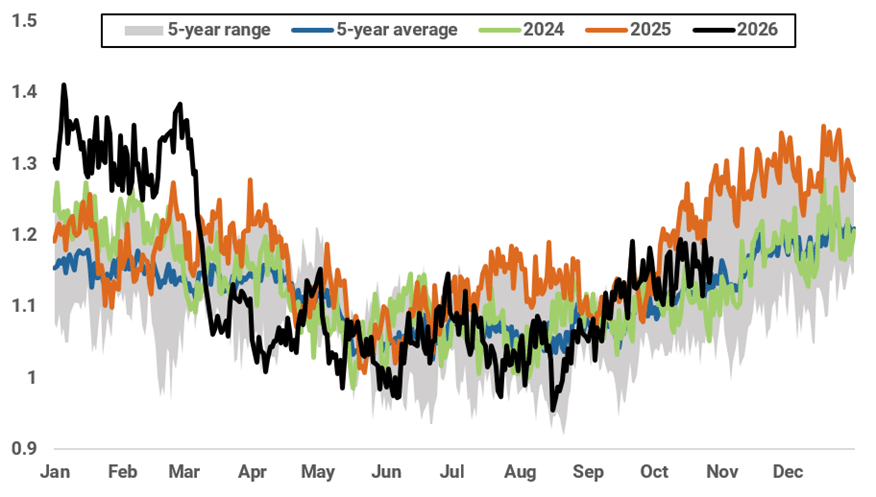
Global LNG exports declined by 0.09 mt w/w to 8.12 mt last week, marking their lowest weekly level in three weeks. The decline was primarily driven by reduced Russian LNG supply, which fell by 0.13 mt w/w to 0.56 mt.
Looking ahead, Kpler remains focused on Middle Eastern LNG loadings, with Kpler continuing to actively monitor ballast vessel arrivals to Ras Laffan using AIS, satellite and tug boat activity. Kpler is also closely monitoring ongoing maintenance at several LNG facilities, including Atlantic LNG in Trinidad, Bioko in Equatorial Guinea, and Wheatstone in Australia. Meanwhile, an unexpected decline in exports from Russia's Yamal is being closely watched, despite four additional vessels joining the fleet ahead of Europe’s ban on Russian LNG.
Global LNG exports (mt, 10-day moving average)
Source: Kpler Insight
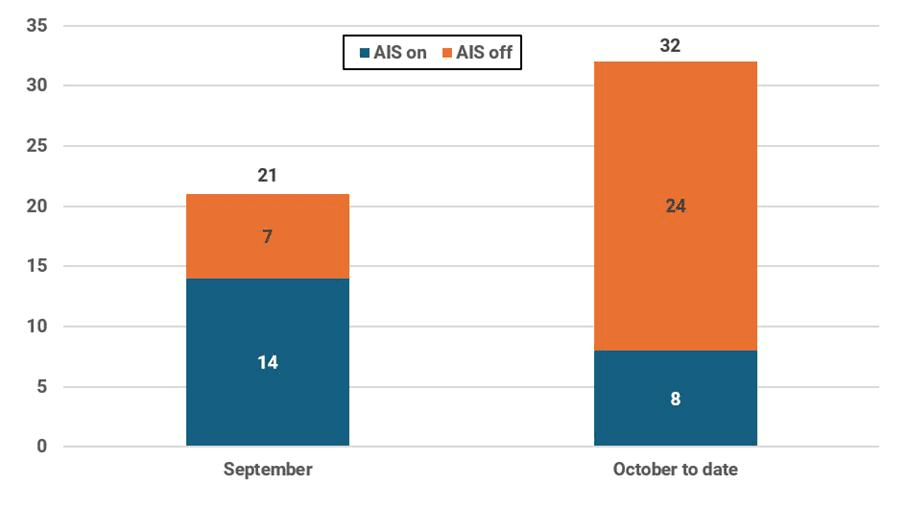
In the Middle East, Kpler has identified 32 LNG vessels berthing at Qatar’s Ras Laffan so far this month, up from 21 in September. Of the October loadings, only eight berthed with their AIS switched on, while the remaining 24 operated dark (see chart). By combining satellite imagery with tugboat movement analysis, Kpler can identify potential dark loadings at individual jetties across Ras Laffan, providing early visibility into loading activity before vessel identities or cargo volumes are fully confirmed. This data can be found in our new daily email with the subject: ‘LNG Loading Detection: Ras Laffan, Qatar’. Kpler Insight estimates loadings in October to come in at 2.5-2.6 mt, up from 1.65 mt in September.
Berthing activity appears to be similar to levels witnessed last week levels. So far, five vessels have been recorded so far this week - three on Monday, one on Tuesday and one on Wednesday. Last week, seven vessels berthed over the entirety of the week. October’s uptick in loading activity is consistent with recent signs of increased thermal activity at the facility. Currently, seven trains are showing signs of thermal activity in the latest satellite imagery from 27 October, with QatarEnergy LNG North train 2 emitting a thermal heat signature in the 25 October image.
Estimated number of vessels berthing at Qatar’s Ras Laffan in September and October-to-date
Source: Kpler. Data as of 29 October 2026.
Meanwhile, Oman’s 3.8 mtpa train 1 facility has restarted operations, with thermal activity resuming between 13-18 October. The entire 11.4 mtpa is now operational, supporting higher LNG deliveries to Asian markets.
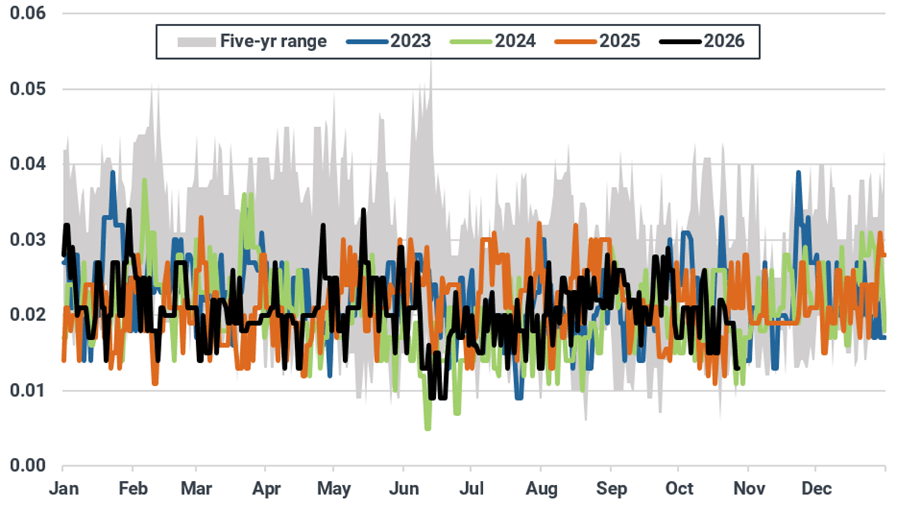
In the Atlantic basin, maintenance is underway at Trinidad and Tobago’s 11.8 mtpa Atlantic LNG plant, with thermal satellite imagery indicating that the 3.3 mtpa train 2 went offline around 9 October. The maintenance cuts capacity at the plant to 72%, with 10-day moving averages moving lower (see chart). Meanwhile, Equatorial Guinea’s Bioko LNG plant has shown no detectable thermal heat signature since 7 October. The facility last exported a cargo on 26 September, aboard the PARTHENON LNG.
Trinidad and Tobago’s LNG exports (mt, 10-day moving average)
Source: Kpler Insight
Russia’s 17.4 mtpa Yamal LNG plant saw exports decline by 0.1 mt w/w to 0.3 mt last week, with Kpler forecasting similarly subdued volumes this week. Exports are currently below the five-year historical range for this time of year, although the reason for the decline remains unclear. Meanwhile, the plant has recently secured four additional Arc4 ice-class vessels to support LNG deliveries to non-European markets from January onwards. Kpler Insight currently predicts 16 additional vessels joining the Yamal fleet between now and January, below the 40 vessels needed to ship supply to Asian and Mediterranean markets and maintain production at similar y/y levels. Kpler Insight’s Yamal LNG freight model assumes 70% of Yamal supply will head to northeast Asia, 15% to southeast Asia and 15% to Mediterranean markets once the European ban on Russian LNG comes into force in January.
Supply elsewhere in the Atlantic basin remains robust. Nigeria’s 22 mtpa Bonny LNG plant continues to maintain strong output despite being in its typical maintenance period. Algeria’s LNG exports are recovering following the easing of pipeline constraints from maintenance activities, with the Bethioua plant accounting for most of the increase. The US’ 6 mtpa Golden Pass train 1 facility continues to receive higher feedgas volumes, averaging at 0.74 bcf/d so far this week.
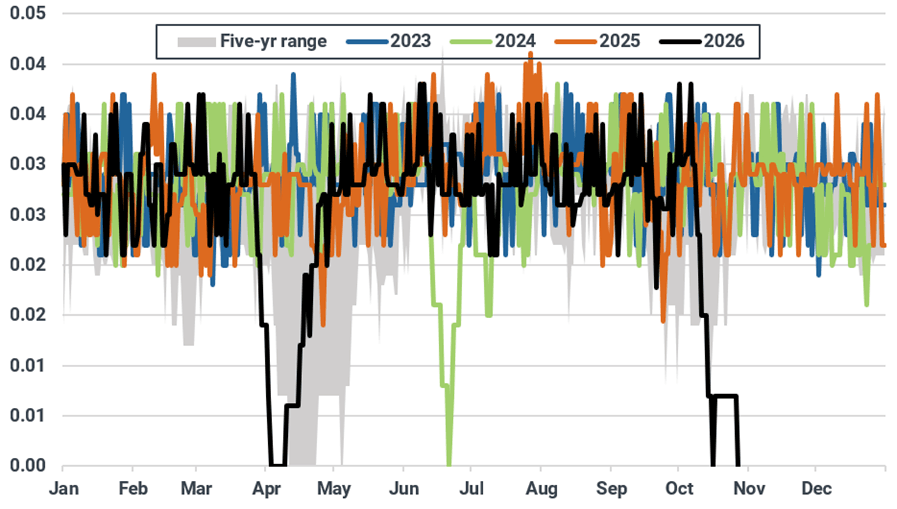
In the Pacific basin, exports out of Australia’s 9 mtpa Wheatstone plant have plummeted amid maintenance at both trains that is set to last until 19 November. The facility has exported only four cargoes this month, down from 12 in September. Kpler Insight expects limited supply from the project over the next three weeks.
Australia’s Wheatstone LNG exports (mt, 10-day moving average)
Source: Kpler Insight
Market Insights you can trust
Kpler delivers unbiased, expert-driven intelligence that helps you stay ahead of supply, demand, and market shifts.
Trade smarter. Request access to Kpler today.

See why the most successful traders and shipping experts use Kpler