
Global LNG prices to hold steady on mixed fundamentals, renewed US-Iran talks
Both TTF and Asian LNG prices fell last week as the US and Iran carried out talks in the sidelines of the UN General Assembly, reducing geopolitical premiums. While demands on either side of the conflict have changed little, the market braced itself for potentially positive news regarding the potential reopening of the Strait of Hormuz.
Market & trading calls
European TTF front-month price outlook: Stable, as improving supply and milder temperatures in Northwest Europe are offset by tighter market conditions in Southern Europe. Recovering North Sea supply as Norwegian maintenance eases, resumed UK flows via the Interconnector and above-average temperatures should loosen the Northwest European balance. In contrast, Algerian maintenance and weak wind generation are expected to keep Southern European gas markets tighter and support gas-fired generation. Geopolitics remains the primary source of volatility, with potential progress in US-Iran talks providing downside risk, while a breakdown in negotiations could restore some of the geopolitical premium recently priced out of TTF.
Asian LNG front-month price outlook: Stable, as softer Japanese, South Korean and South Asian demand offsets firmer Q4 requirements in China. Weaker domestic and pipeline supply and higher North China heating demand support China's LNG call, while LNG purchases from Singapore provides modest upside. However, softer Northeast Asian procurement and price-sensitive South Asian demand cap gains, with progress in US-Iran talks adding further downside risk.
Asian LNG – TTF spread outlook: Set to remain stable, as both Asian LNG and TTF are expected to remain stable next week. Asian LNG increased its premium to TTF with the spread trading at $1.64/MMbtu as of 23 September, compared to $0.84/MMbtu on 16 September.
US Henry Hub front-month price outlook: Stable, as upward support from a recent pullback in production is offset by decreasing domestic demand from cooler shoulder season temperatures.
Key natural gas and LNG front-month prices ($/MMBtu)
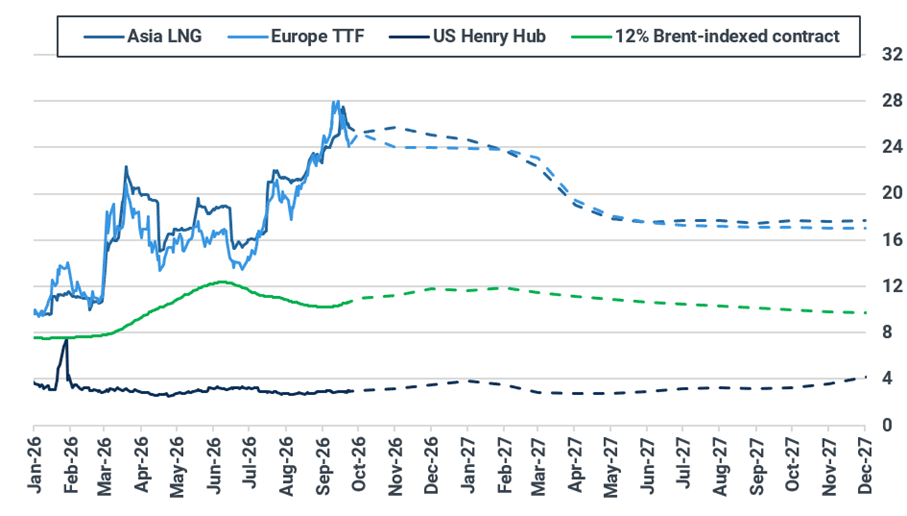
Source: ICE, NYMEX. Brent-indexed price represents 12% slope of 90-day moving average of Brent contract. ICE, NYMEX. Brent-indexed price represents 12% slope of 90-day moving average of Brent contract.
Asian LNG-TTF front-month spread ($/MMBtu)
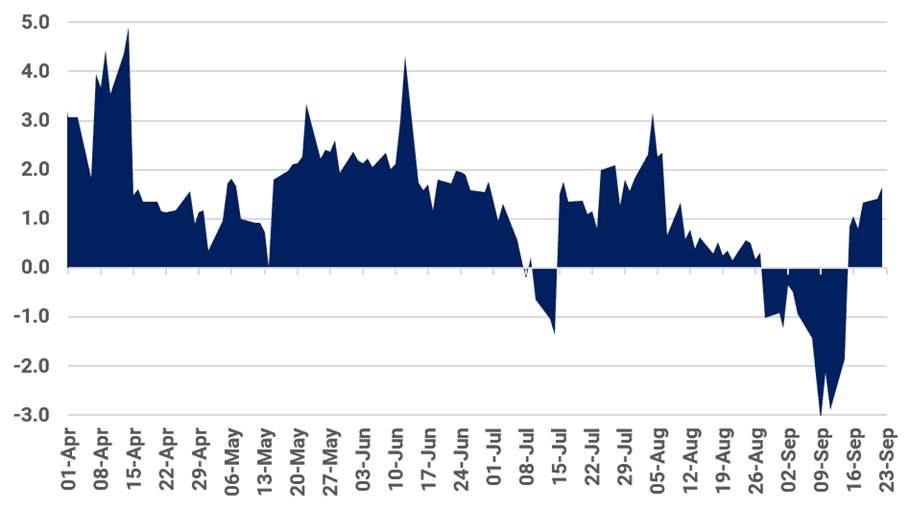
Source: ICE, Kpler Insight
Europe: TTF to remain stable as improving supply and milder temperatures in Northwest Europe offset tighter market conditions in Southern European, while geopolitics remains a key risk
The European TTF front-month contract declined for a second consecutive week, settling at $24.08/MMBtu on 23 September, down 8.7% from $26.38/MMBtu on 16 September. Bearish fundamentals provided some downside, as above-average temperatures delay the return of meaningful heating demand in the continent, stronger wind displaced gas-fired generation and higher LNG imports loosened the balance. However, much of the decrease likely reflected easing sentiment around the Strait of Hormuz, as transits have recently increased and the US and Iran held talks on reopening the Strait on the sidelines of the UN General Assembly in New York. These factors outweighed tighter pipeline supply as Norwegian maintenance reached its peak, while ongoing works in Algeria and TurkStream maintenance curtailed flows into Southern, Central, and Eastern Europe. Ukraine also resumed exports to Hungary providing some relief to the region amid the TurkStream maintenance.
Looking ahead, Kpler Insight maintains a stable outlook for the TTF front-month contract next week. Recovering North Sea supply as Norwegian maintenance eases, resumed UK flows via the Interconnector and above-average temperatures in Northwest Europe should loosen the balance. The end of TurkStream maintenance on 26 September, alongside potential for continued exports from Ukraine into the continent to support restocking, should provide further supply relief in Central and Eastern Europe. This will be partly offset by tighter fundamentals in Southern Europe, where weak wind and above-average temperatures support gas-fired generation, while North African maintenance curtails pipeline supply. Geopolitics remain the key source of volatility, with US-Iran talks providing a potential downside if progress is made towards reopening the Strait of Hormuz. The risk premium could also swiftly return if talks fail to achieve progress. Further headline-driven volatility can be expected around major geopolitical events this week, including the UN General Assembly and a Xi-Trump meeting.
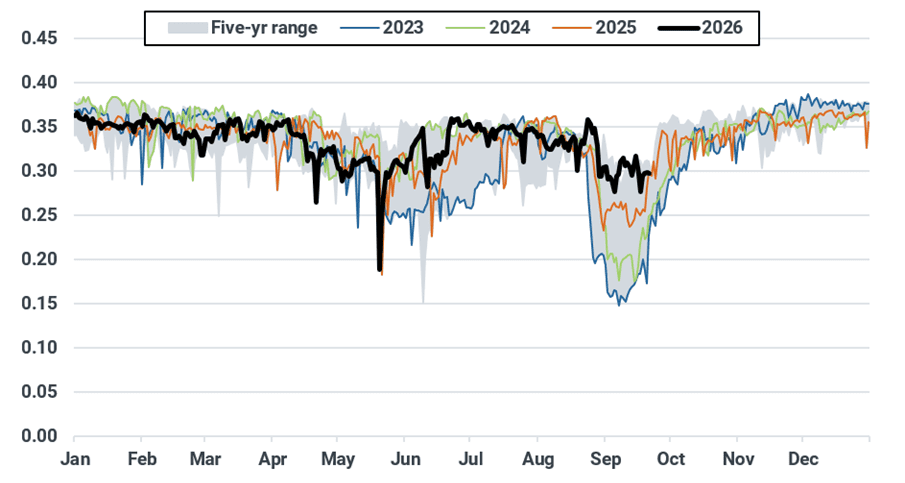
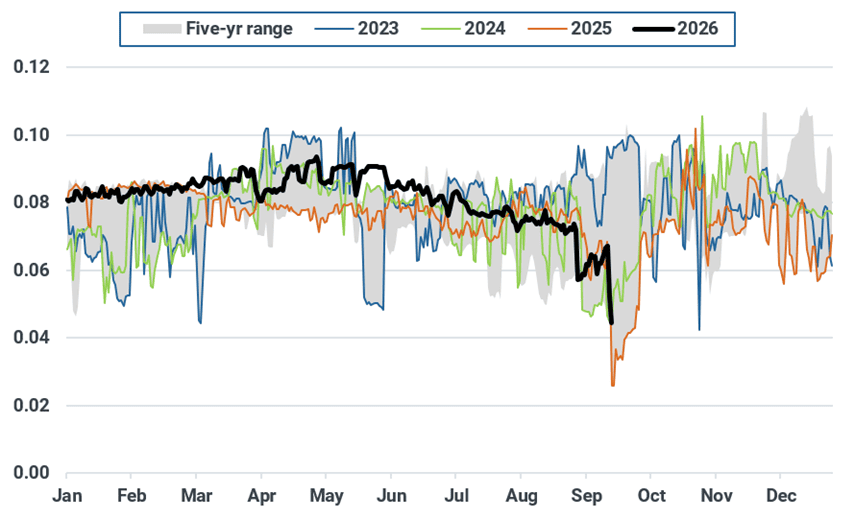
EU-27 net pipeline imports decreased by 8.9% w/w to an estimated 2.51 bcm. The decline was mainly driven by lower Algerian flows (-0.20 bcm w/w), as upstream maintenance and works at several North African interconnection points curtailed deliveries to Europe. Lower TurkStream flows due to ongoing maintenance (-0.03 bcm w/w) and Azeri (-0.03 bcm w/w) flows added to the decline, while UK imports increased marginally (+0.03 bcm w/w) following the end of Interconnector maintenance on 21 September.
Looking ahead, Kpler Insight expects pipeline imports to increase next week. Despite unplanned work at the Troll field being extended by one day to 26 September, Norwegian maintenance is now past its peak, with diminishing unavailability expected to support higher North Sea supply. The end of TurkStream maintenance on 26 September and the return of flows from UK via the Interconnector should provide further upside. Exports from Ukraine, which resumed this week, particularly into Hungary, are expected to continue in the near term, providing additional supply relief to the CEE region, while capacity bookings point to potential for flows to persist into October. However, planned BBL maintenance from 30 September and ongoing works in Algeria will cap gains.
Norwegian flows to the EU + UK (bcm)
Source: ENTSOG
Algerian flows to the EU (bcm)
Source: ENTSOG
GASSCO scheduled unavailability for fields and processing plants (mcm/d)
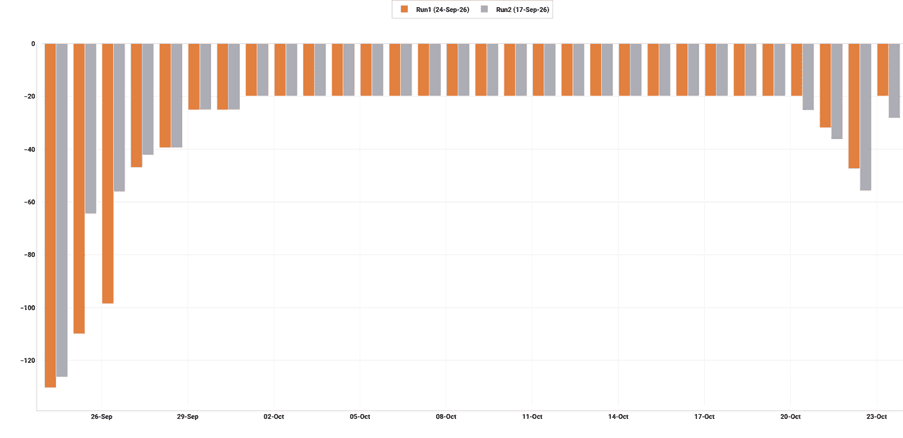
Source: GASSCO, on 24 September 2026, 09:00 UTC
European LNG imports surged by 29.2% w/w to an estimated 2.21 mt, driven by higher arrivals into Northwest Europe, the UK and the Mediterranean. Elevated TTF prices over the last weeks have kept Northwest Europe competitive for flexible LNG, with NWE DES trading at a $0.61/MMBtu discount to TTF as of 23 September. Similarly, PSV's day-ahead €3.50/MWh average premium to TTF in September supported higher Italian LNG arrivals as Algerian maintenance curtailed pipeline supply. UK imports also increased amid lower Norwegian supply, with the return of Interconnector capacity supporting flows to the continent. Looking ahead, Kpler Insight expects LNG imports to edge lower next week, as the end of TurkStream maintenance supports recovering pipeline supply into the CEE region weighing on Mediterranean imports. Italy's Toscana LNG terminal will provide downside from October as planned maintenance takes place.
European weekly LNG imports by region (mt)
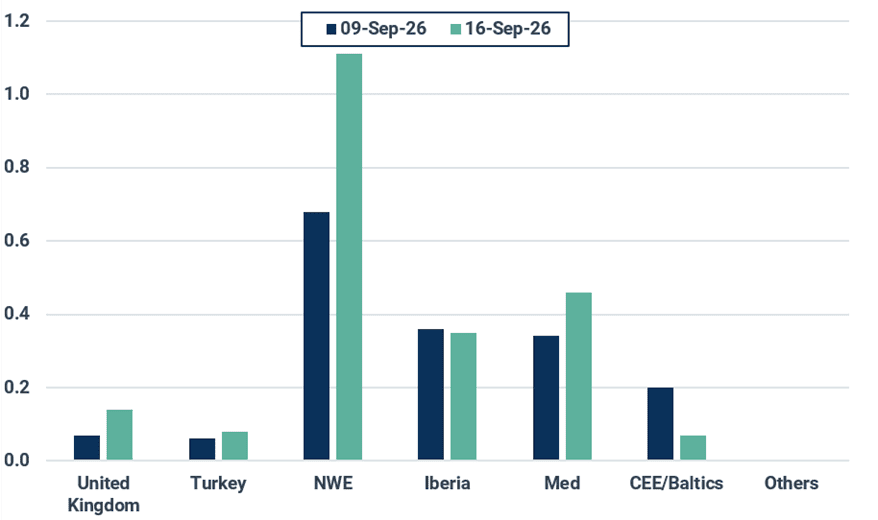
Source: Kpler Insight. Data represents week commencing 09/09 and 16/09. NWE=FR, BEL, NL, GER. Iberia=ESP, POR. Med=ITA, HVR, GRE. Baltics/CEE=FI, LT, POL. Others=SWE, MT.
Local distribution consumption (LDC) across 16 EU countries increased by 5.3% w/w to an estimated 1.2 bcm. LDC has remained near the lows of the past three years for a 14th consecutive week, with temperatures in Northwest and Southern Europe averaging 0.8°C and 1.7°C above the five-year average, respectively. Looking ahead, Kpler Insight expects LDC to edge slightly higher next week, as lower temperatures in Central and Eastern Europe support heating demand, outweighing upward temperature revisions in Northwest Europe and continued above-average temperatures in Southern Europe.
EU-16 weekly consumption in the local distribution sector (bcm)
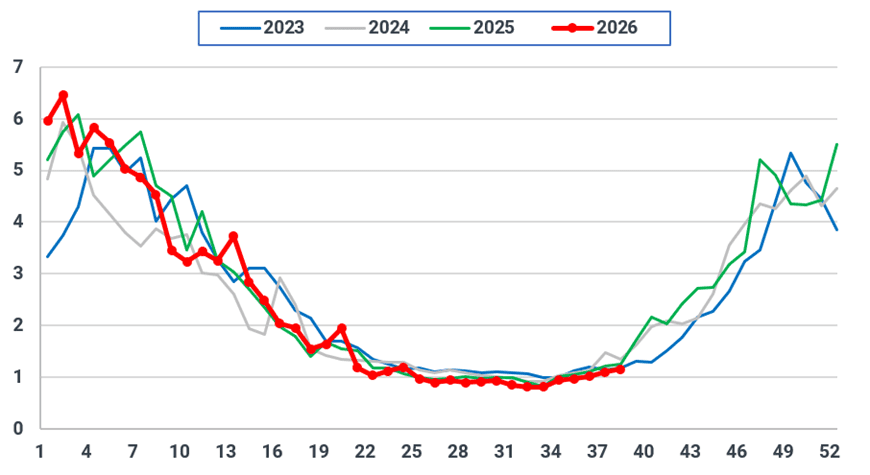
Source: ENTSOG, ENAGAS, Eustream, AGCM, Kpler Insight. The EU-16 perimeter includes AT, BE, DE, CZ, FR, HU, GR, IT, NL, LU, PL, PT, RO, SL, SK, and ES.
EU gas-fired generation decreased by 15% w/w to an estimated 6 TWh. The decline was driven by lower total power demand (-1.4% w/w) and a 57% w/w surge in wind generation, which displaced thermal generation, with coal output also falling by 19.5% w/w. Looking ahead, the outlook for gas-fired generation is mixed. Above-average temperatures and weakening wind should support gas burns in Southern Europe, while periods of stronger wind generation in Northwest Europe are expected to limit the call on gas.
EU-25 weekly gas-fired generation (TWh)
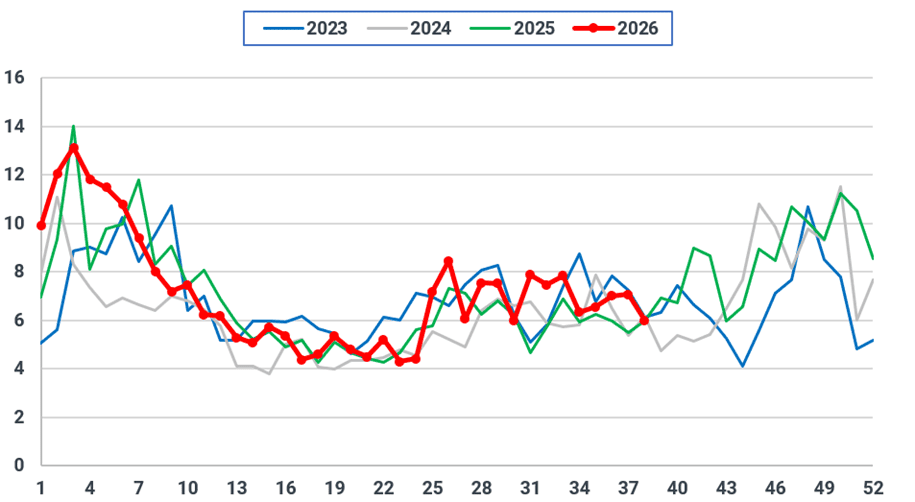
Source: Kpler Power, Kpler Insight.
Northwest Europe daily average temperature forecast (°C)
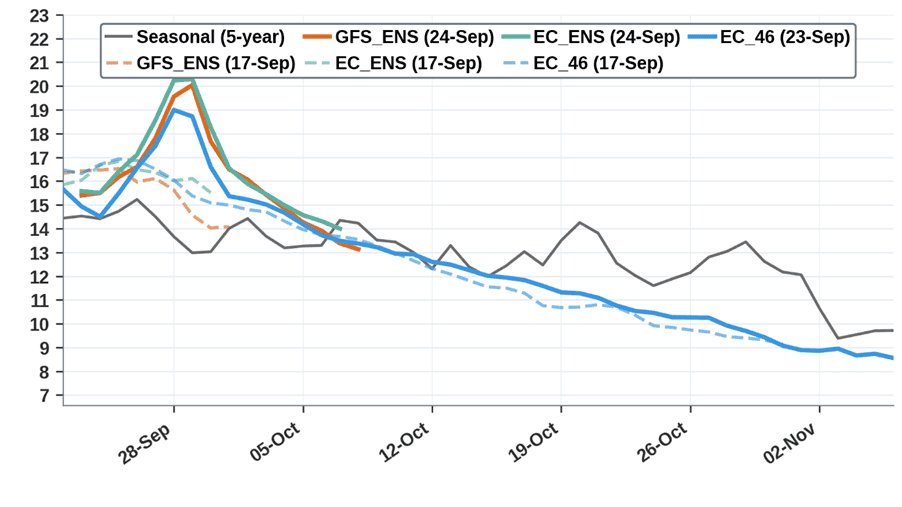
Source: Kpler Insight. Run comparison 24/09 (solid) vs. 17/09 (dotted), 00:00 UTC. Seasonal is a five-year average. NWE includes France, Belgium, Netherlands and Germany.
Southern Europe daily average temperature forecast (°C)
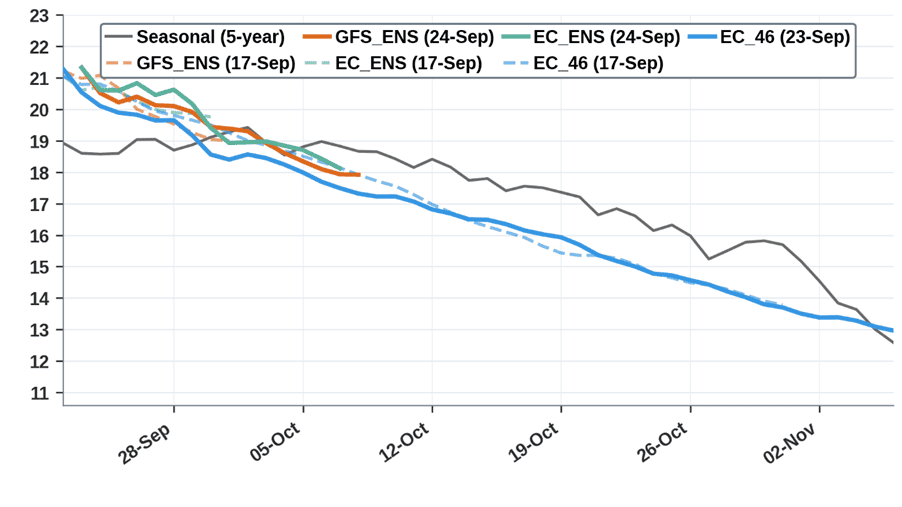
Source: Kpler Insight. Run comparison 24/09 (solid) vs. 17/09 (dotted), 00:00 UTC. Seasonal is a five-year average. Southern Europe includes Portugal, Spain and Italy.
EU-27 underground gas storage levels rose to 70.1% full as of 22 September 2026, up 1.4% w/w. Average daily net injections increased to an estimated 0.23 bcm/d (+0.04 bcm/d w/w), supported by lower gas-fired generation and higher LNG imports. Looking ahead, Kpler Insight expects injections to edge higher, particularly in Northwest Europe, as recovering Norwegian supply, resumed flows from the UK and above-average temperatures loosen the regional balance and expand volumes available for storage. In Southern Europe, injections are expected to remain broadly stable as Algerian maintenance and robust gas-fired generation limit gas available for storage. Meanwhile, the TTF front-month premium to the Winter 2026 contract narrowed to €0.93/MWh as of 16 September, from €1.02/MWh a week earlier. While this marginally improves storage economics, the prompt premium continues to disincentivise injections on a spread basis.
EU-27 net cumulative UGS injections since 1 April (bcm)
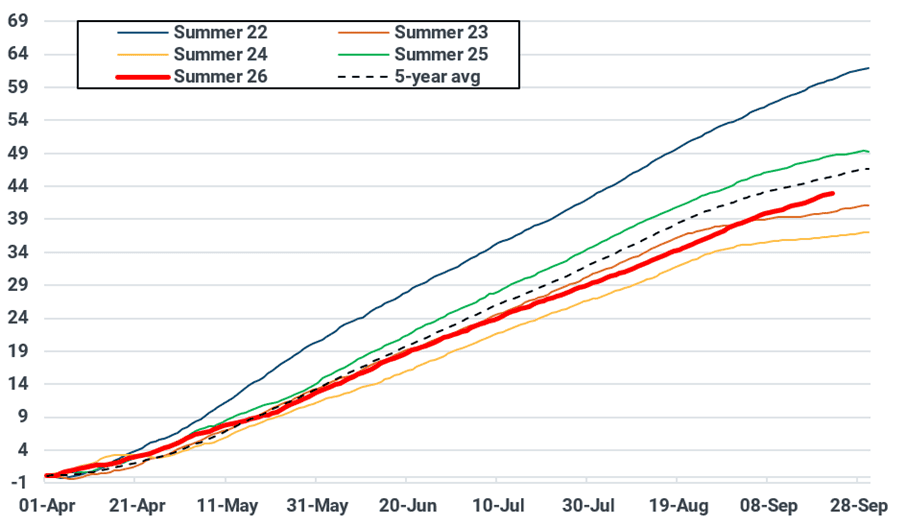
Source: GIE, Kpler Insight. Latest data as of 22 September 2026.
Asia: prompt LNG prices rangebound as softer demand offsets firmer China Q4 requirements
Asian LNG prices fell to $25.73/MMBtu on 23 September from $27.23/MMBtu on 16 September (-$1.50/MMBtu w/w), tracking a broader decline in global gas prices. Renewed US-Iran talks and improving sentiment around the Strait of Hormuz unwound part of the geopolitical risk premium that had driven prices higher in the previous week.
We expect prompt Asian LNG prices to remain broadly stable over the coming week. Softer Japanese procurement, a warmer early-winter outlook across Japan and South Korea, and lower South Asian requirements should cap the upside. China provides the main support, with weaker domestic production and pipeline imports increasing LNG's balancing role going into Q4, while Singapore replacement buying provides a smaller offset. Risks are tilted modestly to the downside, as further progress in US-Iran talks and a recovery in Hormuz LNG transits could further unwind in the geopolitical risk premium.
Lower w/w cooling demand across most major Asian markets should modestly weigh on LNG requirements. Temperatures fell below seasonal norms in Japan, South Korea and northern and southern China, reducing cooling loads as the region moves deeper into shoulder season. Eastern China and India remain the main exceptions, leaving overall weather signals slightly bearish for prompt Asian LNG prices.
Forecasted average temperatures for Asian countries (°C)
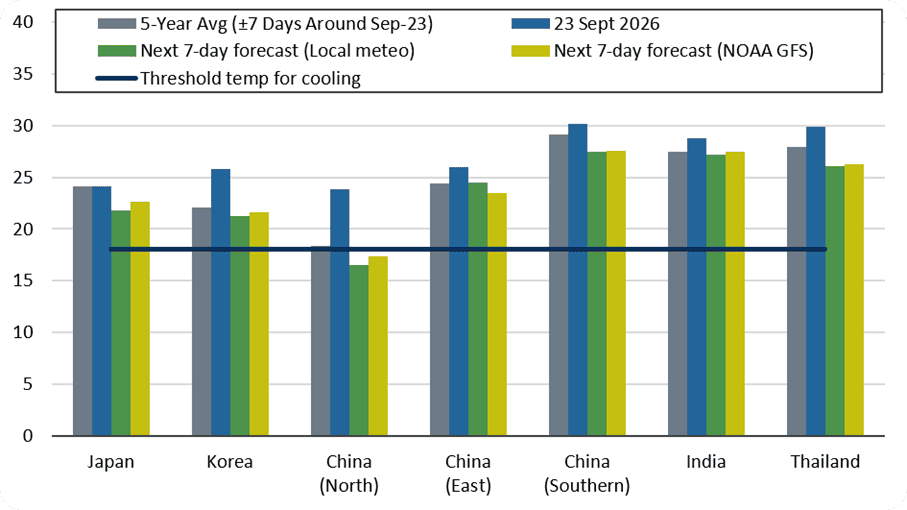
Source: Meteostat, Kpler Insight. As of 24 September 2026 00:00:00 UTC. Population-weighted average temperature of selected major cities across a country is shown for both historical and forecast.
Japan remains a limited source of prompt LNG demand as softer power-sector consumption supports inventory rebuilding ahead of winter. The delayed restart of Mihama 3 could add roughly one cargo-equivalent of gas-for-power demand, though cooler September weather and lower gas-fired availability mostly offsets this increase. Looking further ahead, latest JMA and ECMWF guidance continues to favour a warm start to winter, with population-weighted temperatures around 1.8°C above average in November and 1.5°C above average in December. The warmer outlook remains consistent with Kpler Insight's existing assumptions, leaving the 2026 LNG demand forecast unchanged and limiting the need for additional procurement ahead of winter. The main upside risk remains colder weather or further nuclear delays that accelerate inventory draws.
Japan implied total LNG inventory forecast (mt)
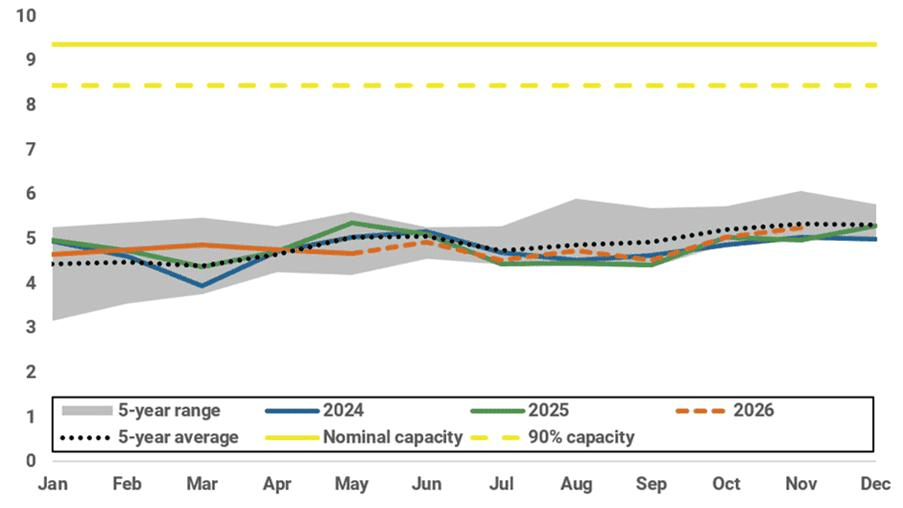
Source: METI, Kpler Insight
Japan's monthly nuclear capacity availability (GW)
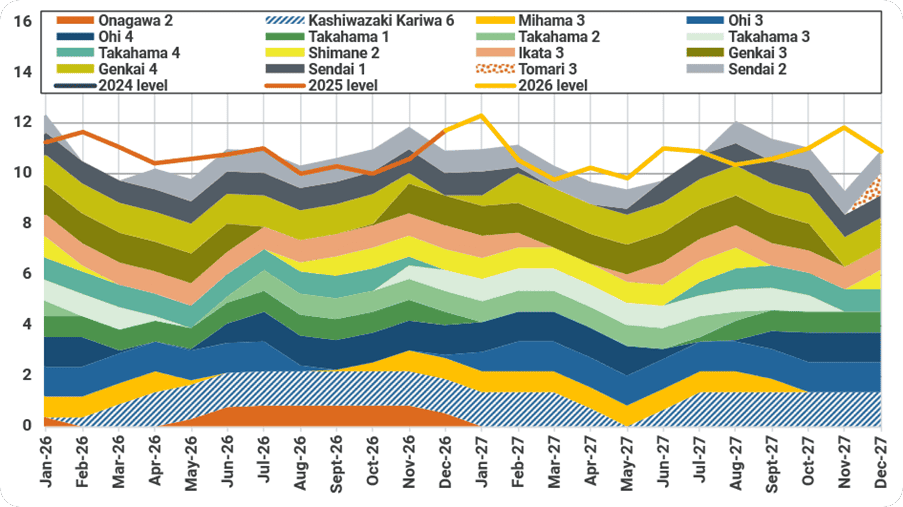
Source: METI, HJKS, Kpler Insight
South Korea's prompt LNG outlook has softened slightly as warmer early winter temperature forecasts reduce heating demand and near-term restocking requirements. KMA assigns a 50% probability of above-normal temperatures in both November and December, while ECMWF puts population-weighted temperatures around 1.6°C above average in November and 1.1°C above average in December. Kpler Insight lowers its 2026 LNG demand forecast by 0.1 mt to 46.9 mt on the warmer December outlook. This limits upside to prompt procurement, although short-lived cold spells remain a risk if a strengthening Siberian High or East Asian winter monsoon drives colder continental air into the peninsula.
Heating Degree Days (HDD) in Korea (Degree-days)
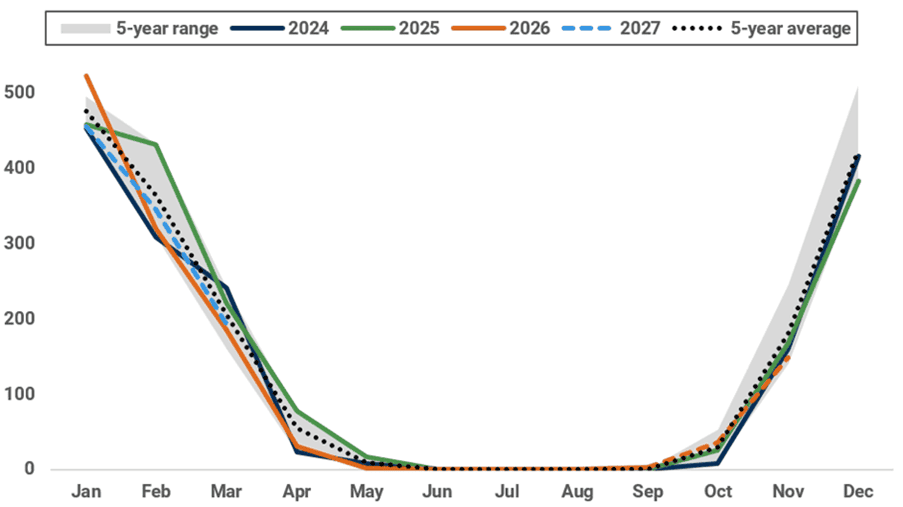
Source: Meteostat, KMA, ECMWF, Kpler Insight. Note: Population-weighted HDD of selected major cities across Korea is shown for both historical and forecast.
China provides the clearest Q4 demand support as weaker domestic and pipeline supply increases LNG's balancing role. Kpler Insight raised China's forecast 2026 LNG demand by 0.6 mt to 61.0 mt as Hainan's production recovery was delayed to November and August pipeline imports undershot expectations. A colder outlook for December in North China adds another 0.2 mt, taking demand to 61.2 mt, with expected HDDs rising to around 660. The additional LNG requirements are concentrated in Q4, increasing China's potential call on LNG in early winter, although warmer East and South China conditions limit the upside.
China's pipeline gas imports by month (bcm)
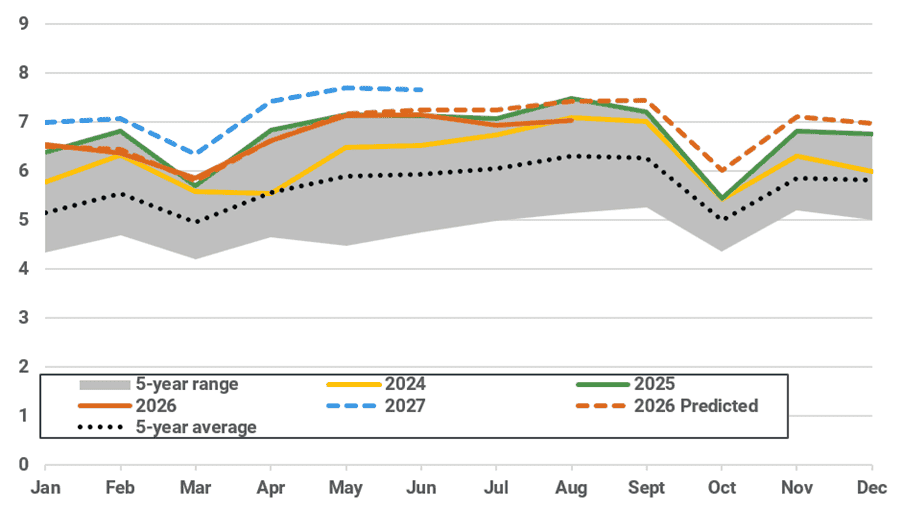
Source: China Customs, Kpler Insight
China monthly gas production forecast and year on year growth (LHS bcm, RHS %)
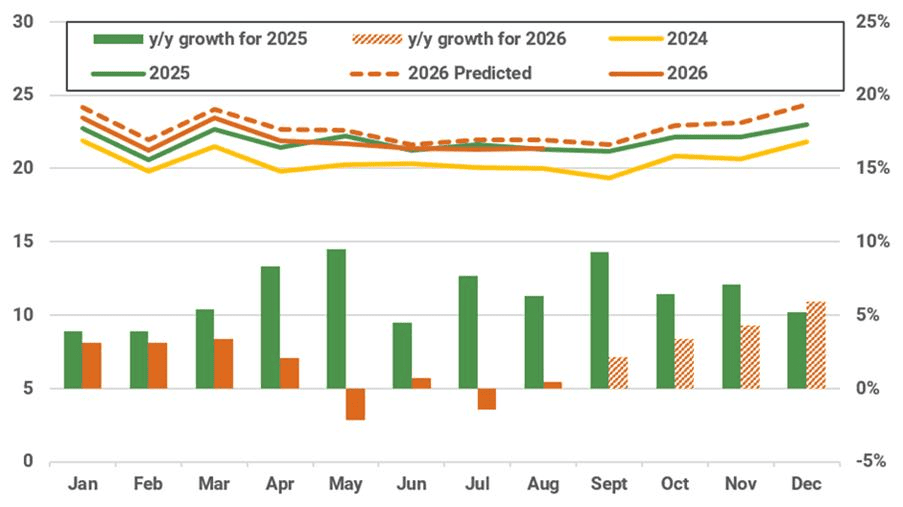
Source: NBS, Kpler Insight
HDD in Northeast Asia through October 2026 - March 2027 (Degree-days)
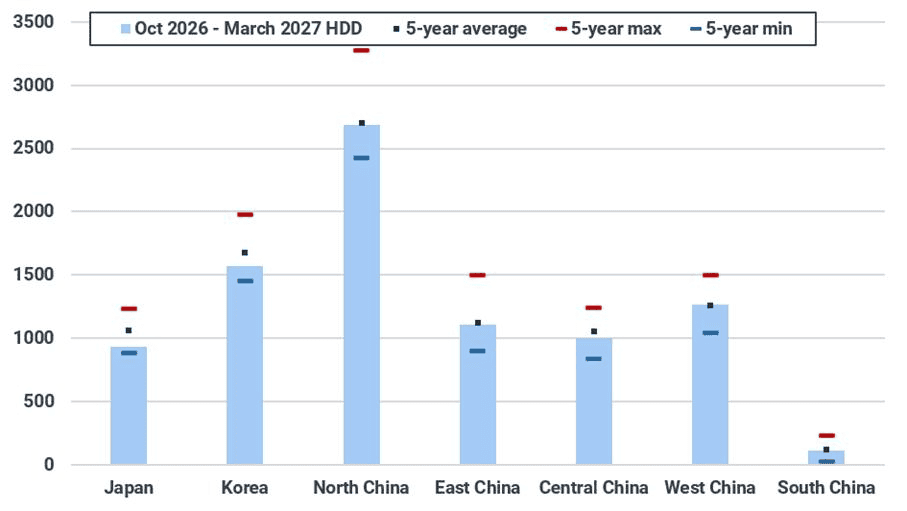
Source: Kpler Insight
Singapore's forecast LNG demand has been increased by 0.1 mt to 5.2 mt on a hotter October-November temperature outlook, while ongoing replacement buying provides some support to prompt demand. However, pipeline imports are expected to remain broadly stable at around 0.5–0.6 bcm/month in Q4, limiting incremental LNG requirements.
Singapore Cooling Degree Days (CDD)
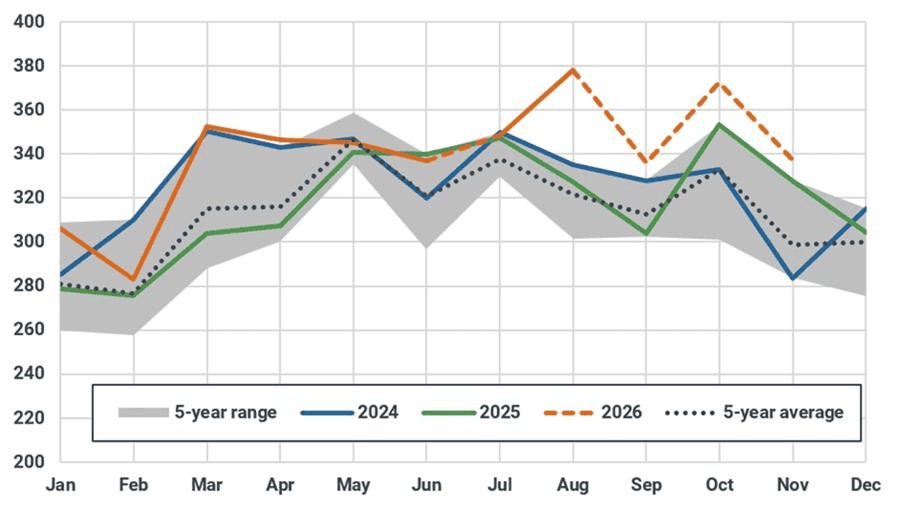
Source: Meteostat, Kpler Insight
Year-on-year changes in Singapore's monthly power generation by fuel (GWh)
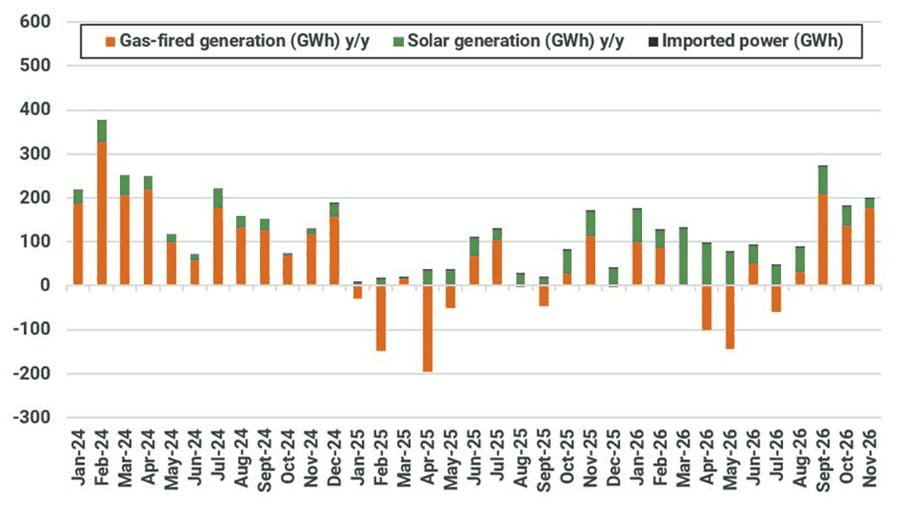
Source: EMA, EMC, Kpler Insight. Note: Latest EMA data is as of May 2026, while EMC data is used for June-August 2026. Kpler Insight forecast starts from September 2026.
Singapore's monthly pipeline imports by country (Bcm)
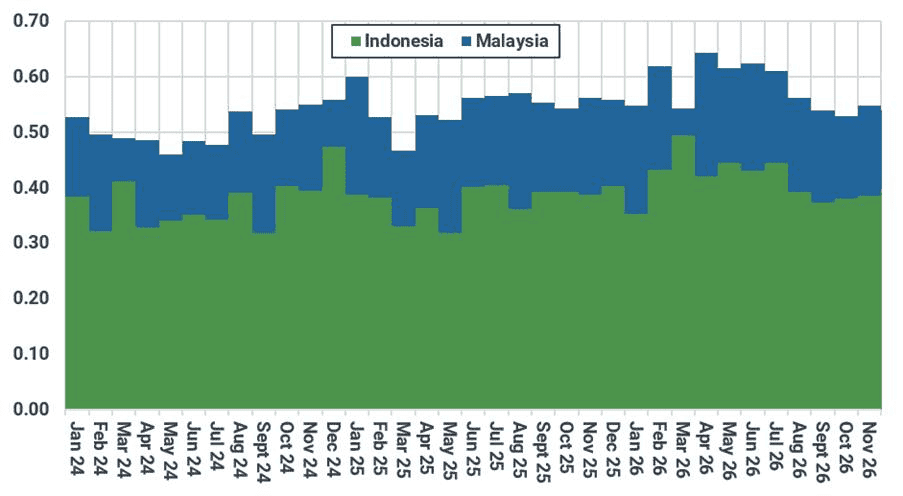
Source: JODI, UN Comtrade, Kpler Insight
High prices continue to weigh on South Asian LNG demand, as fuel switching and price-driven demand destruction reduces spot LNG purchases. Bangladesh's 2026 LNG demand forecast was lowered by 0.2 mt to 6.6 mt, with coal generation displacing gas-fired output through H2 and reducing September-December LNG requirements. Pakistan remains highly price-sensitive, with current Asian LNG price levels effectively pushing the country out of the spot market. Though, resumed Qatari government-to-government deliveries have covered near-term requirements, with a second cargo expected at Port Qasim this month, while recent spot tenders were left unawarded due to price. Pakistan is therefore expected to remain largely absent from spot procurement in the near term.
Bangladesh Power generation y/y (TWh)
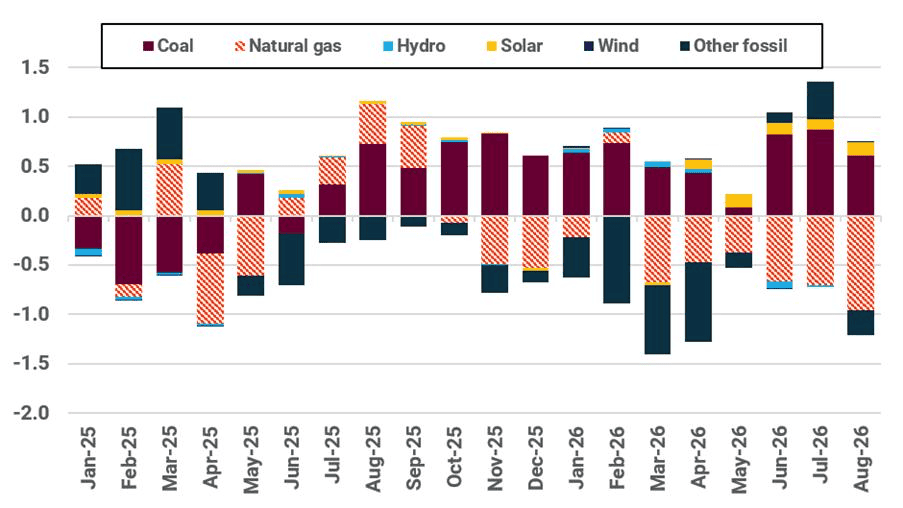
Source: Power Grid Bangladesh PLC
US: Henry Hub to hold near $3.00/MMBtu as October contract expires, November becomes the front-month
US Henry Hub front-month prices settled at $3.04/MMBtu on 23 September, up from $2.89/MMBtu on 16 September. Despite a smaller-than-expected storage report, prices traded essentially flat late last week as cooler temperature forecasts for late September and early October offset upward support from higher LNG feed gas demand. Prices then fell on Monday to $2.84/MMBtu as the Cove Point LNG facility entered annual maintenance and flows into Corpus Christi LNG fell from 2.7 Bcf/d to 2.4 Bcf/d. However, lower prices stimulated buying activity on Tuesday, with prices subsequently rising to $2.97/MMBtu. Traders then moved to cover short positions on Wednesday, pushing prices higher as trading volumes thinned ahead of the expiration of the October contract on 25 September.
Kpler Insight expects Henry Hub prices to remain near $3.00/MMBtu in the final days of the October contract, with upcoming storage results to heavily influence price behavior. Once the November contract becomes the front-month, prices may fall back below $3.00/MMBtu as the market's focus turns to end-of-season storage levels, which are expected to come in above the 5-year average.
US domestic gas consumption by sector (bcf/d)
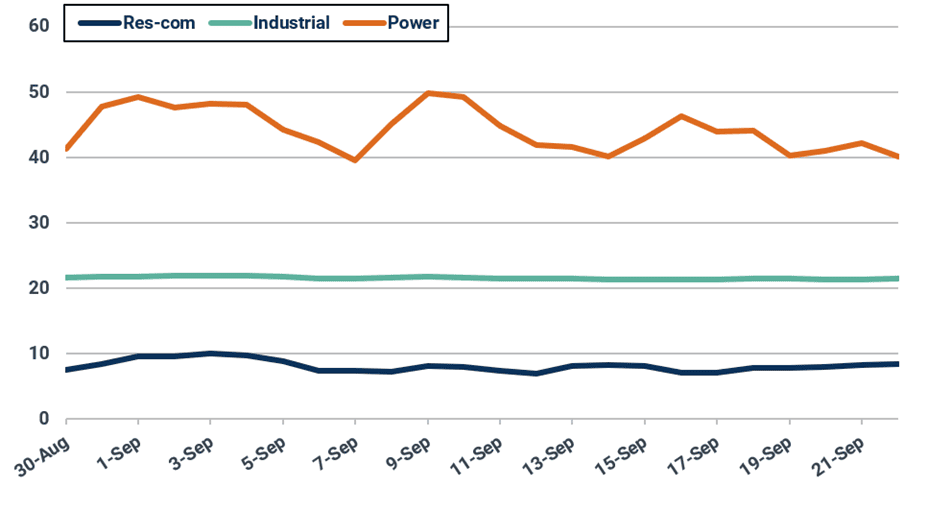
Source: EIA
US gas consumption averaged 71.8 Bcf/d over the last seven days, down 1.2 Bcf/d from the previous week. Lower demand came as parts of the Lower 48 began experiencing early Autumn temperatures that failed to stimulate meaningful heating or cooling demand, though lingering heat in the South kept power burns near 40 Bcf/d. Power demand is expected to fall in the coming days as cooling degree days decrease to near 5-year average levels.
Forecast of cooling degree days
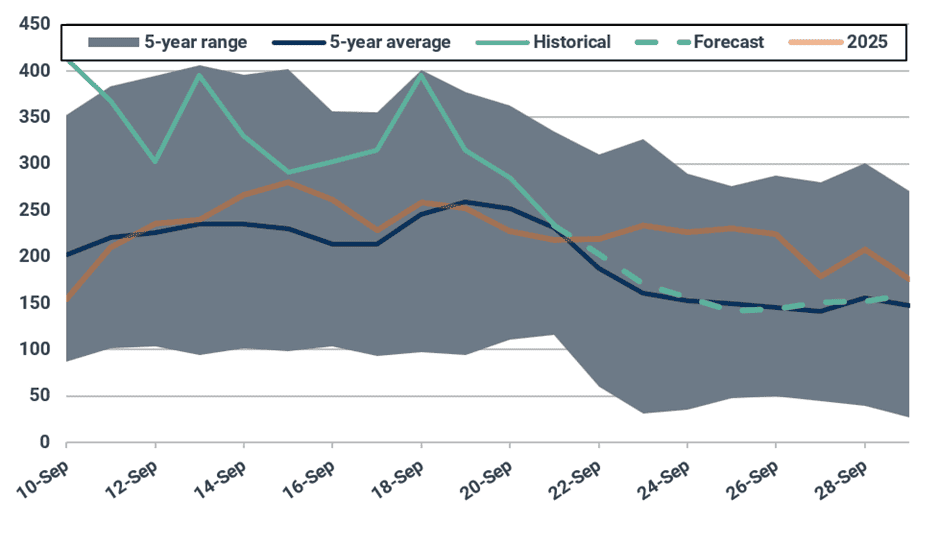
Source: National Weather Service
Dry gas production averaged 111 Bcf/d over the past week, with weak physical prices in the northeast resulting in output curtailments among Marcellus producers. Kpler Insight expects production to decrease to an average of 110.5 bcf/d in the coming week.
Forecast of natural gas volumes in underground storage (bcf)
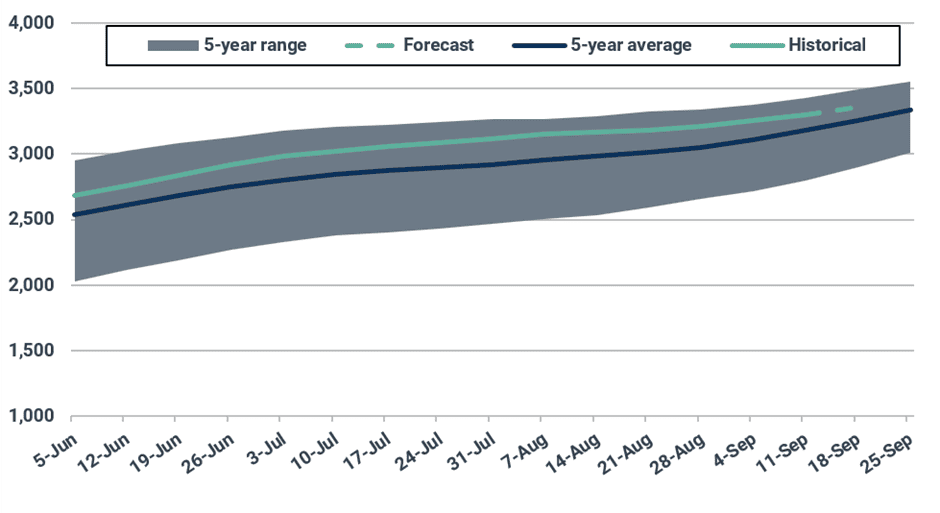
Source: EIA, Kpler Insight
The US injected 44 Bcf into underground storage for the week ending 11 September, coming in below consensus estimates. Inventories rose to 3,298 Bcf, reducing the surplus above the 5-year average to 3.7% from 4.8% the previous week. Another relatively lean storage build is expected for the week ending 18 September as gas-fired power burns remained elevated and LNG feed gas neared all-time highs. Kpler Insight forecasts a net injection of 61 Bcf.
Global LNG supply: US-Iran talks eyed as dark loadings at Ras Laffan and Das Island continue
Global LNG exports edged 0.12 mt lower w/w to 8.06 mt last week, driven primarily by lower US and Russian loadings, which fell by 0.10 mt and 0.09 mt, respectively. US exports declined slightly across Sabine Pass, Plaquemines, and Corpus Christi, while Yamal experienced a short gap in exports over the weekend before loading activity resumed.
Kpler Insight continues to monitor US-Iran talks over reopening the Strait of Hormuz as the main geopolitical risk to LNG supply. Dark loadings continued at Qatar's 77 mtpa Ras Laffan and the UAE's 5.8 mtpa Das Island facilities, while maintenance is ongoing at the 11.4 mtpa Oman LNG. In Africa, higher Algerian exports are supporting LNG availability amid pipeline maintenance affecting flows to Spain and Italy, while Nigeria's 22 mtpa Bonny LNG continues to maximize output amid limited maintenance. The 5.3 mtpa Cove Point facility in the US began its annual maintenance cycle on 19 September, which is expected to last for several weeks. Kpler Insight expects global LNG exports to remain broadly stable this week, with September supply currently forecast at close to 34 mt.
Global LNG exports (mt, 10-day moving average)
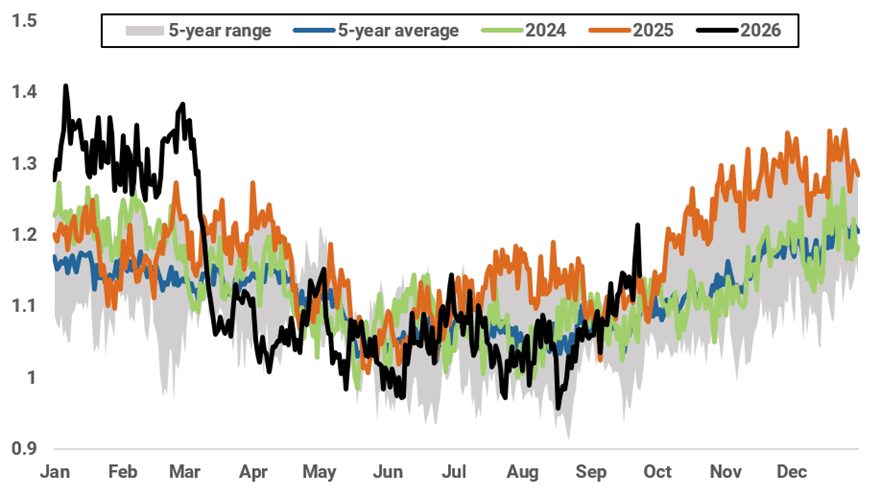
Source: Kpler
Geopolitical developments in the Middle East remain the key supply-side risks as vessel transits through the Strait of Hormuz remain highly restricted. However, US-Iran talks on the sidelines of the UN General Assembly in New York on 22 September over reopening the Strait of Hormuz offered some hope of a possible resolution. Iran has proposed resuming shipping through the Strait within 7 days if the US eases military pressure and lifts its blockade on Iranian ports. Tehran's conditions also include ending the war on all fronts, halting what it calls US "acts of aggression," ending economic warfare, and releasing frozen Iranian assets.
Limited LNG trade continued through the Strait of Hormuz, primarily via dark transits. Though the Shandong Redwood exited the Gulf via the Iranian route on 19 September, traveling to Pakistan under a government-to-government deal. As of 23 September, 20 LNG tankers had crossed the Strait in September, including 10 QatarEnergy-linked and 10 UAE state-owned Adnoc-linked vessels, according to Kpler data. This compares with 13 Adnoc-linked transits and no QatarEnergy-linked transits in August. However, dark loadings at Ras Laffan and Das Island continue to limit visibility over regional export activity.
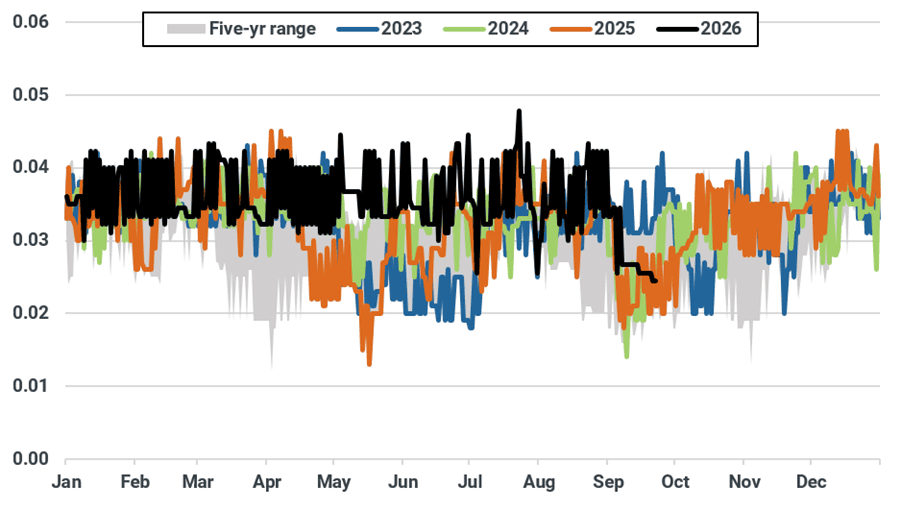
Maintenance continues at Oman LNG's 3.8 mtpa train 1, following the start of scheduled work on 1 September. The duration of the maintenance remains unknown, though partial data for the week beginning 21 September suggests Omani loadings are recovering. The ongoing outage continues to limit Omani LNG availability, adding to Middle East supply uncertainty while Strait of Hormuz disruptions persist.
Oman LNG exports (mt, 10-day moving average)
Source: Kpler
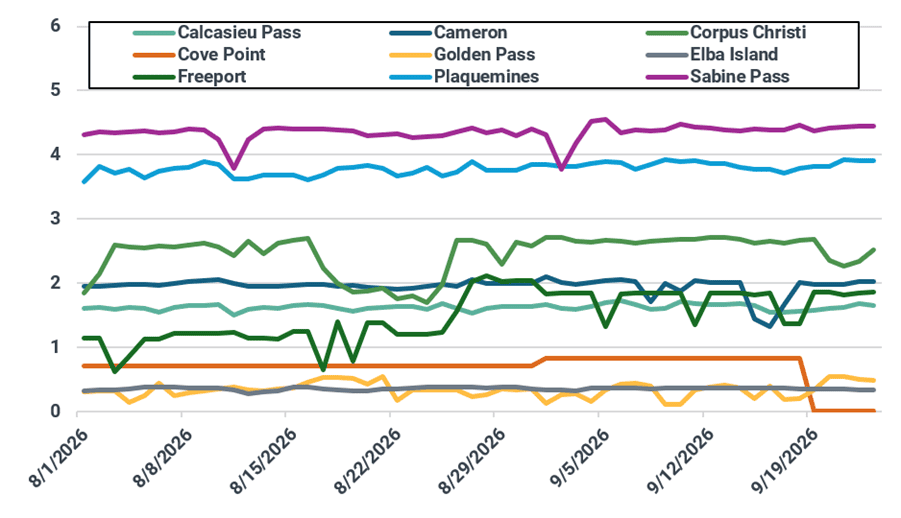
In the US, feedgas has dipped from H1 September highs of ~18 bcf/d down to ~17 bcf/d since mid-September amid maintenance at the US' 5.3 mtpa Cove Point plant and a dip in deliveries to the 25 mtpa Corpus Christi facility, notably from the Tejas pipeline. Maintenance at Cove Point typically lasts 2-3 weeks, with exports likely to be restored by mid-October. We also continue to monitor flows into the 6 mtpa Golden Pass train 1, which have risen back above 0.5 Bcf/d. However, deliveries remain below the 0.8-0.85 Bcf/d expected when the facility produces at nameplate capacity.
US feedgas deliveries by liquefaction plant (Bcf/d)
Source: Williams, Cheniere, Boardwalk, Sempra, Kinder Morgan, Venture Global, Berkshire Hathaway, Golden Pass Pipeline
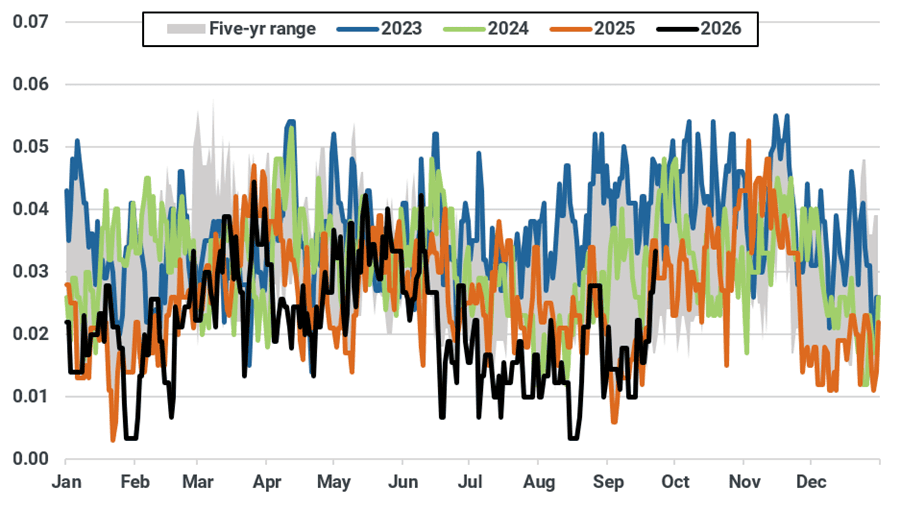
Elsewhere in the Atlantic Basin, Nigerian LNG exports continue to trend above the 5-year range, while Algerian LNG output rises amid ongoing pipeline maintenance affecting flows to Italy and Spain. The increase in Algerian loadings is predominantly from the Bethioua facility. Higher Algerian and Nigerian exports are providing a modest offset to maintenance-related supply losses elsewhere, helping keep global LNG exports stable despite lower US availability and continued Middle East uncertainty.
Algeria LNG exports (mt, 10-day moving average)
Source: Kpler
Market insights you can trust
Kpler delivers unbiased, expert-driven intelligence that helps you stay ahead of supply, demand, and market shifts.
Trade smarter. Request access to Kpler today.

See why the most successful traders and shipping experts use Kpler