Restocking demand, lower Chinese domestic gas production, to push global LNG prices higher as Hormuz transits remain constrained
Maintenance on key North Sea pipelines and fields is expected to reduce supply to the European mainline, driving LNG procurement activities. In Asia, lower-than-expected production results in China, coupled with rising demand in South Korea, China, and Thailand, is expected to push Asian LNG prices to fresh highs. Geopolitics remains the key risk factor in the global LNG market, with pries maintaining a substantial risk premium as progress in US-Iran negotiations remains elusive.
Market and trading calls
European TTF front-month price outlook: Slightly bullish, as lower pipeline supply and a modest recovery in demand are expected to tighten European fundamentals next week. Planned maintenance in Norway, and on the Interconnector and BBL pipelines, will curtail North Sea deliveries into the continent, outweighing higher LNG imports, while consumption is expected to increase. A bullish Asian outlook could provide further support, requiring TTF to remain competitive for uncommitted LNG cargoes. Middle East tensions remain the main upside risk, with restricted Gulf transits and stalled US-Iran negotiations keeping the geopolitical premium elevated.
Asian LNG front-month price outlook: Bullish, as slower Chinese domestic gas production growth and stronger gas-for-power demand, lower South Korean inventories and firmer industrial demand, stronger Thai power-sector gas demand, and sustained Indian spot buying tighten the prompt balance. Japan adds upside risk from regional inventory tightness, while cooler near-term temperatures provide a partial offset. Persistent Strait of Hormuz supply risks remain the key source of upside price volatility.
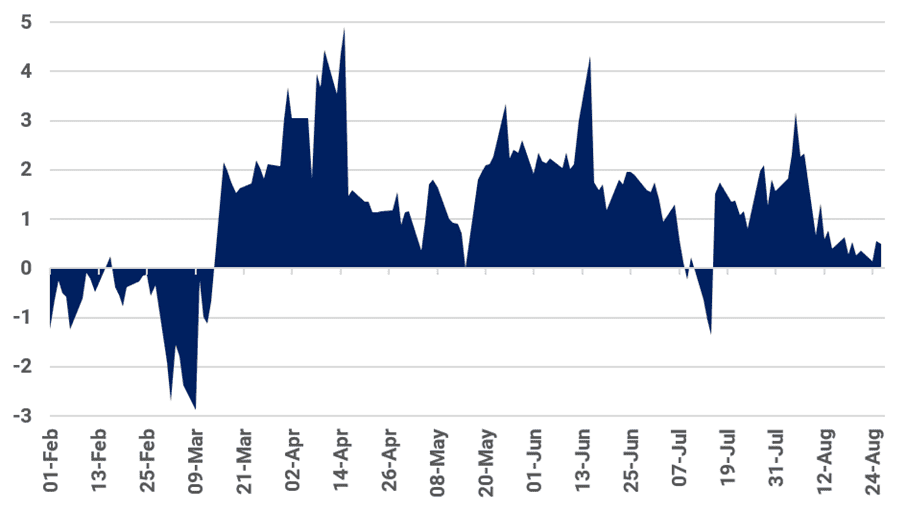
Asian LNG – TTF spread outlook: set to slightly widen, as Asian LNG edges higher compared to TTF. Over the last week, the Asian LNG premium over TTF slightly narrowed, with the spread at $0.50/MMbtu on 26 August, compared to $0.53/MMbtu on 19 August.
US Henry Hub front-month price outlook: Stable, as robust storage levels, strong domestic gas production, and the upcoming expiration of the September contract keep prices from maintaining recent gains.
Key natural gas and LNG front-month prices ($/MMBtu)
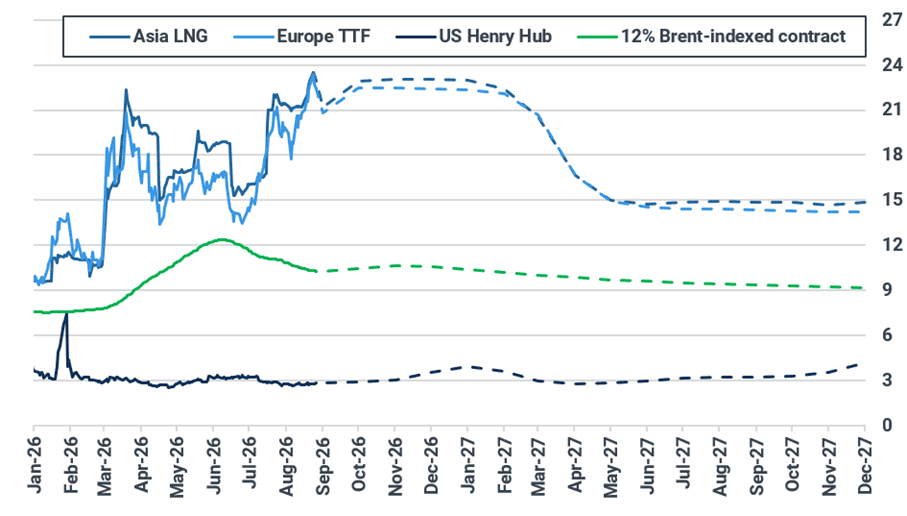
Source: ICE, NYMEX. Brent-indexed price represents 12% slope of 90-day moving average of Brent contract.
Asian LNG-TTF front-month spread ($/MMBtu)
Source: ICE, Kpler Insight
Europe: lower pipeline supply, inter-basin competition, and restocking needs will keep bullish momentum around TTF prices
The European TTF front-month contract rose last week, settling at $22.4/MMBtu on 26 August, up 4.1% from $21.56/MMBtu on 19 August. Front-month prices rallied from Thursday to Tuesday, closing at $23.36/MMBtu on 24 August, the highest since January 2023. The increase was driven by a combination of factors, principally geopolitical risks surrounding the ongoing Middle East conflict, particularly after the US expressed willingness to put additional pressure on countries trading with Iran, and the latter's Persian Gulf Authority adding 10 LNG carriers to a list of non-compliant vessels. Additionally, news that the German Energy Ministry would consider using market intervention tools in the event of security-of-supply risks may have also provided price support. Regarding fundamentals, EU-27 UGS injections slowed slightly, as both LNG and pipeline supply edged lower, while consumption remained mostly balanced, with increases in distribution and industrial demand offset by lower gas use in the power sector.
Looking ahead, Kpler Insight maintains a slightly bullish outlook on the TTF front-month contract for next week. Fundamentally, planned maintenance at key entry points for pipeline imports (Norway, INT, BBL) will reduce overall supply, despite an expected increase in LNG imports, while consumption is anticipated to rise slightly after the European holiday season ends. Increased spot-buying activity in parts of Asia will also support TTF prices, while developments in the Middle East will remain the main price mover, particularly around transits in and out of the Gulf and negotiations between the US and Iran.
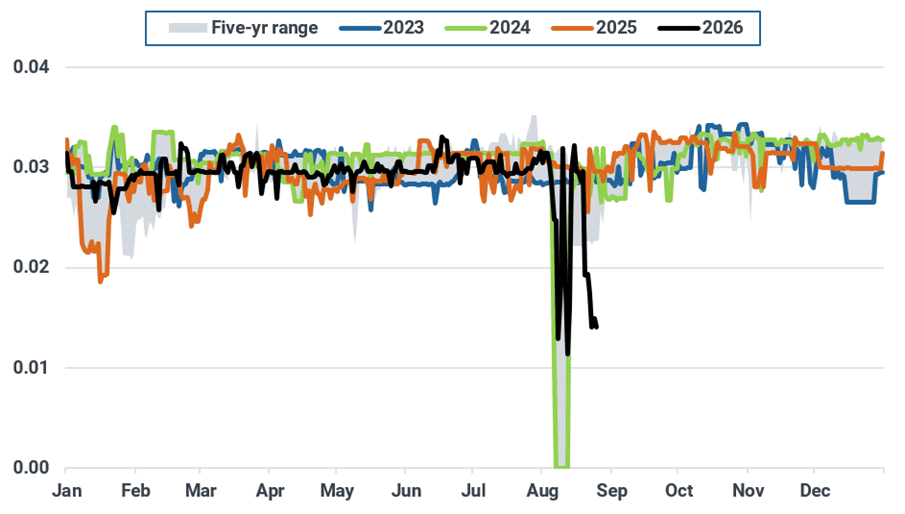
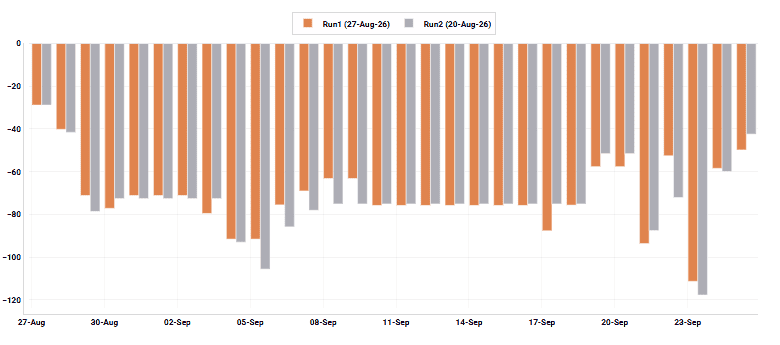
EU net pipeline imports declined w/w to an estimated 3 bcm (-2.9% w/w). The decrease resulted from lower Norwegian imports due to unplanned maintenance at the Kårstø processing plant from 20 to 22 August, and from ongoing planned works at Shah Deniz in Azerbaijan. Looking ahead, Kpler Insight expects net pipeline imports to decrease into next week, driven by the start of seasonal heavy maintenance in Norway and planned works on the INT and BBL pipelines between 1-21 September, which will more than offset the earlier-than-expected return of Azeri pipeline supply (now expected to end on 28 August). Moreover, flows from Algeria may begin to fall ahead of maintenance expected from 11 September onwards.
Daily Azeri flows to the EU (bcm)
Source: ENTSOG
GASSCO scheduled unavailability for fields and processing plants (mcm/d)
Source: GASSCO, on 27 August 2026, 08:00 UTC
European LNG imports fell 13.5% w/w to an estimated 1.41 mt, as lower imports into Iberia and the Mediterranean region outweighed gains in NWE and Turkey. The decline in Southern European imports may reflect increased intra-European competition for LNG, with the Netherlands, France and Germany all showing willingness to pay higher prices to attract incoming cargoes from the Atlantic basin. Looking ahead, despite planned maintenance at terminals in France, Spain and Poland, Kpler Insight expects LNG imports to increase w/w, amid favourable inter-basin pricing dynamics and restocking needs in NWE.
European weekly LNG imports by region (mt)
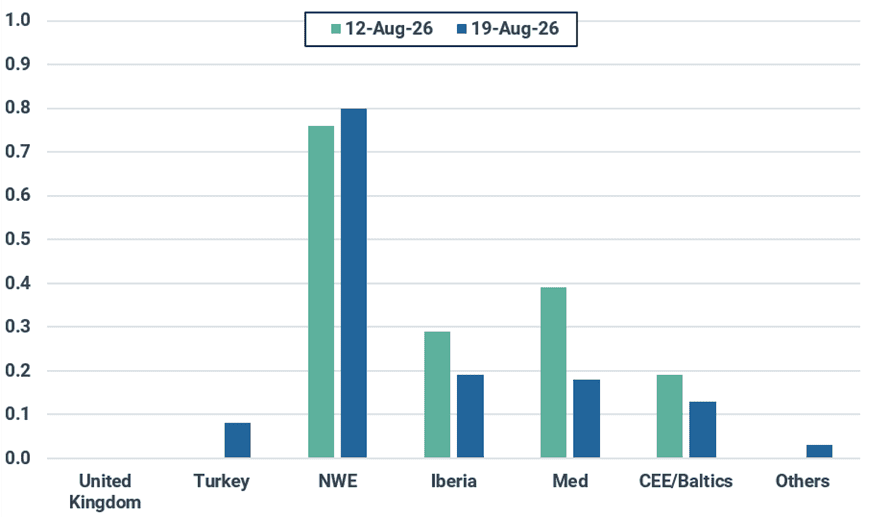
Source: Kpler Insight. Data represents week commencing 12/08 and 05/08. NWE=FR, BEL, NL, GER. Iberia=ESP, POR. Med=ITA, HVR, GRE. Baltics/CEE=FI, LT, POL. Others=SWE, MT.
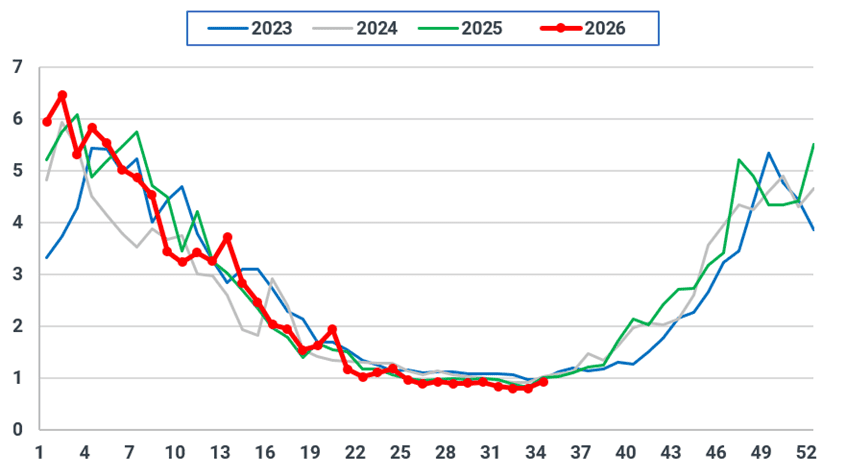
Aggregate local distribution consumption across 16 EU countries increased by 15.2% w/w to an estimated 0.93 bcm, driven by cooler weather as summer temperatures began to ease. Average temperatures across the EU-27 declined by 2.1°C w/w, with Northwest Europe recording a sharper 4.8°C drop and driving most of the increase in consumption. Looking ahead, Kpler Insight expects local distribution consumption to edge slightly higher as temperatures continue to decline across most of Europe.
EU-16 weekly consumption in the local distribution sector (bcm)
Source: ENTSOG, ENAGAS, Eustream, AGCM, Kpler Insight. The EU-16 perimeter includes AT, BE, DE, CZ, FR, HU, GR, IT, NL, LU, PL, PT, RO, SL, SK, and ES.
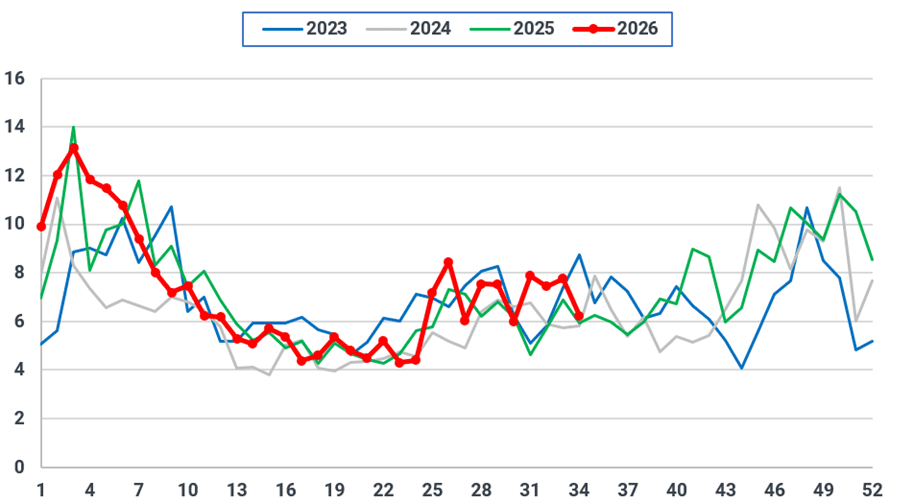
EU-25 gas-fired generation declined by 20% w/w to an estimated 6.2 TWh, driven by lower total power demand (-1.1% w/w) and recovering renewable output displacing gas from the power mix. Wind generation increased by 32% w/w, while hydro and nuclear output rose by 3% and 9%, respectively, supported by higher precipitation and easing weather-related disruptions. Looking ahead, the outlook for gas-fired generation is mixed. In Northwest Europe, upward revisions to wind generation and lower temperatures should limit gas burns. However, Southern Europe could provide some upside, as higher temperatures lift power demand while a weaker wind outlook, particularly in Italy, supports gas-fired generation.
EU-25 weekly gas-fired generation (TWh)
Source: Kpler Power, Kpler Insight.
Northwest Europe average daily temperature forecast (°C)
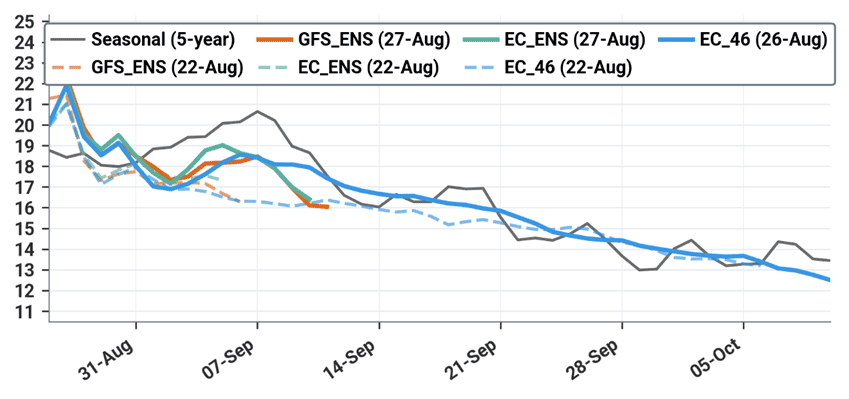
Source: Kpler Insight. Run comparison 20/08 (solid) vs. 13/08 (dotted), 00:00 UTC. Seasonal is a five-year average. NWE includes France, Belgium, Netherlands and Germany.
Southern Europe average daily temperature forecast (°C)
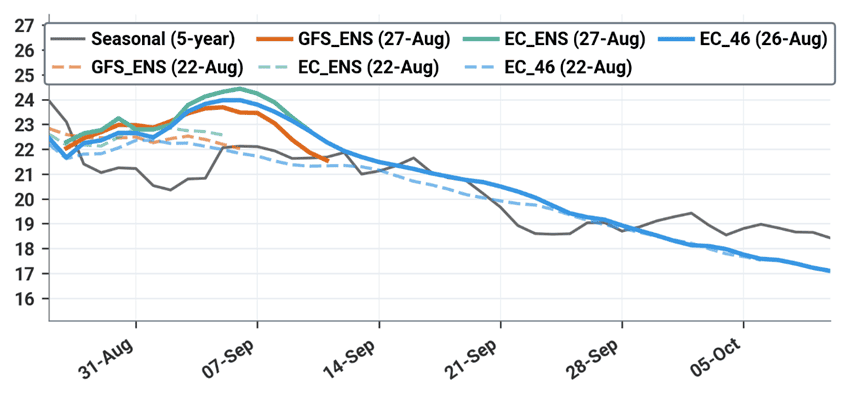
Source: Kpler Insight. Run comparison 20/08 (solid) vs. 13/08 (dotted), 00:00 UTC. Seasonal is a five-year average. Southern Europe includes Portugal, Spain and Italy.
EU-27 underground gas storage levels rose to 63.5% full as of 25 August, up 1.9% w/w. Average daily net injections edged slightly lower at 0.27 bcm/d, as lower pipeline supply and higher local distribution consumption were offset by weak gas-fired generation and higher LNG imports into Northwest Europe allowing a similar daily injection pace. Looking ahead, Kpler Insight expects injection rates to edge lower as Norwegian maintenance weighs on pipeline supply. Meanwhile, the Balance of Summer premium over Winter 26 narrowed to €0.48/MWh (-€0.66/MWh w/w), as the market prices greater winter supply risk from the prolonged Mideast Gulf disruption.
EU-27 net cumulative UGS injections since 1 April (bcm)
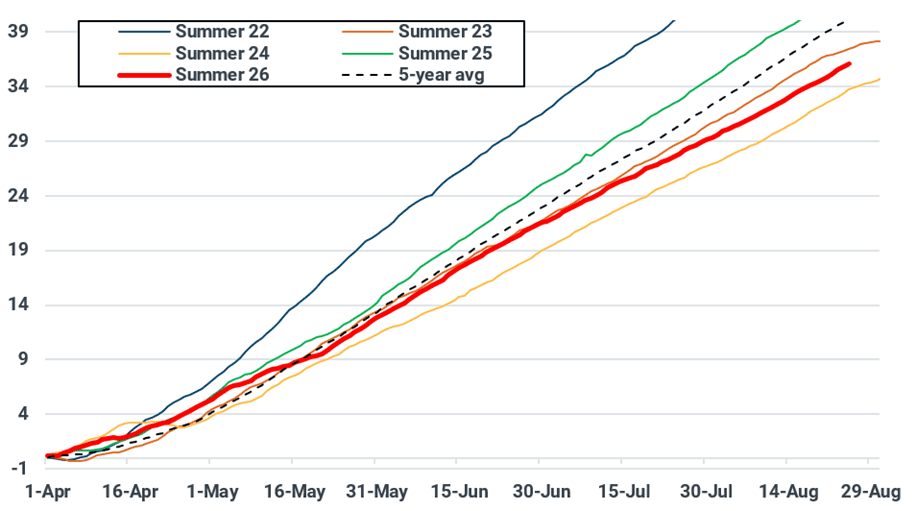
Source: GIE, Kpler Insight. Latest data as of 25 Aug 2026.
Selected TTF contract spreads (€/MWh)
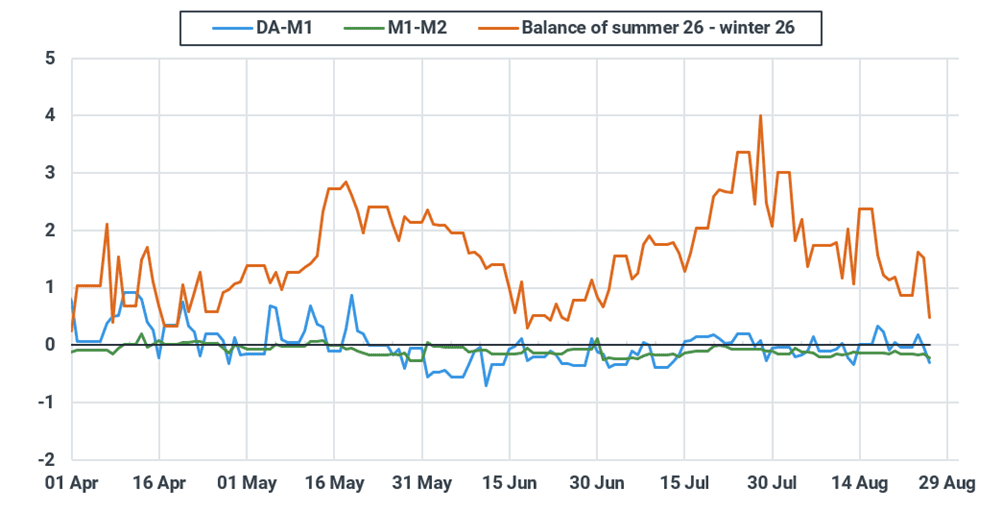
Source: Kpler Insight, Argus, EEX. DA = day-ahead; M1 = Month ahead; M2 = Two month ahead.
Asia: China gas production shortfall, stronger power demand and regional buying tighten prompt LNG
Asian LNG prices rose from $22.09/MMBtu on 19 August to $22.95/MMBtu on 26 August, up 0.86 $/MMBtu w/w tracking higher European gas prices before Iran-Oman talks on 25 August revived hopes of increased transits through the Strait of Hormuz.
We expect prompt Asian LNG prices to remain bullish in the week ahead. Support comes from slower domestic gas production and stronger gas-for-power demand in China, lower inventories and firmer industrial demand in South Korea, stronger power-sector gas demand in Thailand, and continued Indian spot buying despite elevated prices. Regional inventory tightness in Japan adds further upside risk, while softer near-term cooling demand provides a partial offset. Continued Hormuz uncertainty remains an additional upside risk to prompt prices.
Near-term temperatures across Asia are expected to edge lower w/w, with Japan, Thailand, and China below seasonal norms, while South Korea and India remain near-to-marginally-above normal. Lower cooling demand will likely weigh on near-term gas-for-power consumption.
Forecasted average temperatures for Asian countries (°C)
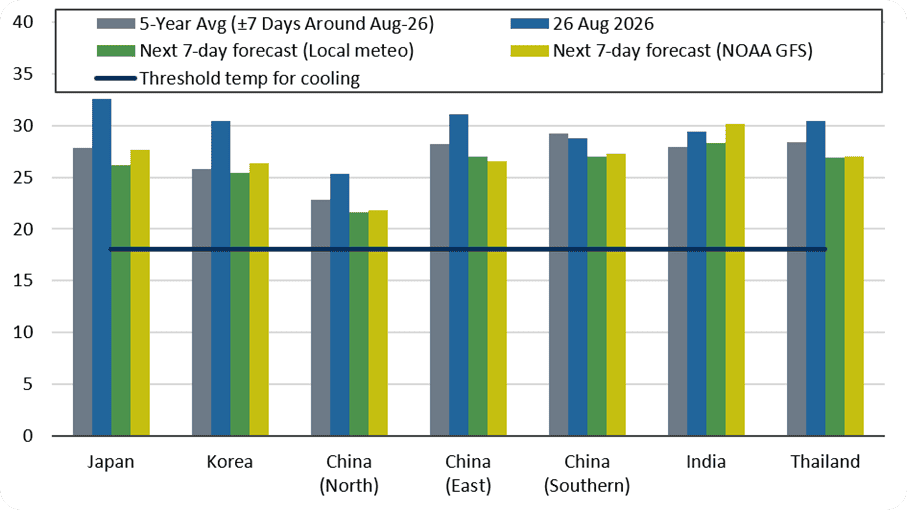
Source: Meteostat, Kpler Insight. As of 27 August 2026 00:00:00 UTC. Population-weighted average temperature of selected major cities across a country is shown for both historical and forecast.
Japan's major power utility LNG inventories rose 4.8% w/w to 2.38 mt as of 23 August, 18% above both the 26 July low and year-ago levels, despite a 24% w/w rebound in power demand to 110 GW after Obon and a 60% increase in gas-fired generation to 5.75 TWh. Near-term cooling demand should ease before heat returns from 31 August, while JMA assigns a 50–60% probability of above-normal temperatures in September–October. The 1.18 GW Ohi 3 reactor also remains offline with no official timeline associated with its restart. National inventories remain comfortable, but regional tightness presents upside risk as Kansai and Tokyo face a combined 5–6 cargo-equivalent inventory gap versus seasonal norms by October. Meanwhile, JLC is forecast to rise from $11.09/MMBtu in June to $15.42/MMBtu in September as higher Q2 JCC prices pass through oil-linked contracts, increasing the relative cost of contracted LNG. Simultaneous restocking in September–October, particularly alongside hotter weather or further outages, would tighten prompt Pacific supply and support Asian LNG prices.
Japan's monthly implied total LNG inventories by region (mt)
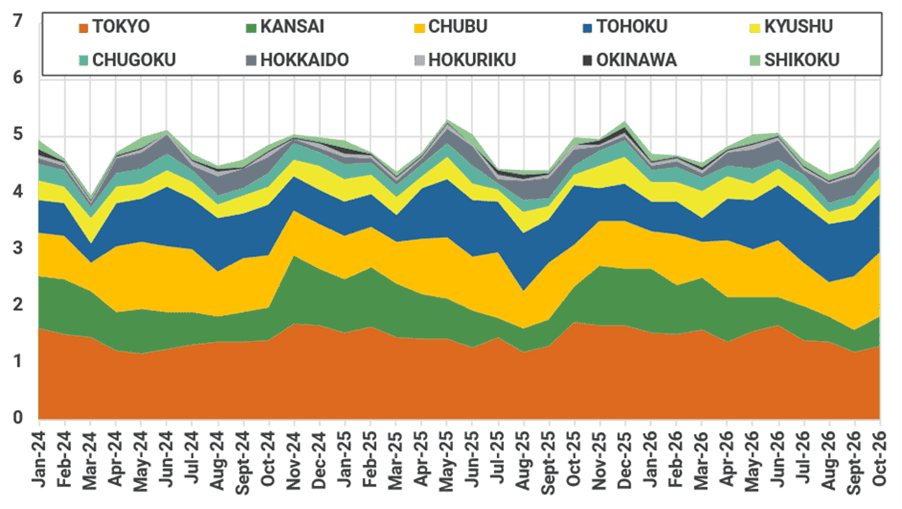
Source: METI, Occto, Kpler Power, Kpler Insight
Japan implied total LNG inventory forecast (mt)
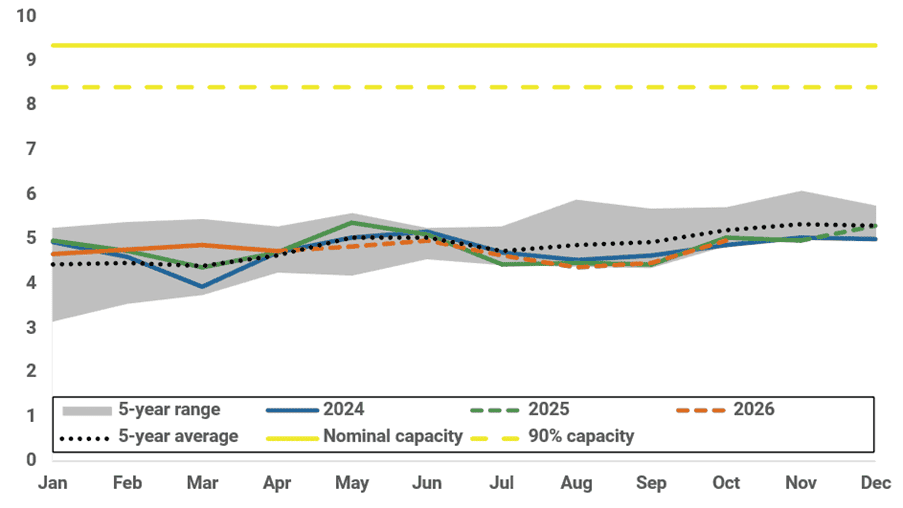
Source: METI, Kpler Insight
South Korea's near-term LNG outlook has turned modestly more bullish. Latest KESIS data put implied LNG inventories at 2.0 mt at end-June, well below the five-year average, while total gas demand reached 4.1 bcm, up 0.3 bcm y/y. Although LNG-fired generation is still expected to fall 2.6 TWh y/y in August as stronger coal and nuclear output displace gas, the lower inventory starting point raises restocking needs through August–September. Firmer industrial gas demand also supports LNG requirements into late Q4. Kpler Insight has therefore raised its 2026 LNG demand forecast by 0.6 mt to 46.8 mt and by 0.2 mt to 47.6 mt for 2027. KMA's 50% probability of above-normal temperatures in September–October and 60% in November is already embedded in the demand outlook, leaving weather broadly neutral at the margin. Overall, lower inventories and stronger non-power demand should provide modest upside pressure to prompt and November–December Asian LNG prices, partly offset by weaker gas-for-power burn.
Historical power generation by fuel type (TWh)
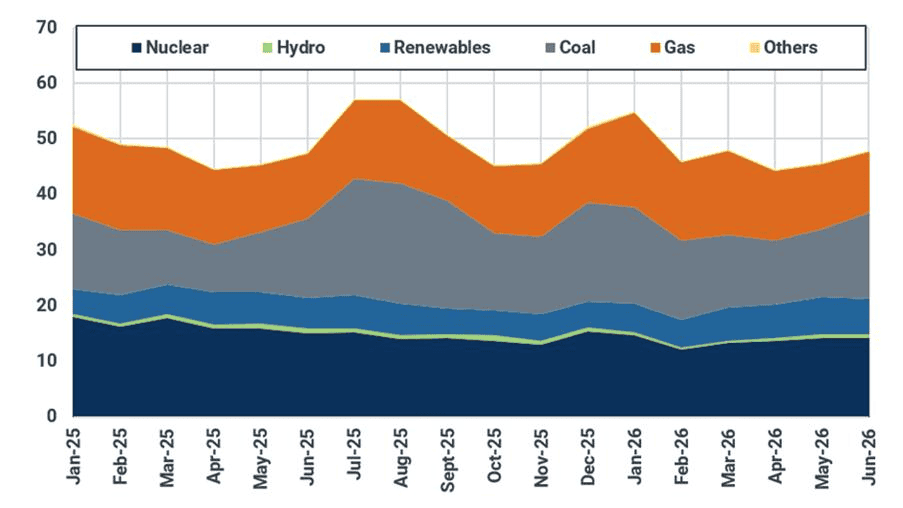
Source: KESIS
South Korea monthly implied LNG inventory (mt)
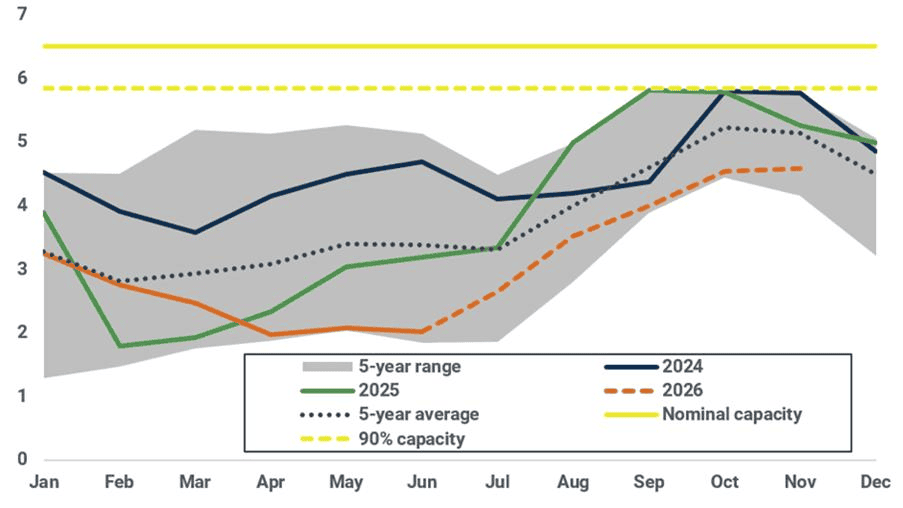
Source: Kpler Insight, KESIS
China remains the strongest incremental bullish demand source in Northeast Asia. Slower domestic gas production and resilient gas-fired generation have prompted Kpler Insight to raise its 2026 LNG demand forecast to 61.4 mt, with the latest 0.4 mt increase reflecting stronger gas-for-power demand as units cycle more flexibly to balance intermittent renewables. July NEA data show solar capacity up 178 GW y/y to 1,288 GW and wind up 112 GW to 687 GW, increasing balancing requirements despite rapid renewable growth. Domestic gas supply also remains constrained, with Hainan and Shanxi expected to recover only by mid-Q4 and Sichuan through early Q4. The combined effect supports stronger September–Q4 restocking and could add 1–2 cargoes per month, providing modest upside to Asian LNG prices.
China monthly gas production forecast and year on year growth (LHS bcm, RHS %)
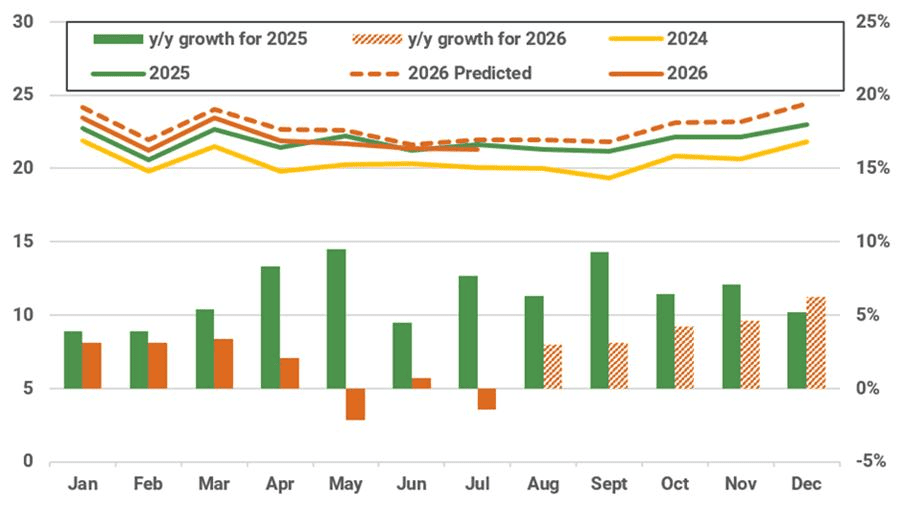
Source: NBS, Kpler Insight
Bangladesh's LNG send-out has partially recovered following the resumption of cargo deliveries to Moheshkhali, although volumes remain below available regasification capacity. The Flex Courageous delivered around 0.07 mt on 22 August—the terminal's first cargo in more than two weeks—lifting send-out to 0.68 Bcfd (19 mcm/d) on 22–23 August. August imports have reached 0.33 mt across five cargoes, while continued spot tenders signal further procurement following the July outage. However, limited cargo availability should keep August send-out below pre-Hormuz crisis levels, with little scope to recover volumes lost earlier in the month.
Indian buyers remain active for September delivery despite elevated spot prices, pointing to firm near-term LNG requirements. GAIL and GSPC have secured cargoes at around $22–23/MMBtu, demonstrating continued willingness to procure prompt supply. Sustained Indian buying is increasing competition for September cargoes and adding upside support to Asian spot LNG prices amid constrained regional availability.
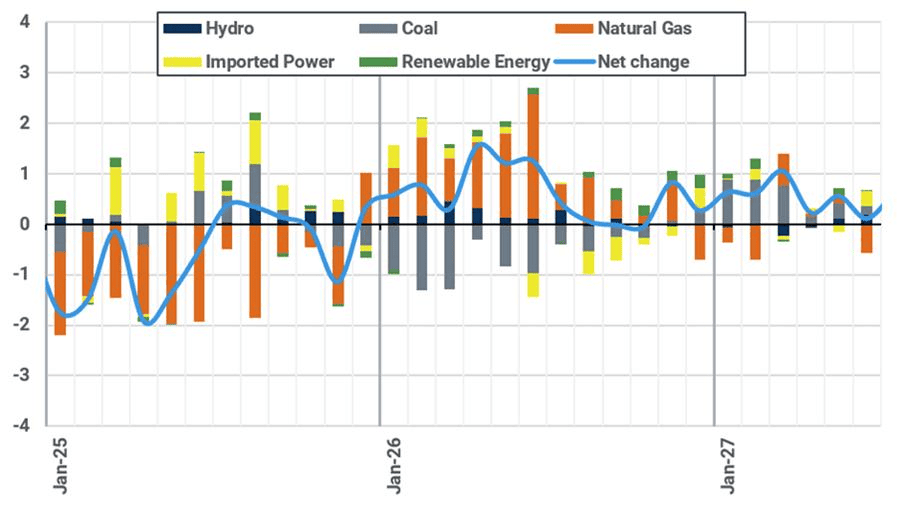
Demand in Thailand has offered bullish support for prompt Asian LNG prices. EPPO data show June gas demand rose 0.54 bcm y/y to 4.35 bcm, with gas-to-power accounting for around 85% of the increase as stronger cooling demand, weaker coal generation, and lower electricity imports lifted gas-fired output by 2.5 TWh y/y to 12.8 TWh. Domestic gas production rose only 0.14 bcm y/y and Myanmar pipeline imports fell 0.04 bcm, leaving LNG to absorb most of the shortfall. Kpler Insight has raised its Thailand 2026 LNG demand forecast by 0.2 mt to 11.9 mt, concentrated in August–September, equivalent to around 1 additional cargo per month. This strengthens Thailand's call on prompt cargoes and adds incremental upside to late-Q3 Asian LNG prices, while the smaller Q4 and 2027 revisions keep the medium-term impact more limited.
Projected year on year changes in electricity generation by fuel in Thailand (TWh)
Source: EPPO, Kpler Insight. Note: Forecast data starts from July 2026.
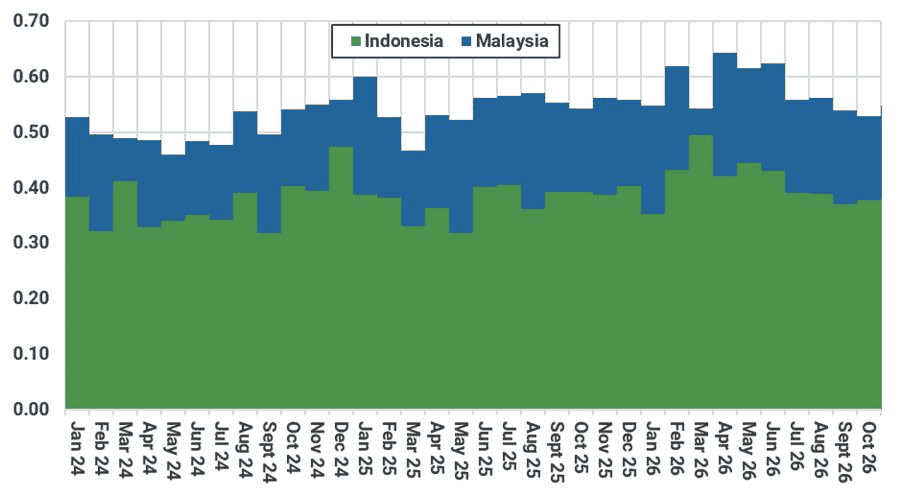
Singapore's gas balance remains broadly neutral for prompt Asian LNG prices. JODI data show pipeline gas imports remained firm at 0.63 bcm in June, around 0.1 bcm higher y/y, including roughly 0.4 bcm from Indonesia and 0.2 bcm from Malaysia. Contracted pipeline supply is expected to remain stable through the remainder of 2026, limiting incremental LNG requirements despite supportive weather and resilient gas-fired generation. Kpler Insight therefore maintains Singapore's 2026 LNG demand forecast at 5.1 mt. Replacement buying amid ongoing supply risks should keep procurement active, but stable pipeline supply and unchanged LNG requirements provide limited incremental support to prompt Asian LNG prices.
Singapore's monthly pipeline imports by country (Bcm)
Source: JODI, UN Comtrade, Kpler Insight
US: Henry Hub prices to shrug off recent gains as above-average storage levels, strong production, offset hotter temperature forecasts
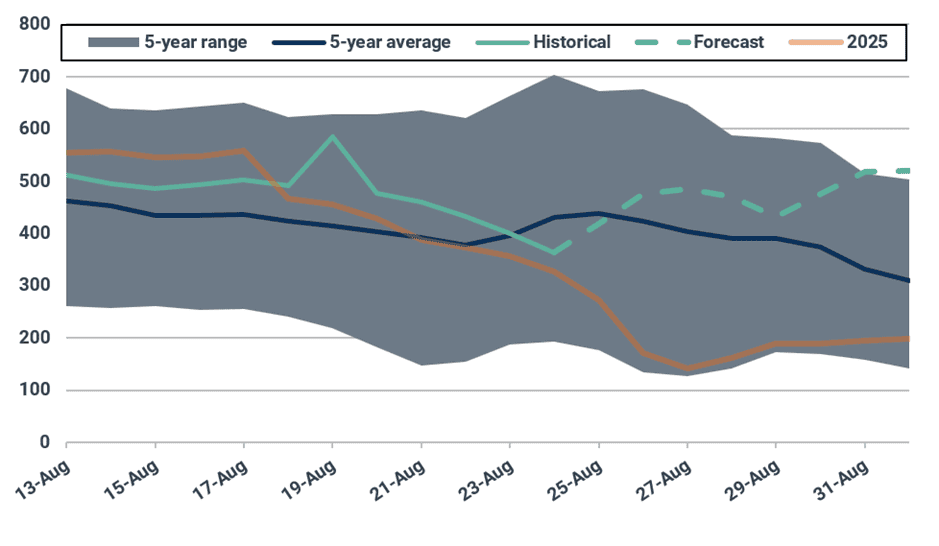
US Henry Hub front-month prices settled at $2.86/MMBtu on 26 August, up from $2.78/MMBtu on 19 August. Prices traded mostly flat over the last week, with robust storage levels, elevated domestic gas production, and mixed revisions to weather models offsetting near-term heat. However, temperature forecasts shifted hotter on Wednesday, with nearly all of the Lower 48 set to experience above average temperatures for the first 2 weeks of September. This shift, coupled with the recovery of feed gas deliveries into Corpus Christi LNG, brought some limited bullish energy to trading on Wednesday.
Henry Hub front-month prices are expected to fall back into the $2.60-2.80/MMBtu range in the coming days as traders look to take profits and above average storage levels weigh on prices. Though, there is likely to be volatility to close out the week as the September contract expires on Friday and October becomes the front-month.
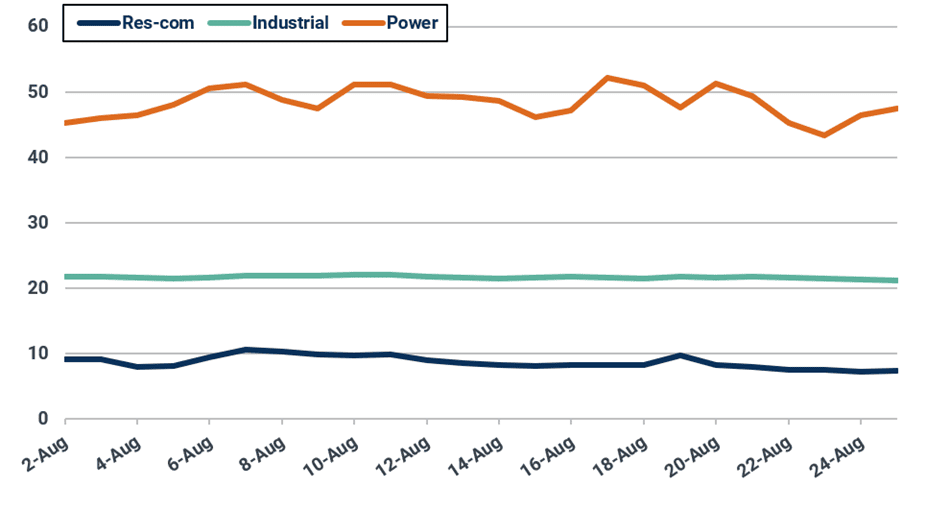
US domestic gas consumption by sector (bcf/d)
Source: EIA
US gas consumption averaged 77 Bcf/d over the last seven days, down 2 Bcf/d from the previous week. While the southern US continued to experience brutal heat, conditions in the Midwest and Northeast proved more temperate. Power burns fell from 51 Bcf/d last Thursday to 43 Bcf/d over the weekend before staging a modest recovery back to 47 Bcf/d on Wednesday. With temperatures projected to rise moderately, power burns are expected to remain near 50 Bcf/d over the next week.
Forecast of cooling degree days
Source: National Weather Service
Dry gas production averaged 112 Bcf/d over the past week, essentially flat with the week before. Producers appear keen to keep output near current levels at least through the beginning of September, though once temperatures began to decrease going into the shoulder season, it's possible that some operators may engage in output cuts, particularly in Appalachia. Kpler Insight expects production to remain near 112 Bcf/d for the week ahead.
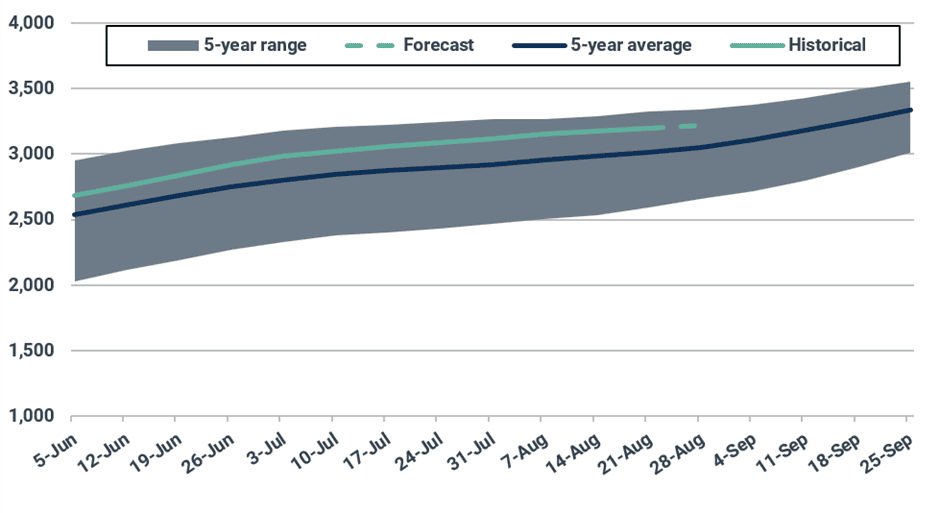
Forecast of natural gas volumes in underground storage (bcf)
Source: EIA, Kpler Insight
The US injected 16 Bcf into underground storage for the week ending 14 August, coming in slightly below market consensus. Inventories grew to 3,169, with the surplus to the 5-year average decreasing from 6.7% to 6.2%. Similarly small storage builds are likely for the remainder of August as heat limits gas available gas available for injection. Kpler Insight forecasts a net build of 24 Bcf for the week ending 21 August.
Global LNG supply: Australia's Prelude and Angola's Soyo plants return from planned maintenance, while US maintenance is ongoing
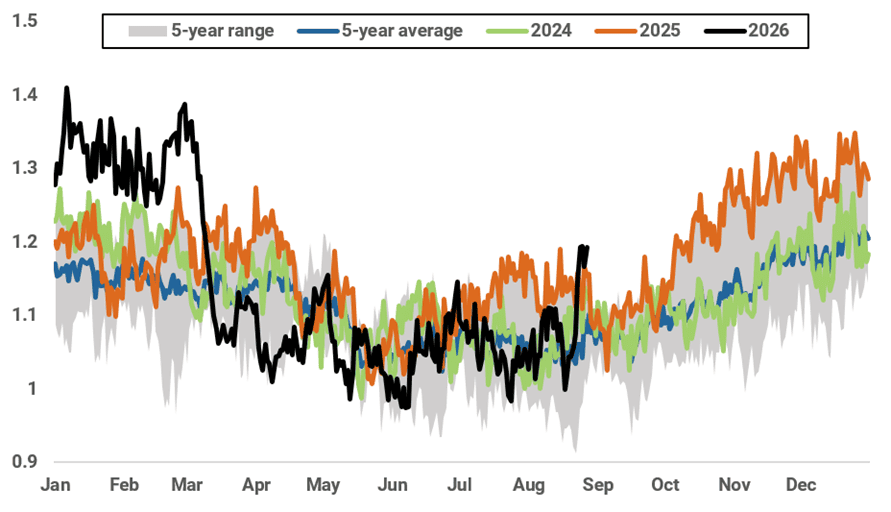
Global LNG exports rose to a two-week high last week, increasing by 1.16 mt w/w to 7.73 mt. A rebound in US (+0.36 mt w/w to 2.51 mt), Australian (+0.15 mt w/w to 1.71 mt) and Canadian supply (+0.14 mt w/w to 0.29 mt) supported the w/w growth.
Qatar remains the key area of focus, with loadings from Ras Laffan at a 12-week low and no ballast vessels returning through the Strait of Hormuz, suggesting exports could remain subdued in the near term. Indonesia's Tangguh is another downside risk, with a nearby wildfire raising the prospect of disruption at the 11.4 mtpa plant. Offsetting these risks, Australia's Prelude FLNG and Angola's Soyo are returning from planned maintenance, providing some additional supply. Meanwhile, maintenance continues at Russia's Yamal and the US' Freeport, although recovering feedgas into Corpus Christi should help limit further disruption to US exports.
Global LNG exports (mt, 10-day moving average)
Source: Kpler
In the Middle East, loadings from Qatar's 77 mtpa Ras Laffan plant dropped to 12-week low last week, down by 0.17 mt w/w to 0.19 mt. Aside from the Al Sahla, which is undergoing maintenance, only two ballast LNG vessels—Al Dafna and Al Shamal—remain offshore, representing around 0.22 mt of capacity. Until ballast vessels re-enter the region from outside of the Strait of Hormuz, loadings are anticipated to be muted.
In the Pacific basin, Kpler Insight sees downside risk to exports from Indonesia's 11.4 mtpa Tangguh project as a wildfire nears the site. The fire, in scrubland and forest near the Tangguh facility in Teluk Bintuni, had encroached to within about 100 metres of a condensate tank at the site, down from roughly 600 metres previously, according to local media reports citing Djoko Siswanto, head of Indonesia's upstream regulator SKK Migas. Project operator BP told Kpler that it is taking "all measures" to protect its people and the liquefaction plant, with a security deployment and evacuation preparations by local authorities now underway. The Bishu Maru arrived at the terminal on 27 August after a short wait offshore.
In Australia, the 3.6 mtpa Prelude FLNG plant has completed its planned maintenance, according to a source close to the project. Kpler data shows the LNG carrier Seapeak Magellan, currently positioned offshore Darwin, in Australia's Northern Territory, is signalling an arrival at Prelude on 29 August. That would be more than three months after the facility shipped its last cargo on 15 May aboard the Methane Patricia Camila.
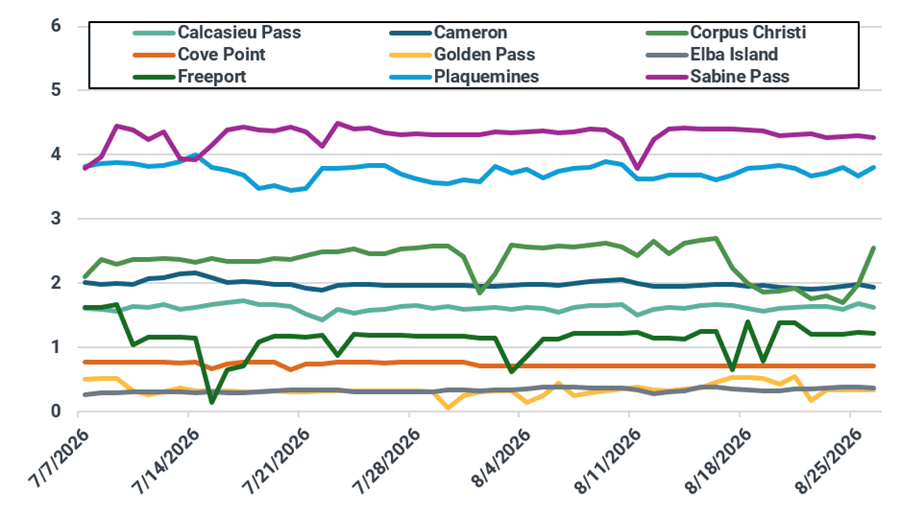
In the Atlantic basin, planned maintenance has ended at Angola's 5.2 mtpa Soyo, with the arrival of the Greenergy Pearl for loading on 26 August. However, maintenance is continuing at Russia's 17.4 mtpa Yamal and one of three 5 mtpa trains at US' 15 mtpa Freeport facility. A ten-day dip in feedgas into Corpus Christi for maintenance has also been observed in conjunction with work on the Corpus Christi Pipeline, however feedgas began to recover on 26 August.
US daily feedgas by liquefaction plant (bcf/d)
Source: Williams, Cheniere, Boardwalk, Sempra, Kinder Morgan, Venture Global, Berkshire Hathaway, Golden Pass Pipeline
Market Insights you can trust
Kpler delivers unbiased, expert-driven intelligence that helps you stay ahead of supply, demand, and market shifts.
Trade smarter. Request access to Kpler today.

See why the most successful traders and shipping experts use Kpler