
TTF to rise on cooling temperatures, early storage withdrawals, as Indian power demand supports Asian LNG prices
Although prices fell last week amid perceived progress in negotiations between the US and Iran, tightening fundamentals in Europe are set to push TTF back towards the €100/MWh mark in the coming days. Heating degree days across many countries in Europe are expected to exceed seasonal averages significantly over the next week, increasing heating demand while pipeline imports are anticipated to fall as the UK pulls more heavily on Norwegian supply to meet its own heating demand. In Asia, strong gas-fired power demand in India and falling LNG inventories in Japan are expected to provide upward support for LNG prices.
Market & trading calls
European TTF front-month price outlook: Bullish, supported by colder-than-average temperatures, which are expected to sustain heating and power demand next week, as well as by the anticipation of lower pipeline and LNG supply into the continent. Following the recent price correction, the widening Asian LNG premium over TTF could provide further upside, as Europe needs to remain competitive to attract flexible LNG cargoes amid rising demand, storage withdrawals and lower pipeline supply. Geopolitical uncertainty remains a key source of risk and volatility.
Asian LNG front-month price outlook: Slightly bullish, supported by stronger Indian gas-for-power demand, declining Japanese utility inventories, coal outages and potential winter restocking requirements. However, China's stable coastal LNG inventories, secured Bangladeshi supplies and limited Pakistani spot appetite should constrain regional procurement. Middle East supply disruptions and colder-than-expected Northeast Asian weather remain key upside risks, while recovering Qatari flows and easing geopolitical tensions could cap further price gains.
Asian LNG – TTF spread outlook: TTF premium to narrow, as TTF is expected to increase more sharply than Asian LNG. The spread flipped w/w, with Asian LNG trading at a $0.51/MMBtu discount to TTF as of 28 October, compared with a $2.53/MMBtu premium on 4 November.
US Henry Hub front-month price outlook: Slightly bearish, as temperature forecasts continue to point to a historically warm November and an extended storage injection season. These bearish factors are expected to keep prices near current levels, with strong LNG feed gas demand and lower production unable to shift Henry Hub higher. However, if temperature forecasts for late November trend cooler, prices may shift higher.
Key natural gas and LNG front-month prices ($/MMBtu)
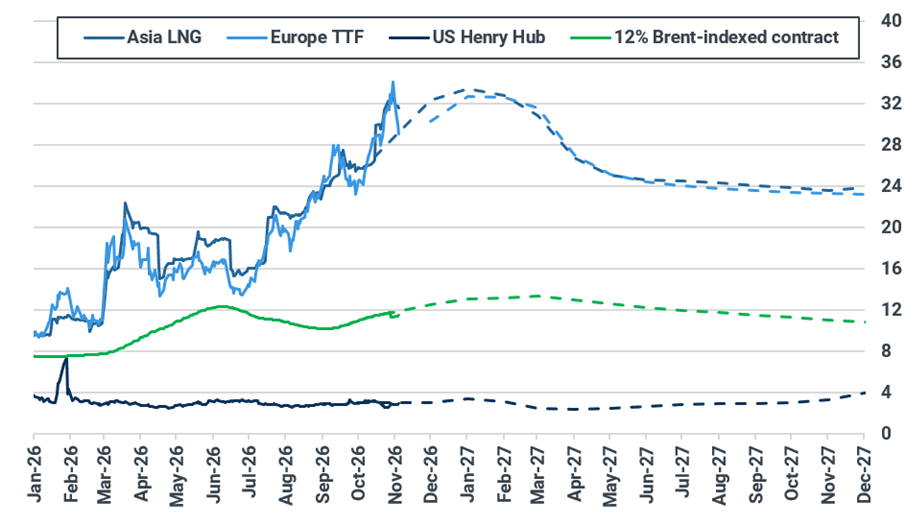
Source: ICE, NYMEX. Brent-indexed price represents 12% slope of 90-day moving average of Brent contract.
Asian LNG-TTF front-month spread ($/MMBtu)
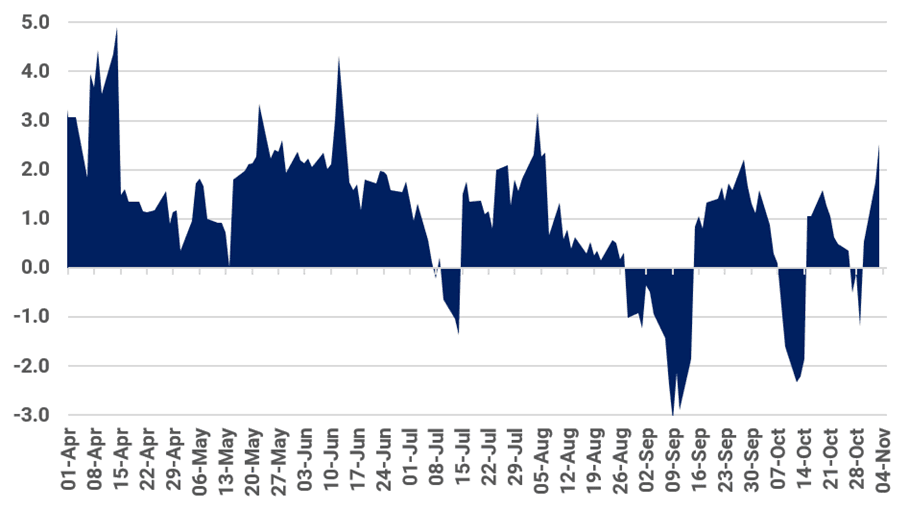
Source: ICE, Kpler Insight
Europe: Bullish TTF outlook amid colder temperatures, lower supply, and the need to remain competitive for flexible LNG
The European TTF front-month contract fell sharply by 11.5% w/w, from $32.86/MMBtu on 28 October to $29.09/MMBtu on 4 November, driven primarily by an unwinding of the geopolitical risk premium. Markets reacted to reports that the US had approved a Qatar-brokered draft MoU with Iran, pairing an Iranian nuclear concession with a partial release of frozen assets and paving the way for renewed talks. Profit-taking after October’s rally added to the early-week move. That said, European fundamentals remain tight, with storage recording sustained net withdrawals since 28 October and inventories levels falling to just above 74%. The seven-day average of total gas consumption also climbed towards the upper end of its seasonal range, having remained near the lower end until late October. On the supply side, higher LNG imports w/w were offset by lower pipeline flows amid Norwegian outages and a strong pull from the United Kingdom.
Looking ahead, Kpler Insight maintains a bullish outlook for the TTF front-month contract next week, supported by tighter near-term fundamentals as gas consumption is anticipated to increase amid lower pipeline and LNG supply to the continent. Despite slight upward revisions to November temperature forecasts, below-average temperatures and weak wind generation are still expected during the 6–12 November window, which should keep heating demand and gas-fired generation supported. Meanwhile, following TTF's sharp correction, the Asian LNG month-ahead contract now trades at a $2.53/MMBtu premium, weakening Europe’s attractiveness as destination for spot LNG. With storage levels already low and demand rising, TTF may need to increase to attract flexible LNG cargoes. Geopolitics remains a key source of upside risk and volatility, as renewed US-Iran tensions following the US midterm elections could threaten Gulf energy flows. However, concerns over higher energy prices and recent US signals against immediate military action could temper escalation risks.
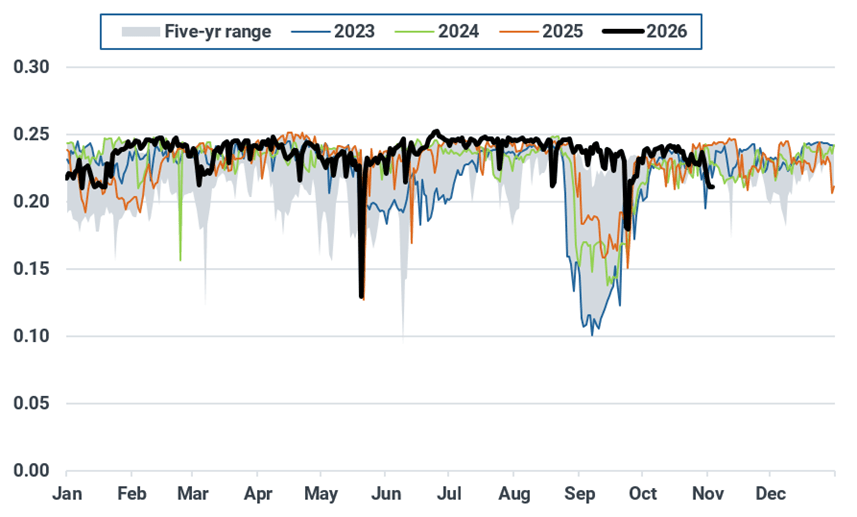
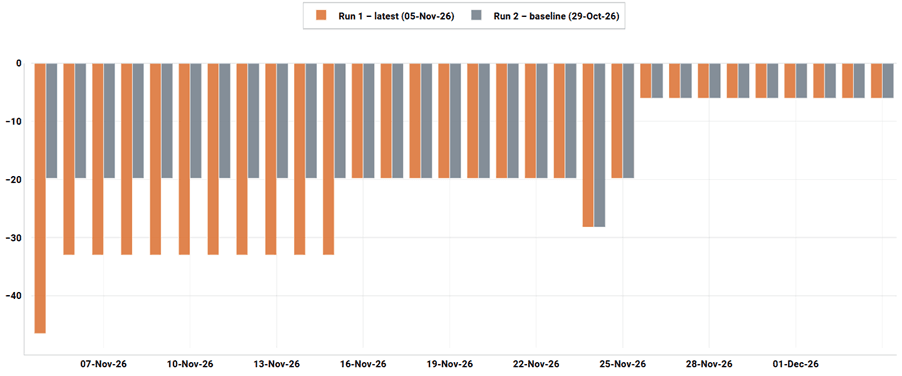
EU-27 net pipeline imports declined by 1.9% w/w to an estimated 2.86 bcm, driven by lower flows from Norway (-0.06 bcm w/w) and the UK (-0.01 bcm w/w). The decline came as Norwegian supply was increasingly redirected towards the UK, where colder-than-average temperatures boosted heating demand and gas-fired generation more than doubled to offset weaker wind and hydro output. This shift was reflected in the widening NBP day-ahead premium over TTF, rising from €0.18/MWh on 28 October to €1.43/MWh on 4 November. Looking ahead, Kpler Insight expects net pipeline imports to the continent to edge lower next week, as upward revisions to Gassco's scheduled unavailability will likely constrain Norwegian pipeline exports. Meanwhile, colder temperatures and weak wind forecasts in the UK are likely to sustain the NBP premium over TTF, keeping Norwegian flows directed towards the UK at the expense of continental Europe.
Daily Norwegian pipeline flows to the EU (bcm)
Source: ENTSOG
GASSCO scheduled unavailability for fields and processing plants (mcm/d)
Source: GASSCO, on 05 November 2026, 13:30 UTC
European LNG imports rose 4.4% w/w to an estimated 2.14 mt, led by higher arrivals to the UK, Turkey and CEE/Baltics. UK sendout reached its highest since early April after a prolonged summer lull, as demand surged and NBP moved to a €1.43/MWh premium over TTF, the widest since July. Meanwhile, three LNG diversions took place, with two cargoes redirected towards Europe, including one from Turkey and another from Egypt to the Netherlands, offset by one diversion from the Netherlands to Turkey. Looking ahead, Kpler Insight expects LNG imports to decline next week, as overall regasification economics and maintenance weigh on arrivals. The European LNG benchmark reported by ACER shifted to a €4.87/MWh premium over TTF as of 4 November, weakening regasification economics. Further downside comes from scheduled regasification constraints in LNG import terminals, including weather-related disruptions at Adriatic LNG (159–211 GWh), reduced storage capacity at Montoir (33%, 7–21 November) and halved capacity at Inkoo (8–9 November), partially offset by the end of restrictions at OLT Toscana on 6 November.
European weekly LNG imports by region (mt)
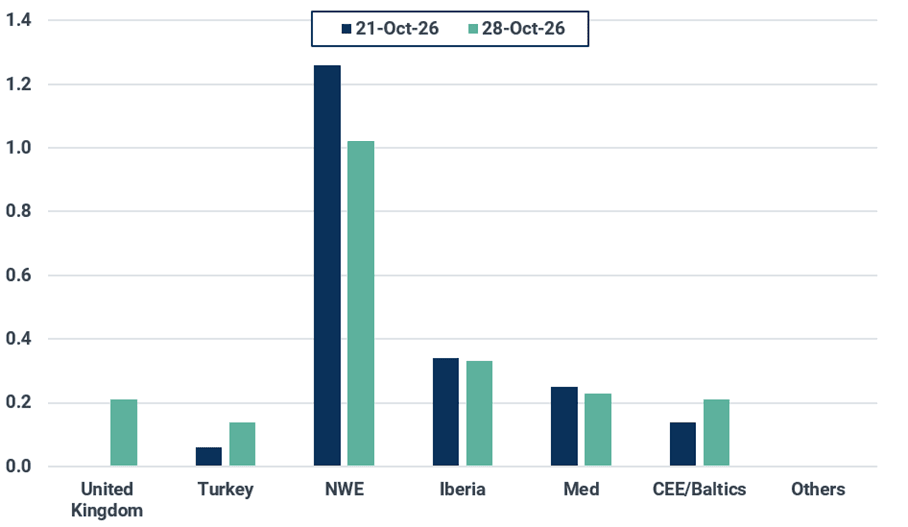
Source: Kpler Insight. Data represents week commencing 28/10 and 21/10. NWE=FR, BEL, NL, GER. Iberia=ESP, POR. Med=ITA, HVR, GRE. Baltics/CEE=FI, LT, POL. Others=SWE, MT.
Local distribution consumption (LDC) across 16 EU countries increased by 20% w/w to an estimated 3 bcm, driven by below-average temperatures across the continent, particularly in Central and Eastern Europe, where temperatures averaged 3.9°C below the five-year average and heating degree days (HDDs) were double their seasonal norm. In Northwest Europe, temperatures averaged 1.9°C below the five-year average, with HDDs 56% above normal. Looking ahead, Kpler Insight expects LDC consumption to increase slightly next week, as downward revisions to short-range temperature forecasts could support heating demand, despite some recovery in temperatures towards the end of the week. That said, the latest EC-46 forecasts point to a milder outlook from 10 November through month-end, with temperatures now expected to remain slightly above seasonal norms across most regions, potentially capping further upside to heating demand.
EU-16 weekly consumption in the local distribution sector (bcm)
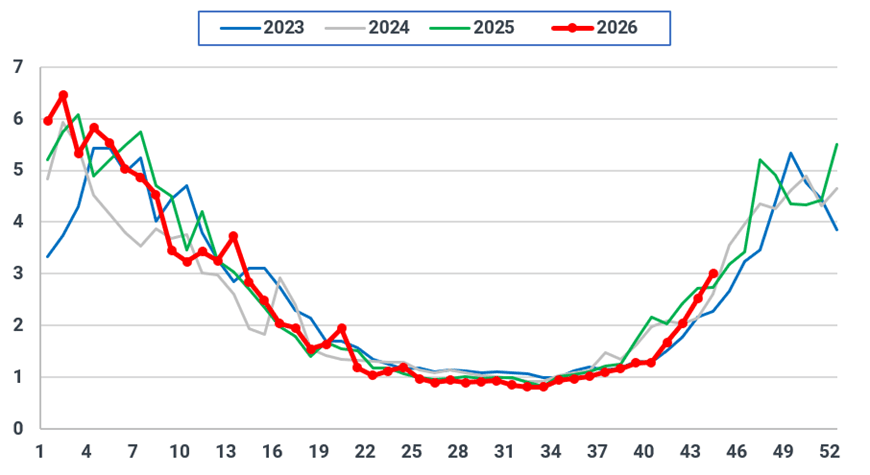
Source: ENTSOG, ENAGAS, Eustream, AGCM, Kpler Insight. The EU-16 perimeter includes AT, BE, DE, CZ, FR, HU, GR, IT, NL, LU, PL, PT, RO, SL, SK, and ES.
Northwest Europe daily average temperature forecast (°C)
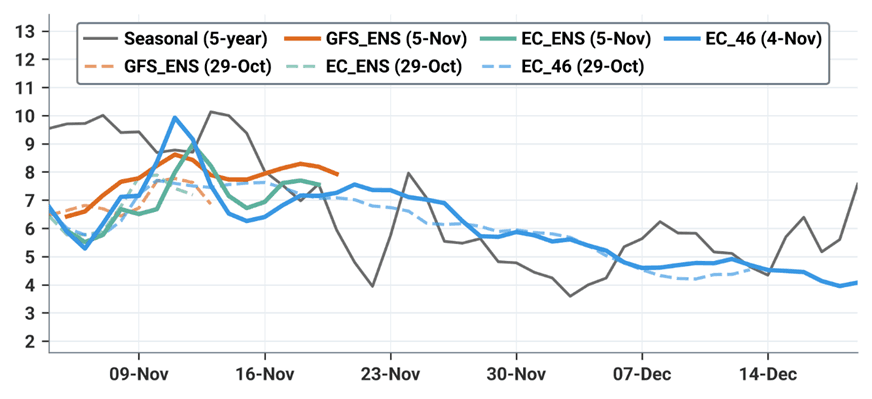
Source: Kpler Insight. Run comparison 05/11 (solid) vs. 29/10 (dotted), 00:00 UTC. Seasonal is a five-year average. NWE includes FR, BE, NL, DE.
Central and Eastern Europe daily average temperature forecast (°C)
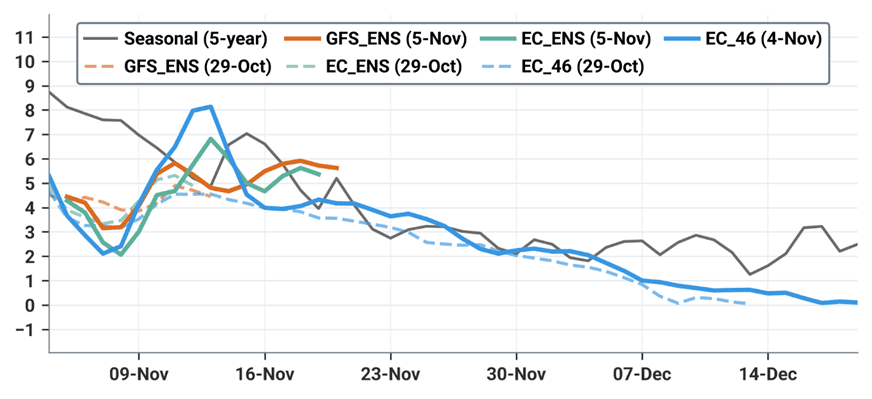
Source: Kpler Insight. Run comparison 05/11 (solid) vs 29/10 (dotted), 00:00 UTC. Seasonal is a five-year average. Central and Eastern Europe includes AT, HU, PL, RO, CZ, MD, SK, SI.
EU-27 gas-fired generation increased sharply by 67% w/w to an estimated 10.7 TWh, driven primarily by a 53% w/w decline in wind generation, alongside a 2.3% increase in total power demand. Thermal generation filled much of the shortfall, with coal-fired output also rising by 40% w/w. Combined, gas and coal generation offset approximately 70% of the decline in wind output, despite stronger nuclear (+9.7% w/w) and hydro (+11.5% w/w) generation. Looking ahead, Kpler Insight expects gas-fired generation to remain broadly stable next week, with wind performance remaining the key driver. Colder temperatures are expected to support overall power demand, while forecasts point to further decline in wind output over the coming days, which could temporarily lift gas burn before a stronger recovery in wind generation later in the week.
EU-25 weekly gas-fired generation (TWh)
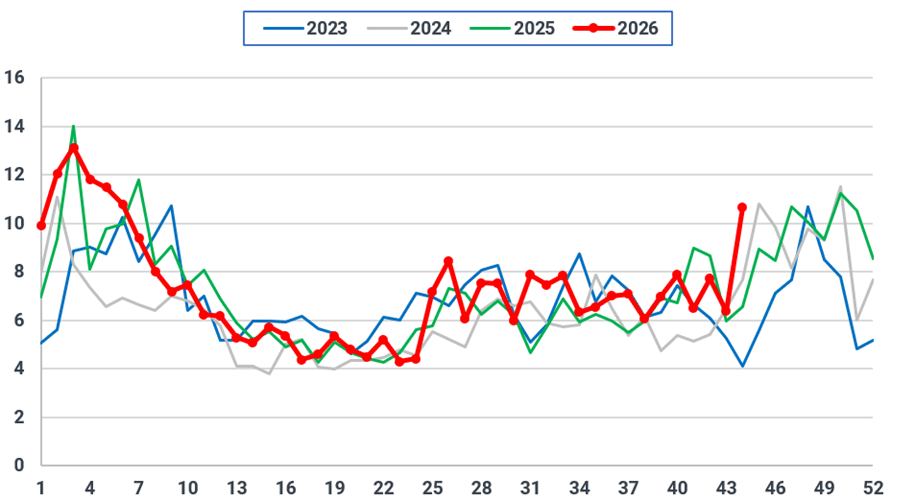
Source: Kpler Power, Kpler Insight.
EU-27 underground gas storage levels fell to 74.1% as of 3 November, down 0.9 percentage points w/w. Storage shifted from average daily net injections of 0.06 bcm/d to withdrawals of 0.13 bcm/d, as lower pipeline supply and stronger demand increased the call on storage. Looking ahead, Kpler Insight expects withdrawals to increase slightly next week, as higher LDC consumption and lower supply are expected to sustain storage requirements, while a recovery in wind generation towards the end of the week could limit gas burn and cap withdrawal rates. Meanwhile, the TTF day-ahead premium to month-ahead narrowed from €1.59/MWh on 28 October to €0.09/MWh on 3 November, potentially signalling an easing of the tight market conditions experienced during last week’s cold, low-wind period in the continent.
EU-27 underground natural gas injections and withdrawals since October (bcm)
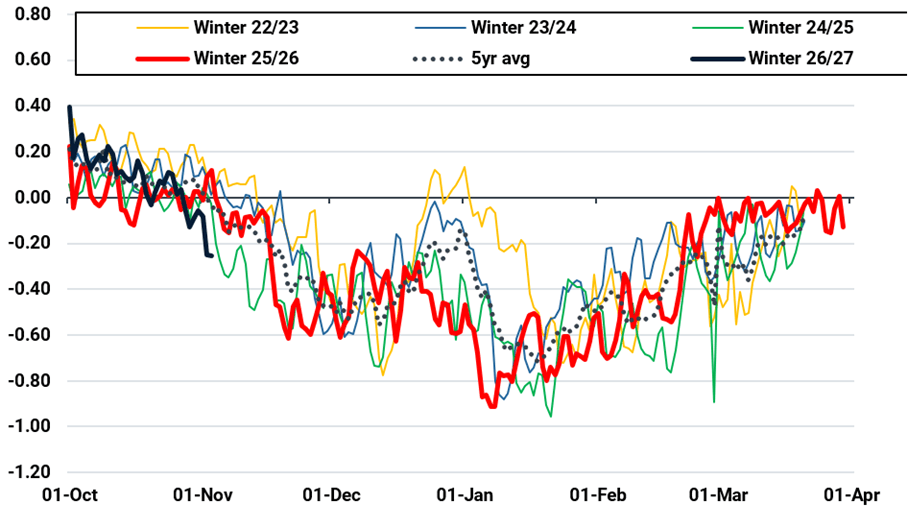
Source: GIE, Kpler Insight. Latest data as of 3 November 2026.
Asia: Spot LNG prices slightly bullish on stronger Indian demand and Japanese restocking risks; subdued Chinese and other regional buying limits upside
Asian spot LNG prices declined to $31.62/MMBtu on 4 November (−$0.74/MMBtu w/w), retreating from a peak of $32.84/MMBtu on 30 October. The decline mirrored a sharper correction in European TTF prices, as renewed optimism over a potential US–Iran agreement eased the geopolitical risk premium despite persistent shipping-security concerns around the Strait of Hormuz.
We maintain a slightly bullish outlook for Asian spot LNG prices next week, supported by stronger Indian gas-for-power demand, declining Japanese utility inventories, coal outages and potential winter restocking requirements. However, China's stable LNG inventories, recovering Indian contractual deliveries and limited spot appetite from Bangladesh and Pakistan should cap upside. Further shipping disruption remains an upside risk, while progress towards a US–Iran agreement could improve Hormuz LNG flows and extend the recent unwind in the geopolitical risk premium.
The near-term weather outlook is mixed, with below-normal temperatures across Japan, South Korea and northern China supporting early heating requirements, while cooler conditions in southern China, India and Thailand reduce cooling-related electricity demand. Overall, Northeast Asian heating demand provides modest upside support, although weaker power demand elsewhere should limit the regional price impact.
Forecasted average temperatures for Asian countries (°C)
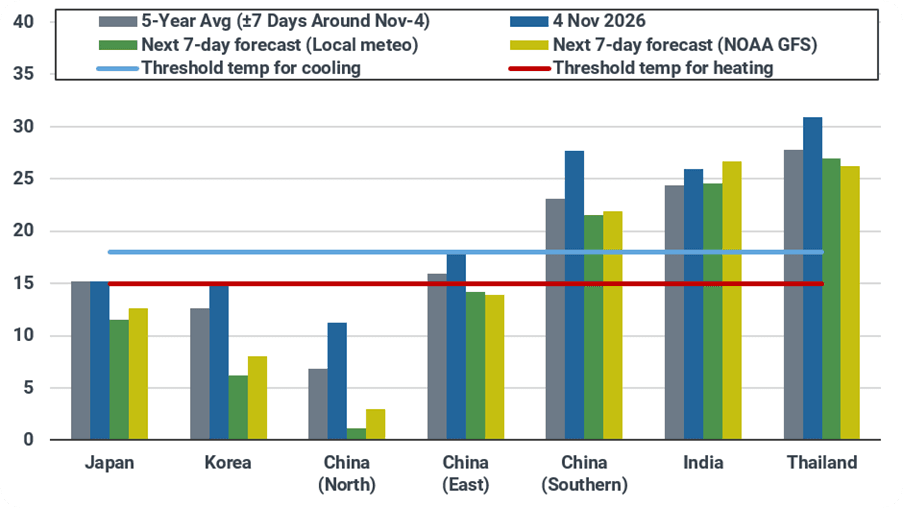
Source: Meteostat, Kpler Insight. As of 5 November 2026 00:00:00 UTC. Population-weighted average temperature of selected major cities across a country is shown for both historical and forecast.
Japan's national LNG balance remains relatively comfortable, but tightening utility and non-power inventories raise modest upside risks to prompt spot procurement. Utility LNG stocks fell 11% w/w to 1.92 mt as of 1 November, down 0.72 mt since 11 October, mainly due to weaker cargo arrivals (around 0.7 mt below recent-year averages), despite gas-fired generation declining 9.3% w/w. At the national level, August METI data showed comparatively comfortable power-sector inventories of 2.75 mt, but non-power stocks stood at just 1.66 mt, around 0.2 mt below expectations, highlighting additional winter replenishment needs. Kpler Insight cut Japan's 2026 LNG demand forecast by 0.4 mt to 62.7 mt on softer power demand and October imports, although November–December coal outages could support additional gas burn. Meanwhile, LNG import costs are forecast to peak at $17.81/MMBtu in November, potentially limiting discretionary purchases. Overall, the prompt Asian LNG price impact remains mostly neutral with a slight bullish bias, as tighter inventories and coal outages are partly offset by softer underlying demand.
y/y changes in power generation by fuel type in Japan (TWh)
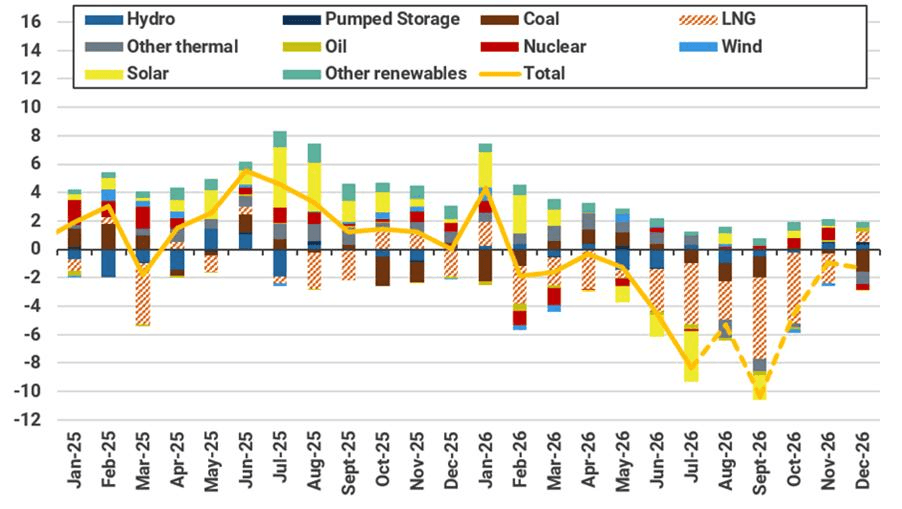
Source: METI, Occto, Kpler Insight. Note: LNG-fired and coal-fired generation for August-October 2026 is reported by Occto. Kpler Insight forecasts for all other generation sources begin in August 2026.
Japan implied LNG inventory forecast for power companies (mt)
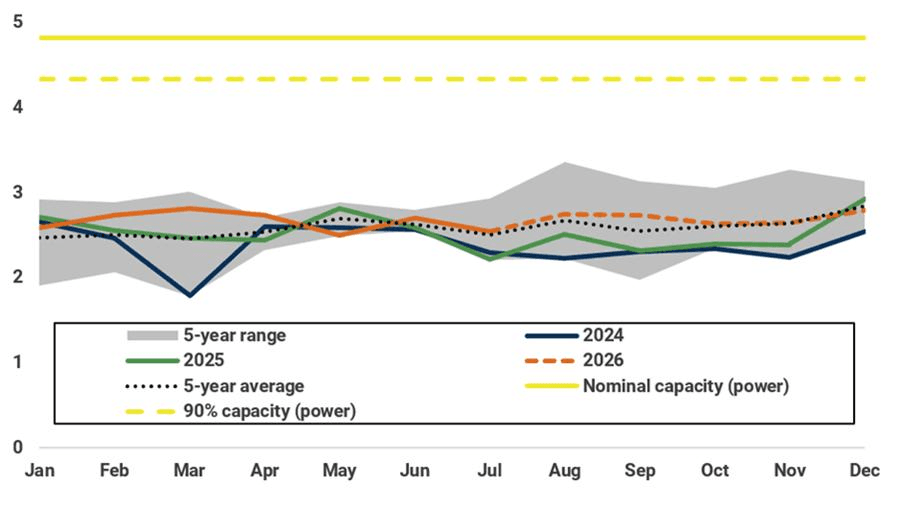
Source: METI, Kpler Insight
Japan implied total LNG inventory forecast (mt)
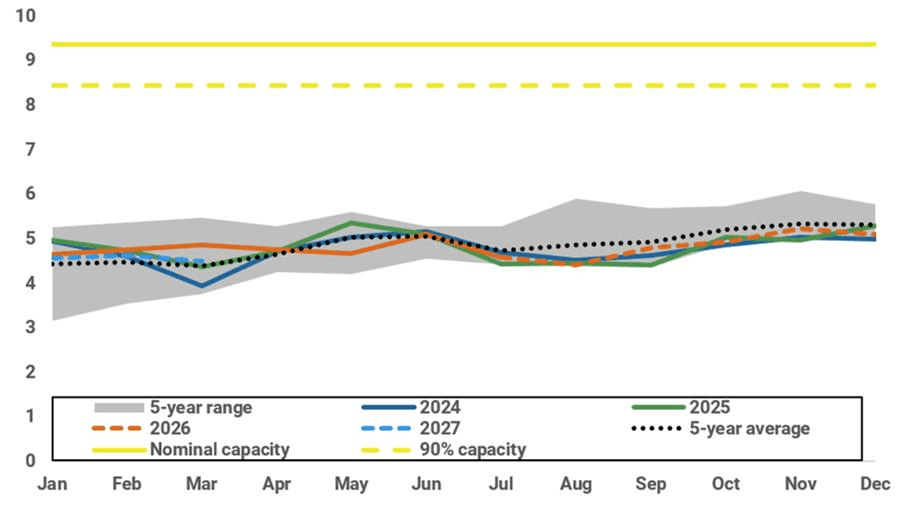
Source: METI, Kpler Insight
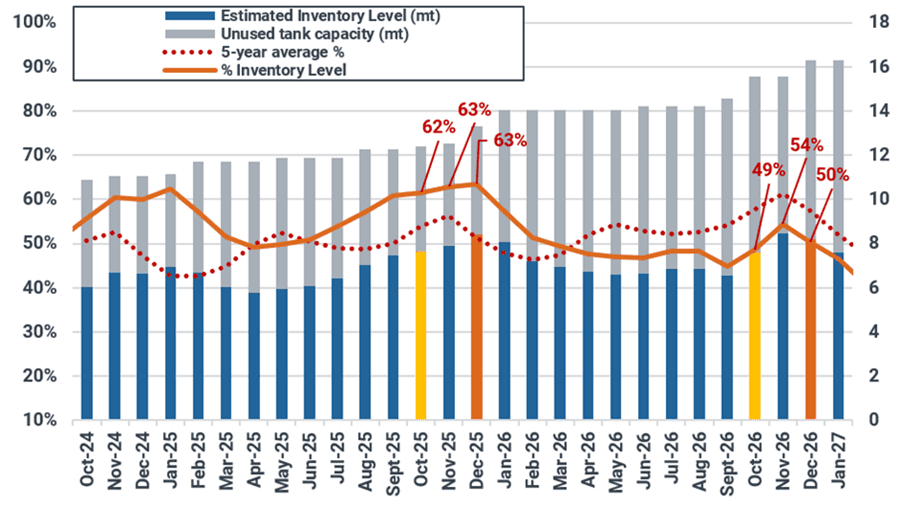
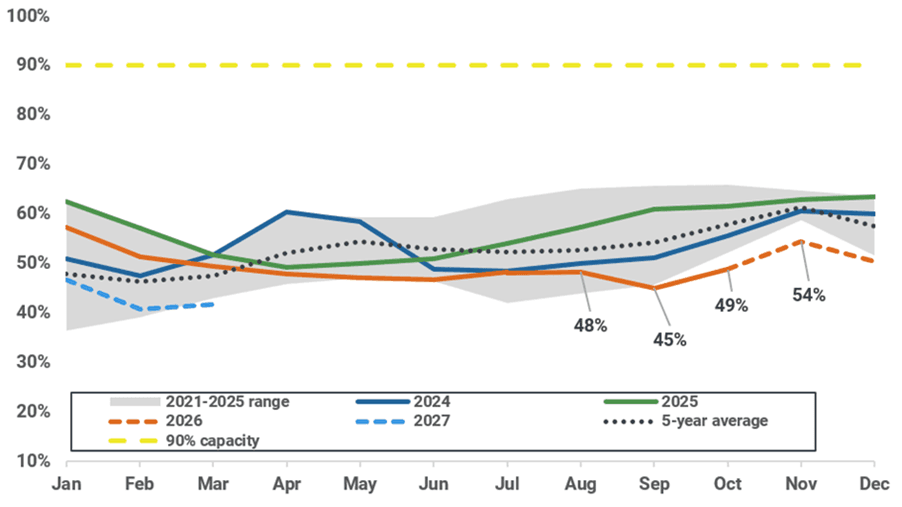
Stronger October LNG imports into China have yet to translate into higher underlying consumption or winter procurement needs. Kpler Insight raised its 2026 LNG demand forecast by 0.1 mt to 62.4 mt, but higher re-exports partly offset stronger imports, leaving November–December restocking requirements broadly unchanged. Coastal LNG inventories are forecast to recover from 49% full at end-October to 54% in November, before easing to 50% in December, with absolute stocks remaining near year-earlier levels despite below-average fill rates. Weak domestic consumption and unattractive spot import economics continue to constrain discretionary buying, while commissioning delays at three underground gas storage facilities have limited implications for coastal LNG demand. Overall, China's impact on prompt Asian LNG prices remains neutral, with colder weather or accelerated inventory draws posing the main upside risks.
China implied total LNG inventory vs terminal capacity (LHS: % of nominal capacity; RHS: mt)
Source: Kpler Insight
China implied LNG inventory forecast (%)
Source: Kpler Insight
Monthly average ex-terminal prices vs spot LNG import costs in China ($/MMBtu)
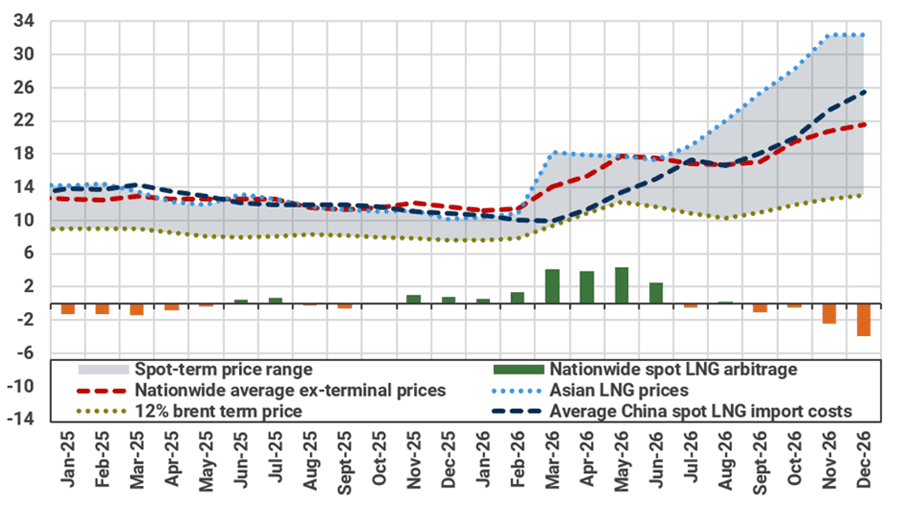
Source: SHPGX, CQPGX, Kpler Insight. Note: 1) Average China spot LNG import costs are represented by China’s landed spot LNG prices (CLD) reported by SHPGX. 2) North, East, South represents average ex-terminal prices across the terminals in respective regions. 3) Nationwide spot arbitrage: ex-terminal prices subtracted by Average China spot import costs. 4) Kpler Insight estimation starts from November onwards.
China implied monthly UGS inventory forecast (bcm)
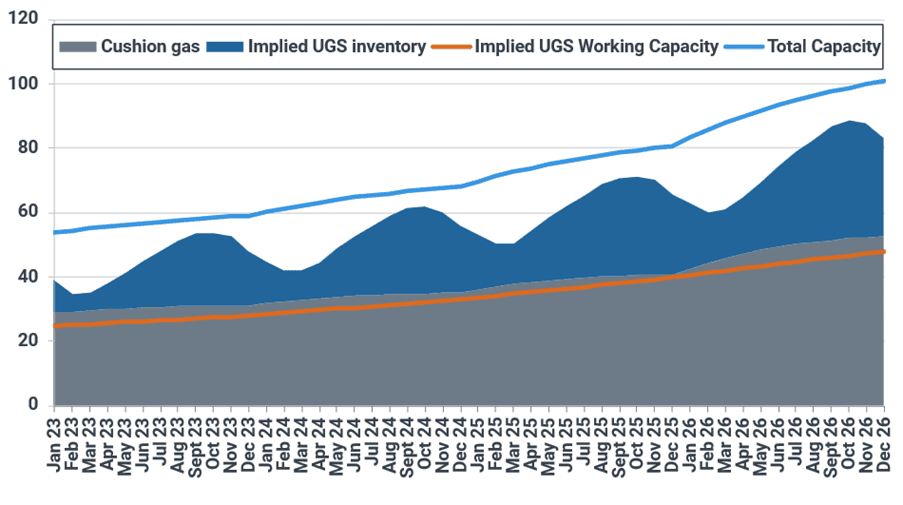
Source: Kpler Insight. Note: Forecast starts from October 2026, and cushion gas is excluded from implied UGS inventory and working capacity estimates.
Taiwan's near-term LNG outlook remains balanced, with weaker wind generation offset by lower cooling demand. Kpler Insight maintains its 2026 LNG demand forecast at 24.6 mt, as softer November–December power consumption limits additional gas burn from weaker northeast monsoon winds. Persistent wind weakness could lift Q1 2027 LNG demand by 0.1 mt (1–2 cargoes). The impact on prompt Asian LNG prices remains neutral, with upside risks from further wind shortfalls or delays in offshore wind commissioning.
Historical and projected power generation y/y changes by fuel type (TWh)
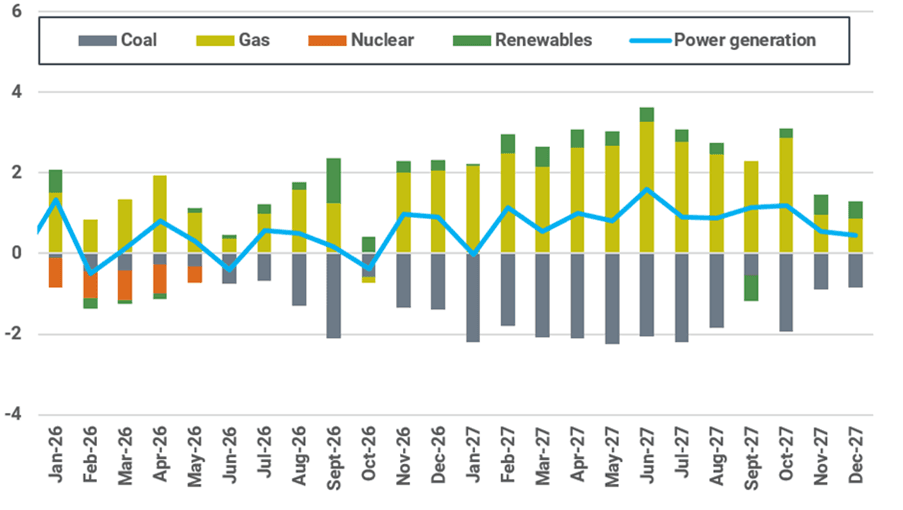
Source: MOEA, Taipower, Kpler Insight. Note: Taipower real-time data is used for September 2026. Kpler Insight forecast data starts from October 2026.
Monthly average renewables utilisation (%)
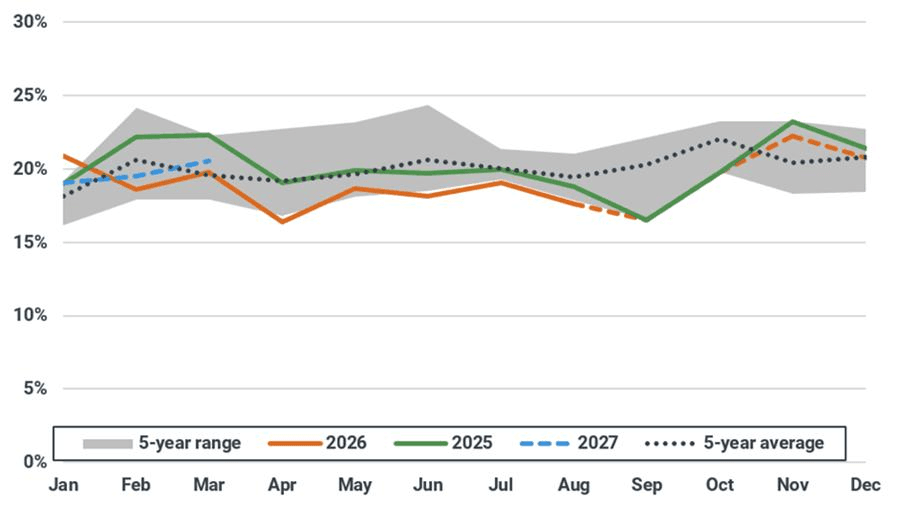
Source: MOEA, Kpler Insight
India provides the strongest near-term demand-side support for Asian LNG prices, driven by elevated power demand and increased gas-fired generation. October LNG imports reached 2.85 mt, around 0.7 mt above expectations, as coal shortages and weaker hydro availability lifted gas-fired output by 4.25 TWh y/y. Kpler Insight raised its 2026 LNG demand forecast by 0.9 mt to 27.1 mt, including 0.2 mt from warmer, drier November–December weather expectations. However, recovering Qatari and UAE deliveries, improving coal availability and price-sensitive industrial demand should limit incremental spot buying. Overall, India's impact on prompt Asian LNG prices remains slightly bullish, with further upside dependent on sustained power demand or renewed coal and hydro constraints.
India monthly gas demand forecast by sector (bcm)
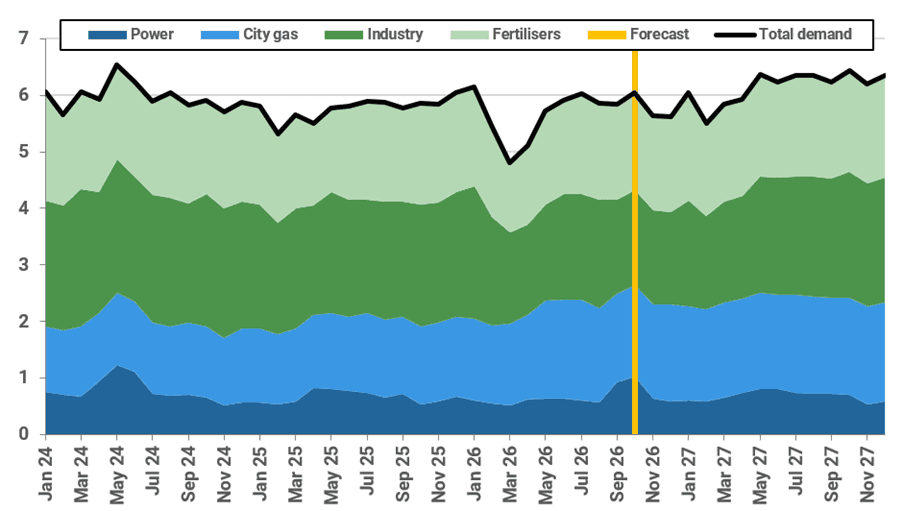
Source: PPAC, Kpler Insight
India y/y power generation by fuel type (TWh)
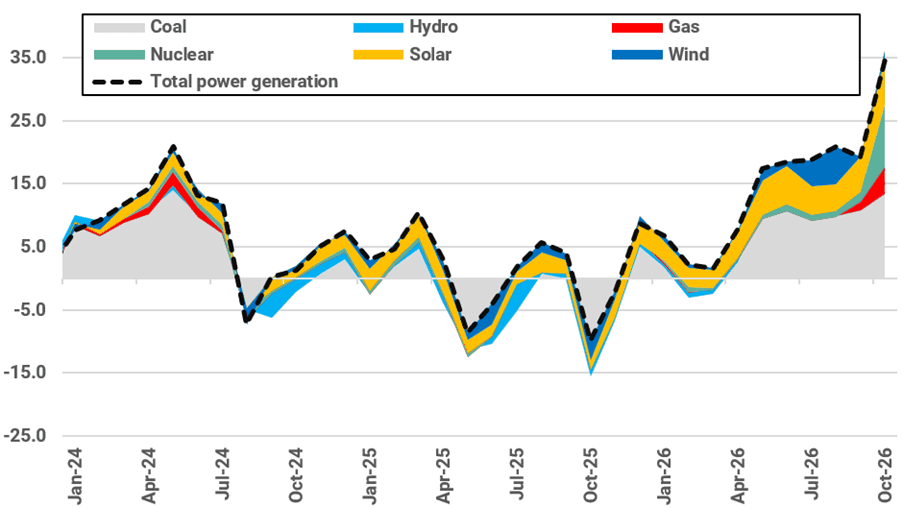
Source: CEA, NPP, Niti Ayog, Kpler Insight
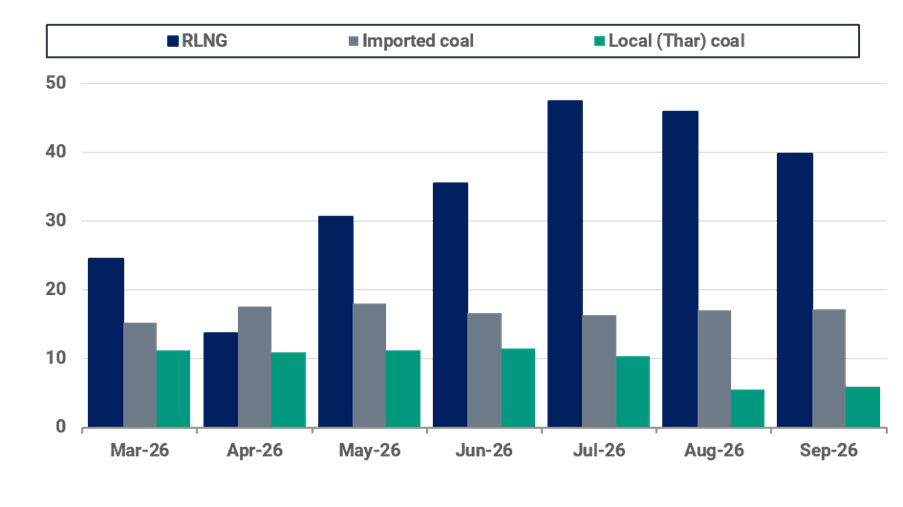
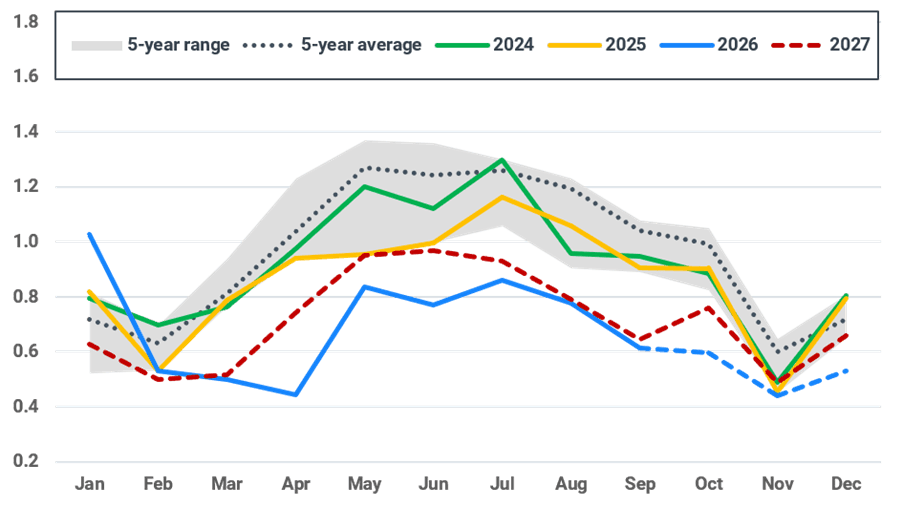
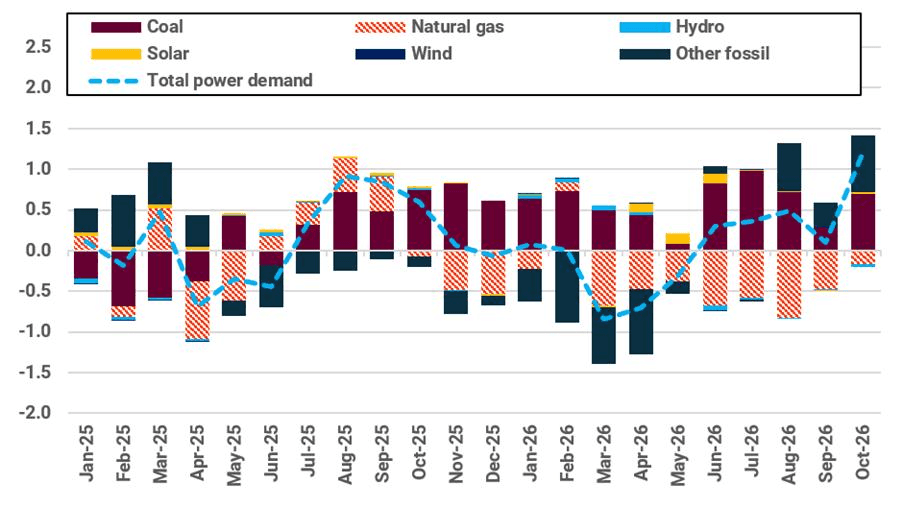
Bangladesh and Pakistan's near-term LNG procurement remains selective, although Pakistan's return to spot tendering signals renewed winter replacement demand. Bangladesh's 2026 LNG demand forecast was lowered by 0.06 mt to 6.62 mt, as coal and fuel oil continue to constrain gas-fired generation, while secured November–December supplies limit fresh spot requirements. Pakistan's 2026 outlook remains unchanged at 3.2 mt, supported by strong coal and nuclear generation and resilient domestic gas production. However, Pakistan LNG Limited (PLL) recently issued a spot tender for two December–January cargoes to cover disrupted Qatari deliveries, while continuing to await expected November Qatari cargoes. This signals renewed winter procurement interest, although elevated prices and limited purchasing flexibility should keep spot buying selective, providing modest upside risk to Asian spot LNG prices over the coming week.
Realised fuel cost of power gen (PKR/kWh)
Sources: Kpler Insight, NEPRA
Pakistan monthly implied gas-to-power demand (bcm)
Sources: Kpler Insight, NEPRA, OGRA
Bangladesh power generation y/y (TWh)
Source: Power Grid Bangladesh PLC
US: Henry Hub to hold near $2.90/MMBtu as weak fundamentals and technical factors cap gains
The December US Henry Hub front-month price settled at $2.96/MMBtu on 4 November, down from $3.03/MMBtu on 28 October. Henry Hub declined late last week and through Monday as increasingly warm temperature forecasts for mid-November and an unexpectedly large storage build for the week ending 23 October weighed on prices. However, a brief cold spell set to impact the central US later this week and lower-than-expected domestic production readings provided some limited upward support, allowing prices to rise from the $2.86/MMBtu settlement on Monday. Additionally, lower prices themselves stimulated some buying activity as traders set up long positions in anticipation of prices potentially rising if temperature forecasts shift colder later in November.
Kpler Insight expects prices to remain rangebound between $2.80-2.95/MMBtu over the next week as weak demand fundamentals keep prices below the $3.00/MMBtu threshold. There is potential downside risk associated with the recent domestic gas production numbers, as values early in the month are often revised up due to eccentricities in how the data is reported.
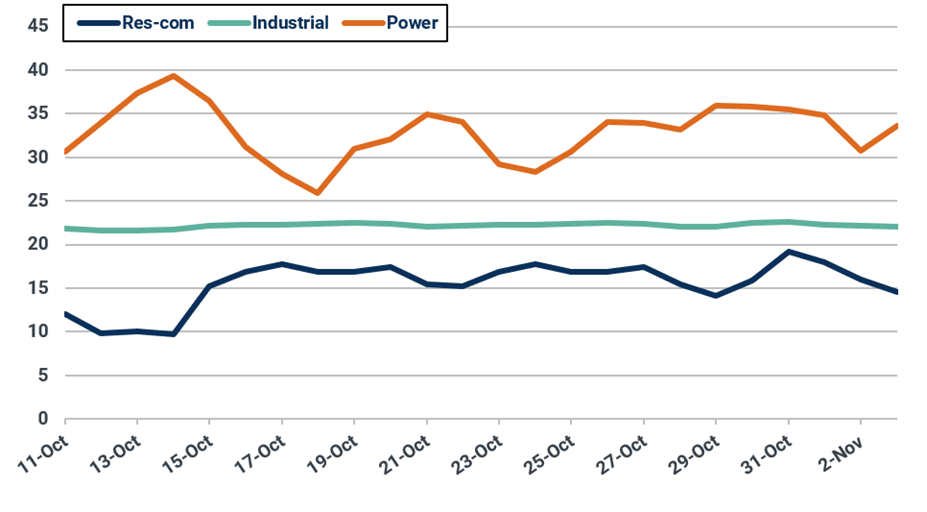
US domestic gas consumption by sector (bcf/d)
Source: EIA
US gas consumption averaged 72.7 Bcf/d over the last seven days, up 1.7 Bcf/d from the previous week. Slightly higher heating demand from lower temperatures in the northeast last week offset a drop in gas-fired power generation as milder temperatures in the southern US reduced cooling loads. Consumption is expected to rise going into next week as the central US experiences a modest cold spell.
Forecast of residential and commercial heating demand (bcf/d)
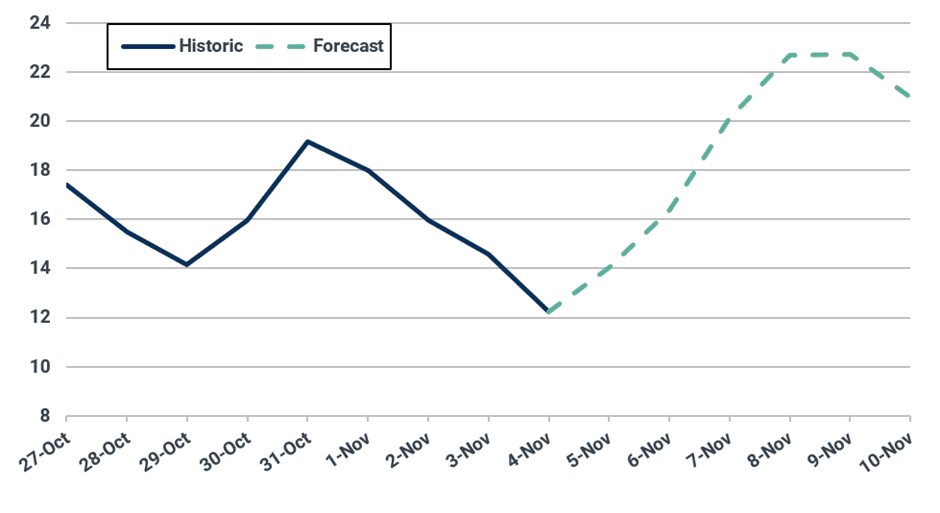
Source: National Weather Service, Kpler Insight
Forecast of heating degree days
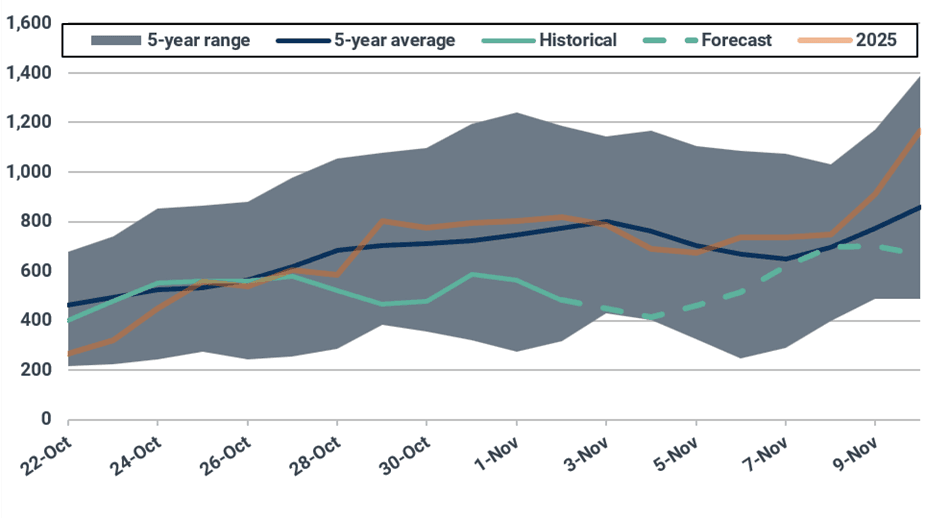
Source: National Weather Service
Dry gas production averaged 107 Bcf/d, down 2 Bcf/d from the week prior. However, supply is often underreported at the beginning of the month and is likely to be revised up in the coming days. Kpler Insight expects production to average near 109 Bcf/d over the next week.
Forecast of natural gas volumes in underground storage (bcf)
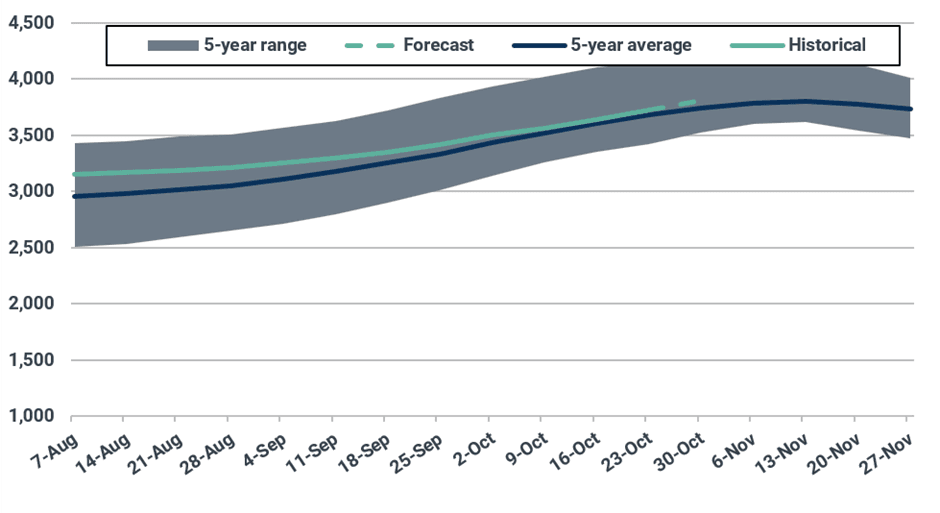
Source: EIA, Kpler Insight
The US injected 80 Bcf into underground storage for the week ending 23 October, coming in above both consensus estimates and 5-year average levels. Inventories rose to 3,724 Bcf, with the surplus above the 5-year average remaining at 1%. This comes after more than 10 consecutive weeks of below average storage builds and likely signals the start of a string of above-normal injections as weak weather-driven demand allows for an extension to the injection season. This will likely lead to inventories expanding their currently slim surplus to the 5-year average. Kpler Insight forecasts a net storage build of 88 Bcf for the week ending 30 October.
Global LNG supply: Mexico’s Energia Costa Azul and US’ Golden Pass T1 continue to show signs of recovering activity following supply woes
Global LNG exports slipped to 8.07 mt last week, down 0.11 mt w/w from 8.18 mt the week prior. The decline stemmed from Qatar which fell by 0.33 mt w/w, however this data is subject to upward revision as dark vessels are identified via satellite and AIS data.
Global LNG exports (mt, 10-day moving average)
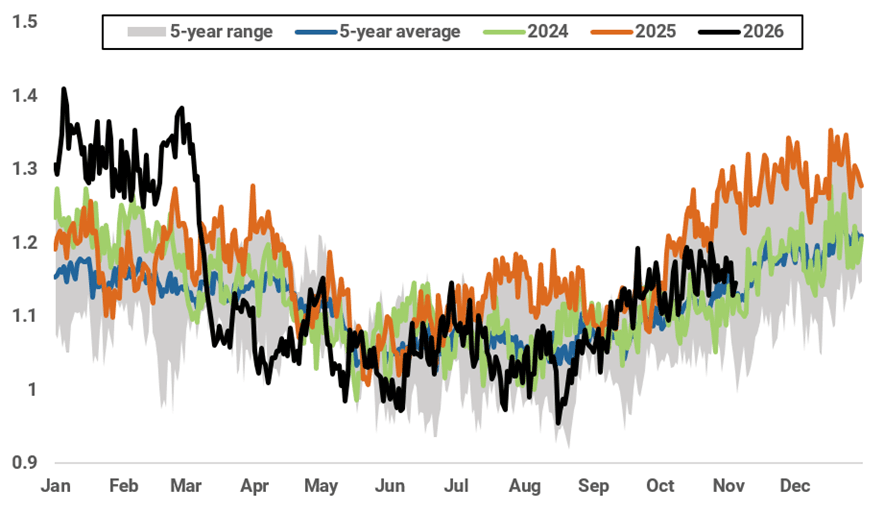
Source: Kpler Insight
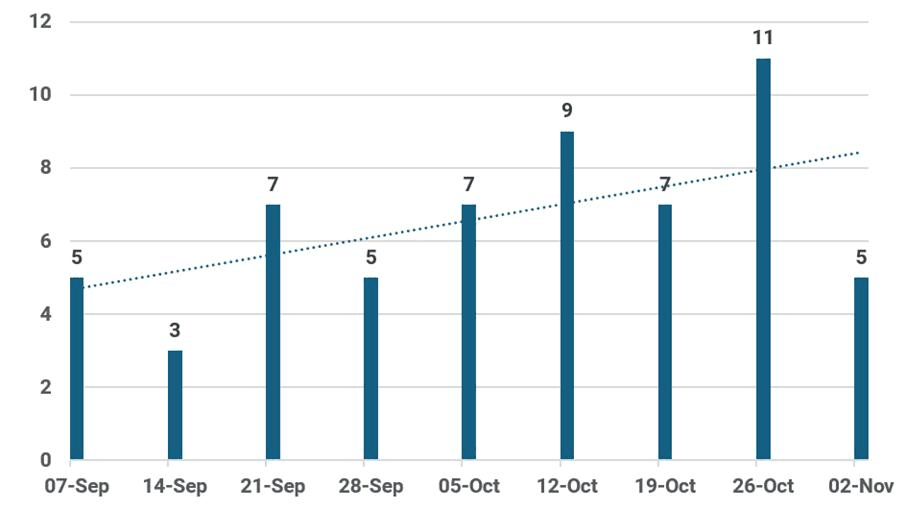
In the Middle East, Kpler has identified eight LNG vessels berthing at Ras Laffan so far this month, of which only two vessels had their AIS activated. In the month of October, 35 berthings were confirmed, representing 2.7-2.8 mt of LNG supply, according to Kpler estimates. This volume equates to just over 40% of the levels witnessed in October last year. A record 11 vessels berthed at Ras Laffan last week, up from seven vessels the week prior (see chart). At the time of publication, five LNG vessels had berthed so far this week.
Number of vessels berthing at Qatar’s Ras Laffan each week
Source: Kpler. Data as of 5 November. Week commencing 2 November subject to upward revision.
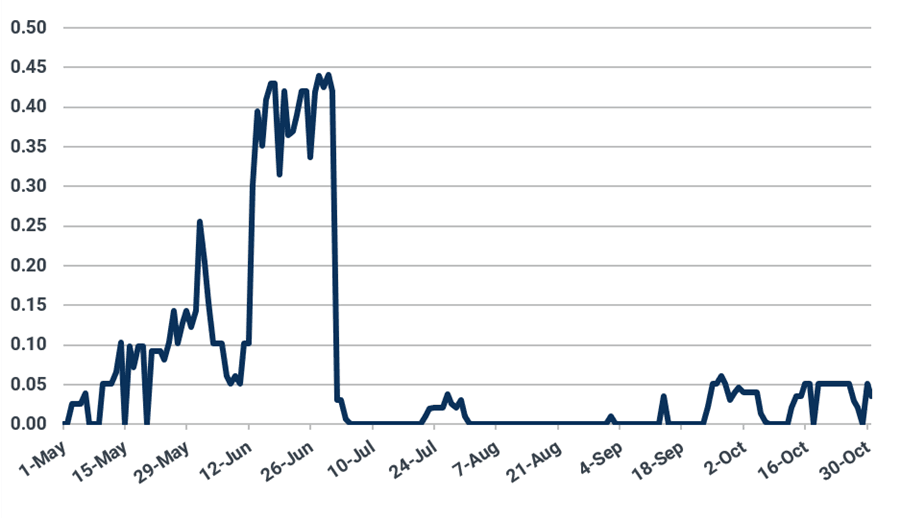
Elsewhere, the arrival of the QOGIR offshore Mexico’s 3.25 mtpa Energia Costa Azul facility indicates a second LNG export could be taking place soon following extensive maintenance. Feedgas into the facility remains at low levels but indicates that activity is resuming and LNG production is taking place. The Costa Azul facility has been offline since exporting its first cargo in July owing to damage on its refrigerant compressors.
Feedgas into Mexico’s Energia Costa Azul facility (bcf/d)
Source: IEnova
Meanwhile, the US’ 6 mtpa Golden Pass train 1, another project that has faced technical delays this summer, is continuing to witness steady feedgas volumes close to full capacity, with a 14th cargo loaded. According to Kpler feedgas monitoring data, daily flows reached 0.79 bcf on 4 November.
Maintenance continues at Trinidad and Tobago’s 11.8 mtpa Atlantic LNG plant, with thermal satellite imagery indicating that the 3.3 mtpa train 2 went offline around 9 October. The maintenance cuts capacity at the plant to 72%.
Equatorial Guinea’s Bioko LNG plant has shown no detectable thermal heat signature since 7 October. The facility last exported a cargo on 26 September, aboard the PARTHENON LNG. No LNG vessels are declaring for the Bioko LNG facility currently.
In the Pacific basin, maintenance is also taking place at Australia’s 9 mtpa Wheatstone plant, which is set to last until 19 November. The facility has exported only four cargoes in October, down from 12 in September. Kpler Insight expects limited supply from the project over the next two weeks.
Market Insights you can trust
Kpler delivers unbiased, expert-driven intelligence that helps you stay ahead of supply, demand, and market shifts.
Trade smarter. Request access to Kpler today.

See why the most successful traders and shipping experts use Kpler
Related posts