
Midterms strip out the war premium, but the next two months make shorts a risky bet
Crude futures have just posted their sharpest sell-off since 2020. Brent fell 16.6% between the 30 October peak and 4 November. On that day the January contract settled at $94.62/bbl after an $8.98/bbl drop. The trigger was the Democrats’ sweep of both chambers of Congress, which the market read as raising pressure on Washington to wind down the war with Iran.
Trend-following CTAs amplified the move, selling around 126 mbbl across crude and products since 30 October, including 52 mbbls on 4 November alone. Brent has since rebounded to around $97/bbl amid fresh tanker incidents in the Hormuz Strait, and prompt spreads have firmed, but it remains on course for a weekly loss of roughly 12%.
The sell-off confirms what we flagged in The Crude View and this month’s House View: the war’s price had moved out of the barrel and onto paper, as futures had always been where geopolitical risk premium sits. October was the heaviest month of the war, with 35 vessel attacks. Even so, crude flows exiting the region remained high, averaging 16.6 mbd in October (excluding Iranian oil), down 500 kbd against 17.1 mbd September and also against pre-war flows.
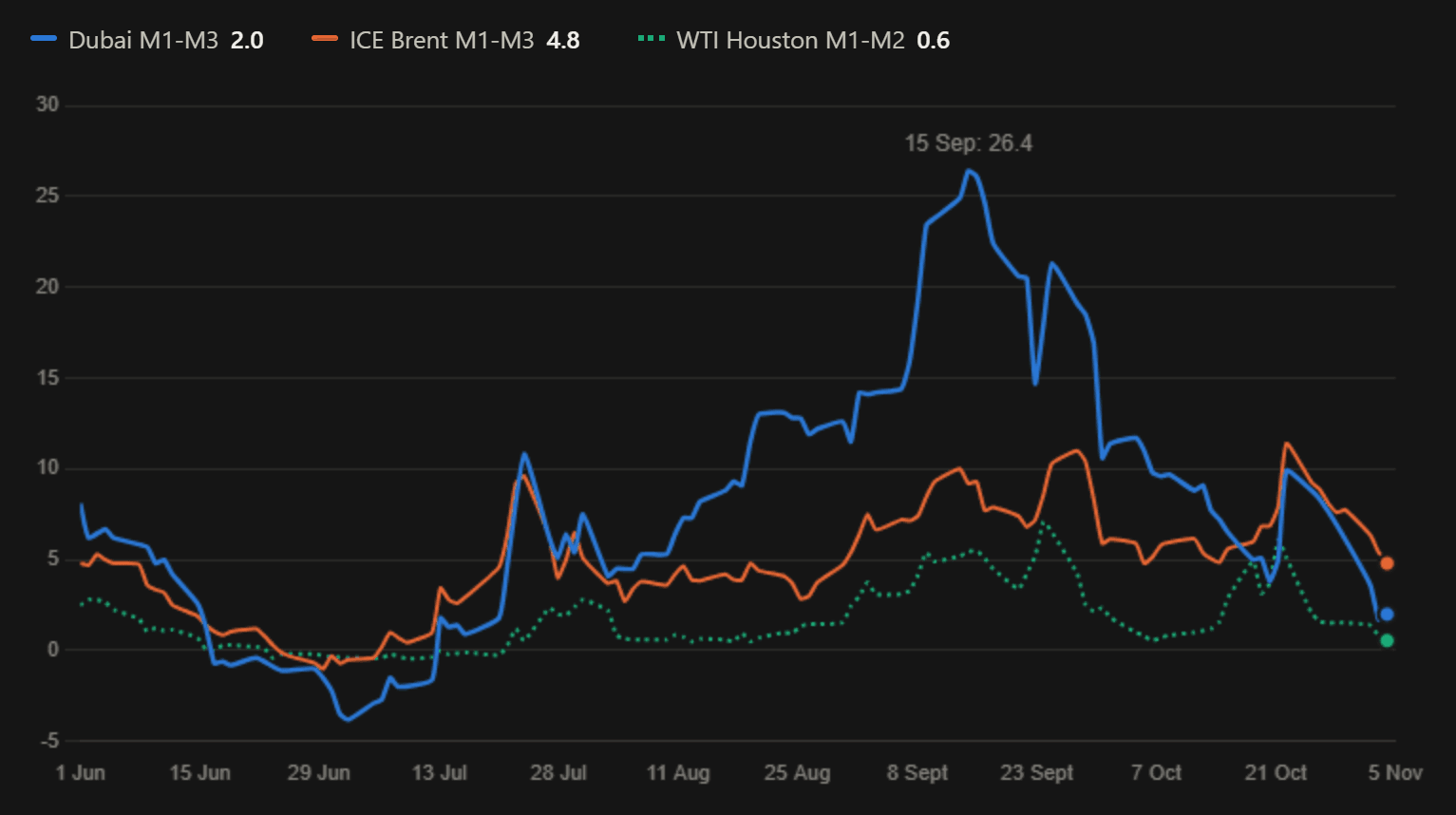
Physical weakness has also deepened, as our latest weekly crude report shows. The DFL spread collapsed from as much as +$18/bbl to +$1.70/bbl over the month (Argus) and the North Sea Dated M1-M2 spread fell to -$3.20/bbl on 4 November, its weakest since May 2020. Dubai M1-M2 flipped into contango for the first time since mid-July, and Murban’s premium to Dubai swaps shrank to $4.50/bbl from more than $30/bbl in mid-September (Argus). Aramco cut its December Arab Light OSP to Asia by $2/bbl to a six-year low, below the market at roughly Oman/Dubai -$7/bbl.
Key market structures ($/bbl)
Source: Argus Media
Freight explains part of this. With PG-China averaging a record $36.60/bbl in October, the freight bill has replaced quality as the thing a differential measures. Sellers inside the Persian Gulf discount to pay it, and grades that cannot pass it on trade at multi-year lows. But freight is not the whole story: Atlantic rates are now falling fast, yet Tupi and Bonny Light arbitrage economics into Asia worsened by around $10/bbl week on week as Dubai’s structure weakened.
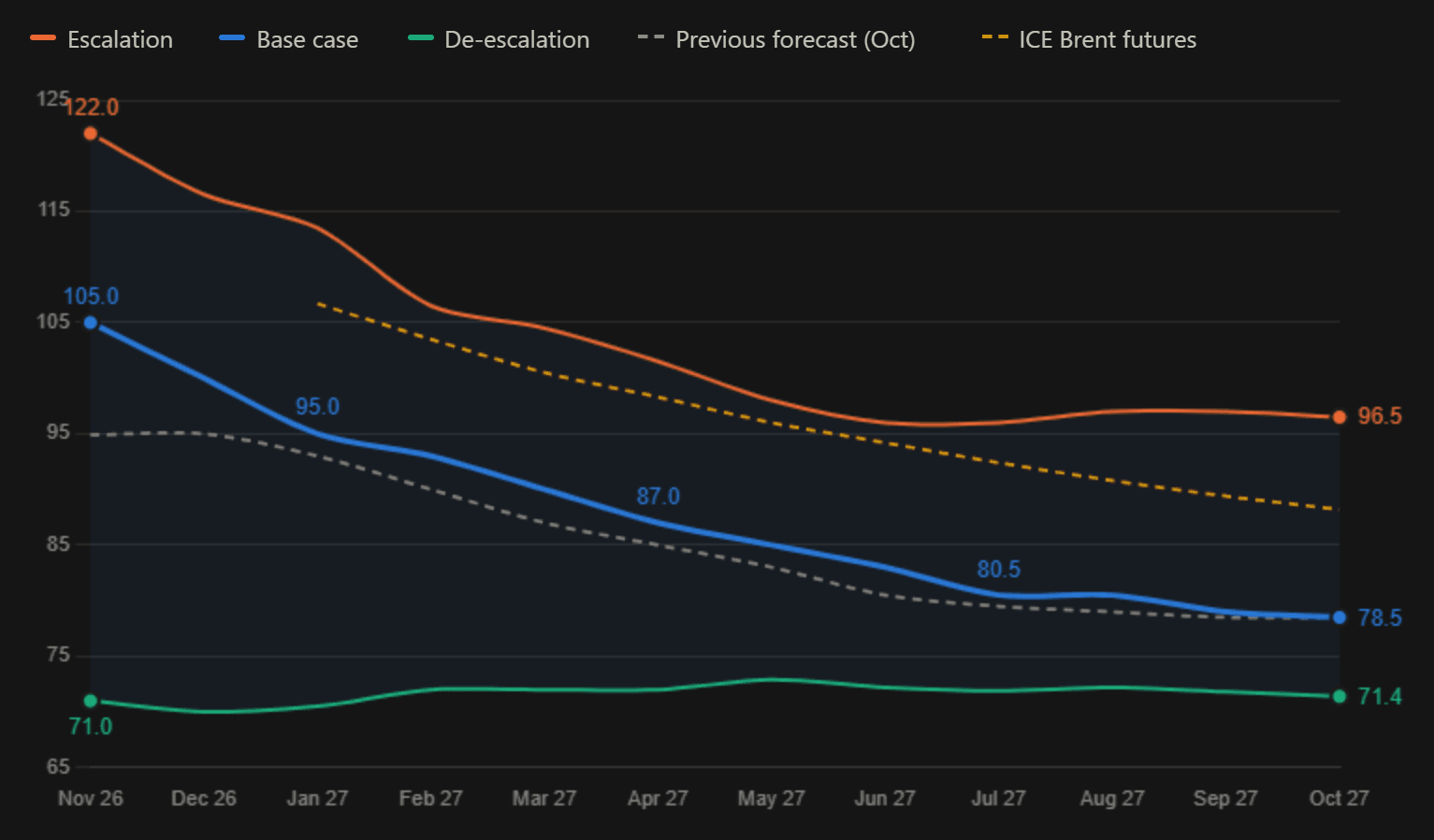
The underlying driver is supply. Our balances show a 1.1 mbd crude surplus in Q4, the first quarterly surplus this year, as Middle Eastern barrels return. That said, being short futures here is risky. Dated is now trading around $96/bbl, about $9/bbl below our November base case of $105/bbl.
The geopolitical risk premium is composed of two layers and prices currently are between the two. First, the risk premium associated with heightened attacks or threats of attacks. Second, the overall distance between the two parties to end the war. The first layer seems to have come out due to the talk of mediation, but the market knows a deal is still needed to resolve the situation. Credible de-escalation headlines could push them lower, but escalation risk is concentrated in the next two months, the window our Compass series laid out in Lame Duck or Angry Duck.
Kpler North Sea Dated price forecast ($/bbl)
Source: Kpler, ICE
Diplomacy is active on the de-escalation path. Trump discussed Qatar’s mediation with its Emir on 6th November, and Washington is reviewing an Iranian nuclear proposal. Doha is also reportedly circulating a two-step plan that would trade the end of the US blockade and some frozen funds for IAEA access and a Hormuz reopening. But Tehran insists Washington must first meet its seven conditions, including sanctions relief, a US withdrawal from the region and reparations. This indicates the two sides are still too far apart. Meanwhile, the more the US waits, the more economic pressure Tehran will feel. Iran has not loaded a crude cargo since 25 August, and we expect its oil revenues (from crude and condensate sales) to hit zero by mid-December. That cliff may raise the risk of further attacks as much as it pushes Tehran towards a deal.
On the military side, there are reports that CENTCOM is finalising plans for major combat operations, though no order has been given. The USS Theodore Roosevelt, in Singapore this week, could reach the region from mid-November. Israeli defence officials, for their part, see no major US build-up yet. The outgoing Congress sits until 3 January. After that, Senate leader Chuck Schumer, who has pledged “we will end the war” with some Republican support, will control war powers votes and funding. President Trump will still benefit veto powers, but the window to act militarily will narrow down post-January. Trump’s personality also needs to be accounted for: he could be looking to authorise a strike to later claim victory, or may push further to save his foreign policy legacy.
Positioning adds to the asymmetry. Trend CTAs have cut Brent exposure from maximum long to 36% long, meaning a portion of managed money length has gone. However, even in a de-escalation scenario, depleted inventories and US/Chinese restocking should keep a floor near $70/bbl. With physical markets already long but geopolitical risk concentrated before January, heavy short exposure remains highly risky until that window closes.
Market Insights you can trust
Kpler delivers unbiased, expert-driven intelligence that helps you stay ahead of supply, demand, and market shifts.
Trade smarter. Request access to Kpler today.

See why the most successful traders and shipping experts use Kpler